
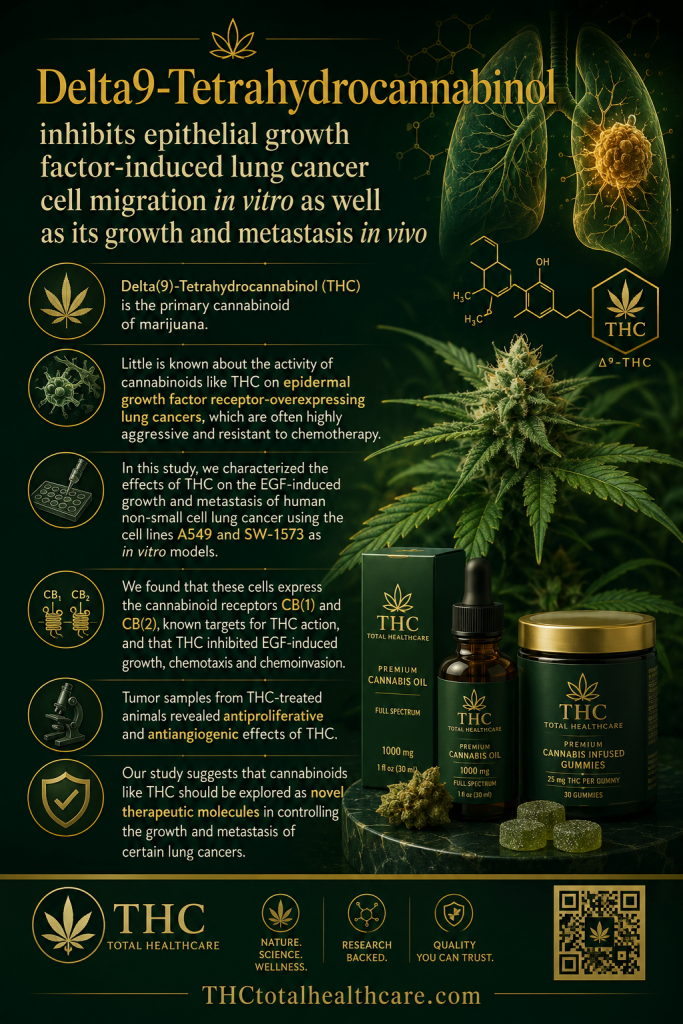
Researchers investigated whether THC could interfere with the growth and spread of aggressive non-small-cell lung cancer. Using human A549 and SW-1573 lung cancer cells, they found that THC inhibited epidermal growth factor (EGF)-induced cancer-cell growth, migration and invasion. THC also disrupted several signaling pathways involved in cancer survival and movement, including ERK1/2, JNK1/2 and AKT.
The researchers then tested THC in mice implanted with human A549 lung cancer cells. Compared with control animals, THC-treated mice showed significant reductions in tumor growth and lung metastasis. Tumors from the THC-treated animals also showed reduced cell proliferation and blood-vessel formation. The authors concluded that cannabinoids such as THC should be further explored as potential therapeutic molecules for controlling the growth and metastasis of certain lung cancers
“Delta(9)-Tetrahydrocannabinol (THC) is the primary cannabinoid of marijuana and has been shown to either potentiate or inhibit tumor growth, depending on the type of cancer and its pathogenesis. Little is known about the activity of cannabinoids like THC on epidermal growth factor receptor-overexpressing lung cancers, which are often highly aggressive and resistant to chemotherapy.
In this study, we characterized the effects of THC on the EGF-induced growth and metastasis of human non-small cell lung cancer using the cell lines A549 and SW-1573 as in vitro models.
We found that these cells express the cannabinoid receptors CB(1) and CB(2), known targets for THC action, and that THC inhibited EGF-induced growth, chemotaxis and chemoinvasion.
Moreover, signaling studies indicated that THC may act by inhibiting the EGF-induced phosphorylation of ERK1/2, JNK1/2 and AKT. THC also induced the phosphorylation of focal adhesion kinase at tyrosine 397. Additionally, in in vivo studies in severe combined immunodeficient mice, there was significant inhibition of the subcutaneous tumor growth and lung metastasis of A549 cells in THC-treated animals as compared to vehicle-treated controls.
Tumor samples from THC-treated animals revealed antiproliferative and antiangiogenic effects of THC.
Our study suggests that cannabinoids like THC should be explored as novel therapeutic molecules in controlling the growth and metastasis of certain lung cancers.”
http://www.ncbi.nlm.nih.gov/pubmed/17621270
https://www.nature.com/articles/1210641
Need this THC study explained? thcXplained.com
