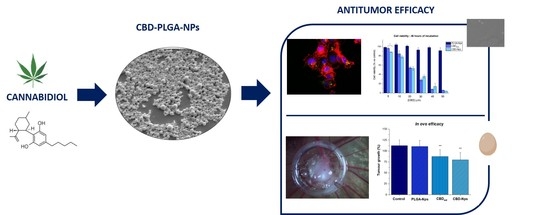
 “The intraperitoneal administration of chemotherapeutics has emerged as a potential route in ovarian cancer treatment. Nanoparticles as carriers for these agents could be interesting by increasing the retention of chemotherapeutics within the peritoneal cavity. Moreover, nanoparticles could be internalised by cancer cells and let the drug release near the biological target, which could increase the anticancer efficacy.
Cannabidiol (CBD), the main nonpsychotropic cannabinoid, appears as a potential anticancer drug. The aim of this work was to develop polymer nanoparticles as CBD carriers capable of being internalised by ovarian cancer cells.
The drug-loaded nanoparticles (CBD-NPs) exhibited a spherical shape, a particle size around 240 nm and a negative zeta potential (-16.6 ± 1.2 mV). The encapsulation efficiency was high, with values above 95%. A controlled CBD release for 96 h was achieved. Nanoparticle internalisation in SKOV-3 epithelial ovarian cancer cells mainly occurred between 2 and 4 h of incubation. CBD antiproliferative activity in ovarian cancer cells was preserved after encapsulation. In fact, CBD-NPs showed a lower IC50 values than CBD in solution. Both CBD in solution and CBD-NPs induced the expression of PARP, indicating the onset of apoptosis. In SKOV-3-derived tumours formed in the chick embryo model, a slightly higher-although not statistically significant-tumour growth inhibition was observed with CBD-NPs compared to CBD in solution.
To sum up, poly-lactic-co-glycolic acid (PLGA) nanoparticles could be a good strategy to deliver CBD intraperitoneally for ovarian cancer treatment.”
https://www.ncbi.nlm.nih.gov/pubmed/32397428
https://www.mdpi.com/1999-4923/12/5/439
 “The recent announcement of marijuana legalization in Canada spiked many discussions about potential health benefits of Cannabis sativa.
 “In recent years, the endocannabinoid system has received great interest as a potential therapeutic target in numerous pathological conditions.
 “Tetrahydrocannabinol (THC), cannabidiol (CBD) and cannabinol (CBN) affect the human endocannabinoid system.
 “To evaluate interest in and patterns of use of non-prescription
 “The endocannabinoid system (ECS) is a multifunctional homeostatic system involved in many physiological and pathological conditions. The ligands of the ECS are the endocannabinoids, whose actions are mimicked by exogenous cannabinoids, such as phytocannabinoids and synthetic cannabinoids. Responses to the ligands of the ECS are mediated by numerous receptors like the classical cannabinoid receptors (CB1 and CB2) as well as ECS-related receptors, e.g., G protein-coupled receptors 18 and 55 (GPR18 and GPR55), transient receptor potential ion channels, and nuclear peroxisome proliferator-activated receptors. The ECS regulates almost all levels of female reproduction, starting with oocyte production through to parturition. Dysregulation of the ECS is associated with the development of gynecological disorders from fertility disorders to cancer. Cannabinoids that act at the ECS as specific agonists or antagonists may potentially influence dysregulation and, therefore, represent new therapeutic options for the therapy of gynecological disorders.”
 “Ovarian cancer, with over a 90% reoccurrence within 18 months of treatment, and approximately a 30% mortality rate after 5 years, is the leading cause of death in cases of gynaecological malignancies. Acquired resistance, and toxic side effects by clinically used agents are major challenges associated with current treatments, indicating the need for new approaches in ovarian cancer treatment.