“One of the most promising potential medical applications of cannabinoids involves their ability to protect cells from a variety of toxic events.
Cannabinoids have been reported to protect neurons from death…
Cannabinoids, such as the pharmacologically active component of marijuana (-)Δ9-tetrahydrocannabinol (THC)…
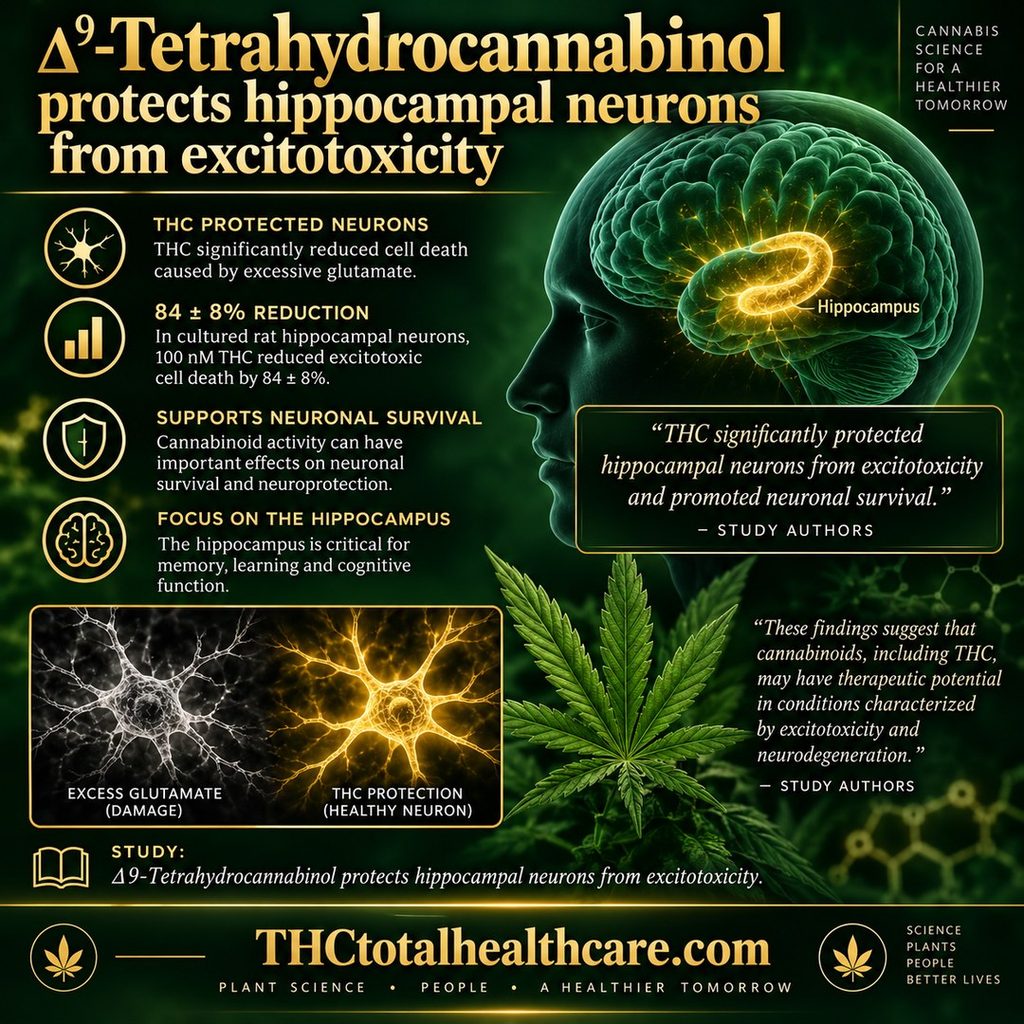
The neuroprotective effects of Δ9-tetrahydrocannabinol (THC) were examined…
Protective effects of Delta(9)-tetrahydrocannabinol… THC may function as an antioxidant to increase cell survival…
THC can produce receptor-independent neuroprotective or cellular protective effects at micromolar concentrations as a result of its antioxidant properties…
In conclusion, THC produces a potent neuroprotective effect…”
“Excitotoxic neuronal death underlies many neurodegenerative disorders.
Because cannabinoid receptor agonists act presynaptically to inhibit glutamate release, we examined the effects of Win 55212-2, a full agonist at CB(1) receptors, and Delta(9)-tetrahydrocannabinol (THC), a partial agonist, on the survival of neurons exposed to an excitotoxic pattern of synaptic activity.
Reducing the extracellular Mg(2+) concentration ([Mg(2+)](o)) to 0.1 mM evoked an aberrant pattern of glutamatergic activity that produced synaptically mediated death of rat hippocampal neurons in culture. Neuronal viability was quantified with a multiwell fluorescence plate scanner equipped to detect propidium iodide fluorescence.
Win 55212-2 (100 nM) and THC (100 nM) significantly reduced 0.1 mM [Mg(2+)](o)-induced cell death by 77 +/- 11% and 84 +/- 8%, respectively. Interestingly, the protection afforded by THC was not significantly different from that produced by Win 55212-2, suggesting that attenuation without a complete block of excitatory activity is sufficient for neuroprotection.
The effect of prolonged drug exposure on the neuroprotection afforded by cannabinoid receptor agonists was also studied. When cultures were pretreated for 24 h with Win 55212-2 (100 nM) or THC (100 nM), inhibition of 0.1 mM [Mg(2+)](o)-induced toxicity was significantly reduced to 39 +/- 19% and 45 +/- 13%, respectively. Thus, desensitization of CB(1) receptors diminishes the neuroprotective effects of cannabinoids.
This study demonstrates the importance of agonist efficacy and the duration of treatment on the neuroprotective effects of cannabinoids. It will be important to consider these effects on neuronal survival when evaluating pharmacologic treatments that modulate the endocannabinoid system.”
“We studied the effects of Win 55212-2 and THC on a synaptic model of excitotoxicity. Despite the fact that THC only partially inhibits glutamatergic synaptic transmission, the protection from neurotoxicity produced by THC equaled that of Win 55212-2 in rat hippocampal culture.”
“THC and Win 55212-2 protected neurons from the excitotoxicity induced by an aberrant pattern of glutamatergic synaptic activity. THC produced neuroprotection comparable to that produced by the full agonist Win 55212-2, even though it is a partial agonist at the CB1 receptor and thus attenuates but does not block synaptic transmission.”
“Cannabinoids protect neurons from excitotoxic injury…
Endogenous or exogenous cannabinoids have shown neuroprotective effects…
The main finding reported here is that cannabinoids protect neurons from excitotoxic injury by a mechanism that involves the activation of CB1R and inhibition of NOS and PKA….
By identifying the signaling pathways responsible for cannabinoid effects in animal models of disease and their human counterparts, it may be possible to design more specific and therefore more efficacious cannabinoid-based therapies.”
“Anxiety disorders are one of the most prevalent classes of mental disorders affecting the general population, but current treatment strategies are restricted by their limited efficacy and side effect profiles.
Although the cannabinoid system is speculated to be a key player in the modulation of stress responses and emotionality, the vast majority of current research initiatives had not incorporated stress exposure into their experimental designs.
This study was the first to investigate the impact of exogenous cannabinoid administration in an acutely stressed mouse model, where CD1 mice were pre-treated with HU-210, a potent CB1R agonist, prior to acute stress exposure and subsequent behavioural testing.
Exogenouscannabinoid administration induced distinct behavioural phenotypes in stressed and unstressed mice…
These findings suggest that exogenous cannabinoids and acute stress act synergistically in an anxiogenic manner.
This study underlies the importance of including stress exposure into future anxiety-cannabinoid research due to the differential impact of cannabinoid administration on stressed and unstressed subjects.”
“Sativex is an emergent treatment option for spasticity in patients affected by multiple sclerosis (MS).
This oromucosal spray, acting as a partial agonist at cannabinoid receptors, may modulate the balance between excitatory and inhibitory neurotransmitters, leading to muscle relaxation that is in turn responsible for spasticity improvement.
The aim of our study was to investigate the role of Sativex in improving spasticity and related symptomatology in MS patients by means of an extensive neurophysiological assessment of sensory-motor circuits…
Our data showed an increase of intracortical inhibition, a significant reduction of spinal excitability, and an improvement in spasticity and associated symptoms.
Thus, we can speculate that Sativex could be effective in reducing spasticity by means of a double effect on intracortical and spinal excitability.”
“The opioid system consists of three receptors, mu, delta, and kappa, which are activated by endogenous opioid peptides (enkephalins, endorphins, and dynorphins).
The endogenous cannabinoid system comprises lipid neuromodulators (endocannabinoids), enzymes for their synthesis and their degradation and two well-characterized receptors, cannabinoid receptors CB1 and CB2.
These systems play a major role in the control of pain as well as in mood regulation, reward processing and the development of addiction.
Both opioid and cannabinoid receptors are coupled to G proteins and are expressed throughout the brain reinforcement circuitry.
A better understanding of opioid-cannabinoid interactions may provide novel strategies for therapies in addicted individuals.”
“The CB2 cannabinoid receptor has been implicated in the regulation of intestinal inflammation.
Following on from the promising activity of a series of 4-oxo-1,4-dihydroquinoline-3-carboxamide, we developed constrained analogues based on a 2H-pyrazolo[4,3-c]quinolin-3(5H)-one scaffold, with improved affinity for the hCB2 receptor and had very high selectivity over the hCB1 receptor.
Importantly, the lead of this series (26, hCB2: K i = 0.39 nM, hCB1: K i > 3000 nM) was found to protect mice against experimental colitis after oral administration.”
“To investigate the regulation of cannabinoid receptors CB1 and CB2 on immune cells by proinflammatory cytokines and its potential relevance to the inflammatory neurological disease, multiple sclerosis (MS).
CB1 and CB2 signalling may be anti-inflammatory and neuroprotective in neuroinflammatory diseases.
Cannabinoids can suppress inflammatory cytokines…
The levels of CB1 and CB2 can be up-regulated by inflammatory cytokines, which can explain their increase in inflammatory conditions including MS”
“The CB1 cannabinoid receptor, the main molecular target of endocannabinoids and cannabis active components, is the most abundant G protein-coupled receptor in the mammalian brain.
In particular, the CB1 receptor is highly expressed in the basal ganglia, mostly on terminals of medium-sized spiny neurons, where it plays a key neuromodulatory function.
The CB1 receptor also confers neuroprotection in various experimental models of striatal damage…
Here, by using an array of pharmacological, genetic and pharmacogenetic approaches, we show that (1) CB1receptor engagement protects striatal cells from excitotoxic death via the phosphatidylinositol 3-kinase/Akt/mammalian target of rapamycin complex 1 pathway, which, in turn, (2) induces brain-derived neurotrophic factor (BDNF) expression through the selective activation of BDNF gene promoter IV, an effect that is mediated by multiple transcription factors.
Collectively, these findings unravel a molecular link between CB1 receptor activation and BDNF expression, and support the relevance of the CB1/BDNF axis in promoting striatal neuron survival.”
“First isolated from Cannabis in 1940 by Roger Adams, the structure of CBD was not completely elucidated until 1963.
Subsequent studies resulted in the pronouncement that THC was the ‘active’ principle of Cannabis and research then focused primarily on it to the virtual exclusion of CBD.
This was no doubt due to the belief that activity meant psychoactivity that was shown by THC and not by CBD.
In retrospect this must be seen as unfortunate since a number of actions of CBD with potential therapeutic benefit were downplayed for many years.
In this review, attention will be focused on the effects of CBD in the broad area of inflammation where such benefits seem likely to be developed.
Topics covered in this review are; the medicinal chemistry of CBD, CBD receptor binding involved in controlling Inflammation, signaling events generated by CBD, downstream events affected by CBD (gene expression and transcription), functional effects reported for CBD and combined THC plus CBD treatment.”