
Cannabidiol Administration Prevents Hypoxia-Ischemia-Induced Hypomyelination in Newborn Rats.

Image result for frontiers in pharmacology“Neonatal hypoxia-ischemia (HI) is a risk factor for myelination disturbances, a key factor for cerebral palsy.

Cannabidiol (CBD) protects neurons and glial cells after HI insult in newborn animals.

We hereby aimed to study CBD’s effects on long-lasting HI-induced myelination deficits in newborn rats.

In conclusion, HI injury in newborn rats resulted in long-lasting myelination disturbance, associated with functional impairment. CBD treatment preserved function and myelination, likely as a part of a general neuroprotective effect.”

https://www.ncbi.nlm.nih.gov/pubmed/31611802

“In conclusion, our study confirms that a HI insult in rats at a brain developmental stage equivalent to term infants leads to long-lasting myelination disturbance which is directly related to long-term functional disturbances. The administration of CBD single dose after the neonatal HI insult protects the maturational process of OL cells, as well as the mOL function and relationship with axons, thus, preserving normal myelination and restoring neurobehavioral function. Those results open exciting perspectives regarding a possible role for CBD in NHIE and other demyelinating pediatric conditions.”

https://www.frontiersin.org/articles/10.3389/fphar.2019.01131/full

‘Standard THC Units’: a proposal to standardise dose across all cannabis products and methods of administration.

Publication cover image“Cannabis products are becoming increasingly diverse, and they vary considerably in concentrations of ∆9 -tetrahydrocannabinol (THC) and cannabidiol (CBD). Higher doses of THC can increase the risk of harm from cannabis, while CBD may partially offset some of these effects. Lower Risk Cannabis Use Guidelines currently lack recommendations based on quantity of use, and could be improved by implementing standard units. However, there is currently no consensus on how units should be measured or standardised across different cannabis products or methods of administration.

ARGUMENT:

Existing proposals for standard cannabis units have been based on specific methods of administration (e.g. joints) and these may not capture other methods including pipes, bongs, blunts, dabbing, vaporizers, vape pens, edibles and liquids. Other proposals (e.g. grams of cannabis) cannot account for heterogeneity in THC concentrations across different cannabis products. Similar to alcohol units, we argue that standard cannabis units should reflect the quantity of active pharmacological constituents (dose of THC). On the basis of experimental and ecological data, public health considerations, and existing policy we propose that a ‘Standard THC Unit’ should be fixed at 5 milligrams of THC for all cannabis products and methods of administration. If supported by sufficient evidence in future, consumption of Standard CBD Units might offer an additional strategy for harm reduction.

CONCLUSIONS:

Standard THC Units can potentially be applied across all cannabis products and methods of administration to guide consumers and promote safer patterns of use.”

https://www.ncbi.nlm.nih.gov/pubmed/31606008

https://onlinelibrary.wiley.com/doi/abs/10.1111/add.14842

Cellular Distribution of Canonical and Putative Cannabinoid Receptors in Canine Cervical Dorsal Root Ganglia.

Image result for frontiers in veterinary science“Growing evidence indicates cannabinoid receptors as potential therapeutic targets for chronic pain.

Consequently, there is an increasing interest in developing cannabinoid receptor agonists for treating human and veterinary pain.

The present study may represent a morphological substrate to consider in order to develop therapeutic strategies against chronic pain.”

https://www.ncbi.nlm.nih.gov/pubmed/31608295

“The anti-nociceptive potential of the endocannabinoid system has prompted the development of therapeutic cannabinoid receptors agonists or medical marjiuana to be used in pets in order to treat chronic pain.”

https://www.frontiersin.org/articles/10.3389/fvets.2019.00313/full

Effects of cannabidiol (CBD) in neuropsychiatric disorders: A review of pre-clinical and clinical findings.

Progress in Molecular Biology and Translational Science“Cannabis sativa (cannabis) is one of the oldest plants cultivated by men. Cannabidiol (CBD) is the major non-psychomimetic compound derived from cannabis. It has been proposed to have a therapeutic potential over a wide range of neuropsychiatric disorders.

In this narrative review, we have summarized a selected number of pre-clinical and clinical studies, examining the effects of CBD in neuropsychiatric disorders. In some pre-clinical studies, CBD was demonstrated to potentially exhibit anti-epileptic, anti-oxidant, anti-inflammatory anti-psychotic, anxiolytic and anti-depressant properties. Moreover, CBD was shown to reduce addictive effects of some drugs of abuse.

In clinical studies, CBD was shown to be safe, well-tolerated and efficacious in mitigating the symptoms associated with several types of seizure disorders and childhood epilepsies.

Given that treatment with CBD alone was insufficient at managing choreic movements in patients with Huntington’s disease, other cannabis-derived treatments are currently being investigated. Patients with Parkinson’s disease (PD) have reported improvements in sleep and better quality of life with CBD; however, to fully elucidate the therapeutic potential of CBD on the symptoms of PD-associated movement disorders, larger scale, randomized, placebo-controlled studies still need to be conducted in the future.

Currently, there are no human studies that investigated the effects of CBD in either Alzheimer’s disease or unipolar depression, warranting further investigation in this area, considering that CBD was shown to have effects in pre-clinical studies.

Although, anxiolytic properties of CBD were reported in the Social Anxiety Disorder, antipsychotic effects in schizophrenia and anti-addictive qualities in alcohol and drug addictions, here too, larger, randomized, placebo-controlled trials are needed to evaluate the therapeutic potential of CBD.”

https://www.ncbi.nlm.nih.gov/pubmed/31601406

https://www.sciencedirect.com/science/article/pii/S187711731930095X?via%3Dihub

The potential role of cannabinoids in dermatology.

 Publication Cover“Cannabis is increasingly being used world-wide to treat a variety of dermatological conditions. Medicinal cannabis is currently legalized in Canada, 31 states in America and 19 countries in Europe. The authors reviewed the literature on the pharmacology and use of cannabinoids in treating a variety of skin conditions including acne, atopic dermatitis, psoriasis, skin cancer, pruritus, and pain. Cannabinoids have demonstrated anti-inflammatory, antipruritic, anti-ageing, and antimalignancy properties by various mechanisms including interacting with the newly found endocannabinoid system of the skin thereby providing a promising alternative to traditional treatments.”

https://www.ncbi.nlm.nih.gov/pubmed/31599175

https://www.tandfonline.com/doi/abs/10.1080/09546634.2019.1675854?journalCode=ijdt20

The Effects of Dosage-Controlled Cannabis Capsules on Cancer-Related Cachexia and Anorexia Syndrome in Advanced Cancer Patients: Pilot Study.

Image result for integrative cancer therapies“Cancer-related cachexia and anorexia syndrome (CACS) is a common phenomenon in cancer patients. Cannabis has been suggested to stimulate appetite but research on this issue has yielded mixed results. The current study aimed to evaluate the effect of dosage-controlled cannabis capsules on CACS in advanced cancer patients.

Methods: The cannabis capsules used in this study contained two fractions of oil-based compounds. The planned treatment was 2 × 10 mg per 24 hours for six months of tetrahydrocannabinol (THC) 9.5 mg and cannabidiol (CBD) 0.5 mg. If patients suffered from side effects, dosage was reduced to 5 mg × 2 per day (THC 4.75 mg, CBD 0.25 mg). Participants were weighed on every physician visit. The primary objective of the study was a weight gain of ≥10% from baseline.

Results: Of 24 patients who signed the consent form, 17 started the cannabis capsules treatment, but only 11 received the capsules for more than two weeks. Three of six patients who completed the study period met the primary end-point. The remaining three patients had stable weights. In quality of life quaternaries, patients reported less appetite loss after the cannabis treatment (p=0.05). Tumor necrosis factor-α (TNF-α) levels decreased after the cannabis treatment but without statistical significance. According to patients’ self-reports, improvement in appetite and mood as well as a reduction in pain and fatigue was demonstrated.

Conclusions: Despite various limitations, this preliminary study demonstrated a weight increase of ≥10% in 3/17 (17.6%) patients with doses of 5mgx1 or 5mgx2 capsules daily, without significant side effects. The results justify a larger study with dosage-controlled cannabis capsules in CACS.”

https://www.ncbi.nlm.nih.gov/pubmed/31595793

“The primary objective of the study was a weight gain of ≥10% from baseline. Despite various limitations, the current preliminary study demonstrated a weight increase of ≥10% in 3/17 (17.6%) of the patients with doses of 5 mg × 1 or 5 mg × 2 capsules daily, without significant side effects.”

https://journals.sagepub.com/doi/10.1177/1534735419881498

The effect of cannabis laws on opioid use.

International Journal of Drug Policy“Many Americans rely on opioids at varying dosages to help ameliorate their suffering. However, empirical evidence is mounting that opioids are ineffective at controlling non-cancer related chronic pain, and many argue the strategies meant to relieve patient suffering are contributing to the growing opioid epidemic.
Concurrently, several states now allow the use of medical cannabis to treat a variety of medical conditions, including chronic pain. Needing more exploration is the impact of cannabis laws on general opioid reliance and whether chronic pain sufferers are opting to use cannabis medicinally instead of opioids.

METHODS:

This study investigates the effect of Medical Marijuana Laws (MML)s on opioid use and misuse controlling for a number of relevant factors using data from several years of the National Survey on Drug Use and Health and multivariate logistic regression and longitudinal analysis strategies.

RESULTS:

Results provide evidence that MMLs may be effective at reducing opioid reliance as survey respondents living in states with medical cannabis legislation are much less apt to report using opioid analgesics than people living in states without such laws, net other factors. Results further indicate that the presence of medicinal cannabis legislation appears to have no influence over opioid misuse.

CONCLUSION:

MMLs may ultimately serve to attenuate the consequences of opioid overreliance.”

https://www.ncbi.nlm.nih.gov/pubmed/31590091

https://www.sciencedirect.com/science/article/abs/pii/S0955395919302567?via%3Dihub

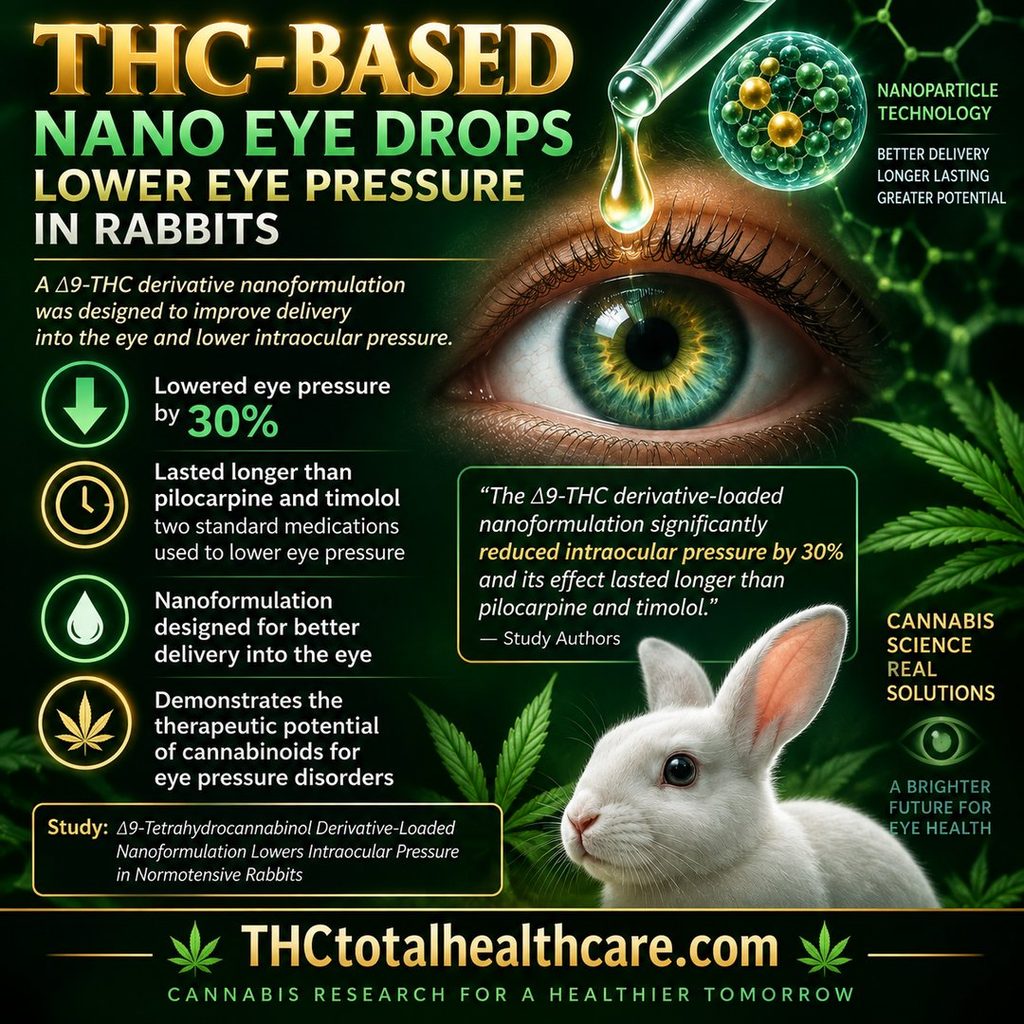
Δ9-Tetrahydrocannabinol Derivative-Loaded Nanoformulation Lowers Intraocular Pressure in Normotensive Rabbits.

THC has been known for decades to lower intraocular pressure, which helped spark early interest in cannabinoids as a possible treatment for glaucoma. Researchers are now exploring whether newer delivery technologies can make that effect more practical and longer lasting. In this study, a nanoformulation containing a Δ9-THC derivative reduced eye pressure by 30% in normotensive rabbits and lasted longer than pilocarpine and timolol, two standard medications used to lower eye pressure.

“Δ9-Tetrahydrocannabinol-valine-hemisuccinate, a hydrophilic prodrug of Δ9-tetrahydrocannabinol, synthesized with the aim of improving the ocular bioavailability of the parent molecule, was investigated in a lipid-based nanoparticle dosage form for ocular delivery.

RESULTS:

A peak intraocular pressure (IOP) drop of 30% from baseline was observed in rabbits treated with SLNs loaded with Δ9-tetrahydrocannabinol-valine-hemisuccinate at 90 minutes. Treated eyes of rabbits receiving Δ9-tetrahydrocannabinol-valine-hemisuccinate SLNs had significantly lower IOP than untreated eyes until 360 minutes, whereas the group receiving the emulsion formulation showed a drop in IOP until 90 minutes only. In comparison to marketed pilocarpine and timolol maleate ophthalmic solutions, Δ9-tetrahydrocannabinol-valine-hemisuccinate SLNs produced a greater effect on IOP in terms of both intensity and duration. In terms of tissue concentrations, significantly higher concentrations of Δ9-tetrahydrocannabinol-valine-hemisuccinate were observed in iris-ciliary bodies and retina-choroid with SLNs.

CONCLUSION:

Δ9-Tetrahydrocannabinol-valine-hemisuccinate formulated in a lipid-based nanoparticulate carrier shows promise in glaucoma pharmacotherapy.

TRANSLATIONAL RELEVANCE:

Glaucoma therapies usually focus on decreased aqueous humor production and increased outflow. However, such therapy is not curative, and there lies a need in preclinical research to focus efforts on agents that not only affect the aqueous humor dynamics but also provide neuroprotection. Historically, there have been bench-scale studies looking at retinal ganglion cell death post-axonal injury. However, for a smooth translation of this in vitro activity to the clinic, animal models examining IOP reduction, i.e., connecting the neuroprotective activity to a measurable outcome in glaucoma management (IOP), need to be investigated. This study investigated the IOP reduction efficacy of cannabinoids for glaucoma pharmacotherapy in a normotensive rabbit model, bringing forth a new class of agents with the potential of IOP reduction and improved permeation to the back of the eye, possibly providing neuroprotective benefits in glaucoma management.”

https://www.ncbi.nlm.nih.gov/pubmed/31588378

“THC has been demonstrated to be effective in glaucoma management, helping to lower IOP in human subjects after smoking marijuana; however, the molecule fails to manifest a similar effect when dosed topically. This research explores molecular bioengineering and formulation-based strategies to improve the ocular bioavailability of THC, facilitating the molecule to translate into a dosage form capable of demonstrating a desired IOP-lowering effect even on topical application. These studies suggest that formulation development efforts along with prodrug derivatization can effectively improve the overall ocular bioavailability of THC. Thus, THC-VHS represents a potential new therapy option for the treatment and management of glaucoma by virtue of its superiority in lowering IOP when compared to antiholinergic and beta blockers, as studied in this model.”

Need this THC study explained? thcXplained.com

The evaluation of Cannabidiol’s effect on the immunotherapy of Burkitt lymphoma.

Biochemical and Biophysical Research Communications

“AF1q has a precise oncogenic function.

The purpose of this study is to investigate whether CBD has an effect on the AF1q/ICAM-1 regulatory axis in Burkitt’s lymphoma (BL), and thus has potential to enhance immunotherapy and reduce side effects.


RESULTS:

AF1q increased oncogenic growth and colony formation, and induced resistance against cell-mediated cytotoxic chemotherapy through attenuation of ICAM-1 expression in BL. CBD was able to reverse the acquired resistance mediated by AF1q/ICAM-1 regulatory axis.

CONCLUSION:

CBD holds potential to enhance the efficacy of immunotherapy for BL with hyperactive AF1q/ICAM-1 regulatory axis, and warrants further study.”

https://www.ncbi.nlm.nih.gov/pubmed/31587870

“Non-psychoactive CBD could potentially enhance the efficacy of immunotherapy in cancer treatment, especially against aggressive B.”

https://www.sciencedirect.com/science/article/pii/S0006291X1931890X?via%3Dihub

Role of Cannabinoids and Terpenes in Cannabis-Mediated Analgesia in Rats.

View details for Cannabis and Cannabinoid Research cover image

“Cannabis sativa has been used for centuries in treating pain. However, the analgesic role of many of its constituents including terpenes is unknown. This research examined the contributions of terpenes (volatile oil) and cannabinoids in cannabis-mediated analgesia in rats.

Methods: Animals received intraperitoneal administration of either vehicle, 10.0 or 18.0 mg/kg morphine, or various doses of the extract without terpenes, isolated terpenes, Δ9-tetrahydrocannabinol (THC), or the full extract. Thirty minutes later animals were tested on hotplate and tail-flick tests of thermal nociception. One week later, rats received a second administration of test articles and were tested 30 min later in the abdominal writhing test of inflammatory nociception.

Results: In the thermal assays, hotplate and tail-flick latencies for morphine-treated rats were dose dependent and significantly higher than vehicle-treated animals. All the cannabinoid compounds except for the isolated terpenes produced dose-dependent increases in hotplate and tail-flick latencies. In the inflammatory nociceptive assay, animals treated with vehicle and isolated terpenes demonstrated increased abdominal writhing, whereas all the cannabinoid compounds significantly decreased abdominal writhing responses.

Conclusions: Overall, THC alone produced robust analgesia equivalent to the full cannabis extract, whereas terpenes alone did not produce analgesia. These data suggest the analgesic activity of cannabis is largely mediated by THC, whereas terpenes alone do not cause alterations in cannabis-mediated analgesia.”

https://www.ncbi.nlm.nih.gov/pubmed/31579834

“The work herein demonstrates that cannabis extracts can not only produce robust analgesia without the terpene-containing volatile oils, but isolated THC appears to be all that is required to produce such effects.”

https://www.liebertpub.com/doi/10.1089/can.2018.0054