“Synthetic cannabinoids, the psychoactive components of the Cannabis sativa (marijuana) and their endogenous counterparts, act through two G protein-coupled receptors, CB1 and CB2.
The endocannabinoids are metabolized by fatty acid amide hydrolase (FAAH).
We have examined CB1 receptor and FAAH expression in human term placenta by immunohistochemistry.
CB1 receptor was found to be present in all layers of the membrane, with particularly strong expression in the amniotic epithelium and reticular cells and cells of the maternal decidua layer. Moderate expression was observed in the chorionic cytotrophoblasts. The expression of FAAH was the highest in amniotic epithelial cells, chorionic cytotrophoblast and maternal decidua layer.
Our results suggest that the human placenta is a likely target for cannabinoid action and metabolism. ”
“Leptin is an anorexigenic mediator that reduces food intake by acting on hypothalamic receptor, Ob-Rb. In contrast, endocannabinoids are orexigenic mediators that act via cannabinoid CB1 receptors in hypothalamus, limbic forebrain, and brainstem.
In the peripheral taste system, leptin administration selectively inhibits behavioral, taste nerve and taste cell responses to sweet compounds. Opposing the action of leptin, endocannabinoids enhance sweet taste responses.
Taken together, our results suggest that circulating leptin, but not local endocannabinoids, may be a dominant modulator for sweet taste in lean mice; however, endocannabinoids may become more effective modulators of sweet taste under conditions of deficient leptin signaling, possibly due to increased production of endocannabinoids in taste tissue.”
“Age-related osteoporosis is characterized by reduced bone formation and accumulation of fat in the bone marrow compartment.
Here, we report that the type 1 cannabinoid receptor (CB1) regulates this process…
The CB1 receptor is therefore unique in that it regulates peak bone mass through an effect on osteoclast activity, but protects against age-related bone loss by regulating adipocyte and osteoblast differentiation of bone marrow stromal cells.”
“In glaucoma, the increased release of glutamate is the major cause of retinal ganglion cell death. Cannabinoids have been demonstrated to protect neuron cultures from glutamate-induced death.
In this study, we test the hypothesis that glutamate causes apoptosis of retinal neurons via the excessive formation of peroxynitrite, and that the neuroprotective effect of the psychotropic Δ9-tetrahydroxycannabinol (THC) or nonpsychotropic cannabidiol (CBD) is via the attenuation of this formation…
The neuroprotection by THC and CBD was because of attenuation of peroxynitrite.
The effect of THC was in part mediated by the cannabinoid receptor CB1.
These results suggest the potential use of CBD as a novel topical therapy for the treatment of glaucoma.
THC and CBD, are similarly potent antioxidants that protect neuron cultures from glutamate-induced cell death or oxidative stress…
In addition to possessing neuroprotective or retinal neuroprotective activity… cannabinoids, such as THC, have been demonstrated to induce dose-related reductions in intraocular pressure in human and in animal models.
This suggests that cannabinoids may offer a multifaceted therapy for glaucoma.
In conclusion, our results indicate that lipid peroxidation and ONOO− formation play an important role in NMDA-induced retinal neurotoxicity and cell loss in the retina, and that THC and CBD, by reducing the formation of these compounds, are effective neuroprotectants.
The present studies could form the basis for the development of new topical therapies for the treatment of glaucoma.”
“Excitotoxic neuronal death underlies many neurodegenerative disorders.
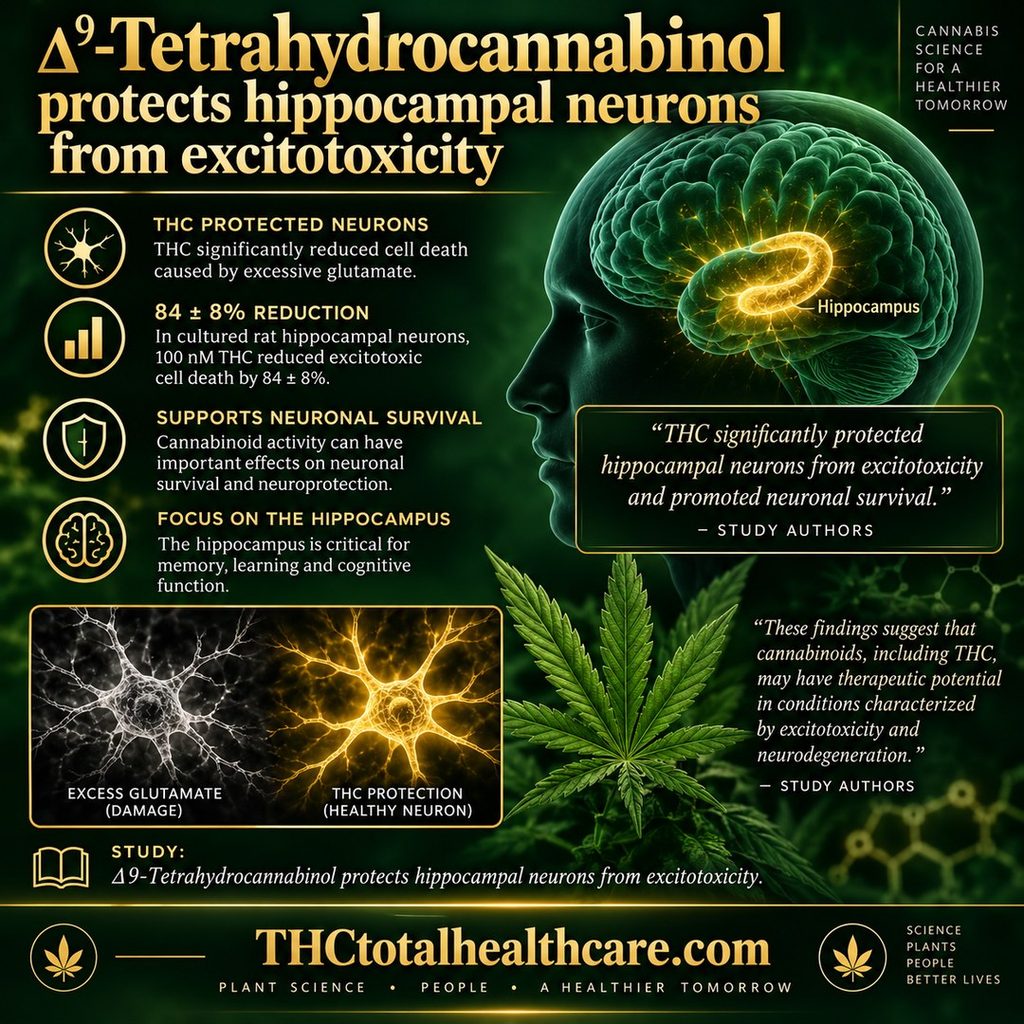
Because cannabinoid receptor agonists act presynaptically to inhibit glutamate release, we examined the effects of Win 55212-2, a full agonist at CB(1) receptors, and Delta(9)-tetrahydrocannabinol (THC), a partial agonist, on the survival of neurons exposed to an excitotoxic pattern of synaptic activity.
Reducing the extracellular Mg(2+) concentration ([Mg(2+)](o)) to 0.1 mM evoked an aberrant pattern of glutamatergic activity that produced synaptically mediated death of rat hippocampal neurons in culture. Neuronal viability was quantified with a multiwell fluorescence plate scanner equipped to detect propidium iodide fluorescence.
Win 55212-2 (100 nM) and THC (100 nM) significantly reduced 0.1 mM [Mg(2+)](o)-induced cell death by 77 +/- 11% and 84 +/- 8%, respectively. Interestingly, the protection afforded by THC was not significantly different from that produced by Win 55212-2, suggesting that attenuation without a complete block of excitatory activity is sufficient for neuroprotection.
The effect of prolonged drug exposure on the neuroprotection afforded by cannabinoid receptor agonists was also studied. When cultures were pretreated for 24 h with Win 55212-2 (100 nM) or THC (100 nM), inhibition of 0.1 mM [Mg(2+)](o)-induced toxicity was significantly reduced to 39 +/- 19% and 45 +/- 13%, respectively. Thus, desensitization of CB(1) receptors diminishes the neuroprotective effects of cannabinoids.
This study demonstrates the importance of agonist efficacy and the duration of treatment on the neuroprotective effects of cannabinoids. It will be important to consider these effects on neuronal survival when evaluating pharmacologic treatments that modulate the endocannabinoid system.”
“We studied the effects of Win 55212-2 and THC on a synaptic model of excitotoxicity. Despite the fact that THC only partially inhibits glutamatergic synaptic transmission, the protection from neurotoxicity produced by THC equaled that of Win 55212-2 in rat hippocampal culture.”
“THC and Win 55212-2 protected neurons from the excitotoxicity induced by an aberrant pattern of glutamatergic synaptic activity. THC produced neuroprotection comparable to that produced by the full agonist Win 55212-2, even though it is a partial agonist at the CB1 receptor and thus attenuates but does not block synaptic transmission.”
“Cannabinoids protect neurons from excitotoxic injury…
Endogenous or exogenous cannabinoids have shown neuroprotective effects…
The main finding reported here is that cannabinoids protect neurons from excitotoxic injury by a mechanism that involves the activation of CB1R and inhibition of NOS and PKA….
By identifying the signaling pathways responsible for cannabinoid effects in animal models of disease and their human counterparts, it may be possible to design more specific and therefore more efficacious cannabinoid-based therapies.”
“Anxiety disorders are one of the most prevalent classes of mental disorders affecting the general population, but current treatment strategies are restricted by their limited efficacy and side effect profiles.
Although the cannabinoid system is speculated to be a key player in the modulation of stress responses and emotionality, the vast majority of current research initiatives had not incorporated stress exposure into their experimental designs.
This study was the first to investigate the impact of exogenous cannabinoid administration in an acutely stressed mouse model, where CD1 mice were pre-treated with HU-210, a potent CB1R agonist, prior to acute stress exposure and subsequent behavioural testing.
Exogenouscannabinoid administration induced distinct behavioural phenotypes in stressed and unstressed mice…
These findings suggest that exogenous cannabinoids and acute stress act synergistically in an anxiogenic manner.
This study underlies the importance of including stress exposure into future anxiety-cannabinoid research due to the differential impact of cannabinoid administration on stressed and unstressed subjects.”
“The CB1 cannabinoid receptor, the main molecular target of endocannabinoids and cannabis active components, is the most abundant G protein-coupled receptor in the mammalian brain.
In particular, the CB1 receptor is highly expressed in the basal ganglia, mostly on terminals of medium-sized spiny neurons, where it plays a key neuromodulatory function.
The CB1 receptor also confers neuroprotection in various experimental models of striatal damage…
Here, by using an array of pharmacological, genetic and pharmacogenetic approaches, we show that (1) CB1receptor engagement protects striatal cells from excitotoxic death via the phosphatidylinositol 3-kinase/Akt/mammalian target of rapamycin complex 1 pathway, which, in turn, (2) induces brain-derived neurotrophic factor (BDNF) expression through the selective activation of BDNF gene promoter IV, an effect that is mediated by multiple transcription factors.
Collectively, these findings unravel a molecular link between CB1 receptor activation and BDNF expression, and support the relevance of the CB1/BDNF axis in promoting striatal neuron survival.”
“Over the last decade, the endocannabinoid system has emerged as a pivotal mediator of acute and chronic liver injury, with the description of the role of CB1 and CB2 receptors and their endogenous lipidic ligands in various aspects of liver pathophysiology.
A large number of studies have demonstrated that CB1 receptor antagonists represent an important therapeutic target, owing to beneficial effects on lipid metabolism and in light of its antifibrogenic properties.
Unfortunately, the brain-penetrant CB1 antagonist rimonabant, initially approved for the management of overweight and related cardiometabolic risks, was withdrawn because of an alarming rate of mood adverse effects.
However, the efficacy of peripherally-restricted CB1 antagonists with limited brain penetrance has now been validated in preclinical models of NAFLD, and beneficial effects on fibrosis and its complications are anticipated.
CB2 receptor is currently considered as a promising anti-inflammatory and antifibrogenic target, although clinical development of CB2 agonists is still awaited.
In this review, we highlight the latest advances on the impact of the endocannabinoid system on the key steps of chronic liver disease progression and discuss the therapeutic potential of molecules targeting cannabinoid receptors…
Overwhelming evidence supports the therapeutic potential of peripherally-restricted CB1 antagonists and CB2 agonists in the management of chronic liver diseases.”
“The endocannabinoid system, through cannabinoid receptor signaling by endocannabinoids, is involved in a wide range of functions and physiopathological conditions.
… liver regeneration, a useful in vivo model of synchronized cell proliferation, is characterized by a peak of anandamide that elicits through CB1 receptor the expression of critical mitosis genes. The aim of this study was to focus on the timing of endocannabinoid signaling changes during the different phases of the cell cycle, exploiting the rat liver regeneration model following partial hepatectomy…
These results support the notion that the signaling mediated by anandamide through CB1 receptor may be important for the entry and progression of cells into the cell cycle and hence for their proliferation under mitogenic signals.”