
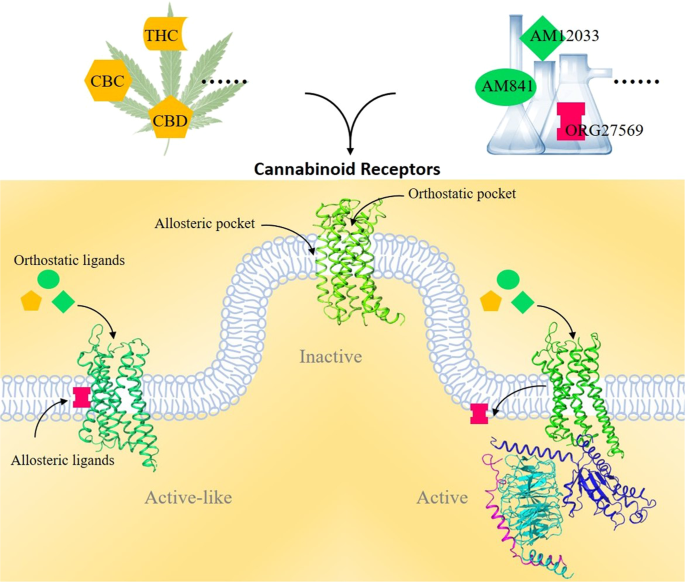
 “Cannabinoids (CBs), analgesic drugs used for thousands of years, were first found in Cannabis sativa, and the multiple CBs used medicinally, such as tetrahydrocannabinol (THC), cannabidiol (CBD) and dozens more, have complex structures. In addition to their production by plants, CBs are naturally present in the nerves and immune systems of humans and animals.
Both exogenous and endogenous CBs carry out a variety of physiological functions by engaging with two CB receptors, the CB1 and CB2 receptors, in the human endocannabinoid system (ECS). Both CB1 and CB2 are G protein-coupled receptors that share a 7-transmembrane (7TM) topology. CB1, known as the central CB receptor, is mainly distributed in the brain, spinal cord, and peripheral nervous system. CB1 activation in the human body typically promotes the release of neurotransmitters, controls pain and memory learning, and regulates metabolism and the cardiovascular system.
Clinically, CB1 is a direct drug target for drug addiction, neurodegenerative diseases, pain, epilepsy, and obesity. Unlike the exclusive expression of CB1 in the nervous system, CB2 is mainly distributed in peripheral immune cells. Selective CB2 agonists would have therapeutic potential in the treatment of inflammation and pain and avoid side effects caused by currently used clinical drugs.
Although significant progress has been made in developing agonists toward CB receptors, efficient clinical drugs targeting CB receptors remain lacking due to their complex signaling mechanisms. The recent structural elucidation of CB receptors has greatly aided our understanding of the activation and signal transduction mechanisms of CB receptors.
Recent structural characterizations of CB receptors will greatly facilitate the design of new ligands to modulate the selective functions of CB receptors. Notably, the CBD was approved by the Food and Drug Administration (FDA) in 2018 to treat epilepsy. We now look forward to more drugs targeting these two CB receptors for clinical usage in the near future.”
 “We observed that cannabidiol supplements were highly effective in treating an infant boy with drug-resistant early infantile epileptic encephalopathy, eliminating his intractable tonic seizures.
 “In this work, we evaluated, for the first time, the antitumor effect of cannabidiol (CBD) as monotherapy and in combination with conventional chemotherapeutics in ovarian cancer and developed PLGA-microparticles as CBD carriers to optimize its anticancer activity.

 “During the last decades, researchers have investigated the functional relevance of adult hippocampal neurogenesis in normal brain function as well as in the pathogenesis of diverse psychiatric conditions.
 “Methamphetamine (METH) is a highly addictive psychostimulant.
 “The compounds present in cannabis have been in use for both recreational and medicinal purposes for many centuries. Changes in the legislation in South Africa have led to an increase in the number of people interested in using these compounds for self-medication. Many of them may approach their general practitioner as the first source of information about possible therapeutic effects. It is important that medical professionals are able to give patients the correct information. Cannabidiol (CBD) is one of the main compounds in cannabis plants, and there is evidence that it can successfully treat certain patients with epilepsy. This review looks at the most recent evidence on the use of CBD in the treatment of epilepsy and explores the mechanisms behind these beneficial effects.”
 “In this study, we report the potential of cannabidiol, one of the major cannabis constituents, for enhancing osteoblastic differentiation in U2OS and MG-63 cells.
 “Highly purified cannabidiol (CBD) (approved as Epidiolex® in the United States) has demonstrated efficacy with an acceptable safety profile in patients with Lennox-Gastaut or Dravet syndrome in four randomized controlled trials. CBD possesses affinity for many target classes with functional effects relevant to the pathophysiology of many disease types, including epilepsy.
 “Deposition of amyloid-beta (Aβ) peptide in the brain is the leading source of the onset and progression of Alzheimer’s disease (AD). Recent studies have suggested that anti-amyloidogenic agents may be a suitable therapeutic strategy for AD.
 “Cannabinoids may have an important therapeutic potential for the treatment of dependence on crack cocaine.