Cannabidiol in treatment of refractory epileptic spasms: An open-label study.

Cover image volume 104, Issue “This study aimed to evaluate clinical efficacy and safety of purified pharmaceutical cannabidiol (CBD) as an adjunctive therapy in refractory childhood-onset epileptic spasms (ES).

METHODS:

Nine patients with ES were enrolled in an Institutional Review Board (IRB)- and Food and Drug Administration (FDA)-approved expanded access investigational new drug trial. Patients received plant-derived highly purified CBD in oral solution in addition to their baseline medications at an initial dosage of 5 mg/kg/day, which was increased by 5 mg/kg/day every week to an initial target dosage of 25 mg/kg/day. Seizure frequency, adverse event, and parents’ subjective reports of cognitive and behavioral changes were recorded after 2 weeks and 1, 2, 3, 6, 9, and 12 months of CBD treatment. Responder rates (percent of patients with >50% reduction in ES frequency from baseline) were calculated. Electrographic changes were studied in relation to CBD initiation and clinical response.

RESULTS:

Overall, the responder rates in 9 patients were 67%, 78%, 67%, 56%, 78%, 78%, and 78% after 2 weeks and 1, 2, 3, 6, 9, and 12 months of CBD treatment, respectively. Three out of nine patients (33%) were ES free after two months of treatment. Parents reported subjective improvements in cognitive and behavioral domains. Side effects, primarily drowsiness, were seen in 89% of patients (n = 8). Eight of the nine (89%) patients had electroencephalographic (EEG) studies prior to and after initiation of CBD. Three out of five patients (60%) had resolution in their hypsarrhythmia pattern.

SIGNIFICANCE:

Purified pharmaceutical CBD may be an effective and safe adjunctive therapy in refractory ES and may also be associated with improvements in electrographic findings.”

https://www.ncbi.nlm.nih.gov/pubmed/32169600

“Purified pharmaceutical cannabidiol seems an effective adjunctive therapy in refractory epileptic spasms. Purified pharmaceutical cannabidiol has corresponding electrographic changes. Purified pharmaceutical cannabidiol seems to exhibit acceptable safety profile.”

https://linkinghub.elsevier.com/retrieve/pii/S1525505020301633

Cannabidiol attenuates behavioral changes in a rodent model of schizophrenia through 5-HT1A, but not CB1 and CB2 receptors.

Pharmacological Research“Preclinical and clinical data indicate that cannabidiol (CBD), a non-psychotomimetic compound from the Cannabis sativa plant, can induce antipsychotic-like effects.

These data suggest that CBD induces antipsychotic-like effects by activating 5-HT1A receptors and indicate that this compound could be an interesting alternative for the treatment of negative and cognitive symptoms of schizophrenia.”

https://www.ncbi.nlm.nih.gov/pubmed/32151683

https://www.sciencedirect.com/science/article/abs/pii/S1043661819315439?via%3Dihub

Evaluation of pharmacokinetics and acute anti-inflammatory potential of two oral cannabidiol preparations in healthy adults.

Phytotherapy Research“Cannabidiol (CBD) is a dietary supplement with numerous purported health benefits and an expanding commercial market. Commercially available CBD preparations range from tinctures, oils, and powders, to foods and beverages.

Despite widespread use, information regarding bioavailability of these formulations is limited. The purpose of this study was to test the bioavailability of two oral formulations of CBD in humans and explore their potential acute anti-inflammatory activity.

This study provides pilot data for designing and powering future studies to establish the anti-inflammatory potential and bioavailability of a larger variety of commercial CBD products consumed by humans.”

https://www.ncbi.nlm.nih.gov/pubmed/32147925

https://onlinelibrary.wiley.com/doi/abs/10.1002/ptr.6651

What Do You Know About Maryjane? A Systematic Review of the Current Data on the THC:CBD Ratio.

Publication Cover“Ratios of delta-9-tetrahydrocannabinol (THC) and cannabidiol (CBD) impact metabolism and therapeutic effects of cannabis.

The medical and scientific communities have not drawn substantive conclusions nor thoroughly explored THC:CBD ratios for “best practice” treatment of different disease processes and their sequelae.

While there is evidence that cannabis provides medical benefits, research is lacking on standardization of medical cannabis use in modern medical practices.”

https://www.ncbi.nlm.nih.gov/pubmed/32124675

Is cannabidiol a drug acting on unconventional targets to control drug-resistant epilepsy?

Publication cover image“Cannabis has been considered as a therapeutic strategy to control intractable epilepsy.

Several cannabis components, especially cannabidiol (CBD), induce antiseizure effects. However, additional information is necessary to identify the types of epilepsies that can be controlled by these components and the mechanisms involved in these effects.

This review presents a summary of the discussion carried out during the 2nd Latin American Workshop on Neurobiology of Epilepsy entitled “Cannabinoid and epilepsy: myths and realities.” This event was carried out during the 10th Latin American Epilepsy Congress in San José de Costa Rica (September 28, 2018).

The review focuses to discuss the use of CBD as a new therapeutic strategy to control drug-resistant epilepsy. It also indicates the necessity to consider the evaluation of unconventional targets such as P-glycoprotein, to explain the effects of CBD in drug-resistant epilepsy.”

https://www.ncbi.nlm.nih.gov/pubmed/32140642

“Cannabidiol is a multitarget drug that represents a new hope to control drug‐resistant epilepsy.”

https://onlinelibrary.wiley.com/doi/full/10.1002/epi4.12376

Cannabidiol is an effective helper compound in combination with bacitracin to kill Gram-positive bacteria.

Scientific Reports “The cannabinoid cannabidiol (CBD) is characterised in this study as a helper compound against resistant bacteria. CBD potentiates the effect of bacitracin (BAC) against Gram-positive bacteria (Staphylococcus species, Listeria monocytogenes, and Enterococcus faecalis) but appears ineffective against Gram-negative bacteria. CBD reduced the MIC value of BAC by at least 64-fold and the combination yielded an FIC index of 0.5 or below in most Gram-positive bacteria tested. Morphological changes in S. aureus as a result of the combination of CBD and BAC included several septa formations during cell division along with membrane irregularities. Analysis of the muropeptide composition of treated S. aureus indicated no changes in the cell wall composition. However, CBD and BAC treated bacteria did show a decreased rate of autolysis. The bacteria further showed a decreased membrane potential upon treatment with CBD; yet, they did not show any further decrease upon combination treatment. Noticeably, expression of a major cell division regulator gene, ezrA, was reduced two-fold upon combination treatment emphasising the impact of the combination on cell division. Based on these observations, the combination of CBD and BAC is suggested to be a putative novel treatment in clinical settings for treatment of infections with antibiotic resistant Gram-positive bacteria.”

https://www.ncbi.nlm.nih.gov/pubmed/32139776

https://www.nature.com/articles/s41598-020-60952-0

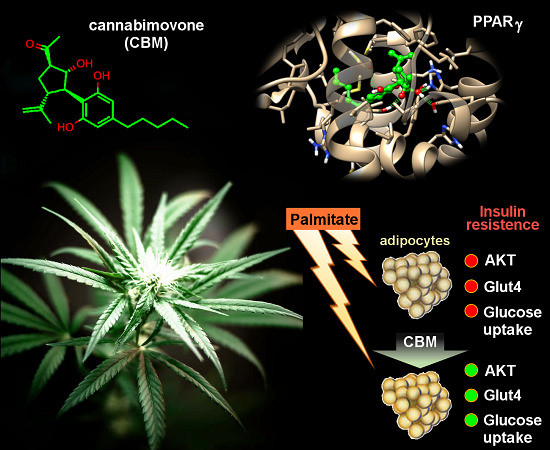
Identification and Characterization of Cannabimovone, a Cannabinoid from Cannabis sativa, as a Novel PPARγ Agonist via a Combined Computational and Functional Study.

 molecules-logo“Phytocannabinoids (pCBs) are a large family of meroterpenoids isolated from the plant Cannabis sativa. Δ9-Tetrahydrocannabinol (THC) and cannabidiol (CBD) are the best investigated phytocannabinoids due to their relative abundance and interesting bioactivity profiles. In addition to various targets, THC and CBD are also well-known agonists of peroxisome proliferator-activated receptor gamma (PPARγ), a nuclear receptor involved in energy homeostasis and lipid metabolism. In the search of new pCBs potentially acting as PPARγ agonists, we identified cannabimovone (CBM), a structurally unique abeo-menthane pCB, as a novel PPARγ modulator via a combined computational and experimental approach. The ability of CBM to act as dual PPARγ/α agonist was also evaluated. Computational studies suggested a different binding mode toward the two isoforms, with the compound able to recapitulate the pattern of H-bonds of a canonical agonist only in the case of PPARγ. Luciferase assays confirmed the computational results, showing a selective activation of PPARγ by CBM in the low micromolar range. CBM promoted the expression of PPARγ target genes regulating the adipocyte differentiation and prevented palmitate-induced insulin signaling impairment. Altogether, these results candidate CBM as a novel bioactive compound potentially useful for the treatment of insulin resistance-related disorders.”
https://www.ncbi.nlm.nih.gov/pubmed/32138197

https://www.mdpi.com/1420-3049/25/5/1119

Safety Assessment of a Hemp Extract using Genotoxicity and Oral Repeat-Dose Toxicity Studies in Sprague-Dawley Rats

Toxicology Reports“Cannabinoids are extracted from Cannabis sativa L. and are used for a variety of medicinal purposes.

Recently, there has been a focus on the cannabinoid Cannabidiol (CBD) and its potential benefits.

This study investigated the safety of a proprietary extract of C. sativa, consisting of 9% hemp extract (of which 6.27% is CBD) and 91% olive oil.

Given the potential of CBD for a variety of human uses and the limited data currently available, these results support that hemp extracts are likely safe human consumption and additional studies should be conducted to validate this conclusion.”

https://www.sciencedirect.com/science/article/pii/S2214750019305207?via%3Dihub

Cannabidiol Effects on Phospholipid Metabolism in Keratinocytes from Patients with Psoriasis Vulgaris

biomolecules-logo“Psoriasis is a chronic inflammatory skin disease characterized by dysregulated keratinocyte differentiation, but oxidative stress also plays an important role in the pathogenesis of this disease.

Here, we examined the effect of cannabidiol (CBD), a phytocannabinoid with antioxidant and anti-inflammatory properties, on the redox balance and phospholipid metabolism in UVA/UVB-irradiated keratinocytes isolated from the skin of psoriatic patients or healthy volunteers.

We conclude that CBD partially reduces oxidative stress in the keratinocytes of healthy individuals, while showing a tendency to increase the oxidative and inflammatory state in the keratinocytes of patients with psoriasis, especially following UV-irradiation.”

https://www.mdpi.com/2218-273X/10/3/367

Cost-Effectiveness Analysis of Cannabinoid Oromucosal Spray Use for the Management of Spasticity in Subjects with Multiple Sclerosis.

 SpringerLink“Multiple sclerosis (MS) is a highly symptomatic disease, with a wide range of disabilities affecting many bodily functions, even in younger persons with a short disease history.

The availability of a cannabinoid oromucosal spray (Sativex) for the management of treatment-resistant MS spasticity has provided a new opportunity for many patients.

OBJECTIVE:

Our study aimed to assess the cost effectiveness of Sativex in Italian patients with treatment-resistant MS spasticity. The analysis was based on the real-world data of a large registry of Italian patients.

CONCLUSION:

The use of Sativex could improve the quality of life of patients with a reasonable incremental cost resulting as a cost-effective option for patients with MS-resistant spasticity. These results could help clinicians and decision makers to develop improved management strategies for spasticity in patients with MS, optimizing the use of available resources.”

https://www.ncbi.nlm.nih.gov/pubmed/32130684

https://link.springer.com/article/10.1007%2Fs40261-020-00895-6