

Combination therapy with cannabidiol and chemotherapeutics in canine urothelial carcinoma cells

“Background: Canine urothelial carcinoma is the most common form of canine bladder cancer. Treatment with chemotherapy has variable response rates leading to most dogs succumbing to their disease within a year. Cannabidiol is an emerging treatment within the field of oncology. In reported in vivo studies, cannabidiol has induced apoptosis, reduced cell migration, and acted as a chemotherapy sensitizer in various human tumor types. The aim of this study was to characterize the effects of cannabidiol on canine urothelial carcinoma cell viability and apoptosis as both a single agent and in combination with chemotherapy in vitro.

Results: Cannabidiol reduced cell viability and induced apoptosis in canine urothelial cells as determined by crystal violet viability assay and annexin V/propidium iodide flow cytometry. Furthermore, combinations of cannabidiol with mitoxantrone and vinblastine chemotherapy yielded significantly reduced cell viability and increased apoptosis compared to single agent treatment alone. The drug interactions were deemed synergistic based on combination index calculations. Conversely, the combination of cannabidiol and carboplatin did not result in decreased cell viability and increased apoptosis compared to single agent treatment. Combination index calculations suggested an antagonistic interaction between these drugs. Finally, the combination of the non-steroidal anti-inflammatory drug piroxicam with cannabidiol did not significantly affect cell viability, although, some cell lines demonstrated decreased cell viability when mitoxantrone was combined with piroxicam.

Conclusions: Cannabidiol showed promising results as a single agent or in combination with mitoxantrone and vinblastine for treatment of canine urothelial carcinoma cells. Further studies are justified to investigate whether these results are translatable in vivo.”

https://pubmed.ncbi.nlm.nih.gov/34352013/

“Cannabidiol (CBD) is a phytocannabinoid derived from the Cannabis sativa plant with well-documented analgesic, anti-inflammatory, and anxiolytic effects. This study determined that CBD treatment reduced viability and induced cell death in canine urothelial carcinoma cells in vitro. Taken together, these results suggest that CBD may be a potential treatment for use in combination with chemotherapeutic agents to improve canine UC carcinoma response rates and survival.”

https://journals.plos.org/plosone/article?id=10.1371/journal.pone.0255591


The Pharmacological Effects of Plant-Derived versus Synthetic Cannabidiol in Human Cell Lines

/WebMaterial/ShowPic/1344608“Introduction: Cannabidiol (CBD) can be isolated from Cannabis sativa L. or synthetically produced. The aim of this study was to compare the in vitro effects of purified natural and synthetic CBD to establish any pharmacological differences or superiority between sources. 

Conclusion: Our results suggest that there is no pharmacological difference in vitro in the antiproliferative, anti-inflammatory, or permeability effects of purified natural versus synthetic CBD. The purity and reliability of CBD samples, as well as the ultimate pharmaceutical preparation, should all be considered above the starting source of CBD in the development of new CBD medicines.

This study demonstrates for the first time that the anticancer, neuroprotective, and intestinal barrier protective properties of purified CBD are similar regardless of the source from which CBD is derived. From a pharmacological perspective, where a molecular target is implicated (i.e., 5HT1A in stroke and CB1 in gut permeability), the effects of CBD were similar. This suggests that any beneficial effects that could be achieved in a clinical setting for purified CBD are likely to be similar at a pharmacodynamic level.”

https://www.karger.com/Article/FullText/517120

“Study finds no in-vitro pharmacological difference in the antiproliferative, anti-inflammatory, or permeability effects of purified natural versus synthetic CBD”

https://www.streetinsider.com/Globe+Newswire/Artelo+Biosciences+Announces+Publication+of+Study+Results+Comparing+the+Pharmacological+Effects+of+Plant-Derived+Versus+Synthetic+Cannabidiol+in+Human+Cell+Lines/18767297.html

Cannabidiol Loaded Extracellular Vesicles Sensitize Triple-Negative Breast Cancer to Doxorubicin in both in-vitro and in vivo Models Running Title: Formulation and anti-cancer potential of CBD loaded hUCMSC-derived Extracellular Vesicles in TNBC

International Journal of Pharmaceutics“Extracellular Vesicles (EVs) were isolated from human umbilical cord mesenchymal stem cells (hUCMSCs) and were further encapsulated with cannabidiol (CBD) through sonication method (CBD EVs). CBD EVs displayed an average particle size of 114.1±1.02 nm, zeta potential of -30.26±0.12 mV, entrapment efficiency of 92.3±2.21% and stability for several months at 4 °C. CBD release from the EVs was observed as 50.74±2.44% and 53.99±1.4% at pH 6.8 and pH 7.4, respectively after 48 h. Ourin-vitrostudies demonstrated that CBD either alone or in EVs form significantly sensitized MDA-MB-231 cells to doxorubicin (DOX) (*P<0.05). Flow cytometry and migration studies revealed that CBD EVs either alone or in combination with DOX induced G1 phase cell cycle arrest and decreased migration of MDA-MB-231 cells, respectively. CBD EVs and DOX combination significantly reduced tumor burden (***P<0.001) in MDA-MB-231 xenograft tumor model. Western blotting and immunocytochemical analysis demonstrated that CBD EVs and DOX combination decreased the expression of proteins involved in inflammation, metastasis and increased the expression of proteins involved in apoptosis. CBD EVs and DOX combination will have profound clinical significance in not only decreasing the side effects but also increasing the therapeutic efficacy of DOX in TNBC.”
https://pubmed.ncbi.nlm.nih.gov/34324983/

https://www.sciencedirect.com/science/article/abs/pii/S0378517321007493?via%3Dihub

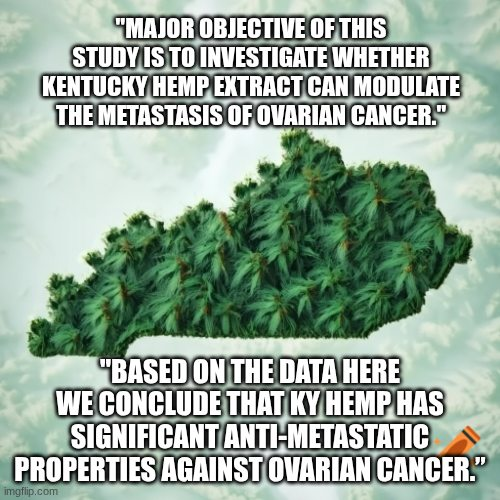
KY Hemp-induced Modulation of Ovarian Cancer Cell Metastasis

“Our laboratory is interested in searching for a new plant-based therapeutics to treat ovarian cancer.

We are interested in studying anti-cancer effects of KY grown hemp as a potential candidate drug.

Marijuana and hemp belong to the same genus and species. However, they are different in cannabidiol (CBD) and tetrahydrocannabinol (THC) content.

Both CBD and THC are therapeutically beneficial. Hemp is harmless and non-addictive.

Major objective of this study is to investigate whether KY hemp extract can modulate the metastasis of ovarian cancer.

Based on the data here we conclude that KY hemp has significant anti-metastatic properties against ovarian cancer.”

https://faseb.onlinelibrary.wiley.com/doi/abs/10.1096/fasebj.2018.32.1_supplement.667.7

Use and caregiver-reported efficacy of medical cannabis in children and adolescents in Switzerland

SpringerLink“Evidence on the use and efficacy of medical cannabis for children is limited. We examined clinical and epidemiological characteristics of medical cannabis treatment and caregiver-reported effects in children and adolescents in Switzerland.

We collected clinical data from children and adolescents (< 18 years) who received Δ9-tetrahydrocannabinol (THC), cannabidiol (CBD), or a combination of the two between 2008 and 2019 in Switzerland. Out of 205 contacted families, 90 agreed to participate. The median age at the first prescription was 11.5 years (interquartile range (IQR) 6-16), and 32 patients were female (36%). Fifty-one (57%) patients received CBD only and 39 (43%) THC. Patients were more likely to receive THC therapy if one of the following symptoms or signs were present: spasticity, pain, lack of weight gain, vomiting, or nausea, whereas seizures were the dominant indication for CBD therapy.

Improvements were reported in 59 (66%) study participants.

The largest treatment effects were reported for pain, spasticity, and frequency of seizures in participants treated with THC, and for those treated with pure CBD, the frequency of seizures. However, 43% of caregivers reported treatment interruptions, mainly because of lack of improvement (56%), side effects (46%), the need for a gastric tube (44%), and cost considerations (23%).

Conclusions: The effects of medical cannabis in children and adolescents with chronic conditions are unknown except for rare seizure disorders, but the caregiver-reported data analysed here may justify trials of medical cannabis with standardized concentrations of THC or CBD to assess its efficacy in the young.

What is Known: • The use of medical cannabis (THC and CBD) to treat a variety of diseases among children and adolescents is increasing. • In contrast to adults, there is no evidence to support the use of medical cannabis to treat chronic pain and spasticity in children, but substantial evidence to support the use of CBD in children with rare seizure disorders.

What is New: • This study provides important insights into prescription practices, dosages, and treatment outcomes in children and adolescents using medical cannabis data from a real-life setting.

• The effects of medical cannabis in children and adolescents with chronic conditions shown in our study support trials of medical cannabis for chronic conditions.”

https://pubmed.ncbi.nlm.nih.gov/34309706/

“For two thirds of participants treated with standardized THC or CBD preparations, the caregiver reported an improvement in their condition and well-being. Medical cannabis could be a promising and useful therapy for children and adolescents with neurological conditions.”

https://link.springer.com/article/10.1007%2Fs00431-021-04202-z

Tetrahydrocannabinol and cannabidiol as an oromucosal spray in a 1:1 ratio: a therapeutic option for patients with central post-stroke pain syndrome?

BMJ Journals - Northern Devon Healthcare NHS Trust“Central pain after stroke due to brainstem infarction is very rare. Treatment is difficult and specific guidelines are lacking. This is the report of a 61-year-old female patient who, after a posterolateral left medulla oblongata insult with incomplete Wallenberg syndrome, subsequently developed a burning and tingling pain in the contralateral leg and a burning and shooting pain in the ipsilateral face in trigeminal branches 1 and 2. More than 3 years of therapy with amitriptyline, gabapentin, pregabalin and various grade II and III opioids was ineffective or showed intolerable side effects. The administration of tetrahydrocannabinol and cannabidiol as an oromucosal spray in a 1:1 ratio improved the pain situation and quality of life quickly and permanently. The encouraging results in the present case may suggest that treatment with medical cannabis should be considered in similar cases when standard therapies are insufficient.”

https://pubmed.ncbi.nlm.nih.gov/34230048/

https://casereports.bmj.com/content/14/7/e243072

New Insights on Hemp Oil Enriched in Cannabidiol: Decarboxylation, Antioxidant Properties and In Vitro Anticancer Effect

antioxidants-logo“This study aimed to obtain and characterize extracted hemp oil enriched in cannabidiol (CBD) by decarboxylation of cannabidiolic acid (CBDA) and to give new insights into its antioxidant and anticancer effects.

CBD-enriched oil promoted NHDF proliferation at up to 15 µg CBD/mL, while inducing apoptosis and ROS production and modulating antioxidant enzymes’ gene expression in cancer cells, being selective for osteosarcoma cells, and induced apoptosis by p53- and ROS-independent mechanisms.

CBD-enriched hemp oil demonstrated antioxidant properties in oxidative conditions and promoted normal fibroblasts’ proliferation, while inducing apoptosis and ROS production in cancer cells.”

https://pubmed.ncbi.nlm.nih.gov/34067035/

https://www.mdpi.com/2076-3921/10/5/738

Cannabidiol Modulates Mitochondrial Redox and Dynamics in MCF7 Cancer Cells: A Study Using Fluorescence Lifetime Imaging Microscopy of NAD(P)H

Archive of "Frontiers in Molecular Biosciences".“The cannabinoid, cannabidiol (CBD), is part of the plant’s natural defense system that when given to animals has many useful medicinal properties, including activity against cancer cells, modulation of the immune system, and efficacy in epilepsy.

Our results support the use of NAD(P)H autofluorescence as an investigative tool and provide further evidence that CBD can modulate mitochondrial function and morphology in a dose-dependent manner, with clear evidence of it inducing oxidative stress at higher concentrations.

This continues to support emerging data in the literature and may provide further insight into its overall mode of action, not only in cancer, but potentially its function in the plant and why it can act as a medicine.”

https://pubmed.ncbi.nlm.nih.gov/34046425/

“Uncontrolled cell growth, or cancer, is frequently associated with increased aerobic glycolysis (the Warburg effect) and alterations in mitochondrial function.

A plant’s ability to develop tumors could explain why so many secondary plant phenolic compounds appear to have anticancer activity in both plant and animal models; over 3,000 species of plants have anticancer activity in animals, with many modulating mitochondrial function and apoptosis

CBD, along with Δ9-tetrahydrocannabinol (THC), is a major phytocannabinoid and both are well described components of medicines.

A growing number of studies have demonstrated the anticancer properties of CBD, in both in vitro and in vivo models.”

https://www.frontiersin.org/articles/10.3389/fmolb.2021.630107/full

Therapeutic Prospects of Cannabinoids in the Immunomodulation of Prevalent Autoimmune Diseases

View details for Cannabis and Cannabinoid Research cover image“Cannabinoids such as ▵-9-THC and CBD can downregulate the immune response by modulating the endocannabinoid system. This modulation is relevant for the treatment of prevalent autoimmune diseases (ADs), such as multiple sclerosis (MS), systemic lupus erythematosus (SLE), diabetes mellitus type 1 (DMT1), and rheumatoid arthritis (RA). These conditions require new therapeutic options with fewer side effects for the control of the autoimmune response. Objective: to conduct a literature review of preclinical scientific evidence that supports further clinical investigations for the use of cannabinoids (natural or synthetic) as potential immunomodulators of the immune response in ADs. 

Methodology: A systematic search was carried out in different databases using different MeSH terms, such as Cannabis sativa L., cannabinoids, immunomodulation, and ADs. Initially, 677 journal articles were found. After filtering by publication date (from 2000 to 2020 for SLE, DMT1, and RA; and 2010 to 2020 for MS) and removing the duplicate items, 200 articles were selected and analyzed by title and summary associated with the use of cannabinoids as immunomodulatory treatment for those diseases. 

Results: Evidence of the immunomodulatory effect of cannabinoids in the diseases previously mentioned, but SLE that did not meet the search criteria, was summarized from 24 journal articles. CBD was found to be one of the main modulators of the immune response. This molecule decreased the number of Th1 and Th17 proinflammatory cells and the production of the proinflammatory cytokines, interleukin (IL)-1, IL-12, IL-17, interferon (IFN)-γ, and tumor necrosis factor alpha, in mouse models of MS and DMT1. Additionally, new synthetic cannabinoid-like molecules, with agonist or antagonist activity on CB1, CB2, TRPV1, PPAR-α, and PPAR-γ receptors, have shown anti-inflammatory properties in MS, DMT1, and RA. 

Conclusion: Data from experimental animal models of AD showed that natural and synthetic cannabinoids downregulate inflammatory responses mediated by immune cells responsible for AD chronicity and progression. Although synthetic cannabinoid-like molecules were evaluated in just two clinical trials, they corroborated the potential use of cannabinoids to treat some ADs. Notwithstanding, new cannabinoid-based approaches are required to provide alternative treatments to patients affected by the large group of ADs.”

https://pubmed.ncbi.nlm.nih.gov/34030476/

https://www.liebertpub.com/doi/10.1089/can.2020.0183

CBG, CBD, Δ9-THC, CBN, CBGA, CBDA and Δ9-THCA as antioxidant agents and their intervention abilities in antioxidant action

Fitoterapia“Positive effect of some cannabinoids in the treatment and prophylaxis of a wide variety of oxidation-associated diseases and growing popularity of supplements containing cannabinoids, mainly cannabinoid oils (e.g. CBD oil, CBG oil), in the self-medication of humans cause a growing interest in the antioxidant properties of these compounds, especially those not showing psychotropic effects.

Herein, we report the antioxidant activity of cannabigerol (CBG), cannabidiol (CBD), Δ9-tetrahydrocannabinol (Δ9-THC), cannabinol (CBN), cannabigerolic acid (CBGA), cannabinolic acid (CBDA) and Δ9-tetrahydrocannabinolic acid (Δ9-THCA) estimated by spectrophotometric methods: ABTS, DPPH, ORAC, beta-carotene CUPRAC and FRAP.

The presented data prove that all the examined cannabinoids exhibit antioxidant activity manifested in their ability to scavenge free radicals, to prevent the oxidation process and to reduce metal ions. Although the intensity of these activities is not the same for the individual cannabinoids it is comparable for all of them with that of E vitamin.”

https://pubmed.ncbi.nlm.nih.gov/33964342/

“The present paper discusses the antioxidant properties of CBG, CBN, CBDA, CBGA and Δ9-THCA which, beside CBD and Δ9-THC, are also supposed to be bioactive compounds useful in the therapeutic treatment of different diseases. According to the literature, CBD and Δ9-THC exhibit strong antioxidant activity, stronger than vitamins C, A and E.

The presented data prove that all the examined cannabinoids – CBG, CBD, Δ9-THC, CBN, CBGA CBDA and Δ9-THCA – exhibit antioxidant activity manifesting itself in their ability to scavenge free radicals, to protect oxidation process and to reduce metal ions. Although, the intensity of these activities for individual cannabinoids is not the same, it is generally comparable to that of E vitamin.”  https://www.sciencedirect.com/science/article/pii/S0367326X21000903?via%3Dihub