Medicinal and Synthetic Cannabinoids for Pediatric Patients: A Review of Clinical Effectiveness and Guidelines [Internet].

Cover of Medicinal and Synthetic Cannabinoids for Pediatric Patients: A Review of Clinical Effectiveness and Guidelines“Cannabinoids are pharmacologically active agents extracted from the cannabis plant. Cannabidiol and tetrahydrocannabinol (THC) are the most studied cannabinoids and both interact with endocannabinoid receptors in various human tissues. The endocannabinoid system moderates physiological functions, such as neurodevelopment, cognition, and motor control.

The products naturally derived from cannabis include marijuana (dried leaves and flowers, mostly for smoking) and oral cannabinoid extracts with varying concentrations of cannabinoids, including cannabidiol and THC. THC is the main psychoactive constituent and cannabidiol seems to have no psychoactive properties. In addition, there are two synthetical cannabinoids approved by the Food and Drug Administration (FDA) in the United States, dronabinol and nabilone, which are molecules similar to a type of THC (δ-9-THC)1 Nabilone is also approved in Canada. Dronabinol is indicated for chemotherapy-induced nausea and vomiting in children. The use of nabilone in children is not recommended.

In Canada, the minimum age for cannabis consumption varies by provinces and territories, and is either 18 or 19 years. A prescription is required to administer cannabinoids among children. Clinically, cannabis has been used to treat children with epilepsy, cancer palliation and primary treatment, chronic pain, and Parkinson disease.

The adverse events that clinicians need to monitor for include negative psychoactive sequelae and development of tolerance. Psychoactive sequelae may be positive, such as relaxation and euphoria, or negative, such as anxiety and irritability. In 2016, CADTH completed a Summary of Abstracts report on the use of cannabis in children with medical conditions such as attention deficit hyperactivity disorder, autism spectrum disorder, Tourette syndrome, epilepsy, posttraumatic stress disorder, or neurodegenerative diseases, and five non-randomized studies were identified. However, there were no control groups in the five studies included in the report.

It is unclear whether there is new evidence or clinical guidance for the use of medical cannabis in children with mental health conditions, neurodegenerative diseases, or pain disorders, particularly in comparison with other possible therapies for those conditions. There is a need to review the clinical effectiveness of cannabis for pediatric care, as well as clinical guidelines.”

https://www.ncbi.nlm.nih.gov/pubmed/31873990

https://www.ncbi.nlm.nih.gov/books/NBK551866/

Use of cannabidiol in anxiety and anxiety-related disorders.

“Cannabidiol (CBD) has a proposed novel role in the management of anxiety owing to its actions on the endocannabinoid system.

The purpose of this systematic review was to evaluate the current evidence on the safety and efficacy of CBD in anxiety and anxiety-related disorders.

RESULTS:

Eight articles were included in the review: 6 small, randomized controlled trials; 1 case series; and 1 case report. These studies examined the role of CBD in the anxiety response of healthy volunteers; in generalized anxiety disorder; in social anxiety disorder; and in the anxiety component of posttraumatic stress syndrome. No articles that evaluated CBD in panic disorder, specific phobia, separation anxiety, and obsessive-compulsive disorder were identified. In the studies, CBD was administered orally as a capsule or as a sublingual spray and as either monotherapy or adjunctive therapy. Doses varied widely, with studies employing fixed CBD doses ranging from 6 mg to 400 mg per dose. Various anxiety assessment scales were used in the studies to assess efficacy, with CBD demonstrating improved clinical outcomes among the instruments. In general, CBD was well-tolerated and associated with minimal adverse effects, with the most commonly noted adverse effects being fatigue and sedation.

CONCLUSION:

CBD has a promising role as alternative therapy in the management of anxiety disorders. However, more studies with standardized approaches to dosing and clinical outcome measurements are needed to determine the appropriate dosing strategy for CBD and its place in therapy.”

https://www.ncbi.nlm.nih.gov/pubmed/31866386

https://www.japha.org/article/S1544-3191(19)30514-X/fulltext

Endocannabinoid system and adult neurogenesis: a focused review.

Current Opinion in Pharmacology“The endocannabinoid system (eCB) is a ubiquitous lipid signaling system composed of at least two receptors, their endogenous ligands, and the enzymes responsible for their synthesis and degradation. Within the brain, the eCB system is highly expressed in the hippocampus and controls basic biological processes, including neuronal proliferation, migration and differentiation, which are intimately linked with embryonal neurogenesis. Accumulated preclinical evidence has indicated that eCBs play a major role also in regulating adult neurogenesis. Increased cannabinoid receptor activity, either by increased eCB content or by pharmacological blockade of their degradation, produces neurogenic effects alongside rescue of phenotypes in animal models of different psychiatric and neurological disorders. Therefore, in the light of the higher therapeutic potential of adult neurogenesis compared to the embryonic one, here we sought to summarize the most recent evidence pointing towards a neurogenic role for eCBs in the adult brain, both under normal and pathological conditions.”

https://www.ncbi.nlm.nih.gov/pubmed/31864101

“The endocannabinoid system is involved in all aspects of the biology of neural stem cells. Selective CB1 and CB2 agonism produces pro-neurogenic effects in different models of brain insults. Further research is needed to characterize the eCB system as a new druggable target for neurogenesis-related diseases.”

https://www.sciencedirect.com/science/article/pii/S1471489219301122?via%3Dihub

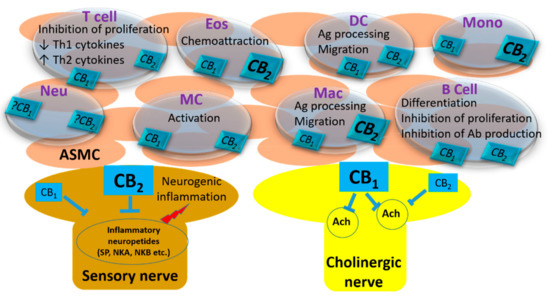
Endocannabinoid System in the Airways.

molecules-logo“Cannabinoids and the mammalian endocannabinoid system is an important research area of interest and attracted many researchers because of their widespread biological effects. The significant immune-modulatory role of cannabinoids has suggested their therapeutic use in several inflammatory conditions. Airways are prone to environmental irritants and stimulants, and increased inflammation is an important process in most of the respiratory diseases. Therefore, the main strategies for treating airway diseases are suppression of inflammation and producing bronchodilation. The ability of cannabinoids to induce bronchodilation and modify inflammation indicates their importance for airway physiology and pathologies. In this review, the contribution of cannabinoids and the endocannabinoid system in the airways are discussed, and the existing data for their therapeutic use in airway diseases are presented.”

https://www.ncbi.nlm.nih.gov/pubmed/31861200

https://www.mdpi.com/1420-3049/24/24/4626

Antidepressant-like effects of β-caryophyllene on restraint plus stress-induced depression.

Behavioural Brain Research“Chronic stress is depressogenic by altering neurotrophic and neuroinflammatory environments of the organism. The endocannabinoid system controls cognitive and emotional responses related with stress through the interaction with endocannabinoid receptors. β-Caryophyllene (BCP) is a CB2 agonist that exhibited anti-inflammatory, analgesic effects but minimal psychoactive effects. To test if BCP exhibits antidepressant-like action, animals were chronically restrained with additional stressors for 28 days, and BCP (25, 50, 100 mg/kg) was intraperitoneally injected once a day during the stress inflicting period. Then despair related behaviors and hippocampal expression of neurotrophic, inflammatory and cannabinoid receptor levels were measured. To test the effect of BCP on long-term depression, field potentials were measured during the application of lipopolysaccharide and low frequency stimulation. In the tail suspension test and forced swim test, chronic stress-induced despair behaviors were reduced by BCP. Also BCP improved the stress-related changes in the hippocampal expression of COX-2, BDNF, and CB2 receptor expression. In organotypic hippocampal slices, BCP reduced the lipopolysaccharide-induced intensification of the long-term depression. In conclusion, BCP improved chronic stress related behavioral and biochemical changes. These results suggest that BCP may be effective in treating depression and stress related mental illnesses.”

https://www.ncbi.nlm.nih.gov/pubmed/31862467

https://linkinghub.elsevier.com/retrieve/pii/S0166432819313348

“β-caryophyllene (BCP) is a common constitute of the essential oils of numerous spice, food plants and major component in Cannabis.”   http://www.ncbi.nlm.nih.gov/pubmed/23138934

“Beta-caryophyllene is a dietary cannabinoid.”    https://www.ncbi.nlm.nih.gov/pubmed/18574142

Stress-induced modulation of endocannabinoid signaling leads to delayed strengthening of synaptic connectivity in the amygdala.

Image result for pnas“Even a brief exposure to severe stress strengthens synaptic connectivity days later in the amygdala, a brain area implicated in the affective symptoms of stress-related psychiatric disorders. However, little is known about the synaptic signaling mechanisms during stress that eventually culminate in its delayed impact on the amygdala. Hence, we investigated early stress-induced changes in amygdalar synaptic signaling in order to prevent its delayed effects.

Whole-cell recordings in basolateral amygdala (BLA) slices from rats revealed higher frequency of miniature excitatory postsynaptic currents (mEPSCs) immediately after 2-h immobilization stress. This was replicated by inhibition of cannabinoid receptors (CB1R), suggesting a role for endocannabinoid (eCB) signaling.

Stress also reduced N-arachidonoylethanolamine (AEA), an endogenous ligand of CB1R. Since stress-induced activation of fatty acid amide hydrolase (FAAH) reduces AEA, we confirmed that oral administration of an FAAH inhibitor during stress prevents the increase in synaptic excitation in the BLA soon after stress.

Although stress also caused an immediate reduction in synaptic inhibition, this was not prevented by FAAH inhibition. Strikingly, FAAH inhibition during the traumatic stressor was also effective 10 d later on the delayed manifestation of synaptic strengthening in BLA neurons, preventing both enhanced mEPSC frequency and increased dendritic spine-density.

Thus, oral administration of an FAAH inhibitor during a brief stress prevents the early synaptic changes that eventually build up to hyperexcitability in the amygdala. This framework is of therapeutic relevance because of growing interest in targeting eCB signaling to prevent the gradual development of emotional symptoms and underlying amygdalar dysfunction triggered by traumatic stress.”

https://www.ncbi.nlm.nih.gov/pubmed/31843894

https://www.pnas.org/content/early/2019/12/13/1910322116

Cannabinoids and the expanded endocannabinoid system in neurological disorders.

 Related image“Anecdotal evidence that cannabis preparations have medical benefits together with the discovery of the psychotropic plant cannabinoid Δ9-tetrahydrocannabinol (THC) initiated efforts to develop cannabinoid-based therapeutics.

These efforts have been marked by disappointment, especially in relation to the unwanted central effects that result from activation of cannabinoid receptor 1 (CB1), which have limited the therapeutic use of drugs that activate or inactivate this receptor.

The discovery of CB2 and of endogenous cannabinoid receptor ligands (endocannabinoids) raised new possibilities for safe targeting of this endocannabinoid system. However, clinical success has been limited, complicated by the discovery of an expanded endocannabinoid system – known as the endocannabinoidome – that includes several mediators that are biochemically related to the endocannabinoids, and their receptors and metabolic enzymes.

The approvals of nabiximols, a mixture of THC and the non-psychotropic cannabinoid cannabidiol, for the treatment of spasticity and neuropathic pain in multiple sclerosis, and of purified botanical cannabidiol for the treatment of otherwise untreatable forms of paediatric epilepsy, have brought the therapeutic use of cannabinoids and endocannabinoids in neurological diseases into the limelight.

In this Review, we provide an overview of the endocannabinoid system and the endocannabinoidome before discussing their involvement in and clinical relevance to a variety of neurological disorders, including Parkinson disease, Alzheimer disease, Huntington disease, multiple sclerosis, amyotrophic lateral sclerosis, traumatic brain injury, stroke, epilepsy and glioblastoma.”

https://www.ncbi.nlm.nih.gov/pubmed/31831863

“The existence of the endocannabinoidome explains in part why some non-euphoric cannabinoids, which affect several endocannabinoidome proteins, are useful for the treatment of neurological disorders, such as multiple sclerosis and epilepsy.”

https://www.nature.com/articles/s41582-019-0284-z

Gastrointestinal Adverse Events of Cannabinoid 1 Receptor Inverse Agonists suggest their Potential Use in Irritable Bowel Syndrome with Constipation: A Systematic Review and Meta-Analysis.

 Image result for J Gastrointestin Liver Dis“Irritable bowel syndrome (IBS) is one of the most common functional gastrointestinal (GI) disorders characterized by pain and impaired bowel movements. Currently available drugs show limited efficacy.

Cannabinoid 1 receptor (CB1) inverse agonists (CB1-RAN) cause diarrhea and may be candidates for the treatment of constipation-predominant IBS (IBS-C). We evaluated the effects of CB1-RAN in clinical trials for their potential use in IBS-C.

METHODS:

Database search identified all clinical trials published up to May 2018 that reported rimonabant and taranabant treatment for at least one month and detailed the GI adverse events (AEs). Categorical outcomes (subgroups of AEs) were analyzed using the odds ratio (OR).

RESULTS:

Eighteen trials met the inclusion criteria. Rimonabant 20 mg produced significantly more overall AEs (OR=1.35, CI: 1.19-1.52, p<0.0001), psychiatric events (OR=1.79, CI: 1.46-2.21, p<0.001) and GI AEs (OR=2.05, CI: 1.65-2.55, p<0.001) compared to placebo. Taranabant at doses ranging from 0.5 to 8 mg produced significantly more overall AEs (OR=1.36, CI: 1.13-1.64, p<0.002), psychiatric AEs (1.82, CI: 1.54-2.16, p<0.001) and GI AEs (OR=1.75, CI: 1.29-2.37, p<0.001) compared to placebo.

CONCLUSIONS:

The approach to target CB1 in the gut for the treatment of IBS-C or chronic constipation seems a promising therapeutic option. Prospective clinical trials on the possible targeting of CB1 and the endocannabinoid system are warranted.”

https://www.ncbi.nlm.nih.gov/pubmed/31826058

https://www.jgld.ro/jgld/index.php/jgld/article/view/265

Missing Pieces to the Endocannabinoid Puzzle.

Image result for trends in molecular medicine“The most bioactive ingredient of cannabis (Cannabis sativa or indica) extracts, Δ9-tetrahydrocannabinol (THC), was identified in the 1960s as one of more than 110 phytocannabinoids. It activates receptors of chemically different endogenous ligands (endocannabinoids) that, unlike THC, are metabolized by several enzymes of the endocannabinoid system. Here, the complexity of the plant-derived and endogenous cannabinoids (eCBs) is discussed, to better appreciate the challenge of: (i) dissecting their mutual interactions; (ii) understanding their impact on human pathophysiology; and (iii) exploiting them for human disease. To this aim, missing pieces to the eCB puzzle must be urgently found, by solving the 3D structures of key components, and interrogating noncanonical modes of regulation and trafficking of these lipid signals.”

https://www.ncbi.nlm.nih.gov/pubmed/31822395

https://www.cell.com/trends/molecular-medicine/fulltext/S1471-4914(19)30293-X?_returnURL=https%3A%2F%2Flinkinghub.elsevier.com%2Fretrieve%2Fpii%2FS147149141930293X%3Fshowall%3Dtrue

Structure-Effect Relationships of Novel Semi-Synthetic Cannabinoid Derivatives.

Image result for frontiers in pharmacology“As a library of cannabinoid (CB) derivatives with (-)-trans–cannabidiol (CBD) or (-)-trans-cannabidivarin (CBDV) scaffold, we synthesized nine novel cannabinoids: 2-hydroxyethyl cannabidiolate (2-HEC), 2-hydroxypentyl cannabidiolate (2-HPC), 2,3-dihydroxypropyl cannabidiolate (GCBD), cyclohexyl cannabidiolate (CHC), n-hexyl-cannabidiolate (HC), 2-(methylsulfonamido)ethyl cannabidiolate (NMSC), 2-hydroxyethyl cannabidivarinolate (2-HECBDV), cyclohexyl cannabidivarinolate (CHCBDV), and n-hexyl cannabidivarinolate (HCBDV). Their binding and intrinsic effects at the CB1- and CB2-receptors and the effects on inflammatory signaling cascades were investigated in in vitro and ex vivo cell models.

Materials and Methods: Binding affinity was studied in membranes isolated from CB-receptor-transfected HEK293EBNA cells, intrinsic functional activity in Chinese hamster ovary (CHO) cells, and activation of nuclear factor κB (NF-κB) and nuclear factor of activated T-cells (NFAT) in phorbol 12-myristate 13-acetate (PMA)/ionomycin (IO)-treated Jurkat T-cells. Inhibition of interleukin (IL)-17-induced pro-inflammatory cytokines and chemokines [IL-6, IL-1β, CC-chemokine ligand 2 (CCL2), and tumor necrosis factor (TNF)-α] was studied in RAW264.7 macrophages at the RNA level. Pro-inflammatory cytokine (IL-1β, IL-6, IL-8, and TNF-α) expression and prostaglandin E2 (PGE2) expression were investigated at the protein level in lipopolysaccharide (LPS)-treated primary human monocytes.

Results: Derivatives with long aliphatic side chains at the ester position at R1 [HC (5)] as well as the ones with polar side chains [2-HECBDV (7), NMSC (6), and 2-HEC (1)] can be selective for CB2-receptors. The CBDV-derivatives HCBDV and CHCBDV demonstrated specific binding at CB1- and CB2-receptors at nanomolar concentrations. 2-HEC, 2-HPC, GCBD, and NMSC were agonists at CB2-receptor and antagonists at CB1-receptor. CHC bound both receptors at submicromolar ranges and was an agonist for these receptors. 2-HECBDV was an agonist at CB2-receptor and an antagonist at the CB1-receptor despite its modest affinity at this receptor (micromolar range). NMSC inhibited NF-κB and NFAT activity, and 2-HEC, 2-HPC, and GCBD dose-dependently inhibited PMA/IO-stimulated NFAT activation. CHC and HC dose-dependently reduced IL-1β and CCL2 messenger RNA (mRNA) expression. NMSC inhibited IL-1β, CCL2, and TNF-α at lower doses. At higher doses, it induced a pronounced increase in IL-6 mRNA. 2-HEC, 2-HPC, and GCBD dose-dependently inhibited LPS-induced IL-1β, TNF-α, and IL-6 synthesis. NMSC further increased LPS-stimulated IL-1β release but inhibited IL-8, TNF-α, and PGE2.

Conclusion: The CBD- and CBDV-derivatives studied are suitable for targeting CB-receptors. Some may be used as selective CB2 agonists. The length of the aliphatic rest at R2 of CBD (pentyl) and CBDV (propyl) did not correlate with the binding affinity. Higher polarity at R1 appeared to favor the agonistic activity at CB2-receptors.”

https://www.ncbi.nlm.nih.gov/pubmed/31824305

https://www.frontiersin.org/articles/10.3389/fphar.2019.01284/full