
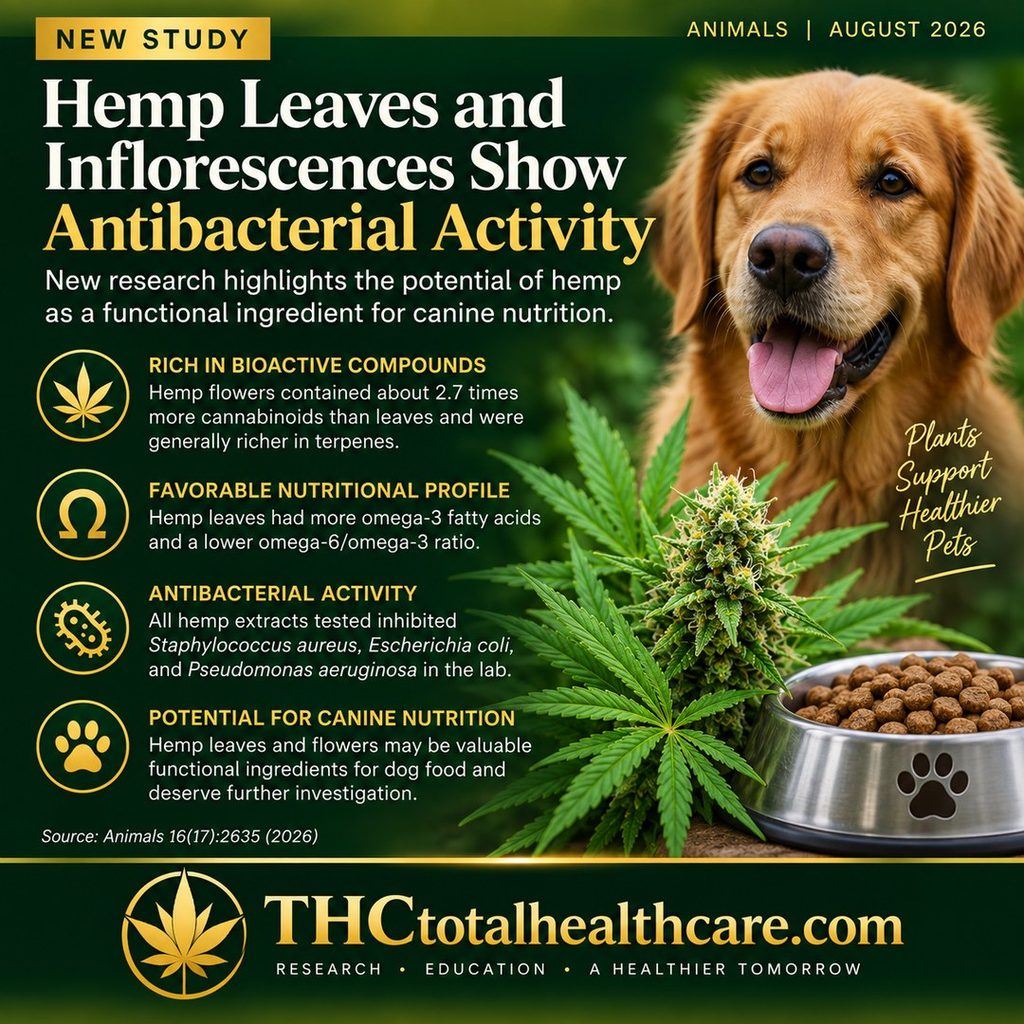
Hemp may have value far beyond its traditional uses. A 2026 study examining hemp leaves and inflorescences found that both plant parts contain bioactive compounds with potential nutritional value, while extracts from the plants also demonstrated antibacterial activity against several important bacterial species.
Researchers found that hemp flowers were especially rich in cannabinoids and terpenes, while the leaves offered a favorable fatty-acid profile. In laboratory testing, hemp extracts showed activity against Staphylococcus aureus, Escherichia coli, and Pseudomonas aeruginosa, highlighting another potential use for compounds naturally produced by the cannabis plant.
The researchers suggest that hemp leaves and flowers deserve further investigation as functional ingredients in canine nutrition. The findings add to growing evidence that parts of the cannabis plant often treated as agricultural byproducts may contain valuable nutritional and biologically active compounds.
“Hemp (Cannabis sativa L.) inflorescences have been extensively characterized for their bioactive compounds, whereas less information is available on hemp leaves despite their potential as a source of nutrients and phytochemicals.
This study compared leaves and inflorescences of four organically grown hemp cultivars (Finola, Futura 75, Dioica, and Kompolti) in terms of cannabinoid, terpene, and fatty acid profiles, lipid quality indices, and in vitro antibacterial activity.
Antibacterial activity against Staphylococcus aureus, Escherichia coli, and Pseudomonas aeruginosa was evaluated using MIC, MBC, and time-kill assays. Total cannabinoid content was approximately 2.7-fold higher in inflorescences than in leaves, which were also generally richer in terpenes. Leaves showed a more favorable fatty acid profile, with higher n-3 polyunsaturated fatty acid proportions and a lower n-6/n-3 ratio.
All extracts exhibited antibacterial activity. Among the tested bacteria, S. aureus was the most susceptible to the hemp extracts, with both growth inhibition and bactericidal activity observed at the lowest tested concentration (MIC/MBC = 0.005%), compared with 0.625% for E. coli and 1.25-2.5% for P. aeruginosa, depending on the extract. Finola and Kompolti inflorescence extracts showed the fastest bactericidal activity against S. aureus.
These findings demonstrate distinct and complementary characteristics of hemp leaves and inflorescences and provide a basis for further investigation of their potential relevance to canine nutrition.”
https://pubmed.ncbi.nlm.nih.gov/42738424
“The pet food industry is increasingly looking for natural ingredients that can improve both the nutritional value and microbiological safety of dog diets while making better use of agricultural resources. Industrial hemp cultivation generates large amounts of leaves that are often underutilized, although they contain valuable natural compounds. This study compared hemp leaves and inflorescences from four industrial hemp cultivars to determine whether these plant materials could be useful in canine nutrition.
The results showed that leaves provide a favorable fatty acid profile, whereas inflorescences are richer in naturally occurring plant compounds such as cannabinoids and terpenes. Extracts from both plant parts also inhibited the growth of bacteria under laboratory conditions. These findings suggest that different hemp plant parts may have complementary roles as functional ingredients in dog foods while supporting more sustainable use of hemp biomass. Further studies in complete diets and feeding trials are needed before practical application.”