MyD88-dependent and -independent signalling via TLR3 and TLR4 are differentially modulated by Δ9-tetrahydrocannabinol and cannabidiol in human macrophages.

Journal of Neuroimmunology“Toll-like receptors (TLRs) are sensors of pathogen-associated molecules that trigger inflammatory signalling in innate immune cells including macrophages. All TLRs, with the exception of TLR3, promote intracellular signalling via recruitment of the myeloid differentiation factor 88 (MyD88) adaptor, while TLR3 signals via Toll-Interleukin-1 Receptor (TIR)-domain-containing adaptor-inducing interferon (IFN)-β (TRIF) adaptor to induce MyD88-independent signalling. Furthermore, TLR4 can activate both MyD88-dependent and -independent signalling (via TRIF).

The study aim was to decipher the impact of the highly purified plant-derived (phyto) cannabinoids Δ9-tetrahydrocannabinol (THC) and cannabidiol (CBD), when delivered in isolation and in combination (1:1), on MyD88-dependent and -independent signalling in macrophages.

TLRs are attractive therapeutic targets given their role in inflammation and initiation of adaptive immunity, and data herein indicate that both CBD and THC preferentially modulate TLR3 and TLR4 signalling via MyD88-independent mechanisms in macrophages. This offers mechanistic insight into the role of phytocannabinoids in modulating cellular inflammation.”

https://www.ncbi.nlm.nih.gov/pubmed/32244040

https://www.jni-journal.com/article/S0165-5728(20)30057-6/pdf

“Cannabinoids have been shown to exert anti-inflammatory activities in various in vivo and in vitro experimental models as well as ameliorate various inflammatory degenerative diseases. Δ9-Tetrahydrocannabinol (THC) is a major constituent of Cannabis. The second major constituent of Cannabis extract is cannabidiol (CBD). Both THC and CBD have been shown to exert anti-inflammatory properties and to modulate the function of immune cells. In summary, our results show that although both THC and CBD exert anti-inflammatory effects, the two compounds engage different, although to some extent overlapping, intracellular pathways. Both THC and CBD decrease the activation of proinflammatory signaling.”  https://www.ncbi.nlm.nih.gov/pmc/articles/PMC2804319/

The anti-inflammatory and analgesic effects of formulated full-spectrum cannabis extract in the treatment of neuropathic pain associated with multiple sclerosis.

 SpringerLink“Cannabis has been used for thousands of years in many cultures for the treatment of several ailments including pain.

The benefits of cannabis are mediated largely by cannabinoids, the most prominent of which are tetrahydrocannabinol (THC) and cannabidiol (CBD). As such, THC and/or CBD have been investigated in clinical studies for the treatment of many conditions including neuropathic pain and acute or chronic inflammation.

While a plethora of studies have examined the biochemical effects of purified THC and/or CBD, only a few have focused on the effects of full-spectrum cannabis plant extract. Accordingly, studies using purified THC or CBD may not accurately reflect the potential health benefits of full-spectrum cannabis extracts.

Indeed, the cannabis plant produces a wide range of cannabinoids, terpenes, flavonoids, and other bioactive molecules which are likely to contribute to the different biological effects. The presence of all these bioactive molecules in cannabis extracts has garnered much attention of late especially with regard to their potential role in the treatment of neuropathic pain associated with multiple sclerosis.:

Herein, the current knowledge about the potential beneficial effects of existing products of full-spectrum cannabis extract in clinical studies involving patients with multiple sclerosis is extensively reviewed. In addition, the possible adverse effects associated with cannabis use is discussed along with how the method of extraction and the delivery mechanisms of different cannabis extracts contribute to the pharmacokinetic and biological effects of full-spectrum cannabis extracts.”

https://www.ncbi.nlm.nih.gov/pubmed/32239248

https://link.springer.com/article/10.1007%2Fs00011-020-01341-1

Terpenoids, Cannabimimetic Ligands, beyond the Cannabis Plant.

molecules-logo “Medicinal use of Cannabis sativa L. has an extensive history and it was essential in the discovery of phytocannabinoids, including the Cannabis major psychoactive compound-Δ9-tetrahydrocannabinol (Δ9-THC)-as well as the G-protein-coupled cannabinoid receptors (CBR), named cannabinoid receptor type-1 (CB1R) and cannabinoid receptor type-2 (CB2R), both part of the now known endocannabinoid system (ECS).

Cannabinoids is a vast term that defines several compounds that have been characterized in three categories: (i) endogenous, (ii) synthetic, and (iii) phytocannabinoids, and are able to modulate the CBR and ECS. Particularly, phytocannabinoids are natural terpenoids or phenolic compounds derived from Cannabis sativa.

However, these terpenoids and phenolic compounds can also be derived from other plants (non-cannabinoids) and still induce cannabinoid-like properties. Cannabimimetic ligands, beyond the Cannabis plant, can act as CBR agonists or antagonists, or ECS enzyme inhibitors, besides being able of playing a role in immune-mediated inflammatory and infectious diseases, neuroinflammatory, neurological, and neurodegenerative diseases, as well as in cancer, and autoimmunity by itself.

In this review, we summarize and critically highlight past, present, and future progress on the understanding of the role of cannabinoid-like molecules, mainly terpenes, as prospective therapeutics for different pathological conditions.”

https://www.ncbi.nlm.nih.gov/pubmed/32235333

https://www.mdpi.com/1420-3049/25/7/1567

Molecular Mechanism and Cannabinoid Pharmacology.

 “Since antiquity, Cannabis has provoked enormous intrigue for its potential medicinal properties as well as for its unique pharmacological effects.
The elucidation of its major cannabinoid constituents, Δ9-tetrahydrocannabinol (THC) and cannabidiol (CBD), led to the synthesis of new cannabinoids (termed synthetic cannabinoids) to understand the mechanisms underlying the pharmacology of Cannabis.

These pharmacological tools were instrumental in the ultimate discovery of the endogenous cannabinoid system, which consists of CB1 and CB2 cannabinoid receptors and endogenously produced ligands (endocannabinoids), which bind and activate both cannabinoid receptors.

CB1 receptors mediate the cannabimimetic effects of THC and are highly expressed on presynaptic neurons in the nervous system, where they modulate neurotransmitter release. In contrast, CB2 receptors are primarily expressed on immune cells.

The endocannabinoids are tightly regulated by biosynthetic and hydrolytic enzymes. Accordingly, the endocannabinoid system plays a modulatory role in many physiological processes, thereby generating many promising therapeutic targets.

An unintended consequence of this research was the emergence of synthetic cannabinoids sold for human consumption to circumvent federal laws banning Cannabis use. Here, we describe research that led to the discovery of the endogenous cannabinoid system and show how knowledge of this system benefitted as well as unintentionally harmed human health.”

https://www.ncbi.nlm.nih.gov/pubmed/32236882

https://link.springer.com/chapter/10.1007%2F164_2019_298

Δ9-Tetrahydrocannabinol (THC) Impairs CD8+ T Cell-Mediated Activation of Astrocytes.

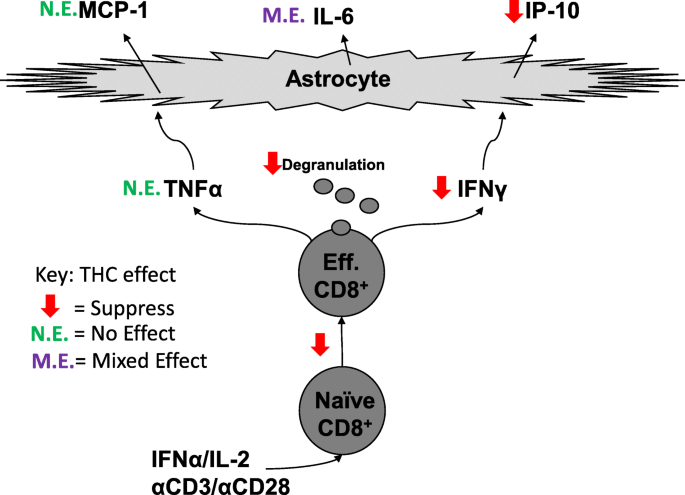
“CD8+ T cells can contribute to neuroinflammation by secretion of inflammatory cytokines like interferon γ (IFNγ) and tumor necrosis factor α (TNFα). Astrocytes, a glial cell in the brain, can be stimulated by IFNγ and TNFα to secrete the inflammatory cytokines, monocyte chemotactic protein 1 (MCP-1), interleukin 6 (IL-6), and interferon-γ inducible protein 10 (IP-10).

Δ9-Tetrahydrocannabinol (THC), the primary psychoactive cannabinoid in Cannabis sativa, possesses potent anti-inflammatory activity.

The objective of this investigation was to assess the effects of THC treatment on CD8+ T cell-mediated activation of astrocytes.

The results suggest that cannabinoid treatment can selectively reduce certain CD8+ T cell responses that contribute to stimulation of astrocytes. Treatment with THC can abate CD8+ T cell-dependent neuroinflammatory processes by inhibiting CD8+ cell differentiation into effector cells, suppressing CD8+ effector cell function, and reducing activation of astrocytes by CD8+ T cell-derived inflammatory cytokines.”

https://www.ncbi.nlm.nih.gov/pubmed/32215844

https://link.springer.com/article/10.1007%2Fs11481-020-09912-z

The endocannabinoid system modulates the ovarian physiology and its activation can improve in vitro oocyte maturation.

Publication cover image“The present study investigated the effect of the lack of CB1 and CB2 receptors in mice ovarian morphology, folliculogenesis, oocyte retrieval, and oocyte maturation and evaluated the use of Δ9-tetrahydrocannabinol (THC) on oocyte in vitro maturation (IVM) by comparing classical IVM and two-step IVM by analyzing the meiotic competence of the oocytes and their evolution toward embryos.

Thus, when CB1 and CB2 receptors were missed, the ovary area and volume was significantly less and the action of the equine chorionic gonadotropin (eCG) hormone was diminished.

In addition, the mutant genotypes had fewer ovarian follicles and they were less competent after eCG administration compared with wild-type mice, and this lack of CB receptors showed a mismatch of oocyte maturation.

However, the in vitro use of THC showed improvements in oocytes IVM after a Pre-IVM step for 48 hr, as those oocytes reached a significantly higher polar body rate, a larger diameter and the best result on blastocysts rate was achieved when THC was used during the IVM step.”

https://www.ncbi.nlm.nih.gov/pubmed/32198753

https://onlinelibrary.wiley.com/doi/abs/10.1002/jcp.29663

“Tetrahydrocannabinol Modulates in Vitro Maturation of Oocytes and Improves the Blastocyst Rates after in Vitro Fertilization. Our data suggest that THC may be useful IVM supplements in clinic as is more feasible and reliable than any synthetic cannabinoid.” https://www.ncbi.nlm.nih.gov/pubmed/31436397

Cannabinoids, Blood-Brain Barrier, and Brain Disposition.

Image result for pharmaceutics“Potential therapeutic actions of the cannabinoids delta-9-tetrahydrocannabinol (THC) and cannabidiol (CBD) are based on their activity as analgesics, anti-emetics, anti-inflammatory agents, anti-seizure compounds.

THC and CBD lipophilicity and their neurological actions makes them candidates as new medicinal approaches to treat central nervous system (CNS) diseases. However, they show differences about penetrability and disposition in the brain.

The present article is an overview about THC and CBD crossing the blood-brain barrier (BBB) and their brain disposition. Several findings indicate that CBD can modify the deleterious effects on BBB caused by inflammatory cytokines and may play a pivotal role in ameliorating BBB dysfunction consequent to ischemia. Thus supporting the therapeutic potential of CBD for the treatment of ischemic and inflammatory diseases of CNS.

Cannabinoids positive effects on cognitive function could be also considered through the aspect of protection of BBB cerebrovascular structure and function, indicating that they may purchase substantial benefits through the protection of BBB integrity. Delivery of these cannabinoids in the brain following different routes of administration (subcutaneous, oral, and pulmonary) is illustrated and commented. Finally, the potential role of cannabinoids in drug-resistance in the clinical management of neurological or psychiatric diseases such as epilepsy and schizophrenia is discussed on the light of their crossing the BBB.”

https://www.ncbi.nlm.nih.gov/pubmed/32183416


Matched pilot study examining cannabis-based dronabinol for acute pain following traumatic injury.

BMJ Journals“To determine whether adjunctive dronabinol, a licensed form of delta-9-tetrahydrocannabinol, reduces opioid consumption when used off-label for managing acute pain following traumatic injury.

CONCLUSIONS:

The results of this study suggest adjunctive dronabinol reduces opioid consumption following traumatic injury.

The opioid-sparing effect of dronabinol may be greater in patients who are marijuana users.”

https://www.ncbi.nlm.nih.gov/pubmed/32154376

https://tsaco.bmj.com/content/5/1/e000391

Cannabinoid modulation of corticolimbic activation to threat in trauma-exposed adults: a preliminary study.

 SpringerLink“Excessive fear and anxiety, coupled with corticolimbic dysfunction, are core features of stress- and trauma-related psychopathology, such as posttraumatic stress disorder (PTSD).

Interestingly, low doses of ∆9-tetrahydrocannabinol (THC) can produce anxiolytic effects, reduce threat-related amygdala activation, and enhance functional coupling between the amygdala and medial prefrontal cortex and adjacent rostral cingulate cortex (mPFC/rACC) during threat processing in healthy adults.

Together, these findings suggest the cannabinoid system as a potential pharmacological target in the treatment of excess fear and anxiety. However, the effects of THC on corticolimbic functioning in response to threat have not be investigated in adults with trauma-related psychopathology.

OBJECTIVE:

To address this gap, the present study tests the effects of an acute low dose of THC on corticolimbic responses to threat in three groups of adults: (1) non-trauma-exposed healthy controls (HC; n = 25), (2) trauma-exposed adults without PTSD (TEC; n = 27), and (3) trauma-exposed adults with PTSD (n = 19).

METHODS:

Using a randomized, double-blind, placebo-controlled, between-subjects design, 71 participants were randomly assigned to receive either THC or placebo (PBO) and subsequently completed a well-established threat processing paradigm during functional magnetic resonance imaging.

RESULTS:

In adults with PTSD, THC lowered threat-related amygdala reactivity, increased mPFC activation during threat, and increased mPFC-amygdala functional coupling.

CONCLUSIONS:

These preliminary data suggest that THC modulates threat-related processing in trauma-exposed individuals with PTSD, which may prove advantageous as a pharmacological approach to treating stress- and trauma-related psychopathology.”

https://www.ncbi.nlm.nih.gov/pubmed/32162103

https://link.springer.com/article/10.1007%2Fs00213-020-05499-8

Antinociceptive and Immune Effects of Delta-9-tetrahydrocannabinol or Cannabidiol in Male Versus Female Rats with Persistent Inflammatory Pain.

Journal of Pharmacology and Experimental Therapeutics: 373 (1)

“Chronic pain is the most common reason reported for using medical cannabis.

The goal of this research was to determine if the two primary phytocannabinoids, THC and CBD, are effective treatments for persistent inflammatory pain.

These results suggest that THC may be more beneficial than CBD for reducing inflammatory pain, in that THC maintains its efficacy with short-term treatment in both sexes, and does not induce immune activation.

SIGNIFICANCE STATEMENT: CBDs and THCs pain-relieving effects are examined in male and female rats with persistent inflammatory pain to determine if individual phytocannabinoids could be a viable treatment for men and women with chronic inflammatory pain. Additionally, sex differences in the immune response to an adjuvant and to THC and CBD are characterized to provided preliminary insight into immune-related effects of cannabinoid-based therapy for pain.”

https://www.ncbi.nlm.nih.gov/pubmed/32179573

http://jpet.aspetjournals.org/content/early/2020/03/16/jpet.119.263319