“Sepsis is a major healthcare problem and current estimates suggest that the incidence of sepsis is approximately 750,000 annually. Sepsis is caused by an inability of the immune system to eliminate invading pathogens.
Here we examined the role of CB(2) receptors in regulating the host’s response to sepsis…
Taken together, our results establish for the first time that CB(2) receptors are important contributors to septic immune dysfunction and mortality, indicating that CB(2) receptors may be therapeutically targeted for the benefit of patients suffering from sepsis.”
“The data supports the involvement of the CB1R signaling in leukocyte activation during sepsis. Drugs targeting the CB1R may have therapeutic potential in systemic inflammation, such as sepsis.”
“Cannabinoid receptor 1 inhibition causes seizures during anesthesia induction in experimental sepsis… The data suggest that CB1R inhibition in combination with pentobarbital may increase the incidence of anesthetic-induced seizures in the case of sepsis.”
“The aim of this study was to investigate the effects of CB2R manipulation on leukocyte activation within the intestinal microcirculation in two acute experimental sepsis models…
CB2R activation reduces leukocyte activation and systemic release of inflammatory mediators in acute experimental sepsis. Drugs targeting the CB2R pathway may have therapeutic potential in sepsis.”
“The sepsis syndrome represents an improper immune response to pathogens and is associated with an unacceptably high rate of mortality. Although supportive care is of benefit to the septic patient, there are no viable therapeutics available that target the immune system suitable for the whole septic population. Recently, using a physiologically relevant murine mouse model, the cannabiniod 2 receptor has been shown to play a critical role in the host response to sepsis. Here, the structure, expression, signaling, and function of the CB2 receptor on leukocytes will be reviewed. Further, the effects mediated by the CB2 receptor during sepsis will be reviewed. Altogether, alterations in inflammation and the host response during sepsis by the CB2 receptor support its use as a possible therapeutic agent.”
“Cannabis sativa L. has been utilized for treatment of pain and sleep disorders since ancient times.
This review examines modern studies on effects of Delta9-tetrahydrocannabinol (THC) and cannabidiol (CBD) on sleep. It goes on to report new information on the effects on sleep in the context of medical treatment of neuropathic pain and symptoms of multiple sclerosis, employing standardized oromucosal cannabis-based medicines containing primarily THC, CBD, or a 1 : 1 combination of the two (Sativex).
Sleep-laboratory results indicate a mild activating effect of CBD, and slight residual sedation with THC-predominant extracts. Experience to date with Sativex in numerous Phase I-III studies in 2000 subjects with 1000 patient years of exposure demonstrate marked improvement in subjective sleep parameters in patients with a wide variety of pain conditions including multiple sclerosis, peripheral neuropathic pain, intractable cancer pain, and rheumatoid arthritis, with an acceptable adverse event profile.
No tolerance to the benefit of Sativex on pain or sleep, nor need for dosage increases have been noted in safety extension studies of up to four years, wherein 40-50% of subjects attained good or very good sleep quality, a key source of disability in chronic pain syndromes that may contribute to patients’ quality of life.”
“Clinical research regarding the therapeutic benefits of cannabis (“marijuana”) has been almost non-existent in the United States since cannabis was given Schedule I status in the Controlled Substances Act of 1970.
In order to discover the benefits and adverse effects perceived by medical cannabis patients, especially with regards to chronic pain, we hand-delivered surveys to one hundred consecutive patients who were returning for yearly re-certification for medical cannabis use in Hawai’i. The response rate was 94%. Mean and median ages were 49.3 and 51 years respectively. Ninety-seven per cent of respondents used cannabis primarily for chronic pain. Average pain improvement on a 0-10 pain scale was 5.0 (from 7.8 to 2.8), which translates to a 64% relative decrease in average pain. Half of all respondents also noted relief from stress/anxiety, and nearly half (45%) reported relief from insomnia. Most patients (71%) reported no adverse effects, while 6% reported a cough or throat irritation and 5% feared arrest even though medical cannabis is legal in Hawai’i.
No serious adverse effects were reported.
These results suggest that Cannabis is an extremely safe and effective medication for many chronic pain patients. Cannabis appears to alleviate pain, insomnia, and may be helpful in relieving anxiety.
Cannabis has shown extreme promise in the treatment of numerous medical problems and deserves to be released from the current Schedule I federal prohibition against research and prescription.”
“The aims of this study are to assess the therapeutic satisfaction within a group of patients using prescribed pharmaceutical-grade cannabis and to compare the subjective effects among the available strains with special focus on their delta-9-tetrahydrocannabinol and cannabidiol content…
One hundred two patients were included; their average age was 53 years and 76% used it for more than a year preceding this study. Chronic pain (53%; n = 54) was the most common medical indication for using cannabis followed by multiple sclerosis (23%; n = 23), and 86% (n = 88) of patients (almost) always experienced therapeutic satisfaction when using pharmaceutical cannabis.
These results show that patients report therapeutic satisfaction with pharmaceutical cannabis, mainly pain alleviation. Some subjective effects were found to differ among the available strains of cannabis, which is discussed in relation to their different tetrahydrocannabinol/cannabidiol content. These results may aid in further research and critical appraisal for medicinally prescribed cannabis products.”
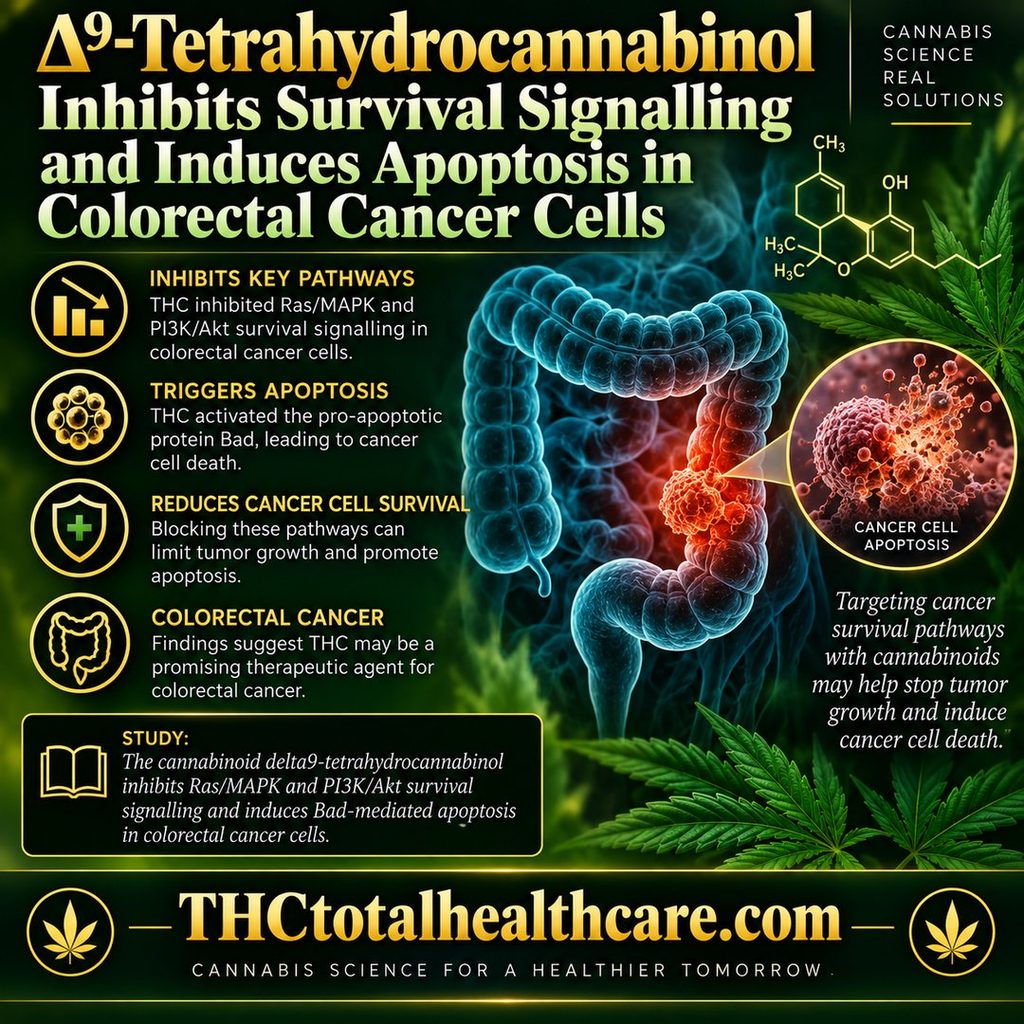
“Deregulation of cell survival pathways and resistance to apoptosis are widely accepted to be fundamental aspects of tumorigenesis.
As in many tumours, the aberrant growth and survival of colorectal tumour cells is dependent upon a small number of highly activated signalling pathways, the inhibition of which elicits potent growth inhibitory or apoptotic responses in tumour cells. Accordingly, there is considerable interest in therapeutics that can modulate survival signalling pathways and target cancer cells for death.
There is emerging evidence that cannabinoids, especially Delta(9)-tetrahydrocannabinol (THC), may represent novel anticancer agents, due to their ability to regulate signalling pathways critical for cell growth and survival.
Here, we report that CB1 and CB2 cannabinoid receptors are expressed in human colorectal adenoma and carcinoma cells, and show for the first time that THC induces apoptosis in colorectal cancer cells.
THC-induced apoptosis was rescued by pharmacological blockade of the CB1, but not CB2, cannabinoid receptor. Importantly, THC treatment resulted in CB1-mediated inhibition of both RAS-MAPK/ERK and PI3K-AKT survival signalling cascades; two key cell survival pathways frequently deregulated in colorectal tumours. The inhibition of ERK and AKT activity by THC was accompanied by activation of the proapoptotic BCL-2 family member BAD. Reduction of BAD protein expression by RNA interference rescued colorectal cancer cells from THC-induced apoptosis.
These data suggest an important role for CB1 receptors and BAD in the regulation of apoptosis in colorectal cancer cells.
The use of THC, or selective targeting of the CB1 receptor, may represent a novel strategy for colorectal cancer therapy.”
“The aim of this study was to assess the effect of select cannabinoids on human immunodeficiency virus type 1 (HIV-1) transactivating (Tat) protein-enhanced monocyte-like cell adhesion to proteins of the extracellular matrix (ECM)…
KEY FINDINGS:
THC and CP55,940 inhibited Tat-enhanced attachment of U937 cells to ECM proteins in a mode that was linked to the cannabinoidreceptor type 2 (CB2R). The cannabinoid treatment of Tat-activated U937 cells was associated with altered β1-integrin expression and distribution of polymerized actin, suggesting a modality by which these cannabinoids inhibited adhesion to the ECM.
SIGNIFICANCE:
The blood-brain barrier (BBB) is a complex structure that is composed of cellular elements and an extracellular matrix (ECM). HIV-1 Tat promotes transmigration of monocytes across this barrier, a process that includes interaction with ECM proteins.
The results indicate that cannabinoids that activate the CB2R inhibit the ECM adhesion process. Thus, this receptor has potential to serve as a therapeutic agent for ablating neuroinflammation associated with HIV-elicited influx of monocytes across the BBB.”