
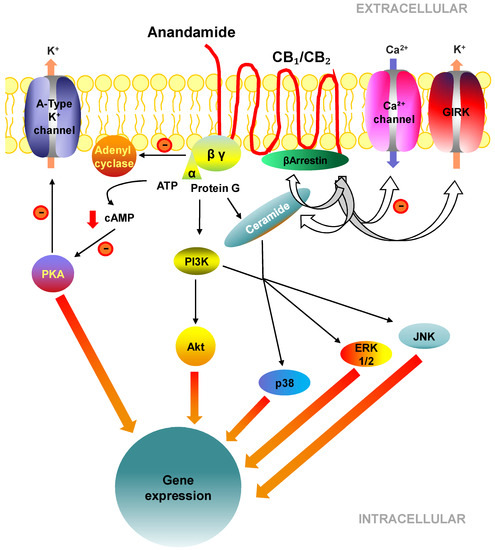
 “Hepatic fibrosis is the consequence of an unresolved wound healing process in response to chronic liver injury and involves multiple cell types and molecular mechanisms. The hepatic endocannabinoid and apelin systems are two signalling pathways with a substantial role in the liver fibrosis pathophysiology-both are upregulated in patients with advanced liver disease. Endogenous cannabinoids are lipid-signalling molecules derived from arachidonic acid involved in the pathogenesis of cardiovascular dysfunction, portal hypertension, liver fibrosis, and other processes associated with hepatic disease through their interactions with the CB1 and CB2 receptors. Apelin is a peptide that participates in cardiovascular and renal functions, inflammation, angiogenesis, and hepatic fibrosis through its interaction with the APJ receptor. The endocannabinoid and apelin systems are two of the multiple cell-signalling pathways involved in the transformation of quiescent hepatic stellate cells into myofibroblast like cells, the main matrix-producing cells in liver fibrosis. The mechanisms underlying the control of hepatic stellate cell activity are coincident despite the marked dissimilarities between the endocannabinoid and apelin signalling pathways. This review discusses the current understanding of the molecular and cellular mechanisms by which the hepatic endocannabinoid and apelin systems play a significant role in the pathophysiology of liver fibrosis.”
A role for cannabinoids in the treatment of myotonia? Report of compassionate use in a small cohort of patients.
 “The symptomatic treatment of myotonia and myalgia in patients with dystrophic and non-dystrophic myotonias is often not satisfactory.
Some patients anecdotally report symptoms’ relief through consumption of cannabis.
METHODS:
A combination of cannabidiol and tetrahydrocannabinol (CBD/THC) was prescribed as compassionate use to six patients (four patients with myotonic dystrophy types 1 and 2, and 2 patients with CLCN1-myotonia) with therapy-resistant myotonia and myalgia. CBD/THC oil was administered on a low dose in the first 2 weeks and adjusted to a higher dose in the following 2 weeks. Myotonia behaviour scale (MBS), hand-opening time, visual analogue scales (VAS) for myalgia and myotonia, and fatigue and daytime sleepiness severity scale (FSS, ESS) were performed weekly to monitor treatment response.
RESULTS:
All patients reported an improvement of myotonia especially in weeks 3 and 4 of treatment: MBS improved of at least 2 points in all patients, the hand-opening time variously improved in 5 out of 6 patients. Chronic myalgia was reported by both DM2 patients at baseline, one of them experienced a significant improvement of myalgia under treatment. Some gastrointestinal complaints, as abdominal pain and diarrhoea, improved in 3 patients; however, 4 out of 6 patients reported new-onset constipation. No other relevant side effect was noticed.
CONCLUSIONS:
These first empirical results suggest a potentially beneficial role of CBD/THC in alleviating myotonia and should encourage further research in this field including a randomized-controlled trial on larger cohorts.”
https://www.ncbi.nlm.nih.gov/pubmed/31655890
https://link.springer.com/article/10.1007%2Fs00415-019-09593-6
“Myotonia is a medical term that refers to a neuromuscular condition in which the relaxation of a muscle is impaired.” https://www.ninds.nih.gov/Disorders/All-Disorders/Myotonia-Information-Page
Medical Marijuana Guidelines for Practice: Health Policy Implications.
 “Cannabis use in pediatric health care remains limited, however, there is increasing evidence on the pharmacologic benefits of medical marijuana for chronic conditions in childhood. Realizing the need for guidance in practice, the National Council of State Boards of Nursing (NCSBN) published guidelines to aid in decision making in nursing practice. While focusing primarily on adult use of cannabis, the guidelines do address special populations such as children and adolescents. This article reviews the endocannabinoid system, current state of legislation on medical marijuana, policy considerations, recent FDA approval of a cannabis product for pediatric use, NCSBN National Nursing Guidelines for Medical Marijuana, and pediatric implications for nursing practice.”
https://www.ncbi.nlm.nih.gov/pubmed/31655786
https://www.jpedhc.org/article/S0891-5245(19)30399-2/fulltext
Effects of Cannabis and Its Components on the Retina: A Systematic Review.
 “Cannabis is the most prevalent drug in the world and its consumption is growing. Cannabinoid receptors are present in the human central nervous system. Recent studies show evidence of the effects of cannabinoids on the retina, and synthesizing the results of these studies may be relevant for ophthalmologists. Thus, this review adopts standardized, systematic review methodology to investigate the effects of exposure to cannabis and components on the retina.
RESULTS:
We retrieved 495 studies, screened 229 studies, assessed 52 studies for eligibility, and included 16 studies for qualitative analysis. The cannabinoids most frequently investigated were delta-9-tetrahydrocannabinol (THC), abnormal cannabidiol, synthetic cannabinoid, and cannabidiol (CDB). The outcomes most studied were neuroretinal dysfunction, followed by vascular effects. The studies also included investigation of neuroprotective and anti-inflammatory effects and teratogenic effects.
CONCLUSIONS:
This review suggests that cannabinoids may have an important role in retinal processing and function.”
https://www.ncbi.nlm.nih.gov/pubmed/31648567
https://www.tandfonline.com/doi/abs/10.1080/15569527.2019.1685534?journalCode=icot20
Medical Cannabis for the Primary Care Physician.
 “Medical cannabis use is common in the United States and increasingly more socially acceptable. As more patients seek out and acquire medical cannabis, primary care physicians will be faced with a growing number of patients seeking information on the indications, efficacy, and safety of medical cannabis. We present a case of a patient with several chronic health conditions who asks her primary care provider whether she should try medical cannabis. We provide a review of the pharmacology of medical cannabis, the state of evidence regarding the efficacy of medical cannabis, variations in the types of medical cannabis, and safety monitoring considerations for the primary care physician.”
Cannabinoids in the treatment of rheumatic diseases: Pros and cons.
 “Medical cannabis is being increasingly used in the treatment of rheumatic diseases because, despite the paucity of evidence regarding its safety and efficacy, a growing number of countries are legalising its use for medical purposes in response to social pressure.
Cannabinoids may be useful in the management of rheumatic disorders for two broad reasons: their anti-inflammatory and immunomodulatory activity, and their effects on pain and associated symptoms.
It is interesting to note that, although a wide range of medications are available for the treatment of inflammation, including an ever-lengthening list of biological medications, the same is not true of the treatment of chronic pain, a cardinal symptom of many rheumatological disorders.
The publication of systematic reviews (SR) concerning the use of cannabis-based medicines for chronic pain (with and without meta-analyses) is outpacing that of randomised controlled trials. Furthermore, narrative reviews of public institution are largely based on these SRs, which often reach different conclusions regarding the efficacy and safety of cannabis-based medicines because of the lack of high-quality evidence of efficacy and the presence of indications that they may be harmful for patients.
Societal safety concerns about medical cannabis (e.g. driving risks, workplace safety and pediatric intoxication) must always be borne in mind, and will probably not be addressed by clinical studies. Medical cannabis and cannabis-based medicines have often been legalised as therapeutic products by legislative bodies without going through the usual process of regulatory approval founded on the results of traditional evidence-based studies. This review discusses the advantages and limitations of using cannabis to treat rheumatic conditions.”
https://www.ncbi.nlm.nih.gov/pubmed/31648042
https://www.sciencedirect.com/science/article/abs/pii/S1568997219302162?via%3Dihub
A time-dependent contribution of hippocampal CB1, CB2, and PPARγ receptors to cannabidiol-induced disruption of fear memory consolidation.
 “Preclinical studies have shown that cannabidiol (CBD) mitigates fear memories by facilitating their extinction or interfering with their generalization and reconsolidation. The brain regions and mechanisms underlying these effects, and their temporal window, are still poorly understood. The present paper aimed at investigating related questions in the dorsal hippocampus (DH) during contextual fear consolidation.
KEY RESULTS:
CBD impaired memory consolidation when given immediately or 1 h after fear conditioning, but not after 3 h. The DH Arc expression was reduced by systemic CBD treatment in both cases. Immediately after fear conditioning, the CBD effect was abolished by CB1 or CB2 receptor blockade, partly reduced by 5-HT1A or A2A antagonism, and remained unchanged after antagonism of PPARγ receptors. 1 h after fear conditioning, the CBD effect was only prevented by PPARγ receptor antagonism. Besides, the FAAH inhibition impaired memory consolidation when URB597 was infused immediately, but not 1 hour after fear conditioning.
CONCLUSIONS AND IMPLICATIONS:
CBD disrupts memory consolidation up to 1 h after fear conditioning, allowing an extended window of opportunity to mitigate aversive memories after their acquisition. The results suggest time-dependent participation of DH anandamide, CB1, CB2, and PPARγ receptors in this process.”
https://www.ncbi.nlm.nih.gov/pubmed/31648363
https://bpspubs.onlinelibrary.wiley.com/doi/abs/10.1111/bph.14895
Cannabidiol prevents LPS-induced microglial inflammation by inhibiting ROS/NF-κB-dependent signaling and glucose consumption.
 “We used mouse microglial cells in culture activated by lipopolysaccharide (LPS, 10 ng/ml) to study the anti-inflammatory potential of cannabidiol (CBD), the major nonpsychoactive component of cannabis.
Under LPS stimulation, CBD (1-10 μM) potently inhibited the release of prototypical proinflammatory cytokines (TNF-α and IL-1β) and that of glutamate, a noncytokine mediator of inflammation. The effects of CBD were predominantly receptor-independent and only marginally blunted by blockade of CB2 receptors.
We established that CBD inhibited a mechanism involving, sequentially, NADPH oxidase-mediated ROS production and NF-κB-dependent signaling events. In line with these observations, active concentrations of CBD demonstrated an intrinsic free-radical scavenging capacity in the cell-free DPPH assay.
Of interest, CBD also prevented the rise in glucose uptake observed in microglial cells challenged with LPS, as did the inhibitor of NADPH oxidase apocynin and the inhibitor of IκB kinase-2, TPCA-1. This indicated that the capacity of CBD to prevent glucose uptake also contributed to its anti-inflammatory activity.
Supporting this view, the glycolytic inhibitor 2-deoxy-d-glucose (2-DG) mimicked the antioxidant/immunosuppressive effects of CBD. Interestingly, CBD and 2-DG, as well as apocynin and TPCA-1 caused a reduction in glucose-derived NADPH, a cofactor required for NADPH oxidase activation and ROS generation.
These different observations suggest that CBD exerts its anti-inflammatory effects towards microglia through an intrinsic antioxidant effect, which is amplified through inhibition of glucose-dependent NADPH synthesis.
These results also further confirm that CBD may have therapeutic utility in conditions where neuroinflammatory processes are prominent.”
Cannabidiol partially blocks the sleepiness in hypocretin-deficient rats. Preliminary data.
 “Excessive daytime sleepiness and cataplexy are among the symptoms of narcolepsy, a sleep disorder caused by the loss of hypocretin/orexin (HCRT/OX) neurons placed into the hypothalamus (LH). Several treatments for managing narcolepsy include diverse drugs to induce alertness, such as antidepressants, amphetamine, or modafinil, etc.
Recent evidence has shown that cannabidiol (CBD), a non-psychotropic derived from Cannabis sativa, shows positive therapeutic effects in neurodegenerative disorders, including Parkinson´s disease. Furthermore, CBD provokes alertness and enhances wake-related neurochemicals in laboratory animals. Thus, it is plausible to hypothesize that excessive somnolence observed in narcolepsy could be blocked by CBD.
Here, we determined whether systemic injection of CBD (5mg/Kg, i.p.) would block the sleepiness in a narcolepsy model.
Hourly analysis of sleep data showed that CBD blocked the sleepiness during the lights-off period across 7h post-injection in lesioned rats.
Taking together, these findings suggest that CBD might prevent sleepiness in narcolepsy.”
Acute and residual effects of smoked cannabis: Impact on driving speed and lateral control, heart rate, and self-reported drug effects
 “Although driving under the influence of cannabis is increasingly common among young adults, little is known about residual effects on driver behavior.
This study examined acute and residual effects of smoked cannabis on simulated driving performance of young cannabis users.
Methods
In this double-blind, placebo-controlled, parallel-group randomized clinical trial, cannabis users (1-4 days/week) aged 19-25 years were randomized with a 2:1 allocation ratio to receive active (12.5% THC) or placebo (0.009% THC) cannabis in a single 750 mg cigarette. A median split (based on whole-blood THC concentrations at the time of driving) was used to divide the active group into low and high THC groups. Our primary outcome was simulated driving performance, assessed 30 minutes and 24 and 48 hours after smoking. Secondary outcomes included blood THC concentrations, subjective drug effects, and heart rate.
Results
Ninety-six participants were randomized, and 91 were included in the final analysis (30 high THC, 31 low THC, 30 placebo). Mean speed (but not lateral control) significantly differed between groups 30 minutes after smoking cannabis (p ≤ 0.02); low and high THC groups decreased their speed compared to placebo. Heart rate, VAS drug effect and drug high increased significantly immediately after smoking cannabis and declined steadily after that. There was little evidence of residual effects in any of the measures.
Conclusion
Acutely, cannabis caused decreased speed, increased heart rate, and increases in VAS drug effect and drug high. There was no evidence of residual effects on these measures over the two days following cannabis administration.
Smoked cannabis (12.5% THC) led to an acute decrease in speed in young adults. There was no clear effect of smoked cannabis on lateral control. There was little evidence of residual effects of smoked cannabis on driving performance.”
https://www.sciencedirect.com/science/article/abs/pii/S0376871619304181