
Chromenopyrazole, a Versatile Cannabinoid Scaffold with in Vivo Activity in a Model of Multiple Sclerosis.

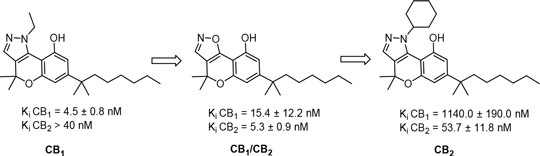
“A combination of molecular modeling and structure-activity relationship studies have been used to fine tune CB2 selectivity in the chromenopyrazole ring, a versatile CB1/CB2 cannabinoid scaffold. Thus, a series of 36 new derivatives covering a wide range of structural diversity have been synthesized and docking studies have been performed for some of them. Biological evaluation of the new compounds includes, among others, cannabinoid binding assays, functional studies and surface plasmon resonance measurements. The most promising compound [43 (PM226)], a selective and potent CB2 agonist isoxazole derivative, was tested in the acute phase of Theiler’s murine encephalomyelitis virus-induced demyelinating disease (TMEV-IDD), a well-established animal model of primary progressive multiple sclerosis. Compound 43 dampened neuroinflammation by reducing microglial activation in the TMEV.”

http://www.ncbi.nlm.nih.gov/pubmed/27309150

“CHROMENOPYRAZOLES: NON-PSYCHOACTIVE AND SELECTIVE CB1CANNABINOID AGONISTS WITH PERIPHERAL ANTINOCICEPTIVE PROPERTIES” http://www.ncbi.nlm.nih.gov/pmc/articles/PMC4049093/

Cannabinoids in the Brain: New Vistas on an Old Dilemma

“The use of cannabis as a therapeutic and recreational substance goes back to thousands of years throughout Asia, Middle East, Southern Africa, and South America.

The discovery of Δ-9-tetrahydrocannabinol (Δ9-THC) by Mechoulam and Gaoni in the midsixties as the major psychoactive constituent of cannabis sativa led to another important discovery, namely, its specific binding site that was isolated and cloned in 1990. This first cannabinoid receptor was coined CB1R and triggered a number of investigations on its expression, localization, and function within the body tissue including the brain, in various species. This was followed by the discovery in 1992 of the first endocannabinoid (eCB), anandamide, followed by another cannabinoid receptor CB2R and a second endocannabinoid called 2-arachidonoylglycerol (2-AG). Later on, some of the enzymes responsible for their synthesis (N-acyl phosphatidylethanolamine phospholipase D (NAPE-PLD); diacylglycerol lipase (DAGL)) and degradation (fatty acid amide hydrolase (FAAH); monoacylglycerol lipase (MAGL)) were identified.

Studies on the expression and localization of the cannabinoid receptors in the brain have burgeoned in the last decade and have furnished valuable data on their putative involvement in various sensory-motor and cognitive functions in diverse animal species, including Man. These studies have recently received substantial attention from pharmaceutical companies as a potential source for novel treatments. Additionally, the dilemma of legalizing the use of cannabis in some countries makes the investigation on cannabinoid systems more momentous. This special issue is therefore timely and brings historical and groundbreaking novel research on the role of these cannabinoid receptors in the mammalian central nervous system (CNS).

We hope that the collected papers in this special issue will contribute to the understanding of the various mechanisms involved in the functions of the endocannabinoid system and the development of new pharmaceutical tools to treat visual disorders.”

http://www.hindawi.com/journals/np/2016/9146713/

Inhibition of autophagy and enhancement of endoplasmic reticulum stress increase sensitivity of osteosarcoma Saos-2 cells to cannabinoid receptor agonist WIN55,212-2.

“WIN55,212-2, a cannabinoid receptor agonist, can activate cannabinoid receptors, which has proven anti-tumour effects in several tumour types. Studies showed that WIN can inhibit tumour cell proliferation and induce apoptosis in diverse cancers.

However, the role and mechanism of WIN in osteosarcoma are still unclear. In this study, we examined the effect of WIN55,212-2 on osteosarcoma cell line Saos-2 in terms of cell viability and apoptosis. Meanwhile, we further explored the role of endoplasmic reticulum stress and autophagy in apoptosis induced by WIN55,212-2.

Our results showed that the cell proliferation of Saos-2 was inhibited by WIN55,212-2 in a dose-dependent and time-dependent manner. WIN55,212-2-induced Saos-2 apoptosis through mitochondrial apoptosis pathway. Meanwhile, WIN55,212-2 can induce endoplasmic reticulum stress and autophagy in Saos-2 cells. Inhibition of autophagy and enhancement of endoplasmic reticulum stress increased apoptosis induced by WIN55,212-2 in Saos-2 cells.

These findings indicated that WIN55,212-2 in combination with autophagic inhibitor or endoplasmic reticulum stress activator may shed new light on osteosarcoma treatment.”

http://www.ncbi.nlm.nih.gov/pubmed/27309350

Autophagy activation by novel inducers prevents BECN2-mediated drug tolerance to cannabinoids.

“Cannabinoids and related drugs generate profound behavioral effects (such as analgesic effects) through activating CNR1 (cannabinoid receptor 1 [brain]). However, repeated cannabinoid administration triggers lysosomal degradation of the receptor and rapid development of drug tolerance, limiting the medical use of marijuana in chronic diseases.

Here we show that a protein involved in macroautophagy/autophagy (a conserved lysosomal degradation pathway), BECN2 (beclin 2), mediates cannabinoid tolerance by preventing CNR1 recycling and resensitization after prolonged agonist exposure, and deletion of Becn2 rescues CNR1 activity in mouse brain and conveys resistance to analgesic tolerance to chronic cannabinoids.

Overall, our findings demonstrate the functional link among autophagy, receptor signaling and animal behavior regulated by psychoactive drugs, and develop a new strategy to prevent tolerance and improve medical efficacy of cannabinoids by modulating the BECN2 interactome and autophagy activity.”

http://www.ncbi.nlm.nih.gov/pubmed/27305347

CB2 Cannabinoid Receptor As Potential Target against Alzheimer’s Disease.

“The CB2 receptor is one of the components of the endogenous cannabinoid system, a complex network of signaling molecules and receptors involved in the homeostatic control of several physiological functions. Accumulated evidence suggests a role for CB2 receptors in Alzheimer’s disease (AD) and indicates their potential as a therapeutic target against this neurodegenerative disease.

Levels of CB2 receptors are significantly increased in post-mortem AD brains, mainly in microglia surrounding senile plaques, and their expression levels correlate with the amounts of Aβ42 and β-amyloid plaque deposition.

Moreover, several studies on animal models of AD have demonstrated that specific CB2 receptor agonists, which are devoid of psychoactive effects, reduce AD-like pathology, resulting in attenuation of the inflammation associated with the disease but also modulating Aβ and tau aberrant processing, among other effects.

CB2 receptor activation also improves cognitive impairment in animal models of AD.

This review discusses available data regarding the role of CB2 receptors in AD and the potential usefulness of specific agonists of these receptors against AD.”

http://www.ncbi.nlm.nih.gov/pubmed/27303261

Indirect modulation of the endocannabinoid system by specific fractions of nutmeg total extract.

“Nutmeg [Myristica fragrans Houtt. (Myristicaceae)] has a long-standing reputation of psychoactivity. Anecdotal reports of nutmeg use as a cheap marijuana substitute, coupled to previous studies reporting a cannabimimetic-like action, suggest that nutmeg may interact with the endocannabinoid system.

The study provides the first piece of evidence that nutmeg interacts with the endocannabinoid system via inhibition of the endocannabinoid catabolizing enzymes. This mechanism provides insight into reported cannabis-like action as well as expands the potential therapeutic utility of nutmeg.”

http://www.ncbi.nlm.nih.gov/pubmed/27296774

Modulation of cannabinoid signaling by hippocampal 5-HT4 serotonergic system in fear conditioning.

“Behavioral studies have suggested a key role for the cannabinoid system in the modulation of conditioned fear memory. Likewise, much of the literature has revealed that the serotonergic system affects Pavlovian fear conditioning and extinction. A high level of functional overlap between the serotonin and cannabinoid systems has also been reported.

To clarify the interaction between the hippocampal serotonin (5-HT4) receptor and the cannabinoid CB1 receptor in the acquisition of fear memory, the effects of 5-HT4 agents, arachidonylcyclopropylamide (ACPA; CB1 receptor agonist), and the combined use of these drugs on fear learning were studied in a fear conditioning task in adult male NMRI mice.

Pre-training intraperitoneal administration of ACPA (0.1 mg/kg) decreased the percentage of freezing time in both context- and tone-dependent fear conditions, suggesting impairment of the acquisition of fear memory. Pre-training, intra-hippocampal (CA1) microinjection of RS67333, a 5-HT4 receptor agonist, at doses of 0.1 and 0.2 or 0.2 µg/mouse impaired contextual and tone fear memory, respectively. A subthreshold dose of RS67333 (0.005 µg/mouse) did not alter the ACPA response in either condition.

Moreover, intra-CA1 microinjection of RS23597 as a 5-HT4 receptor antagonist did not alter context-dependent fear memory acquisition, but it did impair tone-dependent fear memory acquisition. However, a subthreshold dose of the RS23597 (0.01 µg/mouse) potentiated ACPA-induced fear memory impairment in both conditions.

Therefore, we suggest that the blockade of hippocampal 5-HT4 serotonergic system modulates cannabinoid signaling induced by the activation of CB1 receptors in conditioned fear.”

http://www.ncbi.nlm.nih.gov/pubmed/27296273

Cannabidiol Modulates Fear Memory Formation through Interactions with Serotonergic Transmission in the Mesolimbic System.

“Emerging evidence suggests that the largest phytochemical component of cannabis, cannabidiol (CBD), may possess pharmacotherapeutic properties in the treatment of neuropsychiatric disorders.

CBD has been reported to functionally interact with both the mesolimbic dopamine (DA) and serotonergic (5-HT) receptor systems.

Our findings demonstrate a novel NAcVTA circuit responsible for the behavioral and neuronal effects of CBD within the mesolimbic system via functional interactions with serotonergic 5-HT1A receptor signalling.”

http://www.ncbi.nlm.nih.gov/pubmed/27296152

Cannabinoid receptor 2 as anti-obesity target: inflammation, fat storage and browning modulation.

“Obesity is associated with a low-grade inflammatory state, and adipocyte hyperplasia/hypertrophy.

Obesity inhibits the “browning” of white adipose tissue.

Cannabinoid receptor 2 (CB2) agonists reduce food intake and induce anti-obesity effect in mice.

CB2 receptor is a novel pharmacological target that should be considered for obesity.”

http://www.ncbi.nlm.nih.gov/pubmed/27294325

http://www.thctotalhealthcare.com/category/obesity-2/

Treatment of Dravet Syndrome.

“Dravet syndrome is among the most challenging electroclinical syndromes. There is a high likelihood of recurrent status epilepticus; seizures are medically refractory; and patients have multiple co-morbidities, including intellectual disability, behaviour and sleep problems, and crouch gait. Additionally, they are at significant risk of sudden unexplained death.

This review will focus predominantly on the prophylactic medical management of seizures, addressing both first-line therapies (valproate and clobazam) as well as second-line (stiripentol, topiramate, ketogenic diet) or later options (levetiracetam, bromides, vagus nerve stimulation). Sodium channel agents-including carbamazepine, oxcarbazepine, phenytoin and lamotrigine-should be avoided, as they typically exacerbate seizures.

Several agents in development may show promise, specifically fenfluramine and cannabidiol, but they need further evaluation in randomized, controlled trials.

In addition to prophylactic treatment, all patients need home-rescue medication and a status epilepticus protocol that can be carried out in their local hospital. Families must be counselled on non-pharmacologic strategies to reduce seizure risk, including avoidance of triggers that commonly induce seizures (including hyperthermia, flashing lights and patterns).

In addition to addressing seizures, holistic care for a patient with Dravet syndrome must involve a multidisciplinary team that includes specialists in physical, occupational and speech therapy, neuropsychology, social work and physical medicine.”

http://www.ncbi.nlm.nih.gov/pubmed/27264138

http://www.thctotalhealthcare.com/category/dravet-syndome/