
Cannabinoid Receptor as a Novel Target for the Treatment of Prostate Cancer

“Because prostate cancer has become the most common cancer diagnosed in men, developing novel targets and mechanism-based agents for its treatment has become a challenging issue. In recent years cannabinoids, the active components of Cannabis sativa Linnaeus (marijuana) and their derivatives have drawn renewed attention because of their diverse pharmacologic activities such as cell growth inhibition, anti-inflammatory effects, and tumor regression . Cannabinoids have been shown to induce apoptosis in gliomas, PC-12 pheochromocytoma, CHP 100 neuroblastoma, and hippocampal neurons in vitro, and most interestingly, regression of C6-cell gliomas in vivo. Further interest in cannabinoid research came from the discovery of specific cannabinoid systems and the cloning of specific cannabinoid receptors. These diversified effects of cannabinoids are now known to be mediated by the activation of specific G protein-coupled receptors that are normally bound by a family of endogenous ligands, the endocannabinoids. Two different cannabinoid receptors have been characterized and cloned from mammalian tissues: the “central” CB1 receptor, and the “peripheral” CB2 receptor.”

“In the present study, we show for the first time that expression levels of both cannabinoid receptors, CB1 and CB2, are higher in human prostate cancer cells than in normal cells. Importantly, we also show that WIN-55,212-2 (CB1/CB2 agonist) treatment with androgen-responsive LNCaP cells results in a dose- and time-dependent inhibition of cell growth with a concomitant induction of apoptosis, decrease in protein and mRNA expression of androgen receptor and prostate-specific antigen (PSA), decrease in secreted PSA levels, protein expression of proliferating cell nuclear antigen (PCNA), and vascular endothelial growth factor (VEGF). We suggest that cannabinoid receptor agonists may be useful in the treatment of human prostate cancer.”

“…non–habit-forming cannabinoid receptor agonists could be developed as novel therapeutic agents for the treatment of prostate cancer.”

“We conclude that cannabinoids should be considered as agents for the management of prostate cancer.”
.http://cancerres.aacrjournals.org/content/65/5/1635.long

Cannabinoid Receptor Agonist-induced Apoptosis of Human Prostate Cancer Cells LNCaP Proceeds through Sustained Activation of ERK1/2 Leading to G1 Cell Cycle Arrest

“Prostate cancer (CaP)2 ranks as the most common noncutaneous malignancy and the second leading cause of cancer-related deaths in American males, with similar trends in many Western countries…The major cause of mortality from this disease is metastasis of hormone refractory cancer cells that fail to respond to hormone ablation therapy. Because surgery and current treatment options have proven to be inadequate in treating and controlling CaP, the search for novel targets and mechanism-based agents for prevention and treatment of this disease has become a priority.”

“In recent years, cannabinoids the active components of Cannabis sativa linnaeus (marijuana) and their derivatives are drawing renewed attention because of their diverse pharmacological activities such as cell growth inhibition, anti-inflammatory effects, and tumor regression. Further interest in cannabinoid research came from the discovery of the cannabinoid system and the cloning of specific cannabinoid receptors. Two cannabinoid receptors have been identified: the “central” CB1 and the “peripheral” CB2 receptor. In a recent study, we have shown that WIN 55,212-2 a mixed CB1/CB2 receptor agonist imparts cell growth inhibitory effects in LNCaP cells via an induction of apoptosis. An important observation of this study was that WIN 55,212-2 treatment did not result in apoptosis of the normal prostate epithelial cell at similar doses.”

“Cannabinoids and their derivatives are drawing considerable attention in the treatment of cancer because of their diverse activities such as cell growth inhibition, anti-inflammatory effects, and tumor regression. Accumulated evidence indicates that cannabinoid receptor(s) could be an important target for the treatment of cancer. We have earlier shown that WIN-55,212-2 induced apoptosis of prostate cancer LNCaP cells is mediated through CB1 and CB2 receptors and suggested that these receptors could be an important targets for the treatment of prostate cancer…”

“Hence, we conclude that cannabinoid receptor agonist should be considered as an effective agent for the treatment of prostate cancer. If our hypothesis is supported by in vivo experiments, the long term implications of our study could be to develop nonhabit-forming cannabinoid agonist (s) for the management of prostate cancer.”

http://www.jbc.org/content/281/51/39480.long

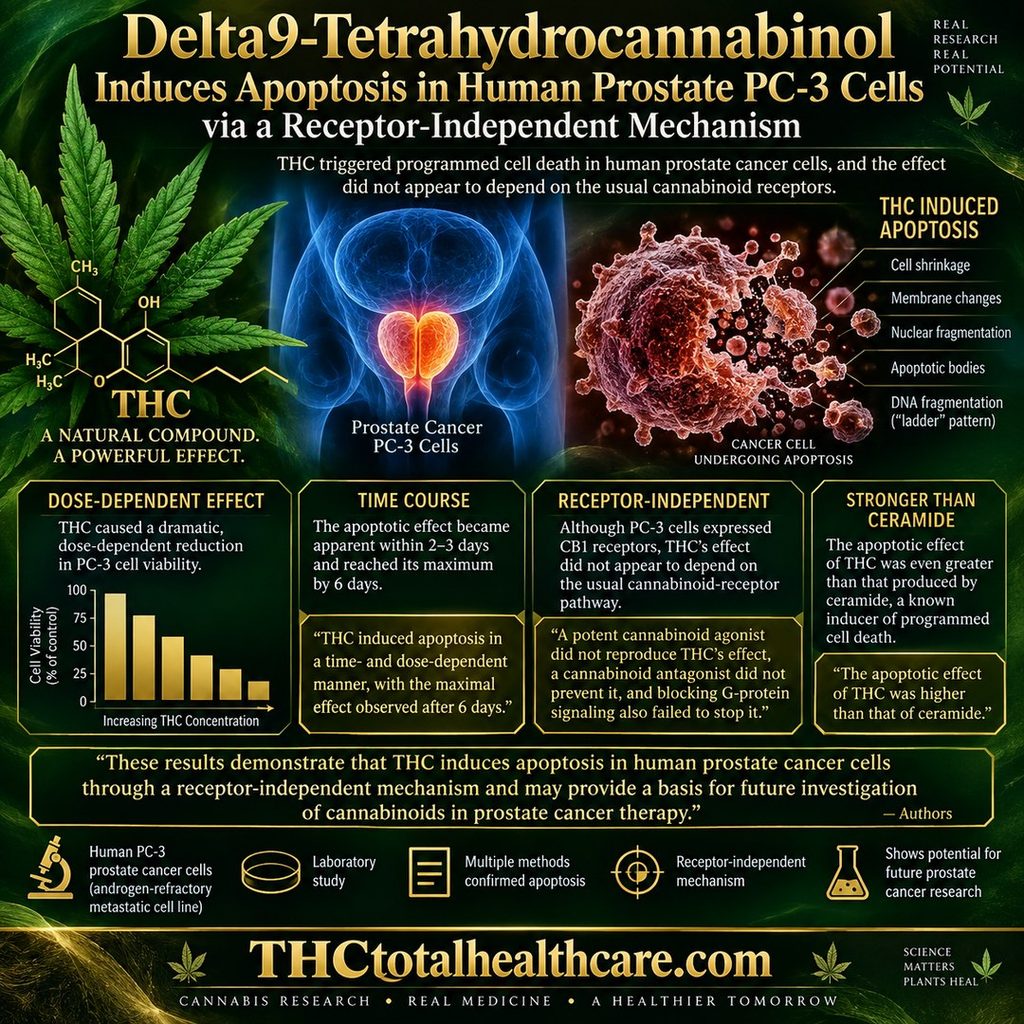
Delta9-tetrahydrocannabinol induces apoptosis in human prostate PC-3 cells via a receptor-independent mechanism.

Researchers investigated how delta-9-tetrahydrocannabinol (THC) affects human PC-3 prostate cancer cells, an androgen-refractory cell line derived from a prostate cancer metastasis to bone. THC caused a dramatic, dose-dependent reduction in cell viability and triggered apoptosis, or programmed cell death. The researchers confirmed apoptosis through several independent signs, including changes in the cell membrane, formation of apoptotic bodies, nuclear fragmentation and the characteristic “ladder” pattern of fragmented DNA.

The effect became apparent within two to three days and reached its maximum by six days. THC also produced a dose-dependent increase in apoptotic cells, and the researchers reported that the apoptotic effect was even greater than that produced by ceramide, which they used as a positive control for programmed cell death.

One of the most unusual findings was that THC’s effect did not appear to depend on the conventional cannabinoid-receptor pathway. Although the PC-3 cells expressed CB1 receptors, a potent cannabinoid agonist did not reproduce THC’s effect, a cannabinoid antagonist did not prevent THC-induced cell death, and blocking G-protein signaling with pertussis toxin also failed to stop it. The authors concluded that THC induced apoptosis through a receptor-independent mechanism and suggested that this effect could provide a basis for future investigation of cannabinoids in prostate cancer therapy.

“The effect of delta9-tetrahydrocannabinol (THC), the major psycho-active component of marijuana, in human prostate cancer cells PC-3 was investigated.

THC caused apoptosis in a dose-dependent manner.

Morphological and biochemical changes induced by THC in prostate PC-3 cells shared the characteristics of an apoptotic phenomenon. First, loss of plasma membrane asymmetry determined by fluorescent anexin V binding. Second, presence of apoptotic bodies and nuclear fragmentation observed by DNA staining with 4′,6-diamino-2-phenylindole (DAPI). Third, presence of typical ‘ladder-patterned’ DNA fragmentation. Central cannabinoid receptor expression was observed in PC-3 cells by immunofluorescence studies. However, several results indicated that the apoptotic effect was cannabinoid receptor-independent, such as lack of an effect of the potent cannabinoid agonist WIN 55,212-2, inability of cannabinoid antagonist AM 251 to prevent cellular death caused by THC and absence of an effect of pertussis toxin pre-treatment.”

https://pubmed.ncbi.nlm.nih.gov/10570948

“Results shown here indicate that the cellular death process induced by THC in prostate tumor cells PC-3 shares the biochemical and morphological changes characteristic of apoptotic cells.”

“Thus, in this study, we have shown that the major active component of marijuana, THC, induced prostate PC-3 cell death by an apoptotic process.

The apoptotic death caused by THC treatment was even higher than that produced by ceramide. In spite of the presence of cannabinoid receptor CB1 in prostate PC-3 cells, THC exerts its action via a non-receptor-mediated pathway. Our results are in concordance with previous studies which demonstrate in other cell types, a cannabinoid induction of apoptosis by a receptor-independent mechanism. Cannabinoids also regulate hematopoietic cell growth independently of receptor. Whatever the precise mechanism underlying the non-receptor-mediated effects of cannabinoids, these molecules regulate fundamental cellular functions like proliferation and cell death.

The apoptotic effect of THC described in this study might provide the basis for future therapeutic application of cannabinoids. Further studies will determinate whether cannabinoids exert other effects in prostate cells.”

https://febs.onlinelibrary.wiley.com/doi/10.1016/S0014-5793%2899%2901073-X

Need this THC study explained? thcXplained.com

Cannabinoids provide neuroprotection against 6-hydroxydopamine toxicity in vivo and in vitro: relevance to Parkinson’s disease.

Abstract

“Cannabinoids have been reported to provide neuroprotection in acute and chronic neurodegeneration. In this study, we examined whether they are also effective against the toxicity caused by 6-hydroxydopamine, both in vivo and in vitro, which may be relevant to Parkinson’s disease (PD). First, we evaluated whether the administration of cannabinoids in vivo reduces the neurodegeneration produced by a unilateral injection of 6-hydroxydopamine into the medial forebrain bundle. As expected, 2 weeks after the application of this toxin, a significant depletion of dopamine contents and a reduction of tyrosine hydroxylase activity in the lesioned striatum were noted, and were accompanied by a reduction in tyrosine hydroxylase-mRNA levels in the substantia nigra. None of these events occurred in the contralateral structures. Daily administration of delta9-tetrahydrocannabinol (delta9-THC) during these 2 weeks produced a significant waning in the magnitude of these reductions, whereas it failed to affect dopaminergic parameters in the contralateral structures. This effect of delta9-THC appeared to be irreversible since interruption of the daily administration of this cannabinoid after the 2-week period did not lead to the re-initiation of the 6-hydroxydopamine-induced neurodegeneration. In addition, the fact that the same neuroprotective effect was also produced by cannabidiol (CBD), another plant-derived cannabinoid with negligible affinity for cannabinoid CB1 receptors, suggests that the antioxidant properties of both compounds, which are cannabinoid receptor-independent, might be involved in these in vivo effects, although an alternative might be that the neuroprotection exerted by both compounds might be due to their anti-inflammatory potential. As a second objective, we examined whether cannabinoids also provide neuroprotection against the in vitro toxicity of 6-hydroxydopamine. We found that the non-selective cannabinoid agonist HU-210 increased cell survival in cultures of mouse cerebellar granule cells exposed to this toxin. However, this effect was significantly lesser when the cannabinoid was directly added to neuronal cultures than when these cultures were exposed to conditioned medium obtained from mixed glial cell cultures treated with HU-210, suggesting that the cannabinoid exerted its major protective effect by regulating glial influence to neurons. In summary, our results support the view of a potential neuroprotective action of cannabinoids against the in vivo and in vitro toxicity of 6-hydroxydopamine, which might be relevant for PD. Our data indicated that these neuroprotective effects might be due, among others, to the antioxidant properties of certain plant-derived cannabinoids, or exerted through the capability of cannabinoid agonists to modulate glial function, or produced by a combination of both mechanisms.”

http://www.ncbi.nlm.nih.gov/pubmed/15837565

Neuroprotection by Δ9-Tetrahydrocannabinol, the Main Active Compound in Marijuana, against Ouabain-Induced In Vivo Excitotoxicity

“These results provide evidence that the cannabinoid system can serve to protect the brain against neurodegeneration.”

“In summary, we have shown that in an in vivo model of neurodegeneration Δ9-THC reduces neuronal damage via a CB1-receptor-mediated mechanism. This holds in both the acute and late phase after induction of excitotoxicity. Δ9-THC inhibits astrogliosis via a non-CB1-receptor-controlled mechanism. The results strengthen the concept that the endogenous cannabinoid system may serve to establish a defense system for the brain. This system may be functional in several neurodegenerative diseases in which excitotoxicity is thought to play a role, such as amyotrophic lateral sclerosis, Huntington’s and Parkinson’s diseases, and also in acute neuronal damage as found in stroke and traumatic brain injury. It is conceivable that the endogenous cannabinoid system can be exploited for therapeutic interventions in these types of primarily incurable diseases.”

http://www.jneurosci.org/content/21/17/6475.long

Sativex-like Combination of Phytocannabinoids is Neuroprotective in Malonate-Lesioned Rats, an Inflammatory Model of Huntington’s Disease: Role of CB(1) and CB(2) Receptors.

Abstract

“We have investigated whether a 1:1 combination of botanical extracts enriched in either Δ(9)-tetrahydrocannabinol (Δ(9)-THC) or cannabidiol (CBD), which are the main constituents of the cannabis-based medicine Sativex, is neuroprotective in Huntington’s disease (HD), using an experimental model of this disease generated by unilateral lesions of the striatum with the mitochondrial complex II inhibitor malonate. This toxin damages striatal neurons by mechanisms that primarily involve apoptosis and microglial activation. We monitored the extent of this damage and the possible preservation of the striatal parenchyma by treatment with a Sativex-like combination of phytocannabinoids using different histological and biochemical markers. Results were as follows: (i) malonate increased the volume of edema measured by in vivo NMR imaging and the Sativex-like combination of phytocannabinoids partially reduced this increase; (ii) malonate reduced the number of Nissl-stained cells, while enhancing the number of degenerating cells stained with FluoroJade-B, and the Sativex-like combination of phytocannabinoids reversed both effects; (iii) malonate caused a strong glial activation (i.e., reactive microglia labeled with Iba-1, and astrogliosis labeled with GFAP) and the Sativex-like combination of phytocannabinoids attenuated both responses; and (iv) malonate increased the expression of inducible nitric oxide synthase and the neurotrophin IGF-1, and both responses were attenuated after the treatment with the Sativex-like combination of phytocannabinoids. We also wanted to establish whether targets within the endocannabinoid system (i.e., CB(1) and CB(2) receptors) are involved in the beneficial effects induced in this model by the Sativex-like combination of phytocannabinoids. This we did using selective antagonists for both receptor types (i.e., SR141716 and AM630) combined with the Sativex-like phytocannabinoid combination. Our results indicated that the effects of this combination are blocked by these antagonists and hence that they do result from an activation of both CB(1) and CB(2) receptors. In summary, this study provides preclinical evidence in support of a beneficial effect of the cannabis-based medicine Sativex as a neuroprotective agent capable of delaying signs of disease progression in a proinflammatory model of HD, which adds to previous data obtained in models priming oxidative mechanisms of striatal injury. However, the interest here is that, in contrast with these previous data, we have now obtained evidence that both CB(1) and CB(2) receptors appear to be involved in the effects produced by a Sativex-like phytocannabinoid combination, thus stressing the broad-spectrum properties of Sativex that may combine activity at the CB(1) and/or CB(2) receptors with cannabinoid receptor-independent actions.”

http://www.ncbi.nlm.nih.gov/pubmed/22860209

Neuroprotective effects of phytocannabinoid-based medicines in experimental models of Huntington’s disease.

Abstract

“We studied whether combinations of botanical extracts enriched in either Δ(9)-tetrahydrocannabinol (Δ(9)-THC) or cannabidiol (CBD), which are the main constituents of the cannabis-based medicine Sativex, provide neuroprotection in rat models of Huntington’s disease (HD). We used rats intoxicated with 3-nitropropionate (3NP) that were given combinations of Δ(9)-THC- and CBD-enriched botanical extracts. The issue was also studied in malonate-lesioned rats. The administration of Δ(9)-THC- and CBD-enriched botanical extracts combined in a ratio of 1:1 as in Sativex attenuated 3NP-induced GABA deficiency, loss of Nissl-stained neurons, down-regulation of CB(1) receptor and IGF-1 expression, and up-regulation of calpain expression, whereas it completely reversed the reduction in superoxide dismutase-1 expression. Similar responses were generally found with other combinations of Δ(9)-THC- and CBD-enriched botanical extracts, suggesting that these effects are probably related to the antioxidant and CB(1) and CB(2) receptor-independent properties of both phytocannabinoids. In fact, selective antagonists for both receptor types, i.e., SR141716 and AM630, respectively, were unable to prevent the positive effects on calpain expression caused in 3NP-intoxicated rats by the 1:1 combination of Δ(9)-THC and CBD. Finally, this combination also reversed the up-regulation of proinflammatory markers such as inducible nitric oxide synthase observed in malonate-lesioned rats. In conclusion, this study provides preclinical evidence in support of a beneficial effect of the cannabis-based medicine Sativex as a neuroprotective agent capable of delaying disease progression in HD, a disorder that is currently poorly managed in the clinic, prompting an urgent need for clinical trials with agents showing positive results in preclinical studies.”

http://www.ncbi.nlm.nih.gov/pubmed/21674569

Neuroprotective antioxidants from marijuana.

“Cannabidiol and other cannabinoids were examined as neuroprotectants in rat cortical neuron cultures exposed to toxic levels of the neurotransmitter, glutamate.

The psychotropic cannabinoid receptor agonist delta 9-tetrahydrocannabinol (THC) and cannabidiol, (a non-psychoactive constituent of marijuana), both reduced NMDA, AMPA and kainate receptor mediated neurotoxicities.

Neuroprotection was not affected by cannabinoid receptor antagonist, indicating a (cannabinoid) receptor-independent mechanism of action. Glutamate toxicity can be reduced by antioxidants. Using cyclic voltametry and a fenton reaction based system,

it was demonstrated that Cannabidiol, THC and other cannabinoids are potent antioxidants. As evidence that cannabinoids can act as an antioxidants in neuronal cultures,

 cannabidiol was demonstrated to reduce hydroperoxide toxicity in neurons.

In a head to head trial of the abilities of various antioxidants to prevent glutamate toxicity, cannabidiol was superior to both alpha-tocopherol and ascorbate in protective capacity.

Recent preliminary studies in a rat model of focal cerebral ischemia suggest that cannabidiol may be at least as effective in vivo as seen in these in vitro studies.”

http://www.ncbi.nlm.nih.gov/pubmed/10863546

Cannabinoids and gliomas.

Abstract

“Cannabinoids, the active components of Cannabis sativa L., act in the body by mimicking endogenous substances–the endocannabinoids–that activate specific cell surface receptors. Cannabinoids exert various palliative effects in cancer patients. In addition, cannabinoids inhibit the growth of different types of tumor cells, including glioma cells, in laboratory animals. They do so by modulating key cell signaling pathways, mostly the endoplasmic reticulum stress response, thereby inducing antitumoral actions such as the apoptotic death of tumor cells and the inhibition of tumor angiogenesis. Of interest, cannabinoids seem to be selective antitumoral compounds, as they kill glioma cells, but not their non-transformed astroglial counterparts. On the basis of these preclinical findings, a pilot clinical study of Delta(9)-tetrahydrocannabinol (THC) in patients with recurrent glioblastoma multiforme has been recently run. The good safety profile of THC, together with its possible growth-inhibiting action on tumor cells, justifies the setting up of future trials aimed at evaluating the potential antitumoral activity of cannabinoids.”

http://www.ncbi.nlm.nih.gov/pubmed/17952650

Cannabinoids selectively inhibit proliferation and induce death of cultured human glioblastoma multiforme cells

Journal of Neuro-Oncology

“Normal tissue toxicity limits the efficacy of current treatment modalities for glioblastoma multiforme (GBM).

We evaluated the influence of cannabinoids on cell proliferation, death, and morphology of human GBM cell lines and in primary human glial cultures, the normal cells from which GBM tumors arise. The influence of a plant derived cannabinoid agonist, Delta(9)-tetrahydrocannabinol Delta(9)-THC), and a potent synthetic cannabinoid agonist, WIN 55,212-2, were compared using time lapse microscopy.

We discovered that Delta(9)-THC decreases cell proliferation and increases cell death of human GBM cells more rapidly than WIN 55,212-2. Delta(9)-THC was also more potent at inhibiting the proliferation of GBM cells compared to WIN 55,212-2. The effects of Delta(9)-THC and WIN 55,212-2 on the GBM cells were partially the result of cannabinoid receptor activation.

The same concentration of Delta(9)-THC that significantly inhibits proliferation and increases death of human GBM cells has no significant impact on human primary glial cultures. Evidence of selective efficacy with WIN 55,212-2 was also observed but the selectivity was less profound, and the synthetic agonist produced a greater disruption of normal cell morphology compared to Delta(9)-THC.”

https://www.ncbi.nlm.nih.gov/pubmed/16078104

https://link.springer.com/article/10.1007%2Fs11060-004-5950-2