
Antitumor Activity of Plant Cannabinoids with Emphasis on the Effect of Cannabidiol on Human Breast Carcinoma

“Delta(9)-Tetrahydrocannabinol (THC) exhibits antitumor effects on various cancer cell types, but its use in chemotherapy is limited by its psychotropic activity. We investigated the antitumor activities of other plant cannabinoids, i.e., cannabidiol, cannabigerol, cannabichromene, cannabidiol acid and THC acid, and assessed whether there is any advantage in using Cannabis extracts (enriched in either cannabidiol or THC) over pure cannabinoids. Results obtained in a panel of tumor cell lines clearly indicate that, of the five natural compounds tested, cannabidiol is the most potent inhibitor of cancer cell growth (IC(50) between 6.0 and 10.6 microM), with significantly lower potency in noncancer cells. The cannabidiol-rich extract was equipotent to cannabidiol, whereas cannabigerol and cannabichromene followed in the rank of potency. Both cannabidiol and the cannabidiol-rich extract inhibited the growth of xenograft tumors obtained by s.c. injection into athymic mice of human MDA-MB-231 breast carcinoma or rat v-K-ras-transformed thyroid epithelial cells and reduced lung metastases deriving from intrapaw injection of MDA-MB-231 cells. Judging from several experiments on its possible cellular and molecular mechanisms of action, we propose that cannabidiol lacks a unique mode of action in the cell lines investigated. At least for MDA-MB-231 cells, however, our experiments indicate that cannabidiol effect is due to its capability of inducing apoptosis via: direct or indirect activation of cannabinoid CB(2) and vanilloid transient receptor potential vanilloid type-1 receptors and cannabinoid/vanilloid receptor-independent elevation of intracellular Ca(2+) and reactive oxygen species. Our data support the further testing of cannabidiol and cannabidiol-rich extracts for the potential treatment of cancer.”

In conclusion, our data indicate that cannabidiol, and possibly Cannabis extracts enriched in this natural cannabinoid, represent a promising nonpsychoactive antineoplastic strategy. In particular, for a highly malignant human breast carcinoma cell line, we have shown here that cannabidiol and a cannabidiol-rich extract counteract cell growth both in vivo and in vitro as well as tumor metastasis in vivo. Cannabidiol exerts its effects on these cells through a combination of mechanisms that include either direct or indirect activation of CB2 and TRPV1 receptors and induction of oxidative stress, all contributing to induce apoptosis. Additional investigations are required to understand the mechanism of the growth-inhibitory action of cannabidiol in the other cancer cell lines studied here.”
http://jpet.aspetjournals.org/content/318/3/1375.long

THC inhibits breast cancer cell proliferation through JunD

“Tetrahydrocannabinol is a potent inhibitor of proliferation in cultured breast cancer cells and exerts its effect through the JunD transcription factor complex, researchers report.

There is increasing evidence that cannabinoids, the active components of marijuana, possess antitumoral properties by inhibiting proliferation and angiogenesis or promoting apoptosis.

A previous study reported by MedWire News showed that cannabidiol, a non-toxic phytocannabinoid, can inhibit breast cancer spread in a rodent model of the disease.

In the present study, Cristina Sanchez (Complutense University, Madrid, Spain) and colleagues turned their attention to the more potent plant-derived cannabinoid, Δ9-tetrahydrocannabinol (THC).

“These findings point therefore to a new target to inhibit breast cancer progression, which may contribute to the design of efficient treatments for this malignancy,’ Sanchez et al conclude in the journal Oncogene.”

http://www.medwire-news.md/46/74849/Oncology/THC_inhibits_breast_cancer_cell_proliferation_through_JunD.html

Cannabis destroys cancer cells

“Scientists working in the UK have revealed that cannabis has the potential to destroy leukemia cells.

The team – based at Queen Mary’s School of Medicine and Dentistry in London – have followed up on their previous findings that the main active ingredient in cannabis, tetrahydrocannabinol (THC) has the potential to be used effectively against some forms of cancer.

THC has previously been shown to attack cancer cells by interfering with important growth-processing pathways, however its mechanism of doing so has remained a mystery. Now, Dr Liu and his colleagues, using microarray technology – allowing them to simultaneously detect changes in more than 18,000 genes in cells treated with THC – have begun to uncover the existence of processes through which THC can kill cancer cells and potentially promote survival.”

http://www.labnews.co.uk/news/cannabis-destroys-cancer-cells/


THC From Cannabis Destroys Cancer Cells

“The study results strongly suggest that if taken regularly, cannabis oil may be able to induce remission in leukemia patients without the horrendous side effects typically associated with standard radio-chemical treatment options. Although this is only one such study, other similar studies have shown equally impressive results.

 Many of the active ingredients found in cannabis-derived drugs show exceptional promise in treating some of the greatest hurdles facing modern medical science. In addition to their aforementioned capacity for safely treating certain forms of deadly cancer, they also show great promise in alleviating autoimmune conditions such as rheumatoid arthritis, multiple sclerosis, and even inflammatory bowel disease. A growing number of experts also note their possible viability treating a range of neurological disorders including Alzheimer’s and Lou Gehrig’s disease.”

http://www.globalhealingcenter.com/natural-health/thc-from-cannabis-destroys-cancer-cells/

Marijuana May Fight Lung Tumors – CBSNews

“the active ingredient in marijuana may help combat lung cancer, new research suggests.

Moreover, other early research suggests the cannabis compound could help fight brain, prostate, and skin cancers as well, Preet says.

The finding builds on the recent discovery of the body’s own cannabinoid system, Preet says. Known as endocannabinoids, the natural cannabinoids stimulate appetite and control pain and inflammation.

THC seeks out, attaches to, and activates two specific endocannabinoids that are present in high amounts on lung cancer cells, Preet says. This revs up their natural anti-inflammatory properties. Inflammation can promote the growth and spread of cancer.

In the new study, the researchers first demonstrated that THC inhibited the growth and spread of cells from two different lung cancer cell lines and from patient lung tumors. Then, they injected THC into mice that had been implanted with human lung cancer cells. After three weeks, tumors shrank by about 50 percent, compared with tumors in untreated mice.”

 http://www.cbsnews.com/2100-500368_162-2696726.html

Marijuana Compound May Fight Lung Cancer – ABCNews

“the active ingredient in pot may help fight lung cancer, new research shows.

Harvard University researchers have found that, in both laboratory and mouse studies, delta-tetrahydrocannabinol (THC) cuts tumor growth in half in common lung cancer while impeding the cancer’s ability to spread.

The compound “seems to have a suppressive effect on certain lines of cancer cells,” explained Dr. Len Horovitz, a pulmonary specialist at Lenox Hill Hospital in New York City.

According to the researchers, THC fights lung cancer by curbing epidermal growth factor (EGF), a molecule that promotes the growth and spread of particularly aggressive non-small cell lung cancers.”

http://abcnews.go.com/Health/Healthday/story?id=4506595

Marijuana Fights Cancer and Helps Manage Side Effects, Researchers Find

 “Mounting evidence shows ‘cannabinoids’ in marijuana slow cancer growth, inhibit formation of new blood cells that feed a tumor, and help manage pain, fatigue, nausea, and other side effects.

“Cannabidiol offers hope of a non-toxic therapy that could treat aggressive forms of cancer without any of the painful side effects of chemotherapy,” says McAllister, who is seeking support to conduct clinical trials with the marijuana compound on breast cancer patients.

Within the medical science community, the discovery that cannabinoids have anti-tumoral properties is increasingly recognized as a seminal advancement in cancer therapeutics.”
 

Cannabinoid receptor 1 is a potential drug target for treatment of translocation-positive rhabdomyosarcoma

“Because cannabinoid receptor agonists are capable of reducing proliferation and inducing apoptosis (cell death) in diverse cancer cells such as glioma, breast cancer, and melanoma, we evaluated whether CB1 is a potential drug target in rhabdomyosarcoma.

Rhabdomyosarcoma (RMS) is the most common soft-tissue sarcoma in children…

 Our study shows that treatment with the cannabinoid receptor agonists HU210 (cloned THC from Hebrew University) and Delta(9)-tetrahydrocannabinol (THC from cannabis) lowers the viability of translocation-positive rhabdomyosarcoma cells through the induction of apoptosis…

These results support the notion that cannabinoid receptor agonists could represent a novel targeted approach for treatment of translocation-positive rhabdomyosarcoma.”

Full text: http://mct.aacrjournals.org/content/8/7/1838.long

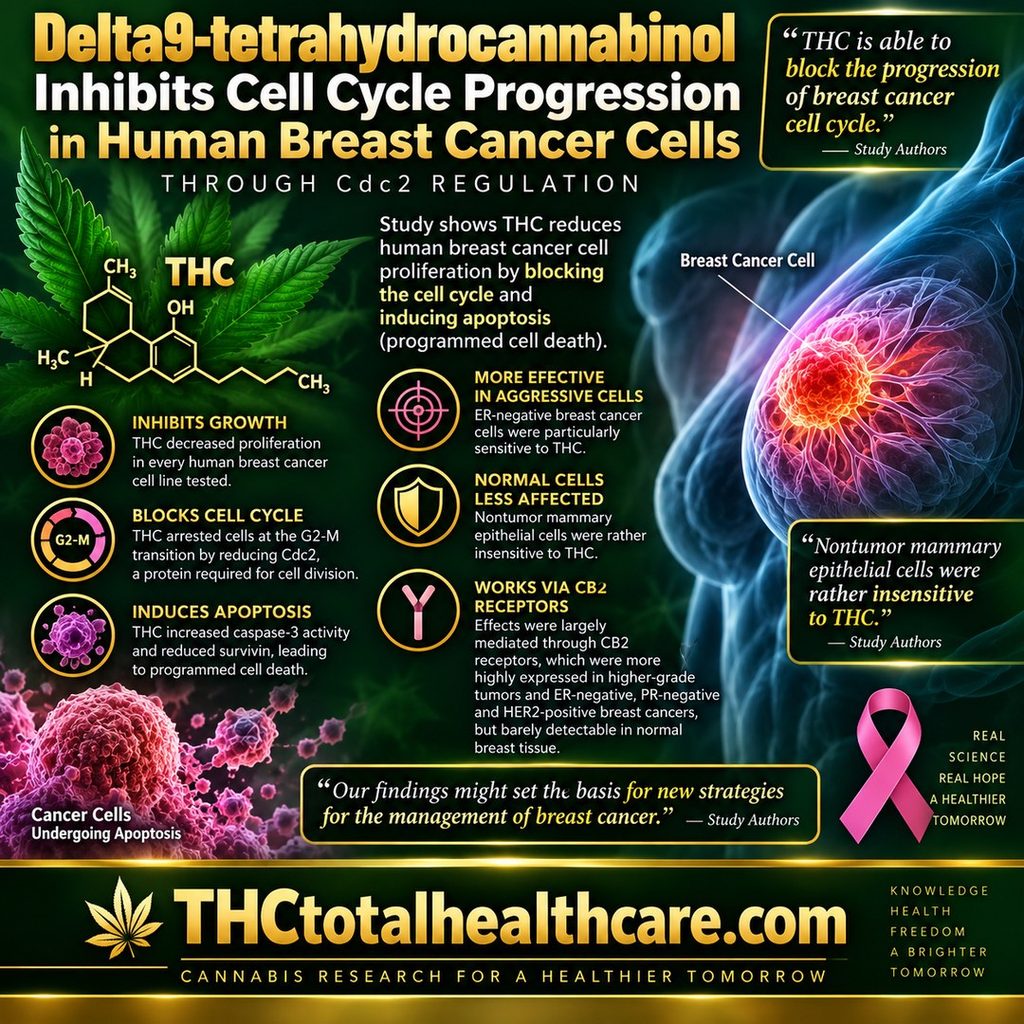
Delta9-tetrahydrocannabinol inhibits cell cycle progression in human breast cancer cells through Cdc2 regulation.

Researchers found that Δ9-tetrahydrocannabinol (THC) reduced the growth of multiple human breast cancer cell lines by stopping cells from progressing through the cell cycle and by triggering apoptosis, or programmed cell death. THC blocked the cells at the G2-M stage by reducing Cdc2, a protein needed for cell division, and breast cancer cells engineered to produce more Cdc2 became more resistant to THC.

The study also found that aggressive ER-negative breast cancer cells were particularly sensitive to THC, while normal human mammary epithelial cells were much less affected. THC’s effects were largely associated with CB2 cannabinoid receptors, which were more highly expressed in higher-grade tumors and in ER-negative, PR-negative and HER2-positive breast tumors, while CB2 expression was barely detectable in normal breast tissue.

The researchers concluded that these findings could help form the basis for new cannabinoid-based strategies for managing breast cancer.

“It has been proposed that cannabinoids are involved in the control of cell fate. Thus, these compounds can modulate proliferation, differentiation, and survival in different manners depending on the cell type and its physiopathologic context. However, little is known about the effect of cannabinoids on the cell cycle, the main process controlling cell fate.

Here, we show that Delta(9)-tetrahydrocannabinol (THC), through activation of CB(2) cannabinoid receptors, reduces human breast cancer cell proliferation by blocking the progression of the cell cycle and by inducing apoptosis. In particular, THC arrests cells in G(2)-M via down-regulation of Cdc2, as suggested by the decreased sensitivity to THC acquired by Cdc2-overexpressing cells.

Of interest, the proliferation pattern of normal human mammary epithelial cells was much less affected by THC. We also analyzed by real-time quantitative PCR the expression of CB(1) and CB(2) cannabinoid receptors in a series of human breast tumor and nontumor samples. We found a correlation between CB(2) expression and histologic grade of the tumors. There was also an association between CB(2) expression and other markers of prognostic and predictive value, such as estrogen receptor, progesterone receptor, and ERBB2/HER-2 oncogene. Importantly, no significant CB(2) expression was detected in nontumor breast tissue.

Taken together, these data might set the bases for a cannabinoid therapy for the management of breast cancer.”

https://pubmed.ncbi.nlm.nih.gov/16818634

Cannabinoid receptors are expressed in human breast tumors.” 

“THC inhibits proliferation of human breast cancer cells.

https://aacrjournals.org/cancerres/article/66/13/6615/525923/9-Tetrahydrocannabinol-Inhibits-Cell-Cycle

Need this THC study explained? thcXplained.com

Anti-tumoral Action of Cannabinoids

“Delta9-Tetrahydrocannabinol, the main active component of marijuana… Here, we show that intratumoral administration of Delta9-tetrahydrocannabinol… induced a considerable regression of malignant gliomas… Cannabinoid treatment did not produce any substantial neurotoxic effect… cannabinoids signal apoptosis (cell death/suicide) by a pathway involving cannabinoid receptors… These results may provide the basis for a new therapeutic approach for the treatment of malignant gliomas.”

‎”Remarkably, cannabinoids kill glioma cells selectively and can protect non-transformed glial cells from death…”

http://www.ncbi.nlm.nih.gov/pubmed/10700234