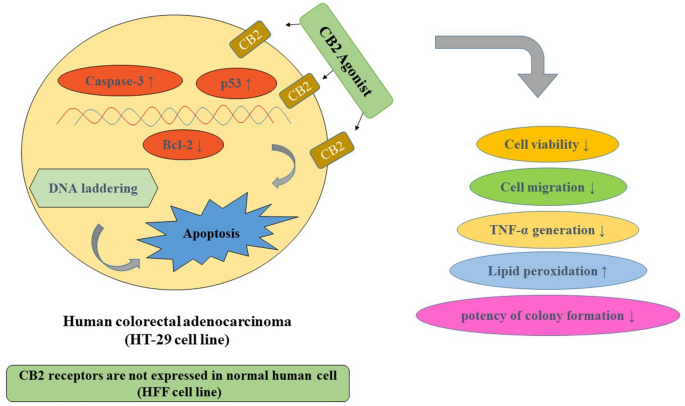
“Colorectal cancer (CRC) is between the top three occurring cancers worldwide. The anticancer effects of Cannabinoid receptor 2 (CB2) agonist (GW833972A) in the presence and absence of its inverse agonist (SR144528) on Human colorectal adenocarcinoma cells (HT-29) was investigated. Following cell viability assays on HT-29 and HFF cells, the molecular mechanism(s) of cytotoxicity and apoptotic pathways of cell death were analyzed. The anticancer effects of CB2 agonist were measured with tumor cell migration and colony-forming assays. Real-time PCR and Western blotting techniques were used to examine any alterations in the expression of apoptotic genes. A concentration and time-dependent cytotoxicity of CB2 agonist with IC50 value of 24.92 ± 6.99 μM was obtained. The rate of lipid peroxidation was elevated, while the TNF-α concentration was declined, significantly (p < 0.05). CB2 agonist (50 μM) reduced the colony-forming capability by 83% and tumor cell migration by 50%. Apoptotic effects of CB2 agonist were revealed with the increase of apoptotic cells in Acridine orange/Ethidium bromide staining, clear DNA fragmentation, pro-apoptotic genes and proteins upregulation (Caspase-3 and p53), and significant downregulation of anti-apoptotic Bcl-2. All assessments demonstrated that CB2 agonist-induced effects were reversed by CB2 inverse agonist. These data suggest that CB2 agonists at micro-molar concentrations might be considered in the CRC treatment, and their effectiveness attributes to the apoptosis induction via upregulation of caspase-3 and p53 and downregulation of Bcl-2.”
https://pubmed.ncbi.nlm.nih.gov/33886060/
https://link.springer.com/article/10.1007/s11010-021-04158-6
 “Glioblastoma multiforme (GBM) is the most lethal subtype of glioma.
 “Cannabidiol (CBD) has been shown to slow cancer cell growth and is toxic to human glioblastoma cell lines. Thus, CBD could be an effective therapeutic for glioblastoma.
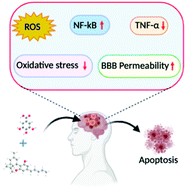
 “Considering the advantages of using medicinal herbs as supplementary treatments to sensitize conventional anti-cancer drugs, studying functional mechanisms and regulatory effects of Echinacea purpurea (as a non-cannabinoid plant)


 “Cannabis sativa contains more than 500 constituents, yet the anticancer properties of the vast majority of cannabis compounds remains unknown. We aimed to identify cannabis compounds and their combinations presenting cytotoxicity against bladder urothelial carcinoma (UC), the most common urinary system cancer.
 “Low tetrahydrocannabinol Cannabis sativa products, also known as hemp products, have become widely available and their use in veterinary patients has become increasingly popular. Despite prevalence of use, the veterinary literature is lacking and evidence-based resource for cannabinoid efficacy.
 “Cannabis has long been used for healing and recreation in several regions of the world. Over 400 bioactive constituents, including more than 100 phytocannabinoids, have been isolated from this plant. The non-psychoactive cannabidiol (CBD) and the psychoactive Δ9-tetrahydrocannabinol (Δ9-THC) are the major and widely studied constituents from this plant.
 “∆ 9 -Tetrahydrocannabinol (∆9 -THC), the active phytocannabinoid in cannabis, is virtually an adjunct to the endogenous endocannabinoid signaling system.