
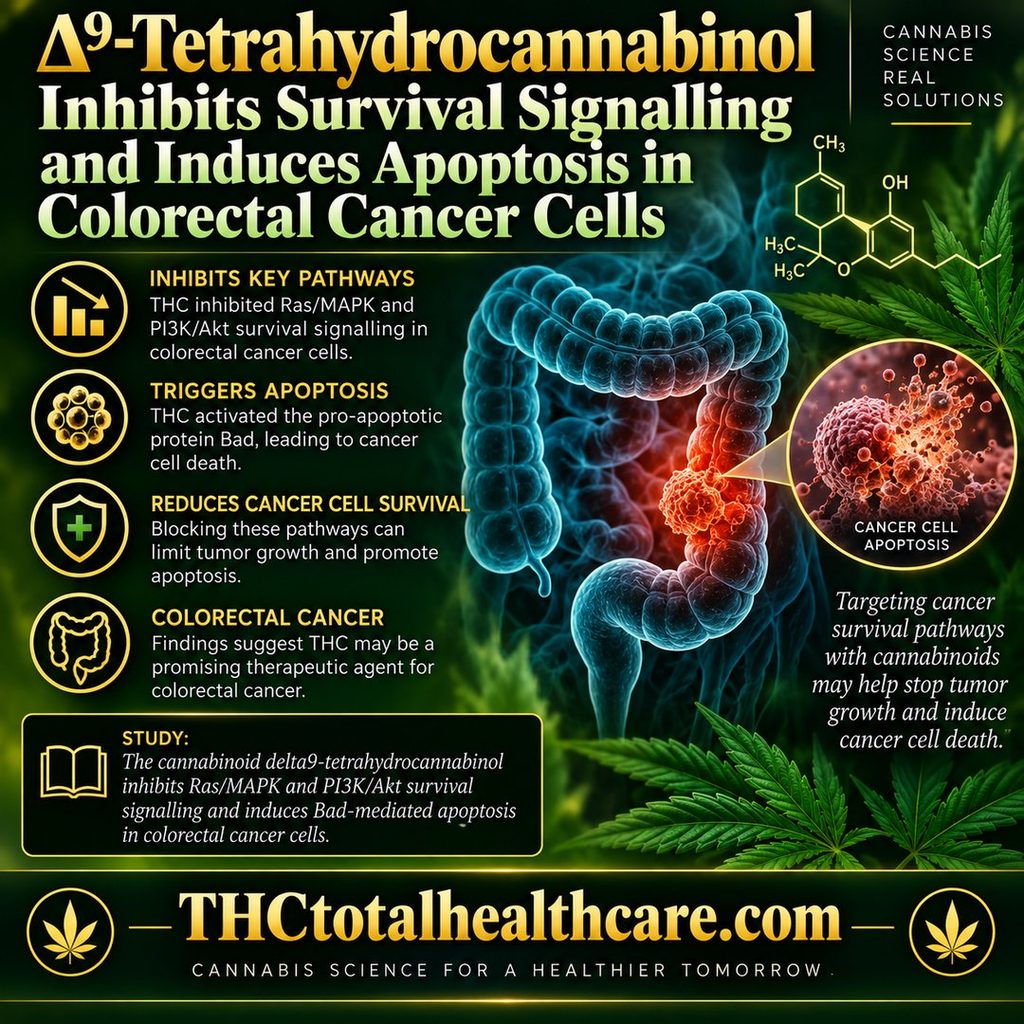
The cannabinoid delta(9)-tetrahydrocannabinol inhibits RAS-MAPK and PI3K-AKT survival signalling and induces BAD-mediated apoptosis in colorectal cancer cells.

“Deregulation of cell survival pathways and resistance to apoptosis are widely accepted to be fundamental aspects of tumorigenesis.

As in many tumours, the aberrant growth and survival of colorectal tumour cells is dependent upon a small number of highly activated signalling pathways, the inhibition of which elicits potent growth inhibitory or apoptotic responses in tumour cells. Accordingly, there is considerable interest in therapeutics that can modulate survival signalling pathways and target cancer cells for death.

There is emerging evidence that cannabinoids, especially Delta(9)-tetrahydrocannabinol (THC), may represent novel anticancer agents, due to their ability to regulate signalling pathways critical for cell growth and survival.

Here, we report that CB1 and CB2 cannabinoid receptors are expressed in human colorectal adenoma and carcinoma cells, and show for the first time that THC induces apoptosis in colorectal cancer cells.

THC-induced apoptosis was rescued by pharmacological blockade of the CB1, but not CB2, cannabinoid receptor. Importantly, THC treatment resulted in CB1-mediated inhibition of both RAS-MAPK/ERK and PI3K-AKT survival signalling cascades; two key cell survival pathways frequently deregulated in colorectal tumours. The inhibition of ERK and AKT activity by THC was accompanied by activation of the proapoptotic BCL-2 family member BAD. Reduction of BAD protein expression by RNA interference rescued colorectal cancer cells from THC-induced apoptosis.

These data suggest an important role for CB1 receptors and BAD in the regulation of apoptosis in colorectal cancer cells.

The use of THC, or selective targeting of the CB1 receptor, may represent a novel strategy for colorectal cancer therapy.”

http://www.ncbi.nlm.nih.gov/pubmed/17583570

http://www.thctotalhealthcare.com/category/colon-cancer/

Need this THC study explained? thcXplained.com

Cannabinoid inhibits HIV-1 Tat-stimulated adhesion of human monocyte-like cells to extracellular matrix proteins.

“The aim of this study was to assess the effect of select cannabinoids on human immunodeficiency virus type 1 (HIV-1) transactivating (Tat) protein-enhanced monocyte-like cell adhesion to proteins of the extracellular matrix (ECM)…

KEY FINDINGS:

THC and CP55,940 inhibited Tat-enhanced attachment of U937 cells to ECM proteins in a mode that was linked to the cannabinoidreceptor type 2 (CB2R). The cannabinoid treatment of Tat-activated U937 cells was associated with altered β1-integrin expression and distribution of polymerized actin, suggesting a modality by which these cannabinoids inhibited adhesion to the ECM.

SIGNIFICANCE:

The blood-brain barrier (BBB) is a complex structure that is composed of cellular elements and an extracellular matrix (ECM). HIV-1 Tat promotes transmigration of monocytes across this barrier, a process that includes interaction with ECM proteins.

The results indicate that cannabinoids that activate the CB2R inhibit the ECM adhesion process. Thus, this receptor has potential to serve as a therapeutic agent for ablating neuroinflammation associated with HIV-elicited influx of monocytes across the BBB.”

http://www.ncbi.nlm.nih.gov/pubmed/24742657

http://www.thctotalhealthcare.com/category/hivaids/

Prophylactic cannabinoid administration blocks the development of paclitaxel-induced neuropathic nociception during analgesic treatment and following cessation of drug delivery.

“Chemotherapeutic treatment results in chronic pain in an estimated 30-40 percent of patients. Limited and often ineffective treatments make the need for new therapeutics an urgent one. We compared the effects of prophylactic cannabinoids as a preventative strategy for suppressing development of paclitaxel-induced nociception…

Our results support the therapeutic potential of cannabinoids for suppressing chemotherapy-induced neuropathy in humans.”

http://www.ncbi.nlm.nih.gov/pubmed/24742127

http://www.thctotalhealthcare.com/category/neuropathic-pain/

The Impact of State Medical Marijuana Legislation on Adolescent Marijuana Use.

“The state-level legalization of medical marijuana has raised concerns about increased accessibility and appeal of the drug to youth. The objective of this study was to assess the impact of medical marijuana legalization across the United States by comparing trends in adolescent marijuana use between states with and without legalization of medical marijuana…

CONCLUSIONS:

This study did not find increases in adolescent marijuana use related to legalization of medical marijuana.”

http://www.ncbi.nlm.nih.gov/pubmed/24742758

“Legalizing medical marijuana doesn’t increase use among adolescents, study says” http://www.sciencedaily.com/releases/2014/04/140423102754.htm#.U1heqwRkPNA.twitter

[Therapeutic use of cannabis derivatives].

“The therapeutic use of cannabis has generated a lot of interest in the past years, leading to a better understanding of its mechanisms of action…

Cannabinoids such as dronabinol, Sativex and nabilone have been tested for the treatment of acute and chronic pain. These agents are most promising to relieve chronic pain associated with cancer, with human immunodeficiency virus infection and with multiple sclerosis…”

http://www.ncbi.nlm.nih.gov/pubmed/24701869

WIN induces apoptotic cell death in human colon cancer cells through a block of autophagic flux dependent on PPARγ down-regulation.

“Cannabinoids have been reported to possess anti-tumorigenic activity in cancer models…

Here, we show that the synthetic cannabinoid WIN55,212-2 (WIN)-induced apoptosis in colon cancer cell lines is accompanied by endoplasmic reticulum stress induction.

In conclusion, at our knowledge, our results are the first to show that the reduction of PPARγ levels contributes to WIN-induced colon carcinoma cell death by blocking the pro-survival autophagic response of cells.”

http://www.ncbi.nlm.nih.gov/pubmed/24696378

Can Physical Exercise or Food Deprivation Cause Release of Fat-Stored Cannabinoids in Humans?

“The aim of this study was to evaluate whether physical exercise or food deprivation may increase cannabionoid levels in serum or urine in abstinent chronic cannabis users.

We conclude that exercise and/or food deprivation are unlikely to cause sufficient cannabinoid concentration changes to hamper correct interpretations in drug testing programmes.”

http://www.ncbi.nlm.nih.gov/pubmed/24674455

Fasting and exercise increase plasma cannabinoid levels in THC pre-treated rats: an examination of behavioural consequences.

“Δ9-Tetrahydrocannabinol (THC), the main psychoactive constituent of cannabis, accumulates in fat tissue where it can remain for prolonged periods.

Under conditions of increased fat utilisation, blood cannabinoid concentrations can increase.

These results confirm that fasting and exercise can increase plasma cannabinoid levels…”

http://www.ncbi.nlm.nih.gov/pubmed/24696079

Anandamide Attenuates Th-17 Cell-Mediated Delayed-Type Hypersensitivity Response by Triggering IL-10 Production and Consequent microRNA Induction

thumbnail

“Endogenous cannabinoids [endocannabinoids] are lipid signaling molecules that have been shown to modulate immune functions..

Cannabinoids are compounds derived from the Cannabis sativa plant and exert many effects on the immune system. Cannabinoids have potential as therapeutic agents in several different disease conditions, including experimental autoimmune hepatitis, Multiple Sclerosis, and Graft vs. Host Disease…

This report suggested a role of the endogenous cannabinoid system in regulation of allergic inflammation.

These studies also suggest that endogenous cannabinoid system is one of the homeostatic mechanisms that the body employs to down-regulate immune response to foreign antigens as well as combat autoimmunity.

Targeting of this system could yield valuable therapeutics in the future.”

http://www.plosone.org/article/info%3Adoi%2F10.1371%2Fjournal.pone.0093954

Pharmacology and toxicology of Cannabis derivatives and endocannabinoid agonists.

“For centuries Cannabis sativa and cannabis extracts have been used in natural medicine.

Delta(9)-tetrahydrocannabinol (THC) is the main active ingredient of Cannabis. THC seems to be responsible for most of the pharmacological and therapeutic actions of cannabis.

In a few countries THC extracts (i.e. Sativex) or THC derivatives such as nabilone, and dronabinol are used in the clinic for the treatment of several pathological conditions like chemotherapy-induced nausea and vomiting, multiple sclerosis and glaucoma.

Over recent years, alternative approaches using synthetic cannabinoid receptor agonists or agents acting as activators of the endocannabinoid systems are under scrutiny with the hope to develop more effective and safer clinical applications.

The present article review recent study and patents with focus on the cannabinoid system as a target for the treatment of central nervous system disorders with emphasis on agonists.”

http://www.ncbi.nlm.nih.gov/pubmed/19832688