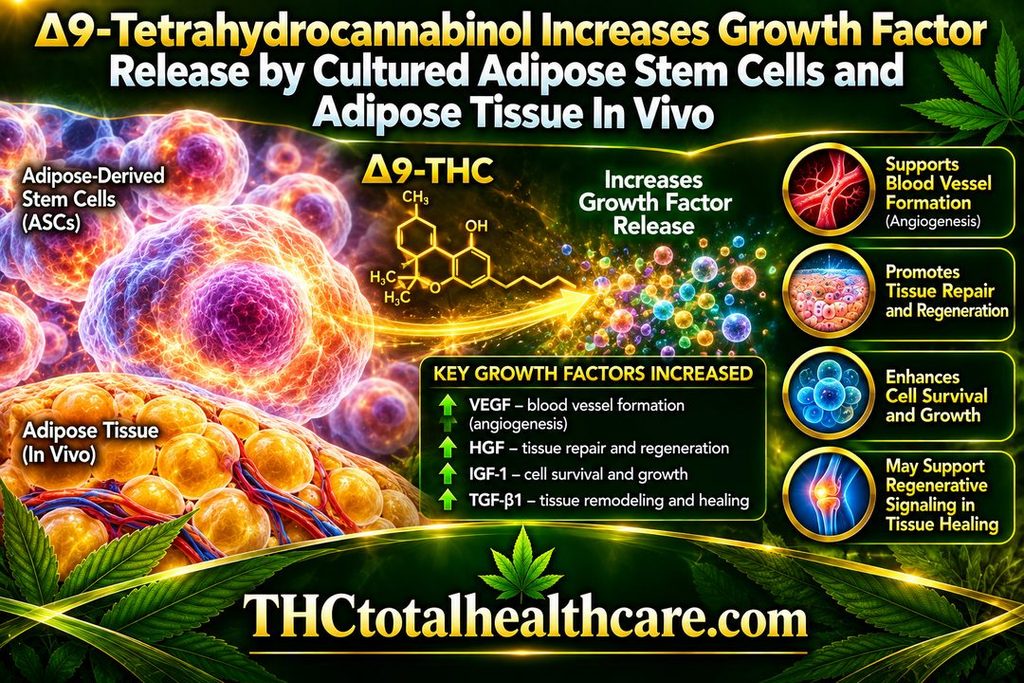
Δ9-THC increased the release of growth factors from cultured adipose-derived stem cells and from adipose tissue in vivo. These growth factors are involved in processes such as cell survival, tissue repair, blood-vessel formation, and regeneration.
The researchers found that THC changed the secretory activity of adipose stem cells rather than simply affecting their growth. This suggests that THC may influence how these cells communicate with surrounding tissue and support repair through the factors they release.
The findings point to a potential role for THC in regenerative signaling and tissue-healing biology, particularly through adipose-derived stem cells and the local tissue environment. The study adds another dimension to cannabinoid research by showing that THC can affect not just mature cells, but also the reparative signals produced by stem-cell populations.
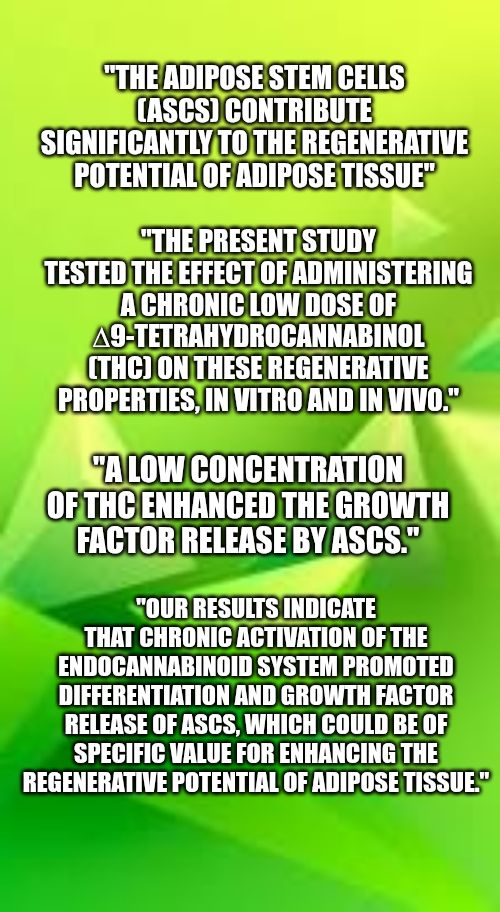
“Background: Because of its biocompatibility and its soft and dynamic nature, the grafting of adipose tissue is regarded an ideal technique for soft-tissue repair. The adipose stem cells (ASCs) contribute significantly to the regenerative potential of adipose tissue, because they can differentiate into adipocytes and release growth factors for tissue repair and neovascularization to facilitate tissue survival. The present study tested the effect of administering a chronic low dose of ∆9-tetrahydrocannabinol (THC) on these regenerative properties, in vitro and in vivo.
Methods: Human ASCs were exposed to increasing concentrations of THC. Resazurin conversion was applied to investigate the effect on metabolic activity, cell number was assessed by crystal violet staining, tri-linear differentiation was evaluated by specific colorimetric approaches, and the release of growth factors was analyzed by ELISA. Two groups of mice were treated daily either with a low dose of THC (3 mg/kg) or a vehicle solution. After 3 weeks, adipose tissue was obtained from excised fat deposits, homogenized and tested for growth factor contents.
Results: THC decreased ASC proliferation but increased metabolic activity as well as adipogenic and chondrogenic differentiation. A low concentration of THC (1 µM) enhanced the growth factor release by ASCs. The concentration of these cytokines was also increased in adipose tissue of mice treated with THC.
Conlusion: Our results indicate that chronic activation of the endocannabinoid system promoted differentiation and growth factor release of ASCs, which could be of specific value for enhancing the regenerative potential of adipose tissue.”
https://pubmed.ncbi.nlm.nih.gov/39825991/
“Our findings may offer a new approach for improved application of adipose tissue in regenerative medicine.”
https://link.springer.com/article/10.1007/s13770-024-00692-8
Need this THC study explained? thcXplained.com