“Amyotrophic lateral sclerosis (ALS) is a fatal neurodegenerative disease that primarily affects motor neurons.
The sensitivity of cannabinoid CB1 receptors controlling both glutamate and GABA transmission was remarkably potentiated in ALS mice, indicating that adaptations of the endocannabinoid system might be involved in the pathophysiology of ALS. In conclusion, our data identify possible physiological correlates of striatal dysfunction in ALS mice, and suggest that cannabinoid CB1 receptors might be potential therapeutic targets for this dramatic disease.”
“NSC-34 cells, a hybridoma cell line derived from the fusion of neuroblastoma cells with mice spinal cord cells, have been widely used as an in vitro model for the study of motor neuron diseases [i.e. amyotrophic lateral sclerosis (ALS)]. In the present study, they were used to characterize different elements of the cannabinoid signaling system, which have been reported to serve as targets for the neuroprotective action of different natural and synthetic cannabinoid compounds…
Assuming that glutamate toxicity is one of the major causes of neuronal damage in ALS and other motor neurons diseases, the differentiated NSC-34 cells might serve as a useful model for studying neuroprotection with cannabinoids in conditions of excitotoxic injury, mitochondrial malfunctioning and oxidative stress.”
“Multiple sclerosis (MS) and amyotrophic lateral sclerosis (ALS) are chronic diseases of the central nervous system (CNS), featured by a complex interplay between inflammation and neurodegeneration. Increasing evidence supports the involvement of the endocannabinoid system (ECS) in both inflammatory and neurodegenerative processes typical of these pathological conditions. Exogenous or endogenous cannabinoids regulate the function of immune system by limiting immune response. On the other hand, by preventing excitotoxic damage, cannabinoids protect neuronal integrity and function. Of note, the ECS not only plays a role as modulator of disease processes, but it can also be disrupted by the same diseases. Agents modulating cannabinoid receptors or endocannabinoid tone provide promising therapeutic opportunities in the treatment of inflammatory neurodegenerative disorders of the CNS.”
“Alterations of the endocannabinoid system (ECS) have been recently implicated in a number of neuroinflammatory and neurodegenerative conditions so that the pharmacological modulation of cannabinoid (CB) receptors and/or of the enzymes controlling synthesis, transport, and degradation of these substances has emerged as a valuable option to treat neurological diseases.
Here, we describe the current knowledge concerning the rearrangement of ECS in a primarily inflammatory disorder of the central nervous system such as multiple sclerosis (MS), and in a primarily degenerative condition such as amyotrophic lateral sclerosis (ALS).
Furthermore, the data supporting a therapeutic role of agents modulating CB receptors or endocannabinoid tone in these disorders will also be reviewed. Complex changes of ECS take place in both diseases, influencing crucial aspects of their pathophysiology and clinical manifestations. Neuroinflammation, microglial activation, oxidative stress, and excitotoxicity are variably combined in MS and in ALS and can be modulated by endocannabinoids or by drugs targeting the ECS.”
“Marijuana has been classified as a Schedule 1 narcotic since the 1960’s, which means it is deemed by the federal government to have no medicinal value and heavy risk. However, there is an increasing body of research to show that marijuana can be helpful for certain debilitating conditions and 15 states have now legalized it for medicinal usage. One of those conditions research is showing marijuana’s medicinal value is multiple sclerosis (MS) and another is Amyotrophic Lateral Sclerosis (ALS). They are both diseases involving neurologic deterioration.
Approximately 200 individuals per week are diagnosed with MS, with the usual onset between 20 and 40 years of age. The disease has no known cure and involves a neuro-degeneration in which the brain and spinal cord nerves undergo a gradual destruction of its protective tissue called myelin.
Myelin covers these regions in what’s called a Myelin sheath, and as the sheath degenerates symptoms include painful muscle spasms, numbness, impaired vision, loss of coordination, tremors, weakness, and imbalance (ataxia). The disease is progressive and can become incapacitating and lead to death.
MS patients may find that marijuana relieves symptoms of spasticity, tremors, imbalance, depression, and fatigue. Numerous studies have looked at Sativex, which is an oral cannabis spray developed in the UK. It has been shown to relieve pain, spasticity, depression, fatigue, and incontinence.
THC appears to have some immunosuppressive or immunomodulatory effects. This may be beneficial to MS patients. Long term studies need to be completed to see if this is for real and a disease modifying effect is real.
Lou Gehrig’s disease, also called Amyotrophic Lateral Sclerosis, involves the ongoing loss of the brain’s motor neurons. It is rapidly progressive, and usually fatal. There is no known cause. The usual age of onset is 40 to 60 years, and men are more commonly affected.
The most well known person with ALS is Stephen Hawking, a physicist who has lived for over 40 years after being diagnosed. He is the exception, the unfortunate usual prognosis is grim, with about half of patients dying with 2.5 years of onset.
The cannabinoids in medical marijuana may protect against glutamate toxicity. This may be very helpful because ALS involves excessive glutamate in the brain tissue, spinal fluid, and serum of those suffering.
By lowering the chance of glutamate toxicity, there is a chance that marijuana may have a neuroprotective effect. In addition, patients describe alleviation of pain and spasms, improvement of appetite, and less drooling issues which is a common problem with ALS.”
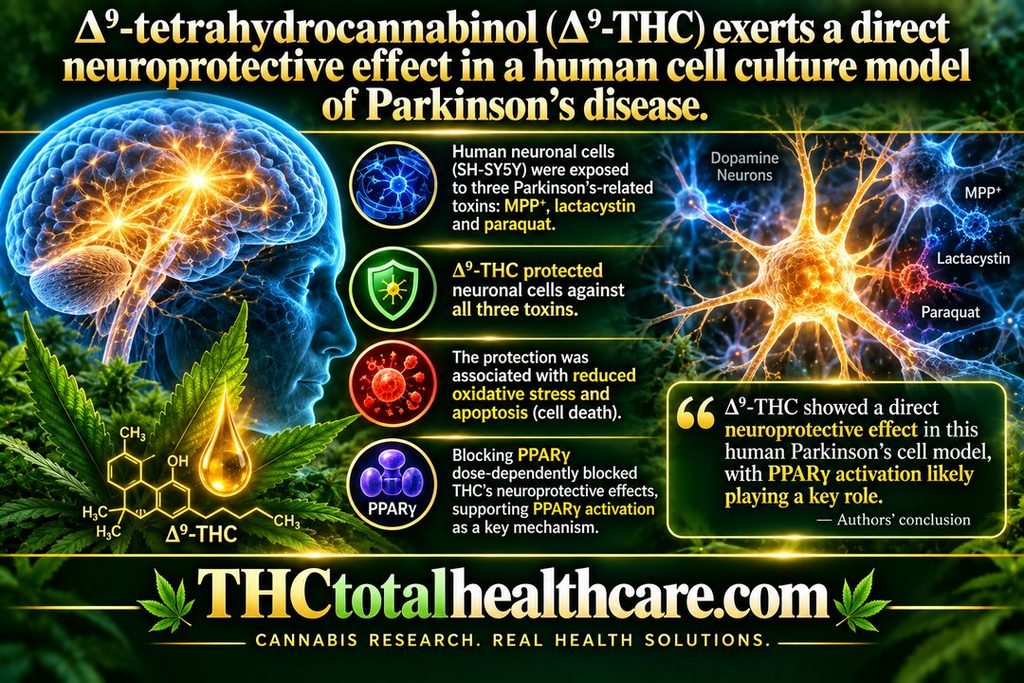
Δ9-THC directly protected human neuronal cells in a laboratory model of Parkinson’s disease from three different Parkinson’s-related toxins: MPP+, lactacystin, and paraquat. Across the experiments, THC reduced toxin-induced cell injury, oxidative stress, and apoptosis.
The researchers found that this neuroprotective effect was linked strongly to PPARγ activation. Blocking PPARγ reduced THC’s protective effects, while THC increased PPARγ expression in injured cells, pointing to this pathway as an important part of the mechanism.
These findings show that THC acted directly on vulnerable human neuronal cells in this Parkinson’s disease model, not just on symptoms. The study adds evidence that THC may have neuroprotective potential in conditions involving oxidative stress, mitochondrial dysfunction, and neuronal loss.
“Aims: Δ⁹-tetrahydrocannabinol (Δ⁹-THC) is neuroprotective in models of Parkinson’s disease (PD). Although CB1 receptors are increased within the basal ganglia of PD patients and animal models, current evidence suggests a role for CB1 receptor-independent mechanisms. Here, we utilized a human neuronal cell culture PD model to further investigate the protective properties of Δ⁹-THC.
Methods: Differentiated SH-SY5Y neuroblastoma cells were exposed to PD-relevant toxins: 1-methyl-4-phenylpyridinium (MPP+), lactacystin and paraquat. Changes in CB1 receptor level were determined by quantitative polymerase chain reaction and Western blotting. Cannabinoids and modulatory compounds were co-administered with toxins for 48 h and the effects on cell death, viability, apoptosis and oxidative stress assessed.
Results: We found CB1 receptor up-regulation in response to MPP+, lactacystin and paraquat and a protective effect of Δ⁹-THC against all three toxins. This neuroprotective effect was not reproduced by the CB1 receptor agonist WIN55,212-2 or blocked by the CB1 antagonist AM251. Furthermore, the antioxidants α-tocopherol and butylhydroxytoluene as well as the antioxidant cannabinoids, nabilone and cannabidiol were unable to elicit the same neuroprotection as Δ⁹-THC. However, the peroxisome proliferator-activated receptor-gamma (PPARγ) antagonist T0070907 dose-dependently blocked the neuroprotective, antioxidant and anti-apoptotic effects of Δ⁹-THC, while the PPARγ agonist pioglitazone resulted in protection from MPP+-induced neurotoxicity. Furthermore, Δ⁹-THC increased PPARγ expression in MPP+-treated SH-SY5Y cells, another indicator of PPARγ activation.
Conclusions: We have demonstrated up-regulation of the CB1 receptor in direct response to neuronal injury in a human PD cell culture model, and a direct neuronal protective effect of Δ⁹-THC that may be mediated through PPARγ activation.”
“In conclusion, we have demonstrated up-regulation of the CB1 receptor in a human cell culture model of PD, as well as a direct neuroprotective effect of the phytocannabinoid, Δ9-THC, not mediated by the CB2 receptor. Although a CB1 receptor-mediated effect cannot totally be excluded, we propose that activation of PPARγ leading to antioxidant effects is highly relevant in mediating the neuroprotection afforded by Δ9-THC in our model.”
“Previous findings have indicated that a cannabinoid, such as Δ(9)-THCV, which has antioxidant properties and the ability to activate CB(2) receptors but to block CB(1) , might be a promising therapy for alleviating symptoms and delaying neurodegeneration in Parkinson’s disease (PD).
…Given its antioxidant properties and its ability to activate CB(2) but to block CB(1) receptors, Δ(9)-THCV has a promising pharmacological profile for delaying disease progression in PD and also for ameliorating parkinsonian symptoms…
Conclusion
In summary, given its antioxidant properties and its ability to activate CB2 but block CB1 receptors at a dose of 2 mg·kg−1, Δ9-THCV seems to have an interesting and therapeutically promising pharmacological profile. Thus, in contrast to other phytocannabinoids that have been investigated to date, it shows promise both for the treatment of disease progression in PD and for the relief of PD symptoms. This represents an important advance in the search for potential novel anti-parkinsonian agents, since Δ9-THCV administered alone or in combination with CBD may provide a much needed improved treatment for PD.”
“Current therapies for Parkinson’s disease (PD) like l-dopa and dopamine (DA) agonists have declined efficacy after long term use. Therefore, research towards supplementary or alternative medication is needed. The implementation in PD can be expedited by application of compounds already used in the clinic. In this study the therapeutic effects of the psychoactive compounds Delta(9)-tetrahydrocannabinol (Delta(9)-THC) and modafinil were tested in the 1-methyl-1,2,3,6-tetrahydropyridine (MPTP)-marmoset model for PD. The anti-parkinson effects of Delta(9)-THC (4 mg/kg) and modafinil (100 mg/kg) in parkinsonian marmosets were assessed with two behavioral rating scales covering parkinsonian symptoms and involuntary movements and two test systems assessing the locomotor activity and hand-eye coordination. Delta(9)-THC improved activity and hand-eye coordination, but induced compound-related side-effects. Modafinil improved activity and observed parkinsonian symptoms but not hand-eye coordination. It can be concluded that both compounds have therapeutic values and could supplement existing therapies for PD.”
“We have recently demonstrated that two plant-derived cannabinoids, Delta9-tetrahydrocannabinol and cannabidiol (CBD), are neuroprotective in an animal model of Parkinson’s disease (PD), presumably because of their antioxidant properties. To further explore this issue, we examined the neuroprotective effects of a series of cannabinoid-based compounds, with more selectivity for different elements of the cannabinoid signalling system, in rats with unilateral lesions of nigrostriatal dopaminergic neurons caused by local application of 6-hydroxydopamine. We used the CB1 receptor agonist arachidonyl-2-chloroethylamide (ACEA), the CB2 receptor agonist HU-308, the non-selective agonist WIN55,212-2, and the inhibitors of the endocannabinoid inactivation AM404 and UCM707, all of them administered i.p. Daily administration of ACEA or WIN55,212-2 did not reverse 6-hydroxydopamine-induced dopamine (DA) depletion in the lesioned side, whereas HU-308 produced a small recovery that supports a possible involvement of CB2 but not CB1 receptors. AM404 produced a marked recovery of 6-hydroxydopamine-induced DA depletion and tyrosine hydroxylase deficit in the lesioned side. Possibly, this is caused by the antioxidant properties of AM404, which are derived from the presence of a phenolic group in its structure, rather than by the capability of AM404 to block the endocannabinoid transporter, because UCM707, another transporter inhibitor devoid of antioxidant properties, did not produce the same effect. None of these effects were observed in non-lesioned contralateral structures. We also examined the timing for the effect of CBD to provide neuroprotection in this rat model of PD. We found that CBD, as expected, was able to recover 6-hydroxydopamine-induced DA depletion when it was administered immediately after the lesion, but it failed to do that when the treatment started 1 week later. In addition, the effect of CBD implied an upregulation of mRNA levels for Cu,Zn-superoxide dismutase, a key enzyme in endogenous defenses against oxidative stress. In summary, our results indicate that those cannabinoids having antioxidant cannabinoid receptor-independent properties provide neuroprotection against the progressive degeneration of nigrostriatal dopaminergic neurons occurring in PD. In addition, the activation of CB2 (but not CB1) receptors, or other additional mechanisms, might also contribute to some extent to the potential of cannabinoids in this disease.”
“An anonymous questionnaire sent to all patients attending the Prague Movement Disorder Centre revealed that 25% of 339 respondents had taken cannabis and 45.9% of these described some form of benefit.”