To investigate the protective effect of paeoniflorin on hippocampal neurons in rats subjected to cerebral ischemia and reperfusion through activating cannabinoid receptor 2 (CBR2).
Conclusion:
CBR2 may participate in the protective effect of paeoniflorin on hippocampal neurons of cerebral ischemia-reperfusion rat models.”
“The endocannabinoid (eCB) system helps recovery following traumatic brain injury (TBI).
Treatment with 2-arachidonoylglycerol (2-AG), a cerebral eCB ligand, was found to ameliorate the secondary damage.
Interestingly, the fatty acid amino acid amide (FAAA) N-arachidonoyl-L-serine (AraS) exerts similar eCB dependent neuroprotective. The present study aimed to investigate the effects of the FAAA palmitoyl-serine (PalmS) following TBI.
We suggest that the neuroprotective action of PalmS is mediated by indirect activation of the eCB receptors following TBI. One such mechanism may involve receptor palmitoylation which has been reported to result in structural stabilization of the receptors and to an increase in their activity. Further research is required in order to establish this assumption.”
“Because of their neuroprotective properties, cannabinoids are being investigated in neurodegenerative disorders, mainly in preclinical studies. These disorders also include amyotrophic lateral sclerosis (ALS), a degenerative disease produced by the damage of the upper and lower motor neurons leading to muscle denervation, atrophy and paralysis.
The studies with cannabinoids in ALS have been conducted exclusively in a transgenic mouse model bearing mutated forms of human superoxide dismutase-1, the first gene that was identified in relation with ALS.
The present study represents the first attempt to investigate the endocannabinoid system in an alternative model, the transgenic mouse model of TAR-DNA binding protein-43 (TDP-43), a protein related to ALS and also to frontotemporal dementia…
In conclusion, our data support the idea that the endocannabinoid signaling system, in particular the CB2 receptor, may serve for the development of a neuroprotective therapy in TDP-43-related disorders. We are presently engaged in pharmacological experiments to investigate this possibility.”
“Diabetic neourophaty is one of the long-term usual outcomes of diabetes.
According to anti-tumor, anti-diabetic and anti-oxidant effects of Cannabis sativa, the aim of this research was to investigate the effect of Cannabis sativa alcoholic extract on Alpha motoneurons degeneration after sciatic nerve compression in diabetic rats…
Conclusion: Using alcoholic extract of Cannabis sativa as a neuroprotective agent can prevent the progression of neural system disorders as a result of hyperglycemia.”
“In glaucoma, the increased release of glutamate is the major cause of retinal ganglion cell death. Cannabinoids have been demonstrated to protect neuron cultures from glutamate-induced death.
In this study, we test the hypothesis that glutamate causes apoptosis of retinal neurons via the excessive formation of peroxynitrite, and that the neuroprotective effect of the psychotropic Δ9-tetrahydroxycannabinol (THC) or nonpsychotropic cannabidiol (CBD) is via the attenuation of this formation…
The neuroprotection by THC and CBD was because of attenuation of peroxynitrite.
The effect of THC was in part mediated by the cannabinoid receptor CB1.
These results suggest the potential use of CBD as a novel topical therapy for the treatment of glaucoma.
THC and CBD, are similarly potent antioxidants that protect neuron cultures from glutamate-induced cell death or oxidative stress…
In addition to possessing neuroprotective or retinal neuroprotective activity… cannabinoids, such as THC, have been demonstrated to induce dose-related reductions in intraocular pressure in human and in animal models.
This suggests that cannabinoids may offer a multifaceted therapy for glaucoma.
In conclusion, our results indicate that lipid peroxidation and ONOO− formation play an important role in NMDA-induced retinal neurotoxicity and cell loss in the retina, and that THC and CBD, by reducing the formation of these compounds, are effective neuroprotectants.
The present studies could form the basis for the development of new topical therapies for the treatment of glaucoma.”
“One of the most promising potential medical applications of cannabinoids involves their ability to protect cells from a variety of toxic events.
Cannabinoids have been reported to protect neurons from death…
Cannabinoids, such as the pharmacologically active component of marijuana (-)Δ9-tetrahydrocannabinol (THC)…
The neuroprotective effects of Δ9-tetrahydrocannabinol (THC) were examined…
Protective effects of Delta(9)-tetrahydrocannabinol… THC may function as an antioxidant to increase cell survival…
THC can produce receptor-independent neuroprotective or cellular protective effects at micromolar concentrations as a result of its antioxidant properties…
In conclusion, THC produces a potent neuroprotective effect…”
“Excitotoxic neuronal death underlies many neurodegenerative disorders.
Because cannabinoid receptor agonists act presynaptically to inhibit glutamate release, we examined the effects of Win 55212-2, a full agonist at CB(1) receptors, and Delta(9)-tetrahydrocannabinol (THC), a partial agonist, on the survival of neurons exposed to an excitotoxic pattern of synaptic activity.
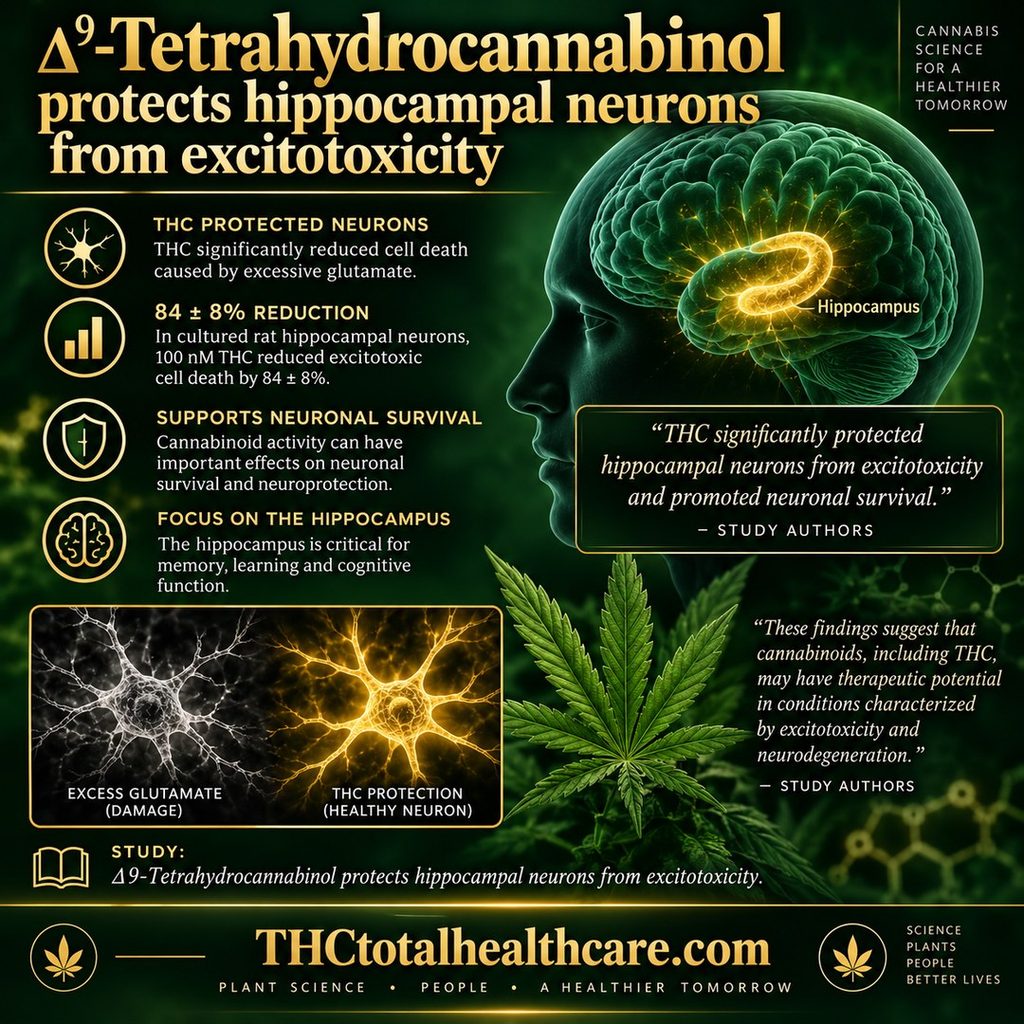
Reducing the extracellular Mg(2+) concentration ([Mg(2+)](o)) to 0.1 mM evoked an aberrant pattern of glutamatergic activity that produced synaptically mediated death of rat hippocampal neurons in culture. Neuronal viability was quantified with a multiwell fluorescence plate scanner equipped to detect propidium iodide fluorescence.
Win 55212-2 (100 nM) and THC (100 nM) significantly reduced 0.1 mM [Mg(2+)](o)-induced cell death by 77 +/- 11% and 84 +/- 8%, respectively. Interestingly, the protection afforded by THC was not significantly different from that produced by Win 55212-2, suggesting that attenuation without a complete block of excitatory activity is sufficient for neuroprotection.
The effect of prolonged drug exposure on the neuroprotection afforded by cannabinoid receptor agonists was also studied. When cultures were pretreated for 24 h with Win 55212-2 (100 nM) or THC (100 nM), inhibition of 0.1 mM [Mg(2+)](o)-induced toxicity was significantly reduced to 39 +/- 19% and 45 +/- 13%, respectively. Thus, desensitization of CB(1) receptors diminishes the neuroprotective effects of cannabinoids.
This study demonstrates the importance of agonist efficacy and the duration of treatment on the neuroprotective effects of cannabinoids. It will be important to consider these effects on neuronal survival when evaluating pharmacologic treatments that modulate the endocannabinoid system.”
“We studied the effects of Win 55212-2 and THC on a synaptic model of excitotoxicity. Despite the fact that THC only partially inhibits glutamatergic synaptic transmission, the protection from neurotoxicity produced by THC equaled that of Win 55212-2 in rat hippocampal culture.”
“THC and Win 55212-2 protected neurons from the excitotoxicity induced by an aberrant pattern of glutamatergic synaptic activity. THC produced neuroprotection comparable to that produced by the full agonist Win 55212-2, even though it is a partial agonist at the CB1 receptor and thus attenuates but does not block synaptic transmission.”
“Cannabinoids protect neurons from excitotoxic injury…
Endogenous or exogenous cannabinoids have shown neuroprotective effects…
The main finding reported here is that cannabinoids protect neurons from excitotoxic injury by a mechanism that involves the activation of CB1R and inhibition of NOS and PKA….
By identifying the signaling pathways responsible for cannabinoid effects in animal models of disease and their human counterparts, it may be possible to design more specific and therefore more efficacious cannabinoid-based therapies.”
“To investigate the regulation of cannabinoid receptors CB1 and CB2 on immune cells by proinflammatory cytokines and its potential relevance to the inflammatory neurological disease, multiple sclerosis (MS).
CB1 and CB2 signalling may be anti-inflammatory and neuroprotective in neuroinflammatory diseases.
Cannabinoids can suppress inflammatory cytokines…
The levels of CB1 and CB2 can be up-regulated by inflammatory cytokines, which can explain their increase in inflammatory conditions including MS”
“4-Hydroxy-3-methoxy-acetophenone (apocynin) is a naturally occurring methoxy-substitute catechol that is isolated from the roots of Apocynin cannabinum (Canadian hemp) and Picrorhiza kurroa (Scrophulariaceae).
It has been previously shown to have antioxidant and neuroprotective properties in several models of neurodegenerative disease, including cerebral ischemia.
The present study investigates the effects of apocynin on transient global cerebral ischemia (TGCI)-induced retrograde memory deficits in rats.
The protective effects of apocynin on neurodegeneration and the glial response to TGCI are also evaluated.
The present results confirm that TGCI causes memory impairment in the AvRM and that apocynin prevents these memory deficits and attenuates hippocampal neuronal death in a sustained way.
These findings support the potential role of apocynin in preventing neurodegeneration and cognitive impairments following TGCI in rats.
The long-term protective effects of apocynin may involve inhibition of the glial response.”