Cannabinoid CB2 receptor agonists protect the striatum against malonate toxicity: relevance for Huntington’s disease.

An external file that holds a picture, illustration, etc.<br /><br />
Object name is nihms94694f6.jpg

“Cannabinoid agonists might serve as neuroprotective agents in neurodegenerative disorders… Cannabinoids may also offer neuroprotection in Huntington’s disease (HD)…

Here, we examined this hypothesis in a rat model ofHuntington’s disease (HD)…

Our results showed that only compounds able to activate CB2 receptors were capable of protecting striatal projection neurons from malonate-induced death. That CB2 receptor agonists are neuroprotective was confirmed…

…neuroprotection was attained exclusively with antioxidant cannabinoids like Δ9-tetrahydrocannabinol (Δ9-THC; or cannabidiol (CBD)…

In summary, our results demonstrate that stimulation of CB2 receptors protect the striatum against malonate toxicity, likely through a mechanism involving glial cells, in particular reactive microglial cells in which CB2 receptors would be upregulated in response to the lesion. Activation of these receptors would reduce the generation of proinflammatory molecules like TNF-alpha.

Altogether, our results support the hypothesis that CB2 receptors could constitute a therapeutic target to slowdown neurodegeneration in HD.”

http://www.ncbi.nlm.nih.gov/pmc/articles/PMC2706932/

http://www.thctotalhealthcare.com/category/huntingtons/

THC for Huntington’s Disease? CB1 receptors important for more than drug use

Psychology Today: Here to Help

“Smoking marijuana doesn’t have to be a bad thing – Especially if you have HD.

The idea that THC can be used to relieve disease symptoms isn’t a new thing – Glaucoma, HIV, and cancer patients have all benefited from the use of CB1 agonists whether in the form of marijuana leaves or a pharmacologically similar product (like dronabinol).

Nevertheless, the idea of using THC or other CB1 agonists for the treatment of HD is pretty new…

The results of this study suggest that THC and other CB1 compounds may not only be able to improve symptoms in already symptomatic HD patients, but also slow down the progression of such a devestating disease.

Good news all around and a great use of THC as far as I’m concerned (medical use and removal from schedule-1 anyone?!).”

http://www.psychologytoday.com/blog/all-about-addiction/201102/thc-huntingtons-disease-cb1-receptors-important-more-drug-use

http://www.thctotalhealthcare.com/category/huntingtons/

Cannabis-Based Medicine Reduces Multiple Pathological Processes in AβPP/PS1 Mice.

“Several recent findings suggest that targeting the endogenous cannabinoid system can be considered as a potential therapeutic approach to treat Alzheimer’s disease (AD).

The present study supports this hypothesis demonstrating that delta-9-tetrahydrocannabinol (THC) or cannabidiol (CBD) botanical extracts, as well as the combination of both natural cannabinoids, which are the components of an already approved cannabis-based medicine, preserved memory in AβPP/PS1 transgenic mice when chronically administered during the early symptomatic stage.

Moreover, THC + CBD reduced learning impairment in AβPP/PS1 mice.

…suggesting a cannabinoid-induced reduction in the harmful effect of the most toxic form of the Aβ peptide.

Among the mechanisms related with these positive cognitive effects, the anti-inflammatory properties of cannabinoids may also play a relevant role…

In summary, the present findings show that the combination of THC and CBD exhibits a better therapeutic profile than each cannabis component alone and support the consideration of a cannabis-based medicine as potential therapy against AD.”

Delta-9-tetrahydrocannabinol + cannabidiol. A reasonable option for some patients with multiple sclerosis.

“Conventional drugs have only a limited impact on spasticity associated with multiple sclerosis and are rarely satisfactory. A solution for oral transmucosal delivery (spray) containing a mixture of cannabis extracts (2.7 mg of delta-9-tetrahydrocannabinol + 2.5 mg of cannabidiol per spray) has been granted marketing authorisation in France for patients who are inadequately relieved by standard treatments. Three double-blind, placebo-controlled trials in a total of about 300 patients tested this combination, in addition to ongoing treatment, for periods of 6 to 14 weeks. Individually, none of these trials showed any tangible anti-spastic efficacy, but two combined analyses showed “response rates” of about 35% with the mixture versus about 25% with placebo. In a trial with 572 patients, the 241 patients who “responded” after 4 weeks of treatment were randomised to either continue using the cannabis extract or receive placebo. Twelve weeks later, 75% of patients using the extract were still “responders”, versus 51% of patients switched to placebo. The principal adverse effects of the cannabis extracts consist of neuropsychiatric disorders that resolve on treatment withdrawal. The potential for abuse increases with the dose and is tangible from 16 sprays per day. Pharmacokinetic interactions due to P-glycoprotein inhibition are likely. Treatment during pregnancy may lead to neonatal withdrawal symptoms. In practice, about 10% of patients in whom standard anti-spastic medications are unsatisfactory benefit from a specific effect of the cannabis extracts contained in this oral spray.”

http://www.ncbi.nlm.nih.gov/pubmed/25121144

The Pharmacokinetics, Efficacy, Safety, and Ease of Use of a Novel Portable Metered-Dose Cannabis Inhaler in Patients With Chronic Neuropathic Pain: A Phase 1a Study.

“Chronic neuropathic pain is often refractory to standard pharmacological treatments.

Although growing evidence supports the use of inhaled cannabis for neuropathic pain, the lack of standard inhaled dosing plays a major obstacle in cannabis becoming a “main stream” pharmacological treatment for neuropathic pain.

The objective of this study was to explore the pharmacokinetics, safety, tolerability, efficacy, and ease of use of a novel portable thermal-metered-dose inhaler (tMDI) for cannabis in a cohort of eight patients suffering from chronic neuropathic pain and on a stable analgesic regimen including medicinal cannabis…

This trial suggests the potential use of the Syqe Inhaler device as a smokeless delivery system of medicinal cannabis, producing a Δ9-THC pharmacokinetic profile with low interindividual variation of Cmax, achieving pharmaceutical standards for inhaled drugs.”

http://www.ncbi.nlm.nih.gov/pubmed/25118789

http://www.thctotalhealthcare.com/category/neuropathic-pain/

CANNABINOIDS INCREASE LUNG CANCER CELL LYSIS BY LYMPHOKINE-ACTIVATED KILLER CELLS VIA UPREGULATION OF ICAM-1.

“Cannabinoids have been shown to promote the expression of the intercellular adhesion molecule 1 (ICAM-1) on lung cancer cells as part of their anti-invasive and antimetastatic action…

Cannabidiol (CBD), a non-psychoactive cannabinoid, enhanced the susceptibility of cancer cells to adhere to and subsequently lysed by LAK cells, with both effects being reversed by a neutralizing ICAM-1 antibody…

ICAM-1-dependent pro-killing effects were further confirmed for the phytocannabinoid Δ9-tetrahydrocannabinol (THC) and R(+)-methanandamide, a stable endocannabinoid analogue…

Altogether, our data demonstrate cannabinoid-induced upregulation of ICAM-1 on lung cancer cells to be responsible for increased cancer cell susceptibility to LAK cell-mediated cytolysis.

These findings provide proof for a novel antitumorigenic mechanism of cannabinoids.”

http://www.ncbi.nlm.nih.gov/pubmed/25069049

http://www.thctotalhealthcare.com/category/lung-cancer/

Anti-Cancer Effects In Active Component Of Marijuana

“Guillermo Velasco and colleagues, at Complutense University, Spain, have provided evidence that suggests that cannabinoids such as the main active component of marijuana (THC) have anticancer effects on human brain cancer cells.

In the study, THC was found to induce the death of various human brain cancer cell lines and primary cultured human brain cancer cells by a process known as autophagy. Consistent with the in vitro data, administration of THC to mice with human tumors decreased tumor growth and induced the tumor cells to undergo autophagy.

As analysis of tumors from two patients with recurrent glioblastoma multiforme (a highly aggressive brain tumor) receiving intracranial THC administration showed signs of autophagy, the authors suggest that cannabinoid administration may provide a new approach to targeting human cancers.”

http://www.medicalnewstoday.com/releases/144770.php

“Cannabinoid action induces autophagy-mediated cell death through stimulation of ER stress in human glioma cells”  http://www.ncbi.nlm.nih.gov/pmc/articles/PMC2673842/

Safety and pharmacokinetics of oral delta-9-tetrahydrocannabinol in healthy older subjects: A randomized controlled trial.

“There is a great concern about the safety of THC-based drugs in older people (≥65 years), as most of THC-trials did not include such group. In this phase 1, randomized, double-blind, double-dummy, placebo-controlled, cross-over trial, we evaluated the safety and pharmacokinetics of three oral doses of Namisol®, a novel THC in tablet form, in older subjects….

In conclusion, THC appeared to be safe and well tolerated by healthy older individuals. Data on safety and effectiveness of THC in frail older persons are urgently required, as this population could benefit from the therapeutic applications of THC.”

http://www.ncbi.nlm.nih.gov/pubmed/25035121

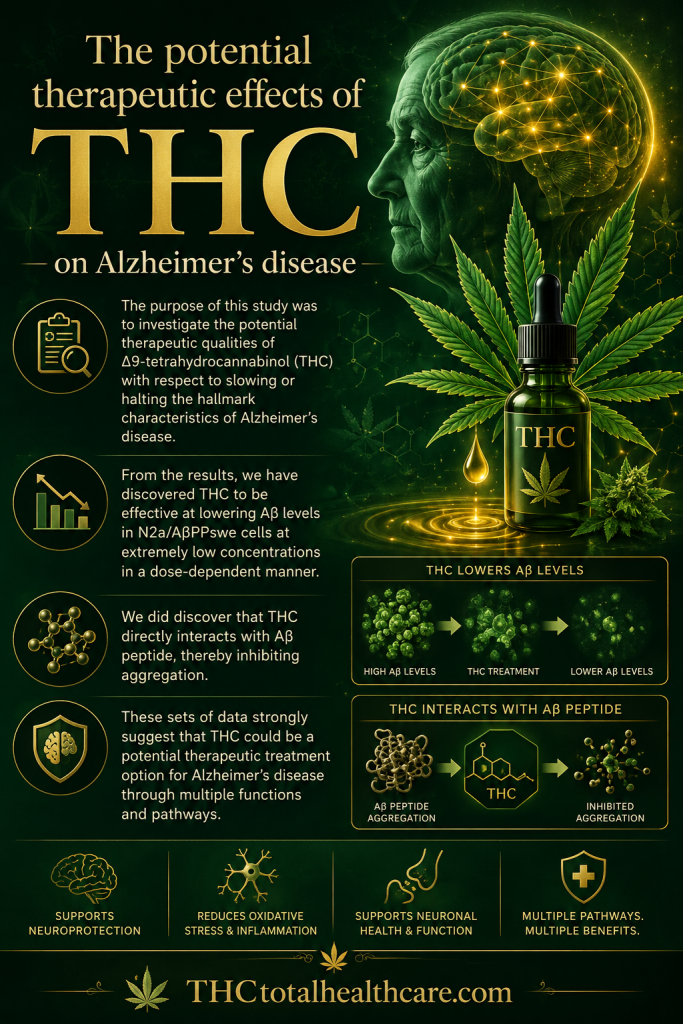
The Potential Therapeutic Effects of THC on Alzheimer’s Disease.

“The purpose of this study was to investigate the potential therapeutic qualities of Δ9-tetrahydrocannabinol (THC) with respect to slowing or halting the hallmark characteristics of Alzheimer’s disease.

N2a-variant amyloid-β protein precursor (AβPP) cells were incubated with THC and assayed for amyloid-β (Aβ) levels at the 6-, 24-, and 48-hour time marks. THC was also tested for synergy with caffeine, in respect to the reduction of the Aβ level in N2a/AβPPswe cells. THC was also tested to determine if multiple treatments were beneficial. The MTT assay was performed to test the toxicity of THC. Thioflavin T assays and western blots were performed to test the direct anti-Aβ aggregation significance of THC. Lastly, THC was tested to determine its effects on glycogen synthase kinase-3β (GSK-3β) and related signaling pathways.

From the results, we have discovered THC to be effective at lowering Aβ levels in N2a/AβPPswe cells at extremely low concentrations in a dose-dependent manner. However, no additive effect was found by combining caffeine and THC together.

We did discover that THC directly interacts with Aβ peptide, thereby inhibiting aggregation. Furthermore, THC was effective at lowering both total GSK-3β levels and phosphorylated GSK-3β in a dose-dependent manner at low concentrations. At the treatment concentrations, no toxicity was observed and the CB1 receptor was not significantly upregulated. Additionally, low doses of THC can enhance mitochondria function and does not inhibit melatonin’s enhancement of mitochondria function.

These sets of data strongly suggest that THC could be a potential therapeutic treatment option for Alzheimer’s disease through multiple functions and pathways.”

https://pubmed.ncbi.nlm.nih.gov/25024327

https://journals.sagepub.com/doi/abs/10.3233/JAD-140093


University Of Saskatchewan Research Suggests Marijuana Analogue Stimulates Brain Cell Growth

ScienceDaily: Your source for the latest research news

“A synthetic substance similar to ones found in marijuana stimulates cell growth in regions of the brain associated with anxiety and depression, pointing the way for new treatments for these diseases, according to University of Saskatchewan medical research published today in The Journal of Clinical Investigation.

Xia Zhang, an associate professor in the U of S neuropsychiatry research unit, led the team that tested the effects of HU-210, a potent synthetic cannabinoid similar to a group of compounds found in marijuana. The synthetic version is about 100 times as powerful as THC, the compound responsible for the high experienced by recreational users.

The team found that rats treated with HU-210 on a regular basis showed neurogenesis – the growth of new brain cells in the hippocampus. This region of the brain is associated with learning and memory, as well as anxiety and depression.

The effect is the opposite of most legal and illicit drugs such as alcohol, nicotine, heroin, and cocaine.

“Most ‘drugs of abuse’ suppress neurogenesis,” Zhang says. “Only marijuana promotes neurogenesis.””

http://www.sciencedaily.com/releases/2005/10/051016083817.htm

“Cannabinoids promote embryonic and adult hippocampus neurogenesis and produce anxiolytic- and antidepressant-like effects… In summary, since adult hippocampal neurogenesis is suppressed following chronic administration of opiates, alcohol, nicotine, and cocaine, the present study suggests that cannabinoids are the only illicit drug that can promote adult hippocampal neurogenesis following chronic administration.”  http://www.jci.org/articles/view/25509