
Getting High on the Endocannabinoid System

“The endogenous cannabinoid system—named for the plant that led to its discovery—is one of the most important physiologic systems involved in establishing and maintaining human health.

Endocannabinoids and their receptors are found throughout the body: in the brain, organs, connective tissues, glands, and immune cells. With its complex actions in our immune system, nervous system, and virtually all of the body’s organs, the endocannabinoids are literally a bridge between body and mind.

By understanding this system, we begin to see a mechanism that could connect brain activity and states of physical health and disease.

…either stimulating or inhibiting the endocannabinoid system could have beneficial effects.

The most direct route of THC administration is by smoking marijuana or other forms of cannabis. Yet purified, FDA-approved medicinal preparations of THC are available in pill form… Why not just take a pill? There are several reasons that some patients prefer puffing over swallowing. One quantitatively minor factor is potential lethality.

It is possible to get a fatal overdose by swallowing too many THC pills at once, whereas documented evidence of death simply from smoking too much cannabis does not seem to exist.”
http://www.ncbi.nlm.nih.gov/pmc/articles/PMC3997295/

Therapeutic Satisfaction and Subjective Effects of Different Strains of Pharmaceutical-Grade Cannabis.

“The aims of this study are to assess the therapeutic satisfaction within a group of patients using prescribed pharmaceutical-grade cannabis and to compare the subjective effects among the available strains with special focus on their delta-9-tetrahydrocannabinol and cannabidiol content…

One hundred two patients were included; their average age was 53 years and 76% used it for more than a year preceding this study. Chronic pain (53%; n = 54) was the most common medical indication for using cannabis followed by multiple sclerosis (23%; n = 23), and 86% (n = 88) of patients (almost) always experienced therapeutic satisfaction when using pharmaceutical cannabis.

These results show that patients report therapeutic satisfaction with pharmaceutical cannabis, mainly pain alleviation. Some subjective effects were found to differ among the available strains of cannabis, which is discussed in relation to their different tetrahydrocannabinol/cannabidiol content. These results may aid in further research and critical appraisal for medicinally prescribed cannabis products.”

http://www.ncbi.nlm.nih.gov/pubmed/24747979

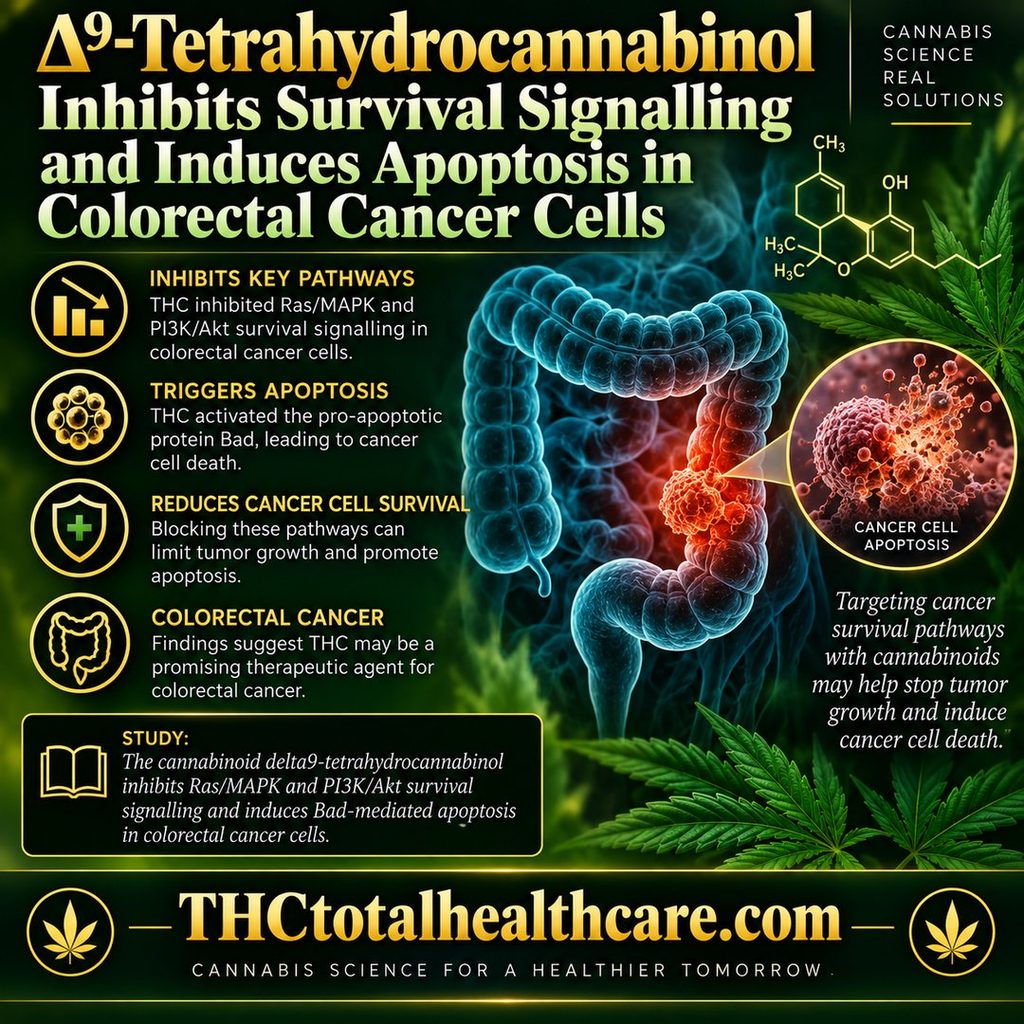
The cannabinoid delta(9)-tetrahydrocannabinol inhibits RAS-MAPK and PI3K-AKT survival signalling and induces BAD-mediated apoptosis in colorectal cancer cells.

“Deregulation of cell survival pathways and resistance to apoptosis are widely accepted to be fundamental aspects of tumorigenesis.

As in many tumours, the aberrant growth and survival of colorectal tumour cells is dependent upon a small number of highly activated signalling pathways, the inhibition of which elicits potent growth inhibitory or apoptotic responses in tumour cells. Accordingly, there is considerable interest in therapeutics that can modulate survival signalling pathways and target cancer cells for death.

There is emerging evidence that cannabinoids, especially Delta(9)-tetrahydrocannabinol (THC), may represent novel anticancer agents, due to their ability to regulate signalling pathways critical for cell growth and survival.

Here, we report that CB1 and CB2 cannabinoid receptors are expressed in human colorectal adenoma and carcinoma cells, and show for the first time that THC induces apoptosis in colorectal cancer cells.

THC-induced apoptosis was rescued by pharmacological blockade of the CB1, but not CB2, cannabinoid receptor. Importantly, THC treatment resulted in CB1-mediated inhibition of both RAS-MAPK/ERK and PI3K-AKT survival signalling cascades; two key cell survival pathways frequently deregulated in colorectal tumours. The inhibition of ERK and AKT activity by THC was accompanied by activation of the proapoptotic BCL-2 family member BAD. Reduction of BAD protein expression by RNA interference rescued colorectal cancer cells from THC-induced apoptosis.

These data suggest an important role for CB1 receptors and BAD in the regulation of apoptosis in colorectal cancer cells.

The use of THC, or selective targeting of the CB1 receptor, may represent a novel strategy for colorectal cancer therapy.”

http://www.ncbi.nlm.nih.gov/pubmed/17583570

http://www.thctotalhealthcare.com/category/colon-cancer/

Need this THC study explained? thcXplained.com

Cannabinoid inhibits HIV-1 Tat-stimulated adhesion of human monocyte-like cells to extracellular matrix proteins.

“The aim of this study was to assess the effect of select cannabinoids on human immunodeficiency virus type 1 (HIV-1) transactivating (Tat) protein-enhanced monocyte-like cell adhesion to proteins of the extracellular matrix (ECM)…

KEY FINDINGS:

THC and CP55,940 inhibited Tat-enhanced attachment of U937 cells to ECM proteins in a mode that was linked to the cannabinoidreceptor type 2 (CB2R). The cannabinoid treatment of Tat-activated U937 cells was associated with altered β1-integrin expression and distribution of polymerized actin, suggesting a modality by which these cannabinoids inhibited adhesion to the ECM.

SIGNIFICANCE:

The blood-brain barrier (BBB) is a complex structure that is composed of cellular elements and an extracellular matrix (ECM). HIV-1 Tat promotes transmigration of monocytes across this barrier, a process that includes interaction with ECM proteins.

The results indicate that cannabinoids that activate the CB2R inhibit the ECM adhesion process. Thus, this receptor has potential to serve as a therapeutic agent for ablating neuroinflammation associated with HIV-elicited influx of monocytes across the BBB.”

http://www.ncbi.nlm.nih.gov/pubmed/24742657

http://www.thctotalhealthcare.com/category/hivaids/

Prophylactic cannabinoid administration blocks the development of paclitaxel-induced neuropathic nociception during analgesic treatment and following cessation of drug delivery.

“Chemotherapeutic treatment results in chronic pain in an estimated 30-40 percent of patients. Limited and often ineffective treatments make the need for new therapeutics an urgent one. We compared the effects of prophylactic cannabinoids as a preventative strategy for suppressing development of paclitaxel-induced nociception…

Our results support the therapeutic potential of cannabinoids for suppressing chemotherapy-induced neuropathy in humans.”

http://www.ncbi.nlm.nih.gov/pubmed/24742127

http://www.thctotalhealthcare.com/category/neuropathic-pain/

The Impact of State Medical Marijuana Legislation on Adolescent Marijuana Use.

“The state-level legalization of medical marijuana has raised concerns about increased accessibility and appeal of the drug to youth. The objective of this study was to assess the impact of medical marijuana legalization across the United States by comparing trends in adolescent marijuana use between states with and without legalization of medical marijuana…

CONCLUSIONS:

This study did not find increases in adolescent marijuana use related to legalization of medical marijuana.”

http://www.ncbi.nlm.nih.gov/pubmed/24742758

“Legalizing medical marijuana doesn’t increase use among adolescents, study says” http://www.sciencedaily.com/releases/2014/04/140423102754.htm#.U1heqwRkPNA.twitter

Marijuana Compound May Help Stop Diabetic Retinopathy

“A compound found in marijuana won’t make you high but it may help keep your eyes healthy if you’re a diabetic, researchers say. Early studies indicate cannabidiol works as a consummate multi-tasker to protect the eye from growing a plethora of leaky blood vessels, the hallmark of diabetic retinopathy, says Dr. Gregory I. Liou, molecular biologist at the Medical College of Georgia.”

http://www.sciencedaily.com/releases/2006/02/060227184647.htm

Blood levels do not predict behavioral or physiological effects of Δ9-tetrahydrocannabinol in rhesus monkeys with different patterns of exposure.

“Recent changes in the legality of cannabis have prompted evaluation of whether blood levels of Δ9-tetrahydrocannabinol (THC) or its metabolites could be used to substantiate impairment, particularly related to behavioral tasks such as driving…

These data indicate that thresholds for blood levels of THC do not provide a consistent index of behavioral impairment across individuals with different patterns of THC exposure.”

http://www.ncbi.nlm.nih.gov/pubmed/24703610

Pot Not Linked to Poor Health

“Marijuana use does not correlate with negative health outcomes or hospitalizations, a study has found.”

“Marijuana may not be linked to health after all, researchers from the Boston Medical Center (BMC) and Boston University School of Medicine showed in the Journal of General Internal Medicine this week (September 23). Specifically, the team found that use of the drug did not correlate with health status or health-care utilization among adults who reported to have used the drug before. The study serves to support mounting evidence that marijuana is likely less harmful than once thought.”

http://www.the-scientist.com/?articles.view/articleNo/37625/title/Pot-Not-Linked-to-Poor-Health/

“Large waist linked to poor health…” http://www.sciencedaily.com/releases/2014/03/140312114559.htm

“Studies show poverty is linked with poor health” http://articles.latimes.com/2011/sep/14/news/la-heb-poverty-health-20110914

[Therapeutic use of cannabis derivatives].

“The therapeutic use of cannabis has generated a lot of interest in the past years, leading to a better understanding of its mechanisms of action…

Cannabinoids such as dronabinol, Sativex and nabilone have been tested for the treatment of acute and chronic pain. These agents are most promising to relieve chronic pain associated with cancer, with human immunodeficiency virus infection and with multiple sclerosis…”

http://www.ncbi.nlm.nih.gov/pubmed/24701869