
The endocannabinoid system as a target for the treatment of cannabis dependence

“Cannabinoid replacement therapy and CB1 receptor antagonism are two potential treatments for cannabis dependence that are currently under investigation. However, abuse liability and adverse side effects may limit the scope of each of these approaches. A potential alternative stems from the recognition that (i) frequent cannabis use may cause an adaptive downregulation of brain endocannabinoid signaling, and (ii) that genetic traits that favor hyperactivity of the endocannabinoid system in humans may decrease susceptibility to cannabis dependence. These findings suggest in turn that pharmacological agents that elevate brain levels of the endocannabinoid neurotransmitters, anandamide and 2-arachidonoylglycerol (2-AG), might alleviate cannabis withdrawal and dependence. One such agent, the fatty-acid amide hydrolase (FAAH) inhibitor URB597, selectively increases anandamide levels in the brain of rodents and primates. Preclinical studies show that URB597 produces analgesic, anxiolytic-like and antidepressant-like effects in rodents, which are not accompanied by overt signs of abuse liability. In this article, we review evidence suggesting that (i) cannabis influences brain endocannabinoid signaling; and (ii) FAAH inhibitors such as URB597 might offer a possible therapeutic avenue for the treatment of cannabis withdrawal.”

“Direct modulation of CB1receptors as a treatment for cannabis dependence”

“Even though, as we have seen above, direct activation of CB1 receptors may yield variable behavioral responses, low-dosage oral Δ9-THC has shown promise in the management of human cannabis withdrawal. The rationale for this approach is that controlled replacement of Δ9-THC for smoked cannabis may reduce the severity of withdrawal symptoms and allow a dependent individual to remain abstinent. Additionally, given that dependent subjects are experienced with cannabis, and Δ9-THC is administered at low doses, administration of the latter is unlikely to result in the anxiety responses observed with inexperienced users or high dosages. Consistent with this idea, two independent clinical studies have shown that low-dose oral Δ9-THC attenuates withdrawal symptom scores and is minimally intoxicating in non-treatment seeking daily cannabis users.””

“Several therapeutic modalities are currently being considered to treat cannabis dependence, including activation or deactivation of CB1receptors. While these stategies show promise in measures of cannabis withdrawal and abstinence, they may also create problems of abuse liability or adverse emotional effects. An additional approach might be to enhance endogenous anandamide signaling using agents that attenuate the deactivation of this endocannabinoid transmitter.”

“Increasing anandamide signaling with deactivation inhibitors, such as the FAAH blocker URB597, potentiates stress coping behaviors in animals, indicating a role for anandamide in physiopathological context of stress-related responses. Similarly, elevation of anandamide in specific brain regions opposes the anhedonic effects of stress and promotes normal positive responses to pleasurable stimuli in rodents. It is reasonable to hypothesize that these effects could act to blunt the negative affect and stress, which is common during cannabis withdrawal, thus allowing cannabis dependent individuals to successfully abstain from drug use.”

http://www.ncbi.nlm.nih.gov/pmc/articles/PMC2647947/

Endometriosis: Marijuana Treatment

“Dr. Phillip Leveque has spent his life as a Combat Infantryman, Physician, Toxicologist and Pharmacologist.

(MOLALLA, Ore.) – I don’t think I have to explain what this is to anybody. If you have it, you know it. Endometriosis is graded in stages I,II, III & IV, with stage I being “minimized” inconvenience while stage IV is severe and usually requires surgery.

As a physician, I had known about endometriosis for years and that some women become narcotic addicts because of it. Pre Menstrual Tension (PMS) may be concurrent though different and I had many PMS patients as well. Some of them became addicts also. I was not surprised when lady patients came to our clinics offering chart notes that they had been prescribed every conceivable analgesic and other medications but they also told me marijuana works better than any regular prescription.

I have a severe pain problem myself caused by too high of a concentration of spinal anesthesia. I got disgusted by the anesthesiologist telling me he didn’t cause it but I got a new understanding for patients in pain.

If the patient says marijuana works for pain, I believe them. Actually in Oregon about sixty percent of patients have some chronic pain syndrome of nerve, muscle, joint, bone, intestinal or genitourinary. It doesn’t seem to matter whatever the source of pain, the bottom line is that MJ gives relief.

I presume stage I endometriosis and minor PMS are effectively treated with aspirin-like drugs, but when the pain etc. is in the moderate/severe level, the ladies have found out by themselves that marijuana/cannabis is effective without the hazard of narcotic addiction or alcoholism.

The U.S. government publicizes that as many as 77 million Americans have used marijuana and perhaps ten million use it frequently.

Marijuana as folk medicine has been used in the U.S. since the middle 1800’s and probably in Mexico and Latin America since the Spanish introduced it in the late 1500’s.

It is no longer amazing to me when a patient tells me of some new disease for which they have discovered marijuana treatment is beneficial.

It is time the DEA and its hoodlums backed off and allow the therapeutic use of medical marijuana, as more and more people are reverting to this tried and true “folk medicine” everyday.”

http://www.salem-news.com/articles/january032008/endo_med_1308.php

[The endogenous cannabinoid system. Therapeutic implications for neurologic and psychiatric disorders].

Abstract

“For about 5,000 years, cannabis has been used as a therapeutic agent. There has been growing interest in the medical use of cannabinoids. This is based on the discovery that cannabinoids act with specific receptors (CB1 and CB2). CB1 receptors are located in specific brain areas (e.g. cerebellum, basal ganglia, and hippocampus) and CB2 receptors on cells of the immune system. Endogenous ligands of the cannabinoid receptors were also discovered (e.g. anandamids). Many physiologic processes are modulated by the two subtypes of cannabinoid receptor: motor functions, memory, appetite, and pain. These innovative neurobiologic/pharmacologic findings could possibly lead to the use of synthetic and natural cannabinoids as therapeutic agents in various areas. Until now, cannabinoids were used as antiemetic agents in chemotherapy-induced emesis and in patients with HIV-wasting syndrome. Evidence suggests that cannabinoids may prove useful in some other diseases, e.g. movement disorders such as Gilles de la Tourette’s syndrome, multiple sclerosis, and pain. These new findings also explain the acute adverse effects following cannabis use.”

http://www.ncbi.nlm.nih.gov/pubmed/15776259

Cannabinoids reduce symptoms of Tourette’s syndrome.

Abstract

“Currently, the treatment of Tourette’s syndrome (TS) is unsatisfactory. Therefore, there is expanding interest in new therapeutical strategies. Anecdotal reports suggested that the use of cannabis might improve not only tics, but also behavioural problems in patients with TS. A single-dose, cross-over study in 12 patients, as well as a 6-week, randomised trial in 24 patients, demonstrated that Delta9-tetrahydrocannabinol (THC), the most psychoactive ingredient of cannabis, reduces tics in TS patients. No serious adverse effects occurred and no impairment on neuropsychological performance was observed. If well-established drugs either fail to improve tics or cause significant adverse effects, in adult patients, therapy with Delta9-THC should be tried. At present, it remains unclear whether herbal cannabis, different natural or synthetic cannabinoid CB1-receptor agonists or agents that interfere with the inactivation of endocannabinoids, may have the best adverse effect profile in TS.”

http://www.ncbi.nlm.nih.gov/pubmed/14521482

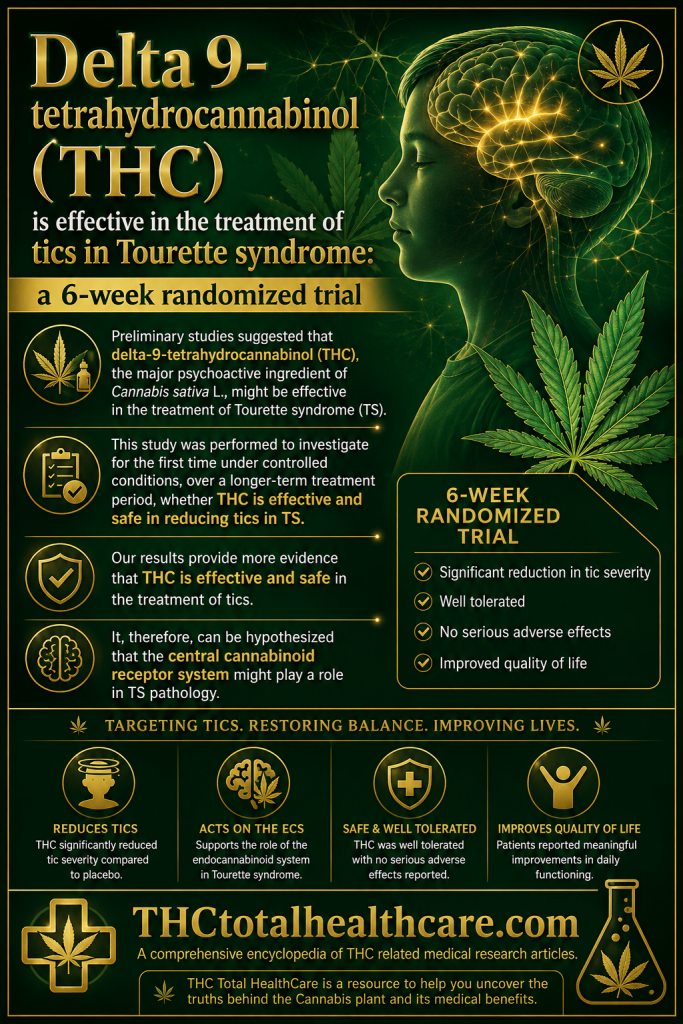
Delta 9-tetrahydrocannabinol (THC) is effective in the treatment of tics in Tourette syndrome: a 6-week randomized trial.

A randomized, double-blind clinical trial found that delta-9-tetrahydrocannabinol (THC) reduced tic severity in people with Tourette syndrome. Participants received THC for six weeks, and researchers reported improvement in several measures of motor and vocal tics compared with placebo. The study also found that THC was generally well tolerated, adding clinical evidence that the endocannabinoid system may play an important role in Tourette syndrome and tic control.

“Preliminary studies suggested that delta-9-tetrahydrocannabinol (THC), the major psychoactive ingredient of Cannabis sativa L., might be effective in the treatment of Tourette syndrome (TS).

This study was performed to investigate for the first time under controlled conditions, over a longer-term treatment period, whether THC is effective and safe in reducing tics in TS.

CONCLUSION:

Our results provide more evidence that THC is effective and safe in the treatment of tics. It, therefore, can be hypothesized that the central cannabinoid receptor system might play a role in TS pathology.”

https://www.ncbi.nlm.nih.gov/pubmed/12716250

“Our results provide more evidence that THC is effective and safe in the treatment of tics.” http://www.psychiatrist.com/jcp/article/Pages/2003/v64n04/v64n0417.aspx

Need this THC study explained?  thcXplained.com

Treatment of Tourette Syndrome with Delta-9-Tetrahydrocannabinol (9-THC): No Influence on Neuropsychological Performance

“Previous studies provide evidence that marijuana (Cannabis sativa) and delta-9-tetrahydrocannabinol (Delta(9)-THC), the major psychoactive ingredient of marijuana, respectively, are effective in the treatment of tics and behavioral problems in Tourette syndrome (TS). It, therefore, has been speculated that the central cannabinoid receptor system might be involved in TS pathology. However, in healthy marijuana users there is an ongoing debate as to whether the use of cannabis causes acute and/or long-term cognitive deficits. In this randomized double-blind placebo-controlled study, we investigated the effect of a treatment with up to 10 mg Delta(9)-THC over a 6-week period on neuropsychological performance in 24 patients suffering from TS. During medication and immediately as well as 5-6 weeks after withdrawal of Delta(9)-THC treatment, no detrimental effect was seen on learning curve, interference, recall and recognition of word lists, immediate visual memory span, and divided attention. Measuring immediate verbal memory span, we even found a trend towards a significant improvement during and after treatment. Results from this study corroborate previous data suggesting that in patients suffering from TS, treatment with Delta(9)-THC causes neither acute nor long-term cognitive deficits. Larger and longer-duration controlled studies are recommended to provide more information on the adverse effect profile of THC in patients suffering from TS.”

“Anecdotal reports and two controlled studies provide evidence that marijuana (Cannabis sativa) and delta-9-tetrahydrocannabinol (THC), the major psychoactive ingredient of marijuana, respectively, are effective in the treatment of tics and behavioral problems in TS.”

“In conclusion, our data are in agreement with anecdotal reports and a pilot study suggesting that -THC treatment in patients suffering from TS has no detrimental effect on neuropsychological performance. We hypothesize that the effects of -THC on cognition in TS patients might be different from those in healthy marijuana users because of the pathology of the disease. Since there is evidence that tics can be improved by THC, an involvement of the central CB1 receptor system in TS pathology has been suggested. However, larger and longer-duration controlled studies are recommended to provide more information on the adverse effect profile of THC in patients suffering from TS.”

http://www.nature.com/npp/journal/v28/n2/full/1300047a.html

Influence of treatment of Tourette syndrome with delta9-tetrahydrocannabinol (delta9-THC) on neuropsychological performance.

Abstract

“Previous studies have suggested that marijuana (cannabis sativa) and delta-9-tetrahydrocannabinol (delta9-THC), the major psychoactive ingredient of marijuana, are effective in the therapy of tics and associated behavioral disorders in Tourette Syndrome (TS). Because there is also evidence that cannabis sativa may cause cognitive impairment in healthy users, we performed a randomized double-blind placebo-controlled crossover trial for delta9-THC in 12 adult TS patients to investigate whether treatment of TS with a single dose of delta9-THC at 5.0 to 10.0 mg causes significant side effects on neuropsychological performance. Using a variety of neuropsychological tests, we found no significant differences after treatment with delta9-THC compared to placebo treatment in verbal and visual memory, reaction time, intelligence, sustained attention, divided attention, vigilance, or mood. Only when using the Symptom Checklist 90-R (SCL-90-R) did our data provide evidence for a deterioration of obsessive-compulsive behavior (OCB) and a trend towards an increase in phobic anxiety. However, these results should be interpreted with caution as SCL-90-R has known limitations on measuring OCB. We suggest that the increase in phobic anxiety is mainly due to the fact that a single-dose treatment rules out the possibility of administering the dosage slowly. In contrast to results obtained from healthy marijuana users, a single-dose treatment with delta9-THC in patients suffering from TS does not cause cognitive impairment. We therefore suggest that further investigations should concentrate on the effects of a longer-term therapy of TS with delta9-THC.”

http://www.ncbi.nlm.nih.gov/pubmed/11229617

Treatment of Tourette’s syndrome with Delta 9-tetrahydrocannabinol (THC): a randomized crossover trial.

Abstract

“Anecdotal reports in Tourette’s syndrome (TS) have suggested that marijuana (cannabis sativa) and delta-9-tetrahydrocannabinol (Delta(9)-THC), the major psychoactive ingredient of marijuana, reduce tics and associated behavioral disorders. We performed a randomized double-blind placebo-controlled crossover single-dose trial of Delta(9)-THC (5.0, 7.5 or 10.0 mg) in 12 adult TS patients. Tic severity was assessed using a self-rating scale (Tourette’s syndrome Symptom List, TSSL) and examiner ratings (Shapiro Tourette’s syndrome Severity Scale, Yale Global Tic Severity Scale, Tourette’s syndrome Global Scale). Using the TSSL, patients also rated the severity of associated behavioral disorders. Clinical changes were correlated to maximum plasma levels of THC and its metabolites 11-hydroxy-Delta(9)-tetrahydrocannabinol (11-OH-THC) and 11-nor-Delta(9)-tetrahydrocannabinol-9-carboxylic acid (THC-COOH). Using the TSSL, there was a significant improvement of tics (p=0.015) and obsessive-compulsive behavior (OCB) (p = 0.041) after treatment with Delta(9)-THC compared to placebo. Examiner ratings demonstrated a significant difference for the subscore “complex motor tics” (p = 0.015) and a trend towards a significant improvement for the subscores “motor tics” (p = 0.065), “simple motor tics” (p = 0.093), and “vocal tics” (p = 0.093). No serious adverse reactions occurred. Five patients experienced mild, transient side effects. There was a significant correlation between tic improvement and maximum 11-OH-THC plasma concentration. Results obtained from this pilot study suggest that a single-dose treatment with Delta(9)-THC is effective and safe in treating tics and OCB in TS. It can be speculated that clinical effects may be caused by 11-OH-THC. A more long-term study is required to confirm these results.”

http://www.ncbi.nlm.nih.gov/pubmed/11951146

Tourette’s syndrome.

Abstract

“Tourette’s syndrome (TS) is a chronic disorder characterized by motor and vocal tics and a variety of associated behaviour disorders. Because current therapy is often unsatisfactory, there is expanding interest in new therapeutic strategies that are more effective, cause less side effects and ameliorate not only tics but also behavioural problems. From anecdotal reports and preliminary controlled studies it is suggested that – at least in a subgroup of patients – cannabinoids are effective in the treatment of TS. While most patients report beneficial effects when smoking marijuana (Cannabis sativa L.), available clinical trials have been performed using oral Δ⁹-tetrahydrocannabinol (THC). In otherwise treatment-resistant TS patients, therefore, therapy with THC should not be left unattempted. To date, it is unknown whether other drugs that interact with the endocannabinoid receptor system might be more effective in the treatment of TS than smoked marijuana or pure THC. Since it has been suggested that abnormalities within the endocannabinoid receptor system might underlie TS pathophysiology, it would be of interest to investigate the effect of substances that for example bind more selectively to the central cannabinoid receptor or inhibit the uptake or the degradation of different endocannabinoids.”

http://www.ncbi.nlm.nih.gov/pubmed/21104394

Medicinal use of cannabis: history and current status.

Abstract

“OBJECTIVE:

To provide an overview of the history and pharmacology of cannabis in relation to current scientific knowledge concerning actual and potential therapeutic uses of cannabis preparations and pure cannabinoids.

METHODS:

The literature on therapeutic uses of cannabis and cannabinoids was assessed with respect to type of study design, quality and variability of data, independent replications by the same or other investigators, magnitude of effects, comparison with other available treatments and reported adverse effects. The results of this review were also compared with those of major international reviews of this topic in the past five years.

CONCLUSIONS:

Pure tetrahydrocannabinol and several analogues have shown significant therapeutic benefits in the relief of nausea and vomiting, and stimulation of appetite in patients with wasting syndrome. Recent evidence clearly demonstrates analgesic and anti-spasticity effects that will probably prove to be clinically useful. Reduction of intraocular pressure in glaucoma and bronchodilation in asthma are not sufficiently strong, long lasting or reliable to provide a valid basis for therapeutic use. The anticonvulsant effect of cannabidiol is sufficiently promising to warrant further properly designed clinical trials. There is still a major lack of long term pharmacokinetic data and information on drug interactions. For all the present and probable future uses, pure cannabinoids, administered orally, rectally or parenterally, have been shown to be effective, and they are free of the risks of chronic inflammatory disease of the airways and upper respiratory cancer that are associated with the smoking of crude cannabis. Smoking might be justified on compassionate grounds in terminally ill patients who are already accustomed to using cannabis in this manner. Future research will probably yield new synthetic analogues with better separation of therapeutic effects from undesired psychoactivity and other side effects, and with solubility properties that may permit topical administration in the eye, or aerosol inhalation for rapid systemic effect without the risks associated with smoke inhalation.”

http://www.ncbi.nlm.nih.gov/pubmed/11854770