The CB1/CB2 receptor agonist WIN-55,212-2 reduces viability of human Kaposi’s sarcoma cells in vitro.

“Kaposi’s sarcoma is a highly vascularized mesenchymal neoplasm arising with multiple lesions of the skin. Endogenous cannabinoids have been shown to inhibit proliferation of a wide spectrum of tumor cells. We studied the effects of cannabinoids on human Kaposi’s sarcoma cell proliferation in vitro.

 To do so, we first investigated the presence of the cannabinoid receptors CB(1) and CB(2) mRNAs in the human Kaposi’s sarcoma cell line KS-IMM by RT-PCR and, subsequently, the effects of the mixed CB(1)/CB(2) agonist WIN-55,212-2 (WIN) on cell proliferation in vitro. WIN showed antimitogenic effects on Kaposi’s sarcoma cells…

  In view of the antiproliferative effects of cannabinoids on KS-IMM cells, one could envision the cannabinoid system as a potential target for pharmacological treatment of Kaposi’s sarcoma”

http://www.ncbi.nlm.nih.gov/pubmed/19539619

Kaposi Sarcoma.

“Kaposi sarcoma (KS) is a low-grade vascular tumor associated with Kaposi sarcoma herpesvirus/human herpesvirus 8 (KSHV/HHV8) infection. Kaposi sarcoma lesions predominantly present at mucocutaneous sites, but may involve all organs and anatomic locations. Recognized epidemiologic-clinical forms of KS include classic, African (endemic), AIDS-associated (epidemic), and iatrogenic KS. New clinical manifestations have been described, such as antiretroviral therapy-related KS regression or flares. Kaposi sarcoma lesions evolve from early (patch stage) macules into plaques (plaque stage) that grow into larger nodules (tumor stage). Newer histologic variants include anaplastic, hyperkeratotic, lymphangioma-like, bullous, telangiectatic, ecchymotic, keloidal, pyogenic granuloma-like, micronodular, intravascular, glomeruloid and pigmented KS, as well as KS with sarcoidlike granulomas and KS with myoid nodules. Latency-associated nuclear antigen (HHV8) is the most specific immunohistochemical marker available to help distinguish KS from its mimics. Since KS remains one of the most common AIDS-defining malignancies, it is important that pathologists be able to recognize KS and its contemporary manifestations.”

http://www.ncbi.nlm.nih.gov/pubmed/23368874

Doctors utilise marijuana as pain relief

“A pair of scientists at California Pacific Medical Center in San Francisco has found that a compound derived from marijuana could stop metastasis in many kinds of aggressive cancer, potentially altering the fatality of the disease forever.

“It took us about 20 years of research to figure this out, but we are very excited,” said Pierre Desprez, one of the scientists behind the discovery. The finding, which has already undergone both laboratory and animal testing, and is awaiting permission for clinical trials in humans.

Desprez, a molecular biologist, spent decades studying ID-1, the gene that causes cancer to spread. Fellow researcher  Sean McAllister was studying the effects of Cannabidiol, or CBD, a non-toxic, non-psychoactive chemical compound found in the cannabis plant. Finally, the pair collaborated, combining CBD and cells containing high levels of ID-1 in a petri dish.

“What we found was that his Cannabidiol could essentially ‘turn off’ the ID-1,” Desprez told HuffPost. The cells stopped spreading and returned to normal.

“We likely would not have found this on our own,” he added. “That’s why collaboration is so essential to scientific discovery.”

Desprez and McAllister’s findings was first published in 2007. Since then, their team has found that CBD works both in the lab and in animals. And now, they’ve found even more good news.

“We started by researching breast cancer. But now we’ve found that Cannabidiol works with many kinds of aggressive cancers–brain, prostate–any kind in which these high levels of ID-1 are present.”

“We’ve found no toxicity in the animals we’ve tested, and Cannabidiol is already used in humans for a variety of other ailments,” he said. Indeed, the compound is used to relieve anxiety and nausea, and, since it is non-psychoactive, does not cause the “high” associated with THC.

While marijuana advocates will surely praise the discovery, Desprez explained that it’s not so easy as just lighting up. “We used injections in the animal testing and are also testing pills. But you could never get enough Cannabidiol for it to be effective just from smoking.”

Furthermore, the team has started synthesizing the compound in the lab instead of using the plant in an effort to make it more potent.”It’s a common practice. But hopefully it will also keep us clear of any obstacles while seeking approval.””

By Sola Ogundipe

http://www.vanguardngr.com/2013/01/doctors-utilise-marijuana-as-pain-relief/

“Cannabidiol as a novel inhibitor of Id-1 gene expression in aggressive breast cancer cells”

https://pubmed.ncbi.nlm.nih.gov/18025276

Oregon family uses medical marijuana to manage son’s autistic rage

“An Oregon family has turned to medical marijuana to manage their son’s severe autistic rage. “It was indescribable, it was horrifying,” said Jeremy Echols, father of 11-year-old Alex. “When you’ve got no other options, are you honestly gonna say no?”

Eleven-year-old Alex Echols is severely autistic, and his doctor said Alex’s self-destructive behavior is brought on by Tuberous Sclerosis, a rare, genetic disorder that affects about 50,000 people in the U.S.  The disorder causes unregulated growth of non-malignant tissue in organs. In Alex’s case, his neurologist said growths in Alex’s brain have led to seizures and autism.”

Read more: http://www.kptv.com/story/20660400/medical-marijuana-used-to-treat-autism

“The Echols have set up a Facebook page that chronicles Alex’s journey. You can find their blog at www.facebook.com/alex.autism.rage.mmj.”

IT’S TRUE: MEDICAL CANNABIS PROVIDES DRAMATIC RELIEF FOR SUFFERERS OF CHRONIC AILMENTS.

“Though controversial, medical cannabis has been gaining ground as a valid therapy, offering relief to suffers of diseases such as cancer, Post-Traumatic Stress Disorder, ALS and more. The substance is known to soothe severe pain, increase the appetite, and ease insomnia where other common medications fail.

In 2009, Zach Klein, a graduate of Tel Aviv University’s Department of Film and Television Studies, directed the documentary Prescribed Grass. Through the process, he developed an interest in the scientific research behind medical marijuana, and now, as a specialist in policy-making surrounding medical cannabis and an MA student at TAU’s Porter School of Environmental Studies, he is conducting his own research into the benefits of medical cannabis.”

Read more: .http://scienceblog.com/59316/its-true-medical-cannabis-provides-dramatic-relief-for-sufferers-of-chronic-ailments/

320px Cannabis macro Its True: Medical Cannabis Provides Dramatic Relief for Sufferers of Chronic Ailments ”

Marijuana’s Medicinal Value Vindicated Once Again, This Time For The Elderly

Image Credit: Photos.com

Lee Rannals for redOrbit.com – Your Universe Online

“Researchers from Tel Aviv University say that smoking a little marijuana could help provide dramatic relief for the elderly who suffer from a variety of chronic ailments.

The scientists tested the effects of marijuana treatment on 19 residents of the Hadarim nursing home in Israel. During the study, the participants reported dramatic physical results, including healthy weight gain and the reduction of pain and tremors.

According to the study authors, the elderly participants also experienced an immediate improvement in their moods and communication skills after smoking cannabis.

Zach Klein, a graduate of Tel Aviv University’s Department of Film and Television Studies, said that the use of prescription medications was also significantly reduced as a result of using medical marijuana

The active ingredient in marijuana THC was first discovered in Israel by professors Raphael Mechoulam and Yechiel Gaoni. Israel is known as the world leader in medical cannabis research, according to Klein.

During the nursing home study, 19 patents between the ages of 69 and 101 were treated with medical cannabis in the form of powder, oil, vapor or smoke three times daily over the course of a year for conditions like chronic pain, lack of appetite, and muscle spasms and tremors.

Both researchers and nursing home staff members monitored participants for signs of improvement in their conditions as well as their overall quality of life.

Seventeen of the study participants achieved a healthy weight during their use of marijuana and experienced a noticeable reduction in pain, muscle spasms, joint stiffness and tremors. Nearly all of the patients using cannabis slept better, longer and had a reduced incidence of nightmares and flashbacks related to Post-Traumatic Stress Disorder (PTSD).

The researchers also reported a decline in the amount of prescribed medications taken by patients, such as antipsychotics, Parkinson’s treatment, mood stabilizers and pain relievers. Towards the end of the study, researchers found that 72 percent of participants were able to reduce their drug intake by an average of 1.7 medications per day.

For the next phase of his research, Klein wants to study the connection between medical cannabis and an improved ability to swallow. Difficulties in swallowing can lead to a decline in nutrition and, ultimately, premature death. He believes that cannabis will have a positive impact on patients suffering from this disorder, which is known in medical jargon as dysphagia.”

http://www.redorbit.com/news/health/1112770306/medical-benefits-of-marijuana-elderly-012413/

Medical cannabis eases pain, improves appetite

“Medical Cannabis treatment can improve appetite, ease chronic pain, and more, researchers say.

Though controversial, medical cannabis has been gaining ground as a valid therapy, offering relief to suffers of diseases such as cancer, Post-Traumatic Stress Disorder, ALS and more.

The substance is known to soothe severe pain, increase the appetite, and ease insomnia where other common medications fail.”

http://articles.timesofindia.indiatimes.com/2013-01-25/health/36547301_1_medical-cannabis-chronic-pain-muscle-spasms

Medical cannabis can improve appetite, ease chronic pain, say researchers

“Though controversial, medical cannabis has been gaining ground as a valid therapy, offering relief to suffers of diseases such as cancer, Post-Traumatic Stress Disorder, ALS and more. The substance is known to soothe severe pain, increase the appetite, and ease insomnia  where other common medications fail.

In 2009, Zach Klein, a graduate of Tel Aviv University’s Department of Film and Television Studies, directed the documentary Prescribed Grass. Through the process, he developed an interest in the scientific research behind medical marijuana, and now, as a specialist in policy-making surrounding medical cannabis and an MA student at TAU’s Porter School of Environmental Studies, he is conducting his own research into the benefits of medical cannabis.

Using marijuana from a farm called Tikkun Olam – a reference to the Jewish concept of healing the world – Klein and his fellow researchers tested the impact of the treatment on 19 residents of the Hadarim nursing home in Israel. The results, Klein says, have been outstanding. Not only did participants experience dramatic physical results, including healthy weight gain and the reduction of pain and tremors, but Hadarim staff saw an immediate improvement in the participants’ moods and communication skills. The use of chronic medications was also significantly reduced, he reports.”

Read more: http://www.news-medical.net/news/20130125/Medical-cannabis-can-improve-appetite-ease-chronic-pain-say-researchers.aspx

Local Delivery of Cannabinoid-Loaded Microparticles Inhibits Tumor Growth in a Murine Xenograft Model of Glioblastoma Multiforme

“Treatment with cannabinoid-loaded microparticles activates apoptosis and inhibits tumor angiogensis. The aim of the present study was therefore to evaluate the antitumor efficacy of biodegradable polymeric microparticles allowing the controlled release of the phytocannabinoids THC and CBD. Our findings show that administration of cannabinoid-loaded microparticles reduces the growth of glioma xenografts supporting that this method of administration could be exploited for the design of cannabinoid-based anticancer treatments.

Cannabinoids, the active components of marijuana and their derivatives, are currently investigated due to their potential therapeutic application for the management of many different diseases, including cancer. Specifically, Δ9-Tetrahydrocannabinol (THC) and Cannabidiol (CBD) – the two major ingredients of marijuana – have been shown to inhibit tumor growth in a number of animal models of cancer, including glioma. Although there are several pharmaceutical preparations that permit the oral administration of THC or its analogue nabilone or the oromucosal delivery of a THC- and CBD-enriched cannabis extract, the systemic administration of cannabinoids has several limitations in part derived from the high lipophilicity exhibited by these compounds. In this work we analyzed CBD- and THC-loaded poly-ε-caprolactone microparticles as an alternative delivery system for long-term cannabinoid administration in a murine xenograft model of glioma. In vitro characterization of THC- and CBD-loaded microparticles showed that this method of microencapsulation facilitates a sustained release of the two cannabinoids for several days. Local administration of THC-, CBD- or a mixture (1:1 w:w) of THC- and CBD-loaded microparticles every 5 days to mice bearing glioma xenografts reduced tumour growth with the same efficacy than a daily local administration of the equivalent amount of those cannabinoids in solution. Moreover, treatment with cannabinoid-loaded microparticles enhanced apoptosis and decreased cell proliferation and angiogenesis in these tumours. Our findings support that THC- and CBD-loaded microparticles could be used as an alternative method of cannabinoid delivery in anticancer therapies.

Δ9-Tetrahydrocannabinol (THC), the main active component of the hemp plant Cannabis sativa, exerts a wide variety of biological effects by mimicking endogenous substances – the endocannabinoids – that bind to and activate specific cannabinoid receptors. So far, two G protein–coupled cannabinoid-specific receptors have been cloned and characterized from mammalian tissues: CB1, abundantly expressed in the brain and at many peripheral sites, and CB2, expressed in the immune system and also present in some neuron subpopulations and glioma cells. One of the most active areas of research in the cannabinoid field is the study of the potential application of cannabinoids in the treatment of different pathologies. Among these therapeutic applications, cannabinoids are being investigated as anti-tumoral agents. Thus, cannabinoid administration curbs the growth of several types of tumor xenografts in rats and mice including gliomas. Based on this preclinical evidence, a pilot clinical trial has been recently run to investigate the anti-tumor action of THC on recurrent gliomas. The mechanism of THC anti-tumoral action relies on the ability of this compound to: (i) promote the apoptotic death of cancer cells (ii) to inhibit tumour angiogenesis and (iii) to reduce the migration of cancer cells.

Conclusions

Data presented in this manuscript show for the first time that in vivo administration of microencapsulated cannabinoids efficiently reduces tumor growth thus providing a proof of concept for the utilization of this formulation in cannabinoid-based anti-cancer therapies.”

Full text: http://www.plosone.org/article/info%3Adoi%2F10.1371%2Fjournal.pone.0054795. 

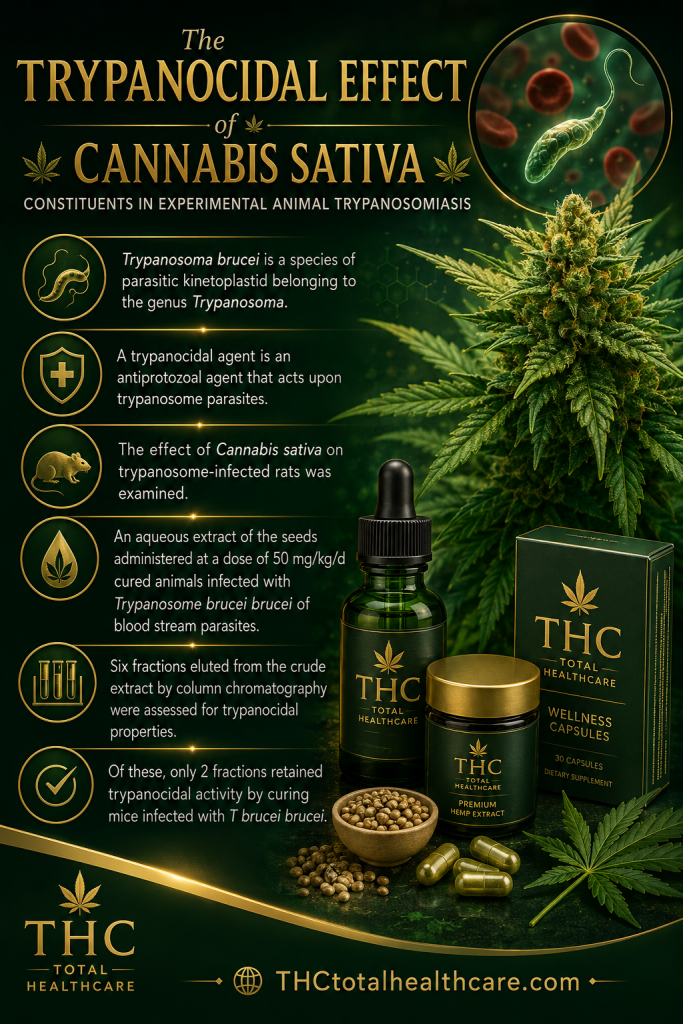
The trypanocidal effect of Cannabis sativa constituents in experimental animal trypanosomiasis.

Image result for cannabis sativa

“The effect of Cannabis sativa on trypanosome-infected rats was examined. An aqueous extract of the seeds administered at a dose of 50 mg/kg/d cured animals infected with Trypanosome brucei brucei of blood stream parasites.

Six fractions eluted from the crude extract by column chromatography were assessed for trypanocidal properties. Of these, only 2 fractions retained trypanocidal activity by curing mice infected with T brucei brucei.”

http://www.ncbi.nlm.nih.gov/pubmed/7900270

Related image

“Trypanosoma brucei is a species of parasitic kinetoplastid belonging to the genus Trypanosoma. The parasite is the cause of a vector-borne disease of vertebrate animals, including humans, carried by genera of tsetse fly in sub-Saharan Africa. In humans T. brucei causes African trypanosomiasis, or sleeping sickness.”  https://en.wikipedia.org/wiki/Trypanosoma_brucei

“A trypanocidal agent is an antiprotozoal agent that acts upon trypanosome parasites.”  https://en.wikipedia.org/wiki/Trypanocidal_agent