
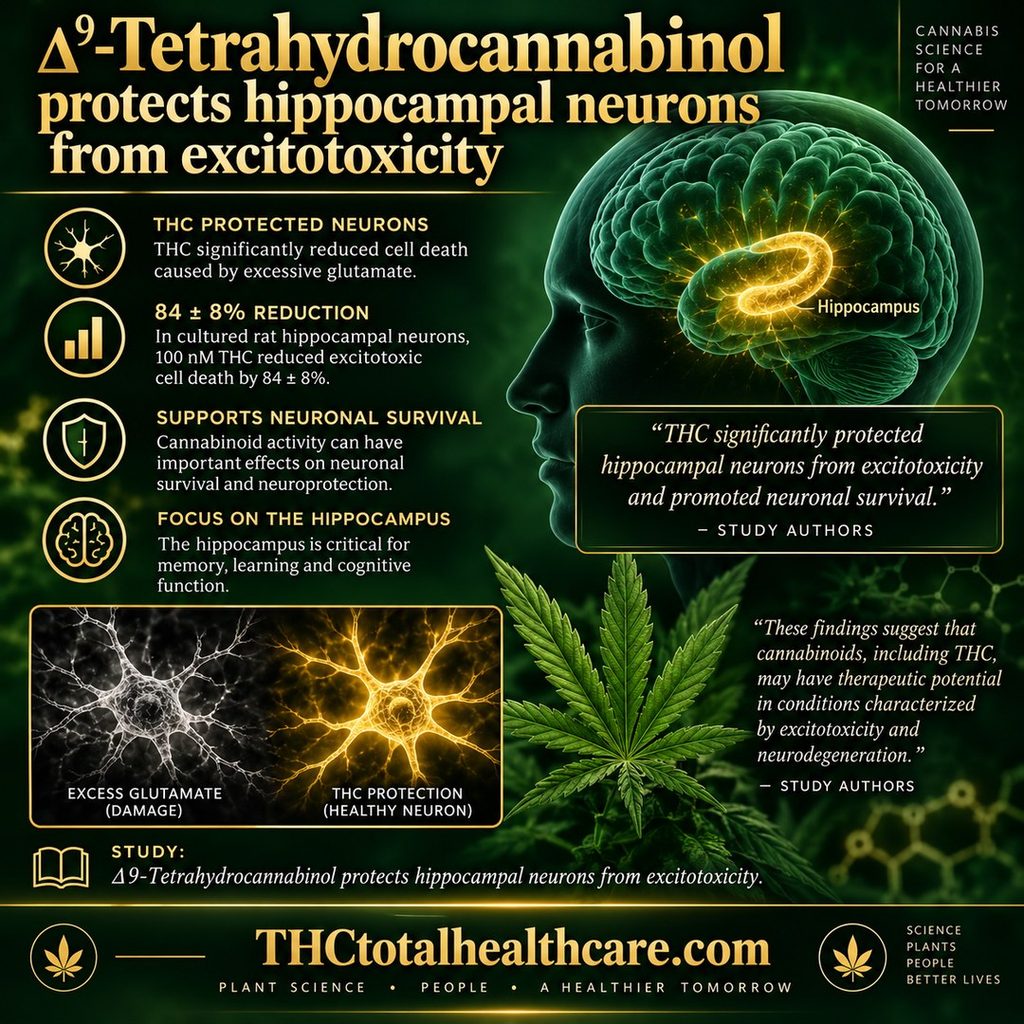
Delta9-tetrahydrocannabinol protects hippocampal neurons from excitotoxicity.

“Excitotoxic neuronal death underlies many neurodegenerative disorders.

Because cannabinoid receptor agonists act presynaptically to inhibit glutamate release, we examined the effects of Win 55212-2, a full agonist at CB(1) receptors, and Delta(9)-tetrahydrocannabinol (THC), a partial agonist, on the survival of neurons exposed to an excitotoxic pattern of synaptic activity.

Reducing the extracellular Mg(2+) concentration ([Mg(2+)](o)) to 0.1 mM evoked an aberrant pattern of glutamatergic activity that produced synaptically mediated death of rat hippocampal neurons in culture. Neuronal viability was quantified with a multiwell fluorescence plate scanner equipped to detect propidium iodide fluorescence.

Win 55212-2 (100 nM) and THC (100 nM) significantly reduced 0.1 mM [Mg(2+)](o)-induced cell death by 77 +/- 11% and 84 +/- 8%, respectively. Interestingly, the protection afforded by THC was not significantly different from that produced by Win 55212-2, suggesting that attenuation without a complete block of excitatory activity is sufficient for neuroprotection.

The effect of prolonged drug exposure on the neuroprotection afforded by cannabinoid receptor agonists was also studied. When cultures were pretreated for 24 h with Win 55212-2 (100 nM) or THC (100 nM), inhibition of 0.1 mM [Mg(2+)](o)-induced toxicity was significantly reduced to 39 +/- 19% and 45 +/- 13%, respectively. Thus, desensitization of CB(1) receptors diminishes the neuroprotective effects of cannabinoids.

This study demonstrates the importance of agonist efficacy and the duration of treatment on the neuroprotective effects of cannabinoids. It will be important to consider these effects on neuronal survival when evaluating pharmacologic treatments that modulate the endocannabinoid system.”

http://www.ncbi.nlm.nih.gov/pubmed/17140550

“We studied the effects of Win 55212-2 and THC on a synaptic model of excitotoxicity. Despite the fact that THC only partially inhibits glutamatergic synaptic transmission, the protection from neurotoxicity produced by THC equaled that of Win 55212-2 in rat hippocampal culture.”

“THC and Win 55212-2 protected neurons from the excitotoxicity induced by an aberrant pattern of glutamatergic synaptic activity. THC produced neuroprotection comparable to that produced by the full agonist Win 55212-2, even though it is a partial agonist at the CB1 receptor and thus attenuates but does not block synaptic transmission.”

https://www.sciencedirect.com/science/article/abs/pii/S0006899306007256?via%3Dihub

Image result for delta-9-tetrahydrocannabinol

Need this THC study explained? thcXplained.com

Sativex in the management of multiple sclerosis-related spasticity: role of the corticospinal modulation.

“Sativex is an emergent treatment option for spasticity in patients affected by multiple sclerosis (MS).

This oromucosal spray, acting as a partial agonist at cannabinoid receptors, may modulate the balance between excitatory and inhibitory neurotransmitters, leading to muscle relaxation that is in turn responsible for spasticity improvement.

The aim of our study was to investigate the role of Sativex in improving spasticity and related symptomatology in MS patients by means of an extensive neurophysiological assessment of sensory-motor circuits…

Our data showed an increase of intracortical inhibition, a significant reduction of spinal excitability, and an improvement in spasticity and associated symptoms.

Thus, we can speculate that Sativex could be effective in reducing spasticity by means of a double effect on intracortical and spinal excitability.”

Cannabidiol (CBD) and its analogs: a review of their effects on inflammation.

“First isolated from Cannabis in 1940 by Roger Adams, the structure of CBD was not completely elucidated until 1963.

Subsequent studies resulted in the pronouncement that THC was the ‘active’ principle of Cannabis and research then focused primarily on it to the virtual exclusion of CBD.

This was no doubt due to the belief that activity meant psychoactivity that was shown by THC and not by CBD.

In retrospect this must be seen as unfortunate since a number of actions of CBD with potential therapeutic benefit were downplayed for many years.

In this review, attention will be focused on the effects of CBD in the broad area of inflammation where such benefits seem likely to be developed.

Topics covered in this review are; the medicinal chemistry of CBD, CBD receptor binding involved in controlling Inflammation, signaling events generated by CBD, downstream events affected by CBD (gene expression and transcription), functional effects reported for CBD and combined THC plus CBD treatment.”

http://www.ncbi.nlm.nih.gov/pubmed/25703248

Exploiting Cannabinoid-Induced Cytotoxic Autophagy to Drive Melanoma Cell Death.

“While the global incidence of cutaneous melanoma is increasing, survival rates for patients with metastatic disease remain less than 10%. Novel treatment strategies are therefore urgently required, particularly for patients bearing BRAF/NRAS wildtype tumours.

Targeting autophagy is a novel means to promote cancer cell death in chemotherapy-resistant tumours and the aim of the present study was to test the hypothesis that cannabinoids promote autophagy-dependent apoptosis in melanoma.

Treatment with Δ9-Tetrahydrocannabinol (THC) resulted in the activation of autophagy, loss of cell viability and activation of apoptosis, while co-treatment with chloroquine or knockdown of Atg7, but not Beclin-1 or Ambra1, prevented THC-induced autophagy and cell death in vitro.

Administration of Sativex-like (a laboratory preparation comprising equal amounts of THC and cannabidiol (CBD)) to mice bearing BRAF wildtype melanoma xenografts substantially inhibited melanoma viability, proliferation and tumour growth paralleled by an increase in autophagy and apoptosis compared to standard single agent temozolomide.

Collectively our findings suggest THC activates non-canonical autophagy-mediated apoptosis of melanoma cells, suggesting cytotoxic autophagy induction with Sativex warrants clinical evaluation for metastatic disease.”

http://www.ncbi.nlm.nih.gov/pubmed/25674907

http://www.thctotalhealthcare.com/category/melanoma/

Evaluation of Phytocannabinoids from High Potency Cannabis sativa using In Vitro Bioassays to Determine Structure-Activity Relationships for Cannabinoid Receptor 1 and Cannabinoid Receptor 2.

“Cannabis has been around for thousands of years and has been used recreationally, medicinally, and for fiber.

Over 500 compounds have been isolated from Cannabis sativa with approximately 105 being cannabinoids. Of those 105 compounds, Δ9-tetrahydrocannabinol has been determined as the primary constituent, which is also responsible for the psychoactivity associated with Cannabis.

Cannabinoid receptors belong to the large superfamily of G protein-coupled receptors.

Targeting the cannabinoid receptors has the potential to treat a variety of conditions such as pain, neurodegeneration, appetite, immune function, anxiety, cancer, and others.

Developing in vitro bioassays to determine binding and functional activity of compounds has the ability to lead researchers to develop a safe and effective drug that may target the cannabinoid receptors…”

http://www.ncbi.nlm.nih.gov/pubmed/25419092

Δ9 -tetrahydrocannabinol and cannabidiol as potential curative agents for cancer. A critical examination of the preclinical literature.

“An internet search with searchwords “cannabis cures cancer” produce a wealth of sites claiming that cannabis has this effect. These sites are freely accessible to the general public and thus contribute to public opinion. But do Δ9 -tetrahydrocannabinol (Δ9 -THC) and cannabidiol (CBD) cure cancer? In the absence of clinical data other than a safety study and case reports, preclinical data should be evaluated in terms of its predictive value. Using a strict approach where only concentrations and/or models relevant to the clinical situation are considered, the current preclinical data does not yet provide robust evidence that systemically administered Δ9 -THC will be useful for the curative treatment of cancer. There is more support for an intratumoural route of administration of higher doses of Δ9 -THC. CBD produces effects in relevant concentrations and models, although more data are needed concerning its use in conjunction with other treatment strategies.”

http://www.ncbi.nlm.nih.gov/pubmed/25669486

http://www.thctotalhealthcare.com/category/cancer/

Fatty Acid Binding Proteins (FABPs) are Intracellular Carriers for Δ9-Tetrahydrocannabinol (THC) and Cannabidiol (CBD).

Image result for fatty acid binding proteins

“Δ9-tetrahydrocannabinol (THC) and cannabidiol (CBD) occur naturally in marijuana (Cannabis) and may be formulated, individually or in combination in pharmaceuticals such as Marinol or Sativex.

Recent reports suggest that CBD and THC elevates the levels of the endocannabinoid anandamide (AEA) when administered to humans, suggesting that phytocannabinoids target cellular proteins involved in endocannabinoid clearance.

Fatty acid binding proteins (FABPs) are intracellular proteins that mediate AEA transport to its catabolic enzyme fatty acid amide hydrolase (FAAH).

By computational analysis and ligand displacement assays, we show that at least three human FABPs bind THC and CBD and we demonstrate that THC and CBD inhibit the cellular uptake and catabolism of AEA by targeting FABPs.

Furthermore, we show that in contrast to rodent FAAH, CBD does not inhibit the enzymatic actions of human FAAH, and thus FAAH inhibition cannot account for the observed increase in circulating AEA in humans following CBD consumption.

Using computational molecular docking and site-directed mutagenesis we identify key residues within the active site of FAAH that confer the species-specific sensitivity to inhibition by CBD.

Competition for FABPs may in part or wholly explain the increased circulating levels of endocannabinoids reported after consumption of cannabinoids.

These data shed light on the mechanism of action of CBD in modulating the endocannabinoid tone in vivo and may explain, in part, its reported efficacy towards epilepsy and other neurological disorders.”

http://www.ncbi.nlm.nih.gov/pubmed/25666611

THE EFFECT OF PHYTOCANNABINOIDS ON AIRWAY HYPERRESPONSIVENESS, AIRWAY INFLAMMATION AND COUGH.

“Cannabis has been demonstrated to have bronchodilator, anti-inflammatory and anti-tussive activity in the airways, but, information on the active cannabinoids, their receptors and the mechanisms for their effects is limited.

We compared the effects of Δ9-tetrahydrocannabinol, cannabidiol, cannabigerol, cannabichromene, cannabidiolic acid and tetrahydrocannabivarin…

The other cannabinoids did not influence cholinergic transmission and only Δ9-THC demonstrated effects on airway hyperresponsiveness, anti-inflammatory activity and antitussive activity in the airways.”

http://www.ncbi.nlm.nih.gov/pubmed/25655949

http://jpet.aspetjournals.org/content/early/2015/02/05/jpet.114.221283.long

Cannabinoid Receptor CB2 Is Involved in Tetrahydrocannabinol-Induced Anti-Inflammation against Lipopolysaccharide in MG-63 Cells.

“Cannabinoid Δ9-tetrahydrocannabinol (THC) is effective in treating osteoarthritis (OA)…

Activation of cannabinoid receptor CB2 reduces inflammation; whether the activation CB2 is involved in THC-induced therapeutic action for OA is still unknown.

We hypothesized that the activation of CB2 is involved in THC-induced anti-inflammation in the MG-63 cells exposed to LPS, and the anti-inflammation is mediated by cofilin-1…

We found that THC suppressed the release of proinflammatory factors, including tumor necrosis factor α (TNF-α), interleukin- (IL-) 1β, IL-6, and IL-8, decreased nuclear factor-κB (NF-κB) expression, and inhibited the upregulation of cofilin-1 protein in the LPS-stimulated MG-63 cells.

These results suggested that CB2 is involved in the THC-induced anti-inflammation in LPS-stimulated MG-63 cells, and the anti-inflammation may be mediated by cofilin-1.”

http://www.ncbi.nlm.nih.gov/pubmed/25653478

http://www.ncbi.nlm.nih.gov/pmc/articles/PMC4310496/

http://www.thctotalhealthcare.com/category/osteoarthritis/

The effects of Δ9-tetrahydrocannabinol and cannabidiol alone and in combination on damage, inflammation and in vitro motility disturbances in rat colitis

“Cannabis is taken as self-medication by patients with inflammatory bowel disease for symptomatic relief.

Cannabinoid receptor agonists decrease inflammation in animal models of colitis, but their effects on the disturbed motility is not known. (-)-Cannabidiol (CBD) has been shown to interact with Δ9-tetrahydrocannabinol (THC) in behavioural studies, but it remains to be established if these cannabinoids interact in vivo in inflammatory disorders.

Therefore the effects of CBD and THC alone and in combination were investigated in a model of colitis…

In this model of colitis, THC and CBD not only reduced inflammation but also lowered the occurrence of functional disturbances. Moreover the combination of CBD and THC could be beneficial therapeutically, via additive or potentiating effects.

As the two phytocannabinoids modulate the immune system and differ in their pharmacological profile, their combination could be more beneficial than either drug alone. Additionally CBD could not only potentiate the therapeutic effects of THC, but also attenuate some of its undesirable effects…”

 http://www.ncbi.nlm.nih.gov/pmc/articles/PMC2931570/

http://www.thctotalhealthcare.com/category/colitis/