Marijuana Effectively Reduces Seizures in Epilepsy Patients

marijuanas

“Medicinal uses of marijuana have been a matter for heated debate for quite some time now. A review by American Academy of neurology collated all available information on marijuana use for brain disease treatment and concluded that except for treating symptoms of multiple sclerosis, there is no hard evidence in favor of medical usage of marijuana.

But now some articles have been published in the journal Epilepsia that contradicts the earlier review. One of these articles is a case study of a family living in Denver, CO. The child in the family suffers from a severe form of epilepsy known as Dravet Syndrome and used to have frequent seizures, as many as 50 convulsions a day. But the child was given “Charlotte’s Web”- a marijuana strain with high levels of cannabidiol (CBD) and tetrahydrocannabinol (THC). Reportedly, the seizures decreased considerably and now the child suffers from only 2 or 3 seizures each month.

According to the author of the article, Dr. Edward Maa, “As medical professionals it is important that we further the evidence of whether CBD in cannabis is an effective antiepileptic therapy.””

http://www.newsonwellness.com/2014/05/marijuana-effectively-reduces-seizures-epilepsy-patients/

http://www.thctotalhealthcare.com/category/epilepsy-2/

Δ9-tetrahydrocannabinol prevents methamphetamine-induced neurotoxicity.

“Methamphetamine (METH) is a potent psychostimulant with neurotoxic properties…

Preclinical studies have shown that natural (Δ9-tetrahydrocannabinol, Δ9-THC) and synthetic cannabinoid CB1 and CB2 receptor agonists exert neuroprotective effects on different models of cerebral damage. Here, we investigated the neuroprotective effect of Δ9-THC on METH-induced neurotoxicity…

Our results indicate that Δ9-THC reduces METH-induced brain damage via inhibition of nNOS expression and astrocyte activation through CB1-dependent and independent mechanisms, respectively.”

http://www.ncbi.nlm.nih.gov/pubmed/24844285

Full-text: http://www.ncbi.nlm.nih.gov/pmc/articles/PMC4028295/

Prevention of Alzheimer’s Could Hinge on Marijuana Science

Alzheimers Disease includes reduced brain activity and function (red areas above), the result of years of accumulated damage. Molecules in pot seem to prevent this damage.

“The British Journal of Pharmacologyhas published a paper that concludes that the ingredients in marijuana likely work to prevent the onset of Alzheimer’s disease, Parkinson’s disease, Huntington’s disease, and age-related dementia.

Smoking, vaping, or eating the pot molecules THC and CBD directly effects nerve cell function, resulting in reduced chronic brain inflammation, reduced oxidative stress, and reduced cellular dysfunction — all the while promoting stability of the human body’s internal environment (homeostasis) and healthy brain cells (neurotrophic support)…

Pot likely prevents Alzheimer’s and other neurodegenerative diseases at the individual cell level. Molecules in pot like THC and CBD (called cannabinoids) plug into a primal, chemical signaling system in cells called “the endocannabinoid system.” Cannabinoids dampen inflammation, protect cells from oxidative damage, and promote cell health on a number of levels, the paper shows.

Manipulating the endocannabinoid system will likely be a key to preventing or curing a bunch of neurodegenerative disorders, the paper concludes.”

http://www.eastbayexpress.com/LegalizationNation/archives/2014/05/13/prevention-of-alzheimers-could-hinge-on-marijuana-science

“Prevention of Alzheimer’s Disease Pathology by Cannabinoids: Neuroprotection Mediated by Blockade of Microglial Activation”  http://www.jneurosci.org/content/25/8/1904.long

http://www.thctotalhealthcare.com/category/alzheimers-disease-ad/

[Tetrahydrocannabinol for treatment of chronic pain].

“Even in the last century cannabis was used in the treatment of chronic pain. The main active component of cannabis Delta-9-Tetrahydrocannabinol (THC) has been increasingly used in the treatment of nausea, vomiting, loss of appetite and depression. It is also recommended in the treatment of chronic pain. We present our first experiences with THC in the treatment of patients with chronic pain.”

http://www.ncbi.nlm.nih.gov/pubmed/11810357

http://www.thctotalhealthcare.com/category/chronic-pain/

http://www.thctotalhealthcare.com/category/pain-2/

Cannabis, pain, and sleep: lessons from therapeutic clinical trials of Sativex, a cannabis-based medicine.

“Cannabis sativa L. has been utilized for treatment of pain and sleep disorders since ancient times.

This review examines modern studies on effects of Delta9-tetrahydrocannabinol (THC) and cannabidiol (CBD) on sleep. It goes on to report new information on the effects on sleep in the context of medical treatment of neuropathic pain and symptoms of multiple sclerosis, employing standardized oromucosal cannabis-based medicines containing primarily THC, CBD, or a 1 : 1 combination of the two (Sativex).

Sleep-laboratory results indicate a mild activating effect of CBD, and slight residual sedation with THC-predominant extracts. Experience to date with Sativex in numerous Phase I-III studies in 2000 subjects with 1000 patient years of exposure demonstrate marked improvement in subjective sleep parameters in patients with a wide variety of pain conditions including multiple sclerosis, peripheral neuropathic pain, intractable cancer pain, and rheumatoid arthritis, with an acceptable adverse event profile.

No tolerance to the benefit of Sativex on pain or sleep, nor need for dosage increases have been noted in safety extension studies of up to four years, wherein 40-50% of subjects attained good or very good sleep quality, a key source of disability in chronic pain syndromes that may contribute to patients’ quality of life.”

http://www.ncbi.nlm.nih.gov/pubmed/17712817

It’s Easier To Die from Drinking Too Much Water Than Smoking Too Much Pot

THC-3D-(with-cannabis-leaf-bkg)

“In February, reports filtered in from Germany that two men died of cardiac arrhythmia triggered by marijuana intoxication. At a headline’s glance, the tragic deaths seemed to spoil cannabis’ unblemished track record: Until that point, no cases of fatal overdose were known to science.

It should be noted, however, that these two men — aged 23 and 28 — did not overdose. The researchers who reviewed their deaths in the journal Forensic Science International reported found that “the younger man had a serious undetected heart problem and the older one had a history of alcohol, amphetamine and cocaine abuse.” Since all other causes of death were ruled out, the researchers assumed that marijuana spiked their heart rates and blood pressures, causing their hearts to fall out of rhythm.

In the absence of underlying health conditions, it is practically impossible to die from smoking marijuana. The LD50 — the dose required to kill half the subjects in a test population — of marijuana’s active chemical THC is somewhere between 15 and 70 grams for the average human. As the University of Michigan’s Mind the Science Gap described, that’s “absurdly high”:

“To put that in perspective, the casual user (once a month or so) generally only needs about 2-3 mg of THC to become intoxicated, while habitual users might need between five and ten times that amount. Since 3 mg = 0.003 g, a casual user would need to smoke about 5000 times their normal amount to approach a potentially lethal dose.””


What chemicals are deadlier than THC? Quite a few actually. Cyanide, arsenic, and strychnine obviously top THC, but so does nicotine, caffeine, ethanol, and table salt! A convincing case can even be made that it’s easier to overdose on the very essence of life on Earth: water.

Though water has a vastly higher LD50 compared to any other chemical — roughly 90 grams per kilogram of body weight — humans are surprisingly able to slurp down too much of it, especially when competition, peer pressure, exercise, or the drug ecstasy are involved.

In 2007, a California woman died from water intoxication after drinking six liters of water — roughly 25 glasses — in three hours. Writing in Scientific American, Coco Ballantyne recounted other noted deaths and issues associated with excessive water intake:


In 2005 a fraternity hazing at California State University, Chico, left a 21-year-old man dead after he was forced to drink excessive amounts of water between rounds of push-ups in a cold basement. Club-goers taking MDMA (“ecstasy”) have died after consuming copious amounts of water trying to rehydrate following long nights of dancing and sweating. Going overboard in attempts to rehydrate is also common among endurance athletes. A 2005 study in the New England Journal of Medicine found that close to one sixth of marathon runners develop some degree of hyponatremia, or dilution of the blood caused by drinking too much water.


Water, of course, is easier to access than marijuana. If THC ubiquitously flowed from taps and showerheads, doubtless somebody would have found a way to overdose. As it is, you’d be hard pressed to find an average person with enough marijuana to kill himself. Thus, water’s body count remains higher.”


http://www.forbes.com/sites/rosspomeroy/2014/04/24/its-easier-to-die-from-drinking-too-much-water-than-smoking-too-much-pot/

Getting High on the Endocannabinoid System

“The endogenous cannabinoid system—named for the plant that led to its discovery—is one of the most important physiologic systems involved in establishing and maintaining human health.

Endocannabinoids and their receptors are found throughout the body: in the brain, organs, connective tissues, glands, and immune cells. With its complex actions in our immune system, nervous system, and virtually all of the body’s organs, the endocannabinoids are literally a bridge between body and mind.

By understanding this system, we begin to see a mechanism that could connect brain activity and states of physical health and disease.

…either stimulating or inhibiting the endocannabinoid system could have beneficial effects.

The most direct route of THC administration is by smoking marijuana or other forms of cannabis. Yet purified, FDA-approved medicinal preparations of THC are available in pill form… Why not just take a pill? There are several reasons that some patients prefer puffing over swallowing. One quantitatively minor factor is potential lethality.

It is possible to get a fatal overdose by swallowing too many THC pills at once, whereas documented evidence of death simply from smoking too much cannabis does not seem to exist.”

http://www.ncbi.nlm.nih.gov/pmc/articles/PMC3997295/

Therapeutic Satisfaction and Subjective Effects of Different Strains of Pharmaceutical-Grade Cannabis.

“The aims of this study are to assess the therapeutic satisfaction within a group of patients using prescribed pharmaceutical-grade cannabis and to compare the subjective effects among the available strains with special focus on their delta-9-tetrahydrocannabinol and cannabidiol content…

One hundred two patients were included; their average age was 53 years and 76% used it for more than a year preceding this study. Chronic pain (53%; n = 54) was the most common medical indication for using cannabis followed by multiple sclerosis (23%; n = 23), and 86% (n = 88) of patients (almost) always experienced therapeutic satisfaction when using pharmaceutical cannabis.

These results show that patients report therapeutic satisfaction with pharmaceutical cannabis, mainly pain alleviation. Some subjective effects were found to differ among the available strains of cannabis, which is discussed in relation to their different tetrahydrocannabinol/cannabidiol content. These results may aid in further research and critical appraisal for medicinally prescribed cannabis products.”

http://www.ncbi.nlm.nih.gov/pubmed/24747979

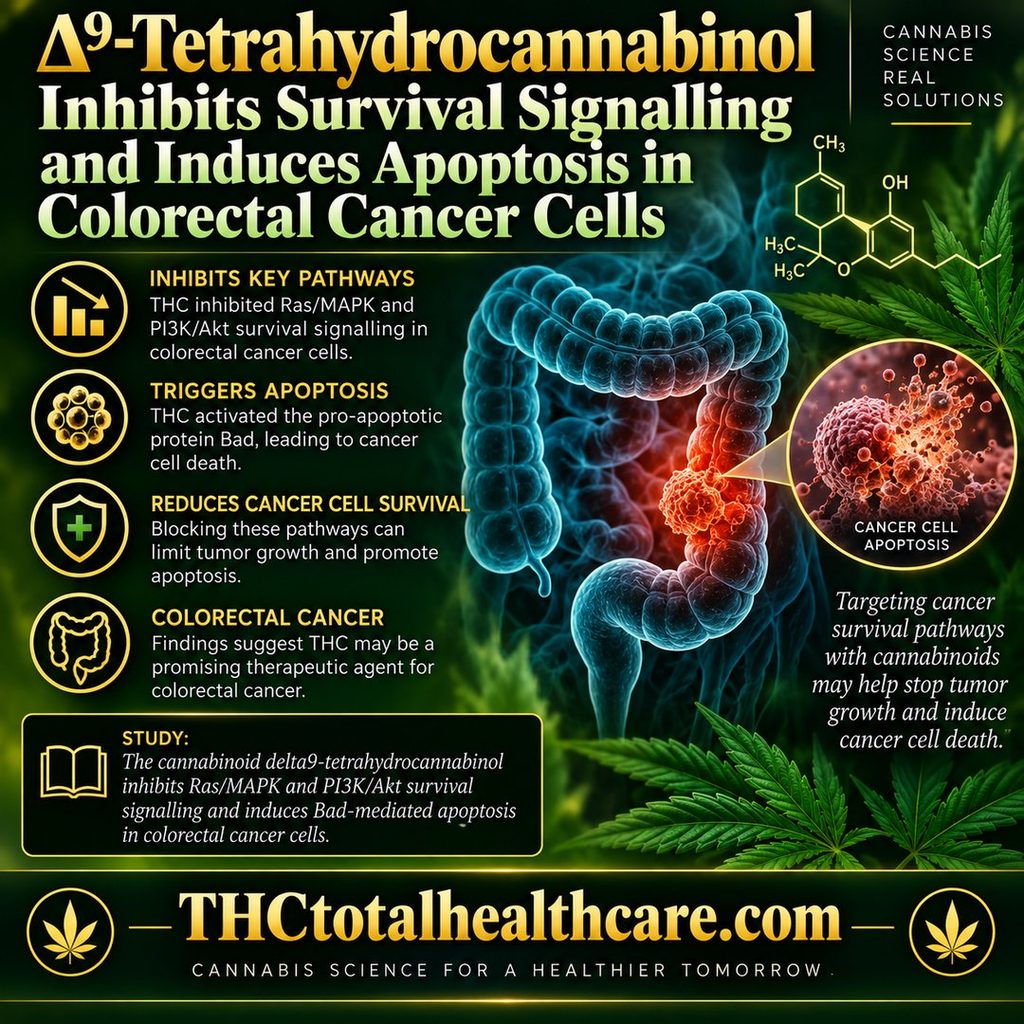
The cannabinoid delta(9)-tetrahydrocannabinol inhibits RAS-MAPK and PI3K-AKT survival signalling and induces BAD-mediated apoptosis in colorectal cancer cells.

“Deregulation of cell survival pathways and resistance to apoptosis are widely accepted to be fundamental aspects of tumorigenesis.

As in many tumours, the aberrant growth and survival of colorectal tumour cells is dependent upon a small number of highly activated signalling pathways, the inhibition of which elicits potent growth inhibitory or apoptotic responses in tumour cells. Accordingly, there is considerable interest in therapeutics that can modulate survival signalling pathways and target cancer cells for death.

There is emerging evidence that cannabinoids, especially Delta(9)-tetrahydrocannabinol (THC), may represent novel anticancer agents, due to their ability to regulate signalling pathways critical for cell growth and survival.

Here, we report that CB1 and CB2 cannabinoid receptors are expressed in human colorectal adenoma and carcinoma cells, and show for the first time that THC induces apoptosis in colorectal cancer cells.

THC-induced apoptosis was rescued by pharmacological blockade of the CB1, but not CB2, cannabinoid receptor. Importantly, THC treatment resulted in CB1-mediated inhibition of both RAS-MAPK/ERK and PI3K-AKT survival signalling cascades; two key cell survival pathways frequently deregulated in colorectal tumours. The inhibition of ERK and AKT activity by THC was accompanied by activation of the proapoptotic BCL-2 family member BAD. Reduction of BAD protein expression by RNA interference rescued colorectal cancer cells from THC-induced apoptosis.

These data suggest an important role for CB1 receptors and BAD in the regulation of apoptosis in colorectal cancer cells.

The use of THC, or selective targeting of the CB1 receptor, may represent a novel strategy for colorectal cancer therapy.”

http://www.ncbi.nlm.nih.gov/pubmed/17583570

http://www.thctotalhealthcare.com/category/colon-cancer/

Need this THC study explained? thcXplained.com

Cannabinoid inhibits HIV-1 Tat-stimulated adhesion of human monocyte-like cells to extracellular matrix proteins.

“The aim of this study was to assess the effect of select cannabinoids on human immunodeficiency virus type 1 (HIV-1) transactivating (Tat) protein-enhanced monocyte-like cell adhesion to proteins of the extracellular matrix (ECM)…

KEY FINDINGS:

THC and CP55,940 inhibited Tat-enhanced attachment of U937 cells to ECM proteins in a mode that was linked to the cannabinoidreceptor type 2 (CB2R). The cannabinoid treatment of Tat-activated U937 cells was associated with altered β1-integrin expression and distribution of polymerized actin, suggesting a modality by which these cannabinoids inhibited adhesion to the ECM.

SIGNIFICANCE:

The blood-brain barrier (BBB) is a complex structure that is composed of cellular elements and an extracellular matrix (ECM). HIV-1 Tat promotes transmigration of monocytes across this barrier, a process that includes interaction with ECM proteins.

The results indicate that cannabinoids that activate the CB2R inhibit the ECM adhesion process. Thus, this receptor has potential to serve as a therapeutic agent for ablating neuroinflammation associated with HIV-elicited influx of monocytes across the BBB.”

http://www.ncbi.nlm.nih.gov/pubmed/24742657

http://www.thctotalhealthcare.com/category/hivaids/