
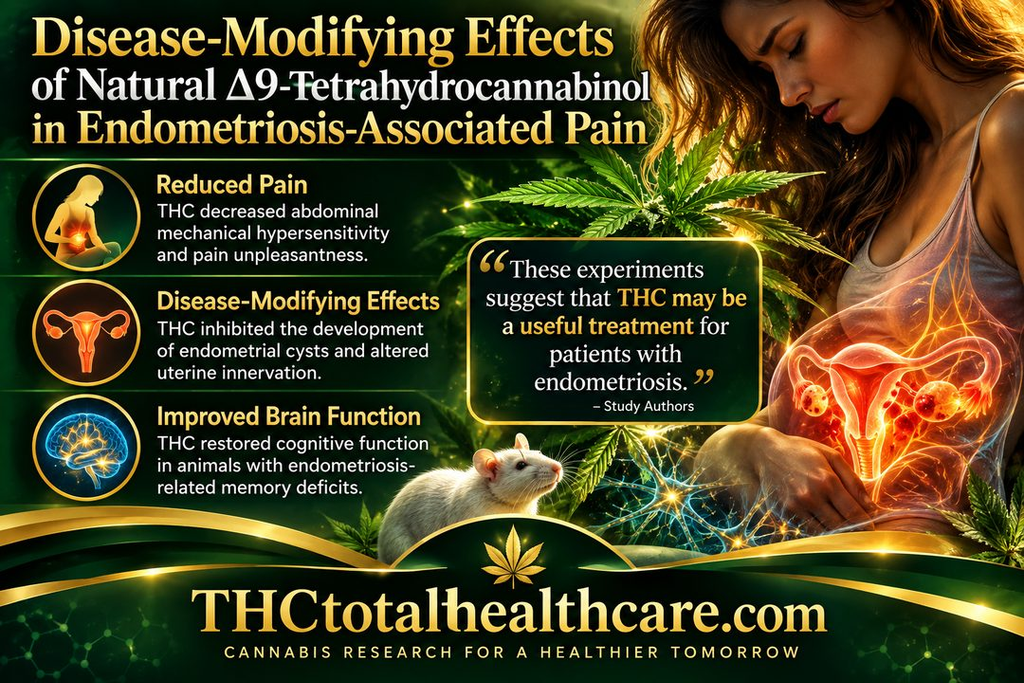
Disease-modifying effects of natural Δ9-tetrahydrocannabinol in endometriosis-associated pain.

In a mouse model of endometriosis, daily treatment with Δ9-THC reduced abdominal mechanical hypersensitivity and the unpleasantness associated with pain. THC also restored cognitive function in animals that had developed substantial memory deficits associated with endometriosis.

The effects went beyond pain relief. THC altered uterine innervation and, most notably, inhibited the development of endometrial cysts, suggesting a potential disease-modifying effect rather than simply masking symptoms.

These findings are important because endometriosis is a chronic condition in which pain, abnormal tissue growth, and neurological effects can all contribute to disease burden. The researchers concluded that the results support clinical investigation of THC as a potential treatment for women with endometriosis.

“Endometriosis is a chronic painful disease highly prevalent in women that is defined by growth of endometrial tissue outside the uterine cavity and lacks adequate treatment.

Medical use of cannabis derivatives is a current hot topic and it is unknown whether phytocannabinoids may modify endometriosis symptoms and development.

Here we evaluate the effects of repeated exposure to Δ9-tetrahydrocannabinol (THC) in a mouse model of surgically-induced endometriosis.

In this model, female mice develop mechanical hypersensitivity in the caudal abdomen, mild anxiety-like behavior and substantial memory deficits associated with the presence of extrauterine endometrial cysts.

Interestingly, daily treatments with THC (2 mg/kg) alleviate mechanical hypersensitivity and pain unpleasantness, modify uterine innervation and restore cognitive function without altering the anxiogenic phenotype. Strikingly, THC also inhibits the development of endometrial cysts.

These data highlight the interest of scheduled clinical trials designed to investigate possible benefits of THC for women with endometriosis.”

https://www.ncbi.nlm.nih.gov/pubmed/31931958

“These experiments suggest that THC may be a useful treatment for patients with endometriosis.”

https://elifesciences.org/articles/50356

Need this THC study explained? thcXplained.com
Targeting Cannabinoid Receptor Activation and BACE-1 Activity Counteracts TgAPP Mice Memory Impairment and Alzheimer’s Disease Lymphoblast Alterations.

“Alzheimer’s disease (AD), the leading cause of dementia in the elderly, is a neurodegenerative disorder marked by progressive impairment of cognitive ability. Patients with AD display neuropathological lesions including senile plaques, neurofibrillary tangles, and neuronal loss.

There are no disease-modifying drugs currently available. With the number of affected individuals increasing dramatically throughout the world, there is obvious urgent need for effective treatment strategy for AD.

The multifactorial nature of AD encouraged the development of multifunctional compounds, able to interact with several putative targets. Here, we have evaluated the effects of two in-house designed cannabinoid receptors (CB) agonists showing inhibitory actions on β-secretase-1 (BACE-1) (NP137) and BACE-1/butyrylcholinesterase (BuChE) (NP148), on cellular models of AD, including immortalized lymphocytes from late-onset AD patients.

We report here that NP137 and NP148 showed neuroprotective effects in amyloid-β-treated primary cortical neurons, and NP137 in particular rescued the cognitive deficit of TgAPP mice. The latter compound was able to blunt the abnormal cell response to serum addition or withdrawal of lymphoblasts derived from AD patients.

It is suggested that NP137 could be a good drug candidate for future treatment of AD.”

https://www.ncbi.nlm.nih.gov/pubmed/31898159

https://link.springer.com/article/10.1007%2Fs12035-019-01813-4

“The ideal treatment for AD should be able to modulate the disease through multiple mechanisms rather than targeting a single dysregulated pathway.” http://www.ncbi.nlm.nih.gov/pubmed/25147120

“These sets of data strongly suggest that THC could be a potential therapeutic treatment option for Alzheimer’s disease through multiple functions and pathways.” http://www.ncbi.nlm.nih.gov/pubmed/25024327

“In fact, exogenous and endogenous cannabinoids seem to be able to modulate multiple processes in AD” http://www.ncbi.nlm.nih.gov/pubmed/25147120

“Our results indicate that cannabinoid receptors are important in the pathology of AD and that cannabinoids succeed in preventing the neurodegenerative process occurring in the disease.” http://www.ncbi.nlm.nih.gov/pubmed/15728830

“Based on the complex pathology of AD, a preventative, multimodal drug approach targeting a combination of pathological AD symptoms appears ideal. Importantly, cannabinoids show anti-inflammatory, neuroprotective and antioxidant properties and have immunosuppressive effects.” http://www.ncbi.nlm.nih.gov/pubmed/22448595

“CBD treatment would be in line with preventative, multimodal drug strategies targeting a combination of pathological symptoms, which might be ideal for AD therapy.” http://www.ncbi.nlm.nih.gov/pubmed/27471947

Cannabinoids and Opioids in the Treatment of Inflammatory Bowel Diseases.

Image result for clinical and translational gastroenterology“In traditional medicine, Cannabis sativa has been prescribed for a variety of diseases. Today, the plant is largely known for its recreational purpose, but it may find a way back to what it was originally known for: a herbal remedy. Most of the plant’s ingredients, such as Δ-tetrahydrocannabinol, cannabidiol, cannabigerol, and others, have demonstrated beneficial effects in preclinical models of intestinal inflammation. Endogenous cannabinoids (endocannabinoids) have shown a regulatory role in inflammation and mucosal permeability of the gastrointestinal tract where they likely interact with the gut microbiome. Anecdotal reports suggest that in humans, Cannabis exerts antinociceptive, anti-inflammatory, and antidiarrheal properties. Despite these reports, strong evidence on beneficial effects of Cannabis in human gastrointestinal diseases is lacking. Clinical trials with Cannabis in patients suffering from inflammatory bowel disease (IBD) have shown improvement in quality of life but failed to provide evidence for a reduction of inflammation markers. Within the endogenous opioid system, mu opioid receptors may be involved in anti-inflammation of the gut. Opioids are frequently used to treat abdominal pain in IBD; however, heavy opioid use in IBD is associated with opioid dependency and higher mortality. This review highlights latest advances in the potential treatment of IBD using Cannabis/cannabinoids or opioids.”

https://www.ncbi.nlm.nih.gov/pubmed/31899693

https://journals.lww.com/ctg/Abstract/latest/Cannabinoids_and_Opioids_in_the_Treatment_of.99898.aspx

Effect of combined doses of Δ9-tetrahydrocannabinol and cannabidiol or tetrahydrocannabinolic acid and cannabidiolic acid on acute nausea in male Sprague-Dawley rats.

 “This study evaluated the potential of combined cannabis constituents to reduce nausea.
CONCLUSION:

Combinations of very low doses of CBD + THC or CBDA + THCA robustly reduce LiCl-induced conditioned gaping. Clinical trials are necessary to determine the efficacy of using single or combined cannabinoids as adjunct treatments with existing anti-emetic regimens to manage chemotherapy-induced nausea.”

https://www.ncbi.nlm.nih.gov/pubmed/31897571

https://link.springer.com/article/10.1007%2Fs00213-019-05428-4

Cannabis for Pediatric Epilepsy.

 Related image“Epilepsy is a chronic disease characterized by recurrent unprovoked seizures. Up to 30% of children with epilepsy will be refractory to standard anticonvulsant therapy, and those with epileptic encephalopathy can be particularly challenging to treat.

The endocannabinoid system can modulate the physiologic processes underlying epileptogenesis. The anticonvulsant properties of several cannabinoids, namely Δ-tetrahydrocannabinol and cannabidiol (CBD), have been demonstrated in both in vitro and in vivo studies.

Cannabis-based therapies have been used for millennia to treat a variety of diseases including epilepsy. Several studies have shown that CBD, both in isolation as a pharmaceutical-grade preparation or as part of a CBD-enriched cannabis herbal extract, is beneficial in decreasing seizure frequency in children with treatment-resistant epilepsy.

Overall, cannabis herbal extracts appear to provide greater efficacy in decreasing seizure frequency, but the studies assessing cannabis herbal extract are either retrospective or small-scale observational studies. The two large randomized controlled studies assessing the efficacy of pharmaceutical-grade CBD in children with Dravet and Lennox-Gastaut syndromes showed similar efficacy to other anticonvulsants. Lack of data regarding appropriate dosing and pediatric pharmacokinetics continues to make authorization of cannabis-based therapies to children with treatment-resistant epilepsy challenging.”

https://www.ncbi.nlm.nih.gov/pubmed/31895184

https://insights.ovid.com/crossref?an=00004691-202001000-00002

Medical Cannabis Use in Palliative Care: Review of Clinical Effectiveness and Guidelines – An Update [Internet].

Cover of Medical Cannabis Use in Palliative Care: Review of Clinical Effectiveness and Guidelines – An Update“Palliative care is defined by the World Health Organization as “an approach that improves the quality of life of patients and their families facing the problem associated with life-threatening illness…”. The last days and hours of a person’s life can be associated with immense physical as well as emotional suffering Relief of pain and other distressing symptoms, and enhancement of quality of life, are among the essential elements of good palliative care. Palliative care could benefit an estimated 69% to 82% of dying individuals in Canada. As Canada’s population ages, with increasing prevalence of chronic conditions and treatments resulting in prolonged life, it is expected that there will be an increased need for palliative care services.
Approximately 9% of Canadians (or 2.7 million) reported using cannabis for medical purposes in the first half of 2019. Herbal cannabis (cannabis sativa) contains hundreds of pharmacological components, many of which are not well-characterized. Tetrahydrocannabinol (THC) is the most prevalent pharmacologically active compound and is primarily responsible for the psychoactive and physical effects of cannabis. Cannabidiol (also commonly referred to as CBD) is the second most prevalent. It has very little if any psychotropic effects. Quantity and ratio of these and other components can vary considerably between plants and even within the same plant.

Two prescription cannabinoids are currently marketed in Canada: Nabiximols (Sativex) which contains THC and cannabidiol, and Nabilone (Cesamet) which is a synthetic cannabinoid. Dronabinol (Marinol), synthetic THC, was withdrawn from the Canadian market however it is available in other jurisdictions. For the purposes of this report, medical cannabis refers to use of the cannabis plant or its extracts or synthetic cannabinoids for medical purposes.

Medical cannabis may be of value for a number of conditions, including but not limited to pain, nausea and vomiting, depression, anxiety and appetite stimulation. Adverse effects of cannabis are very common, developing in 80% to 90% of patients. These include but are not limited to psychiatric disturbances, sedation, speech disorders, impaired memory, dizziness, ataxia, addiction, irritability, and driving impairment. Risk of adverse effects is likely lower with cannabidiol alone as compared to THC. The potential for drug interactions is also an important concern. These risks must be considered along with the an apparent lack of evidence surrounding effectiveness of medical cannabis in many conditions for which its use is promoted.

This report updates and expands on a previous summary of abstracts report.9 The objective of the report is to review evidence and guidelines for use of medical cannabis in the palliative care setting.”

https://www.ncbi.nlm.nih.gov/pubmed/31873991

https://www.ncbi.nlm.nih.gov/books/NBK551867/

Medicinal and Synthetic Cannabinoids for Pediatric Patients: A Review of Clinical Effectiveness and Guidelines [Internet].

Cover of Medicinal and Synthetic Cannabinoids for Pediatric Patients: A Review of Clinical Effectiveness and Guidelines“Cannabinoids are pharmacologically active agents extracted from the cannabis plant. Cannabidiol and tetrahydrocannabinol (THC) are the most studied cannabinoids and both interact with endocannabinoid receptors in various human tissues. The endocannabinoid system moderates physiological functions, such as neurodevelopment, cognition, and motor control.

The products naturally derived from cannabis include marijuana (dried leaves and flowers, mostly for smoking) and oral cannabinoid extracts with varying concentrations of cannabinoids, including cannabidiol and THC. THC is the main psychoactive constituent and cannabidiol seems to have no psychoactive properties. In addition, there are two synthetical cannabinoids approved by the Food and Drug Administration (FDA) in the United States, dronabinol and nabilone, which are molecules similar to a type of THC (δ-9-THC)1 Nabilone is also approved in Canada. Dronabinol is indicated for chemotherapy-induced nausea and vomiting in children. The use of nabilone in children is not recommended.

In Canada, the minimum age for cannabis consumption varies by provinces and territories, and is either 18 or 19 years. A prescription is required to administer cannabinoids among children. Clinically, cannabis has been used to treat children with epilepsy, cancer palliation and primary treatment, chronic pain, and Parkinson disease.

The adverse events that clinicians need to monitor for include negative psychoactive sequelae and development of tolerance. Psychoactive sequelae may be positive, such as relaxation and euphoria, or negative, such as anxiety and irritability. In 2016, CADTH completed a Summary of Abstracts report on the use of cannabis in children with medical conditions such as attention deficit hyperactivity disorder, autism spectrum disorder, Tourette syndrome, epilepsy, posttraumatic stress disorder, or neurodegenerative diseases, and five non-randomized studies were identified. However, there were no control groups in the five studies included in the report.

It is unclear whether there is new evidence or clinical guidance for the use of medical cannabis in children with mental health conditions, neurodegenerative diseases, or pain disorders, particularly in comparison with other possible therapies for those conditions. There is a need to review the clinical effectiveness of cannabis for pediatric care, as well as clinical guidelines.”

https://www.ncbi.nlm.nih.gov/pubmed/31873990

https://www.ncbi.nlm.nih.gov/books/NBK551866/

Cannabis and Neuropsychiatric Disorders: An Updated Review.

 Image result for Acta Neurol Taiwan. journal“Cannabis plant has the scientific name called Cannabis sativa L. Cannabis plant has many species, but there are three main species including Cannabis sativa, Cannabis indica and Cannabis ruderalis. Over 70 compounds isolated from cannabis species are called cannabinoids (CBN).

Cannabinoids produce over 100 naturally occurring chemicals. The most abundant chemicals are delta-9-tetrahydrocannabinol (THC) and Cannabidiol (CBD). THC is psychotropic chemical that makes people feel “high” while CBD is nonpsychotropic chemical. However, cannabinoid chemicals are not found only in the cannabis plant, they are also produced by the mammalian body, called endocannabinoids and in the laboratory, called synthesized cannabinoids.

Endocannabinoids are endogenous lipid-based retrograde neurotransmitters that bind to cannabinoid receptors, and cannabinoid receptor proteins that are expressed throughout the mammalian central nervous system including brain and peripheral nervous system. There are at least two types of endocannabinoid receptors (CB1 and CB2) which are G-protein coupled receptors.

CB1 receptors are particularly abundant in the frontal cortex, hippocampus, basal ganglia, hypothalamus and cerebellum, spinal cord and peripheral nervous system. They are present in inhibitory GABA-ergic neurons and excitatory glutamatergic neurons. CB2 receptor is most abundantly found on cells of the immune system, hematopoietic cells and glia cells. CB2 is mainly expressed in the periphery under normal healthy condition, but in conditions of disease or injury, this upregulation occurs within the brain, and CB2 is therefore expressed in the brain in unhealthy states.

Cannabis and cannabinoid are studied in different medical conditions. The therapeutic potentials of both cannabis and cannabinoid are related to the effects of THC, CBD and other cannabinoid compounds. However, the “high” effect of THC in cannabis and cannabinoid may limit the clinical use, particularly, the study on the therapeutic potential of THC alone is more limited.

This review emphasizes the therapeutic potential of CBD and CBD with THC. CBD has shown to have benefit in a variety of neuropsychiatric disorders including autism spectrum disorder, anxiety, psychosis, neuropathic pain, cancer pain, HIV, migraine, multiple sclerosis, Alzheimer disease, Parkinson disease, Huntington disease, hypoxic-ischemic injury and epilepsy. CBD is generally well tolerated. Most common adverse events are diarrhea and somnolence. CBD also shows significantly low abuse potential.”

https://www.ncbi.nlm.nih.gov/pubmed/31867704

THC exposure during adolescence does not modify nicotine reinforcing effects and relapse in adult male mice.

 “This study investigated the effects of adolescent exposure to the main psychoactive component of cannabis, ∆9-tetrahydrocannabinol (THC), in the reinforcing properties of nicotine in adult male mice. Possible alterations in relapse to nicotine-seeking behaviour in adult animals due to THC adolescent exposure were also evaluated.

RESULTS:

Adolescent THC treatment did not modify acquisition and extinction of nicotine self-administration in adulthood. Moreover, THC exposure did not alter relapse to nicotine seeking induced by stress or nicotine-associated cues.

CONCLUSIONS:

These results suggest that a history of exposure to THC during adolescence under these particular conditions does not modify the reinforcing effects and seeking behaviour of nicotine in the adult period.”

https://www.ncbi.nlm.nih.gov/pubmed/31858159

https://link.springer.com/article/10.1007%2Fs00213-019-05416-8

Cannabinoids and the expanded endocannabinoid system in neurological disorders.

 Related image“Anecdotal evidence that cannabis preparations have medical benefits together with the discovery of the psychotropic plant cannabinoid Δ9-tetrahydrocannabinol (THC) initiated efforts to develop cannabinoid-based therapeutics.

These efforts have been marked by disappointment, especially in relation to the unwanted central effects that result from activation of cannabinoid receptor 1 (CB1), which have limited the therapeutic use of drugs that activate or inactivate this receptor.

The discovery of CB2 and of endogenous cannabinoid receptor ligands (endocannabinoids) raised new possibilities for safe targeting of this endocannabinoid system. However, clinical success has been limited, complicated by the discovery of an expanded endocannabinoid system – known as the endocannabinoidome – that includes several mediators that are biochemically related to the endocannabinoids, and their receptors and metabolic enzymes.

The approvals of nabiximols, a mixture of THC and the non-psychotropic cannabinoid cannabidiol, for the treatment of spasticity and neuropathic pain in multiple sclerosis, and of purified botanical cannabidiol for the treatment of otherwise untreatable forms of paediatric epilepsy, have brought the therapeutic use of cannabinoids and endocannabinoids in neurological diseases into the limelight.

In this Review, we provide an overview of the endocannabinoid system and the endocannabinoidome before discussing their involvement in and clinical relevance to a variety of neurological disorders, including Parkinson disease, Alzheimer disease, Huntington disease, multiple sclerosis, amyotrophic lateral sclerosis, traumatic brain injury, stroke, epilepsy and glioblastoma.”

https://www.ncbi.nlm.nih.gov/pubmed/31831863

“The existence of the endocannabinoidome explains in part why some non-euphoric cannabinoids, which affect several endocannabinoidome proteins, are useful for the treatment of neurological disorders, such as multiple sclerosis and epilepsy.”

https://www.nature.com/articles/s41582-019-0284-z