
A critical review of the antipsychotic effects of cannabidiol: 30 years of a translational investigation.

Abstract

“Δ 9-tetrahydrocannabinol (Δ 9-THC) is the main compound of the Cannabis Sativa responsible for most of the effects of the plant. Another major constituent is cannabidiol (CBD), formerly regarded to be devoid of pharmacological activity. However, laboratory rodents and human studies have shown that this cannabinoid is able to prevent psychotic-like symptoms induced by high doses of Δ 9- THC. Subsequent studies have demonstrated that CBD has antipsychotic effects as observed using animal models and in healthy volunteers. Thus, this article provides a critical review of the research evaluating antipsychotic potential of this cannabinoid. CBD appears to have pharmacological profile similar to that of atypical antipsychotic drugs as seem using behavioral and neurochemical techniques in animal models. Additionally, CBD prevented human experimental psychosis and was effective in open case reports and clinical trials in patients with schizophrenia with a remarkable safety profile. Moreover, fMRI results strongly suggest that the antipsychotic effects of CBD in relation to the psychotomimetic effects of Δ 9-THC involve the striatum and temporal cortex that have been traditionally associated with psychosis. Although the mechanisms of the antipsychotic properties are still not fully understood, we propose a hypothesis that could have a heuristic value to inspire new studies. These results support the idea that CBD may be a future therapeutic option in psychosis, in general and in schizophrenia, in particular.”

http://www.ncbi.nlm.nih.gov/pubmed/22716160

Safety and side effects of cannabidiol, a Cannabis sativa constituent.

“Cannabidiol (CBD), a major nonpsychotropic constituent of Cannabis, has multiple pharmacological actions, including anxiolytic, antipsychotic, antiemetic and anti-inflammatory properties. However, little is known about its safety and side effect profile in animals and humans. This review describes in vivo and in vitro reports of CBD administration across a wide range of concentrations, based on reports retrieved from Web of Science, Scielo and Medline. The keywords searched were “cannabinoids”, “cannabidiol” and “side effects”. Several studies suggest that CBD is non-toxic in non-transformed cells and does not induce changes on food intake, does not induce catalepsy, does not affect physiological parameters (heart rate, blood pressure and body temperature), does not affect gastrointestinal transit and does not alter psychomotor or psychological functions. Also, chronic use and high doses up to 1,500 mg/day of CBD are reportedly well tolerated in humans. Conversely, some studies reported that this cannabinoid can induce some side effects, including inhibition of hepatic drug metabolism, alterations of in vitro cell viability, decreased fertilization capacity, and decreased activities of p-glycoprotein and other drug transporters. Based on recent advances in cannabinoid administration in humans, controlled CBD may be safe in humans and animals. However, further studies are needed to clarify these reported in vitro and in vivo side effects.”

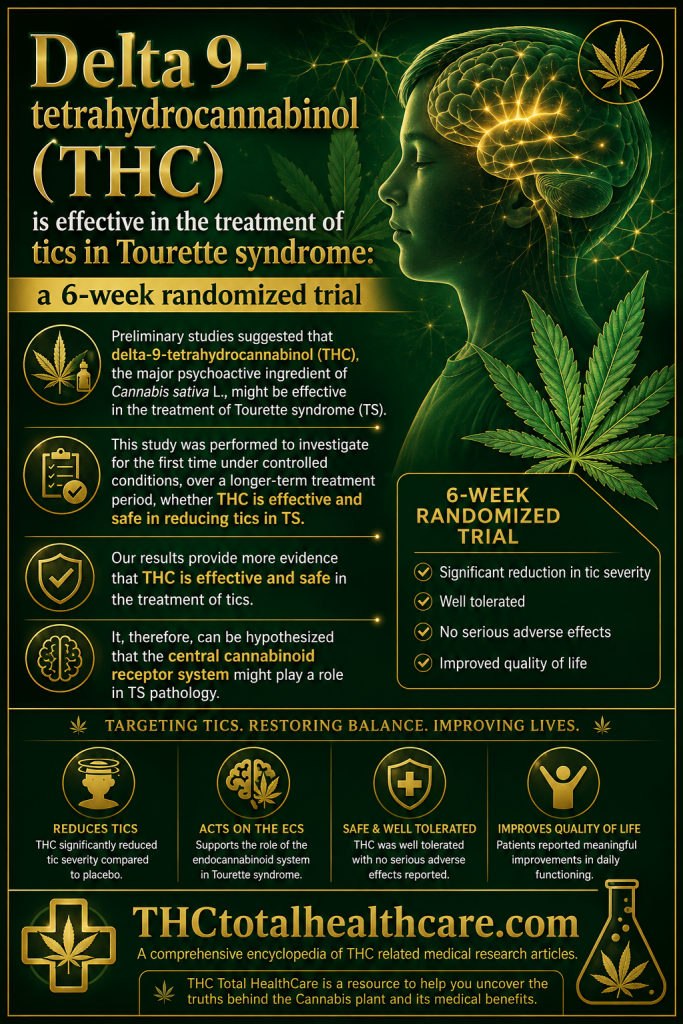
Delta 9-tetrahydrocannabinol (THC) is effective in the treatment of tics in Tourette syndrome: a 6-week randomized trial.

A randomized, double-blind clinical trial found that delta-9-tetrahydrocannabinol (THC) reduced tic severity in people with Tourette syndrome. Participants received THC for six weeks, and researchers reported improvement in several measures of motor and vocal tics compared with placebo. The study also found that THC was generally well tolerated, adding clinical evidence that the endocannabinoid system may play an important role in Tourette syndrome and tic control.

“Preliminary studies suggested that delta-9-tetrahydrocannabinol (THC), the major psychoactive ingredient of Cannabis sativa L., might be effective in the treatment of Tourette syndrome (TS).

This study was performed to investigate for the first time under controlled conditions, over a longer-term treatment period, whether THC is effective and safe in reducing tics in TS.

CONCLUSION:

Our results provide more evidence that THC is effective and safe in the treatment of tics. It, therefore, can be hypothesized that the central cannabinoid receptor system might play a role in TS pathology.”

https://www.ncbi.nlm.nih.gov/pubmed/12716250

“Our results provide more evidence that THC is effective and safe in the treatment of tics.” http://www.psychiatrist.com/jcp/article/Pages/2003/v64n04/v64n0417.aspx

Need this THC study explained?  thcXplained.com

Treatment of Tourette Syndrome with Delta-9-Tetrahydrocannabinol (9-THC): No Influence on Neuropsychological Performance

“Previous studies provide evidence that marijuana (Cannabis sativa) and delta-9-tetrahydrocannabinol (Delta(9)-THC), the major psychoactive ingredient of marijuana, respectively, are effective in the treatment of tics and behavioral problems in Tourette syndrome (TS). It, therefore, has been speculated that the central cannabinoid receptor system might be involved in TS pathology. However, in healthy marijuana users there is an ongoing debate as to whether the use of cannabis causes acute and/or long-term cognitive deficits. In this randomized double-blind placebo-controlled study, we investigated the effect of a treatment with up to 10 mg Delta(9)-THC over a 6-week period on neuropsychological performance in 24 patients suffering from TS. During medication and immediately as well as 5-6 weeks after withdrawal of Delta(9)-THC treatment, no detrimental effect was seen on learning curve, interference, recall and recognition of word lists, immediate visual memory span, and divided attention. Measuring immediate verbal memory span, we even found a trend towards a significant improvement during and after treatment. Results from this study corroborate previous data suggesting that in patients suffering from TS, treatment with Delta(9)-THC causes neither acute nor long-term cognitive deficits. Larger and longer-duration controlled studies are recommended to provide more information on the adverse effect profile of THC in patients suffering from TS.”

“Anecdotal reports and two controlled studies provide evidence that marijuana (Cannabis sativa) and delta-9-tetrahydrocannabinol (THC), the major psychoactive ingredient of marijuana, respectively, are effective in the treatment of tics and behavioral problems in TS.”

“In conclusion, our data are in agreement with anecdotal reports and a pilot study suggesting that -THC treatment in patients suffering from TS has no detrimental effect on neuropsychological performance. We hypothesize that the effects of -THC on cognition in TS patients might be different from those in healthy marijuana users because of the pathology of the disease. Since there is evidence that tics can be improved by THC, an involvement of the central CB1 receptor system in TS pathology has been suggested. However, larger and longer-duration controlled studies are recommended to provide more information on the adverse effect profile of THC in patients suffering from TS.”

http://www.nature.com/npp/journal/v28/n2/full/1300047a.html

Influence of treatment of Tourette syndrome with delta9-tetrahydrocannabinol (delta9-THC) on neuropsychological performance.

Abstract

“Previous studies have suggested that marijuana (cannabis sativa) and delta-9-tetrahydrocannabinol (delta9-THC), the major psychoactive ingredient of marijuana, are effective in the therapy of tics and associated behavioral disorders in Tourette Syndrome (TS). Because there is also evidence that cannabis sativa may cause cognitive impairment in healthy users, we performed a randomized double-blind placebo-controlled crossover trial for delta9-THC in 12 adult TS patients to investigate whether treatment of TS with a single dose of delta9-THC at 5.0 to 10.0 mg causes significant side effects on neuropsychological performance. Using a variety of neuropsychological tests, we found no significant differences after treatment with delta9-THC compared to placebo treatment in verbal and visual memory, reaction time, intelligence, sustained attention, divided attention, vigilance, or mood. Only when using the Symptom Checklist 90-R (SCL-90-R) did our data provide evidence for a deterioration of obsessive-compulsive behavior (OCB) and a trend towards an increase in phobic anxiety. However, these results should be interpreted with caution as SCL-90-R has known limitations on measuring OCB. We suggest that the increase in phobic anxiety is mainly due to the fact that a single-dose treatment rules out the possibility of administering the dosage slowly. In contrast to results obtained from healthy marijuana users, a single-dose treatment with delta9-THC in patients suffering from TS does not cause cognitive impairment. We therefore suggest that further investigations should concentrate on the effects of a longer-term therapy of TS with delta9-THC.”

http://www.ncbi.nlm.nih.gov/pubmed/11229617