The Role of Cannabidiol (CBD) in Chronic Pain Management: An Assessment of Current Evidence.

 “Given the growing challenges in chronic pain management coupled with the ongoing consequences of the opioid epidemic, pain management practitioners are looking into more effective, innovative, and safer alternatives to treat pain.

Cannabis-based medicine had been described for hundreds of years but only recently have we seen the more scientific, evidence-based approach to its use, and ongoing investigations continue to explore its potential medical benefits.

While historically more attention has been paid to the psychoactive component of the cannabis plant Δ9-tetrahydrocannabinol (THC), there have been fewer scientific studies on the medical use of the cannabidiol (CBD) – a non-psychoactive component of the cannabis plant.

RECENT FINDINGS:

By examining recent literature, we investigated the use of CBD and its potential role in pain management. Since there are currently no approved pharmaceutical products that contain CBD alone for the management of pain, this review focused on nabiximols (which is a combined product of THC/CBD in a 1:1 ratio) as the only pharmaceutical product available that contains CBD and is being used for the management of pain.

It is difficult to definitely attribute the therapeutic properties to CBD alone since it is always administered with THC.

Based on the available literature, it is difficult to make a recommendation for the use of CBD in chronic pain management. It is also important to note that there are many CBD products currently available as supplements, but these products are non-pharmaceuticals and lack the appropriate clinical studies to support their efficacy claims.”

https://www.ncbi.nlm.nih.gov/pubmed/31980957 

https://link.springer.com/article/10.1007%2Fs11916-020-0835-4

Phytocannabinoids in Neurological Diseases: Could They Restore a Physiological GABAergic Transmission?

ijms-logo“γ-Aminobutyric acid type A receptors (GABAARs) are the main inhibitory mediators in the central nervous system (CNS). GABAARs are pentameric ligand gated ion channels, and the main subunit composition is usually 2α2βγ, with various isotypes assembled within a set of 19 different subunits. The inhibitory function is mediated by chloride ion movement across the GABAARs, activated by synaptic GABA release, reducing neuronal excitability in the adult CNS. Several studies highlighted the importance of GABA-mediated transmission during neuro-development, and its involvement in different neurological and neurodevelopmental diseases, from anxiety to epilepsy. However, while it is well known how different classes of drugs are able to modulate the GABAARs function (benzodiazepines, barbiturates, neurosteroids, alcohol), up to now little is known about GABAARs and cannabinoids interaction in the CNS. Endocannabinoids and phytocannabinoids are lately emerging as a new class of promising drugs for a wide range of neurological conditions, but their safety as medication, and their mechanisms of action are still to be fully elucidated. In this review, we will focus our attention on two of the most promising molecules (Δ9-tetrahydrocannabinol; Δ9-THC and cannabidiol; CBD) of this new class of drugs and their possible mechanism of action on GABAARs.”

https://www.ncbi.nlm.nih.gov/pubmed/31979108

https://www.mdpi.com/1422-0067/21/3/723

Allosteric Cannabinoid Receptor 1 (CB1) Ligands Reduce Ocular Pain and Inflammation.

molecules-logo“Cannabinoid receptor 1 (CB1) activation has been reported to reduce transient receptor potential cation channel subfamily V member 1 (TRPV1)-induced inflammatory responses and is anti-nociceptive and anti-inflammatory in corneal injury.

We examined whether allosteric ligands, can modulate CB1 signaling to reduce pain and inflammation in corneal hyperalgesia.

Corneal hyperalgesia was generated by chemical cauterization of cornea in wildtype and CB2 knockout (CB2-/-) mice. The novel racemic CB1 allosteric ligand GAT211 and its enantiomers GAT228 and GAT229 were examined alone or in combination with the orthosteric CB1 agonist Δ8-tetrahydrocannabinol (Δ8-THC). Pain responses were assessed following capsaicin (1 µM) stimulation of injured corneas at 6 h post-cauterization. Corneal neutrophil infiltration was also analyzed. GAT228, but not GAT229 or GAT211, reduced pain scores in response to capsaicin stimulation.

Combination treatments of 0.5% GAT229 or 1% GAT211 with subthreshold Δ8-THC (0.4%) significantly reduced pain scores following capsaicin stimulation. The anti-nociceptive effects of both GAT229 and GAT228 were blocked with CB1 antagonist AM251, but remained unaffected in CB2-/- mice. Two percent GAT228, or the combination of 0.2% Δ8-THC with 0.5% GAT229 also significantly reduced corneal inflammation.

CB1 allosteric ligands could offer a novel approach for treating corneal pain and inflammation.”

https://www.ncbi.nlm.nih.gov/pubmed/31968549

https://www.mdpi.com/1420-3049/25/2/417

The effect of orally administered dronabinol on optic nerve head blood flow in healthy subjects- a randomized clinical trial.

Publication cover image“It has been hypothesized that besides its intraocular pressure (IOP) lowering potential, tetrahydrocannabinol (THC) may also improve ocular hemodynamics.

The aim of the present study was to investigate whether single oral administration of dronabinol, a synthetic THC, alters optic nerve head blood flow (ONHBF) and its regulation in healthy subjects.

The study was carried out in a randomized, placebo-controlled, double-masked, two-way crossover design in twenty-four healthy subjects. For each study participant, two study days were scheduled, on which they either received capsules containing 5mg dronabinol or placebo. ONHBF was measured with laser Doppler flowmetry at rest and while the study participants performed isometric exercise for six minutes to increase mean arterial blood pressure (MAP). This was repeated one hour after drug intake. Ocular perfusion pressure (OPP) was calculated as 2/3MAP-IOP.

Dronabinol was well tolerated and no cannabinoid-related psychoactive effects were reported.

Neither administration of dronabinol nor placebo had an effect on IOP, MAP or OPP. In contrast, dronabinol significantly increased ONHBF at rest by 9.5±8.1% whereas placebo did not show a change in ONHBF (0.3±7.4% vs. baseline, p<0.001 between study days). Dronabinol did not alter the autoregulatory response of ONHBF to isometric exercise.

In conclusion, the present data indicate that low dose dronabinol increases ONHBF in healthy subjects without affecting IOP, OPP or inducing psychoactive side effects. In addition, dronabinol does not alter the autoregulatory response of ONHBF to an experimental increase in OPP. Further studies are needed to investigate whether this effect can also be observed in glaucoma patients.”

https://www.ncbi.nlm.nih.gov/pubmed/31977076

https://ascpt.onlinelibrary.wiley.com/doi/abs/10.1002/cpt.1797

Use of cannabinoids in cancer patients: A Society of Gynecologic Oncology (SGO) clinical practice statement.

Gynecologic Oncology“Tetrahydrocannabinol (THC), cannabidiol (CBD) and cannabinol (CBN) affect the human endocannabinoid system.

Cannabinoids reduce chemotherapy induced nausea or vomiting (CINV) and neuropathic pain.

Each state has its own regulations for medical and recreational cannabis use.

Effects of cannabinoids on chemotherapy, immunotherapy, and tumor growth remain under investigation.

Providers should focus indications, alternatives, risks and benefits of medical cannabis use to make appropriate referrals.”

https://www.ncbi.nlm.nih.gov/pubmed/31932107

https://www.gynecologiconcology-online.net/article/S0090-8258(19)31805-0/fulltext

Nightmares and the Cannabinoids.

“The cannabinoids, δ9 tetrahydrocannabinol and its analogue, nabilone, have been found to reliably attenuate the intensity and frequency of post-traumatic nightmares.

This essay examines how a traumatic event is captured in the mind after just a single exposure and repeatedly replicated during the nights that follow.

The adaptive neurophysiological, endocrine and inflammatory changes that are triggered by the trauma and that alter personality and behavior are surveyed. These adaptive changes, once established, can be difficult to reverse. But cannabinoids, uniquely, have been shown to interfere with all of these post-traumatic somatic adaptations.

While cannabinoids can suppress nightmares and other symptoms of the post-traumatic stress disorder, they are not a cure. There may be no cure.

The cannabinoids may best be employed, alone, but more likely in conjunction with other agents, in the immediate aftermath of a trauma to mitigate or even abort the metabolic changes which are set in motion by the trauma and which may permanently alter the reactivity of the nervous system. Steps in this direction have already been taken.”

https://www.ncbi.nlm.nih.gov/pubmed/31934840

http://www.eurekaselect.com/178302/article

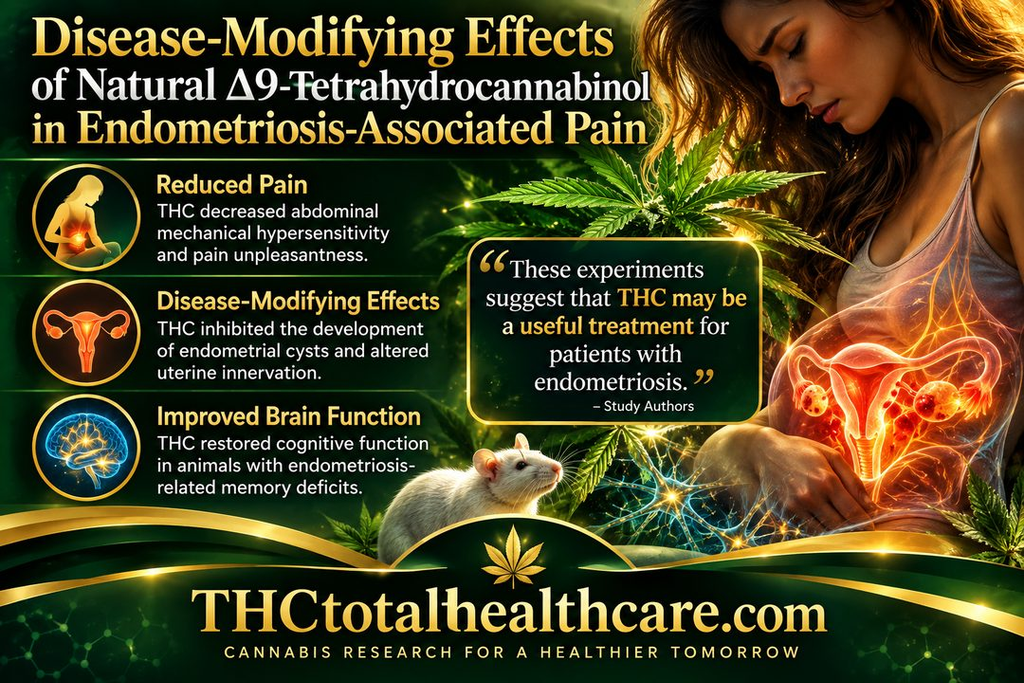
Disease-modifying effects of natural Δ9-tetrahydrocannabinol in endometriosis-associated pain.

In a mouse model of endometriosis, daily treatment with Δ9-THC reduced abdominal mechanical hypersensitivity and the unpleasantness associated with pain. THC also restored cognitive function in animals that had developed substantial memory deficits associated with endometriosis.

The effects went beyond pain relief. THC altered uterine innervation and, most notably, inhibited the development of endometrial cysts, suggesting a potential disease-modifying effect rather than simply masking symptoms.

These findings are important because endometriosis is a chronic condition in which pain, abnormal tissue growth, and neurological effects can all contribute to disease burden. The researchers concluded that the results support clinical investigation of THC as a potential treatment for women with endometriosis.

“Endometriosis is a chronic painful disease highly prevalent in women that is defined by growth of endometrial tissue outside the uterine cavity and lacks adequate treatment.

Medical use of cannabis derivatives is a current hot topic and it is unknown whether phytocannabinoids may modify endometriosis symptoms and development.

Here we evaluate the effects of repeated exposure to Δ9-tetrahydrocannabinol (THC) in a mouse model of surgically-induced endometriosis.

In this model, female mice develop mechanical hypersensitivity in the caudal abdomen, mild anxiety-like behavior and substantial memory deficits associated with the presence of extrauterine endometrial cysts.

Interestingly, daily treatments with THC (2 mg/kg) alleviate mechanical hypersensitivity and pain unpleasantness, modify uterine innervation and restore cognitive function without altering the anxiogenic phenotype. Strikingly, THC also inhibits the development of endometrial cysts.

These data highlight the interest of scheduled clinical trials designed to investigate possible benefits of THC for women with endometriosis.”

https://www.ncbi.nlm.nih.gov/pubmed/31931958

“These experiments suggest that THC may be a useful treatment for patients with endometriosis.”

https://elifesciences.org/articles/50356

Need this THC study explained? thcXplained.com

Cannabinoids and Opioids in the Treatment of Inflammatory Bowel Diseases.

Image result for clinical and translational gastroenterology“In traditional medicine, Cannabis sativa has been prescribed for a variety of diseases. Today, the plant is largely known for its recreational purpose, but it may find a way back to what it was originally known for: a herbal remedy. Most of the plant’s ingredients, such as Δ-tetrahydrocannabinol, cannabidiol, cannabigerol, and others, have demonstrated beneficial effects in preclinical models of intestinal inflammation. Endogenous cannabinoids (endocannabinoids) have shown a regulatory role in inflammation and mucosal permeability of the gastrointestinal tract where they likely interact with the gut microbiome. Anecdotal reports suggest that in humans, Cannabis exerts antinociceptive, anti-inflammatory, and antidiarrheal properties. Despite these reports, strong evidence on beneficial effects of Cannabis in human gastrointestinal diseases is lacking. Clinical trials with Cannabis in patients suffering from inflammatory bowel disease (IBD) have shown improvement in quality of life but failed to provide evidence for a reduction of inflammation markers. Within the endogenous opioid system, mu opioid receptors may be involved in anti-inflammation of the gut. Opioids are frequently used to treat abdominal pain in IBD; however, heavy opioid use in IBD is associated with opioid dependency and higher mortality. This review highlights latest advances in the potential treatment of IBD using Cannabis/cannabinoids or opioids.”

https://www.ncbi.nlm.nih.gov/pubmed/31899693

https://journals.lww.com/ctg/Abstract/latest/Cannabinoids_and_Opioids_in_the_Treatment_of.99898.aspx

Effect of combined doses of Δ9-tetrahydrocannabinol and cannabidiol or tetrahydrocannabinolic acid and cannabidiolic acid on acute nausea in male Sprague-Dawley rats.

 “This study evaluated the potential of combined cannabis constituents to reduce nausea.
CONCLUSION:

Combinations of very low doses of CBD + THC or CBDA + THCA robustly reduce LiCl-induced conditioned gaping. Clinical trials are necessary to determine the efficacy of using single or combined cannabinoids as adjunct treatments with existing anti-emetic regimens to manage chemotherapy-induced nausea.”

https://www.ncbi.nlm.nih.gov/pubmed/31897571

https://link.springer.com/article/10.1007%2Fs00213-019-05428-4

Cannabis for Pediatric Epilepsy.

 Related image“Epilepsy is a chronic disease characterized by recurrent unprovoked seizures. Up to 30% of children with epilepsy will be refractory to standard anticonvulsant therapy, and those with epileptic encephalopathy can be particularly challenging to treat.

The endocannabinoid system can modulate the physiologic processes underlying epileptogenesis. The anticonvulsant properties of several cannabinoids, namely Δ-tetrahydrocannabinol and cannabidiol (CBD), have been demonstrated in both in vitro and in vivo studies.

Cannabis-based therapies have been used for millennia to treat a variety of diseases including epilepsy. Several studies have shown that CBD, both in isolation as a pharmaceutical-grade preparation or as part of a CBD-enriched cannabis herbal extract, is beneficial in decreasing seizure frequency in children with treatment-resistant epilepsy.

Overall, cannabis herbal extracts appear to provide greater efficacy in decreasing seizure frequency, but the studies assessing cannabis herbal extract are either retrospective or small-scale observational studies. The two large randomized controlled studies assessing the efficacy of pharmaceutical-grade CBD in children with Dravet and Lennox-Gastaut syndromes showed similar efficacy to other anticonvulsants. Lack of data regarding appropriate dosing and pediatric pharmacokinetics continues to make authorization of cannabis-based therapies to children with treatment-resistant epilepsy challenging.”

https://www.ncbi.nlm.nih.gov/pubmed/31895184

https://insights.ovid.com/crossref?an=00004691-202001000-00002