
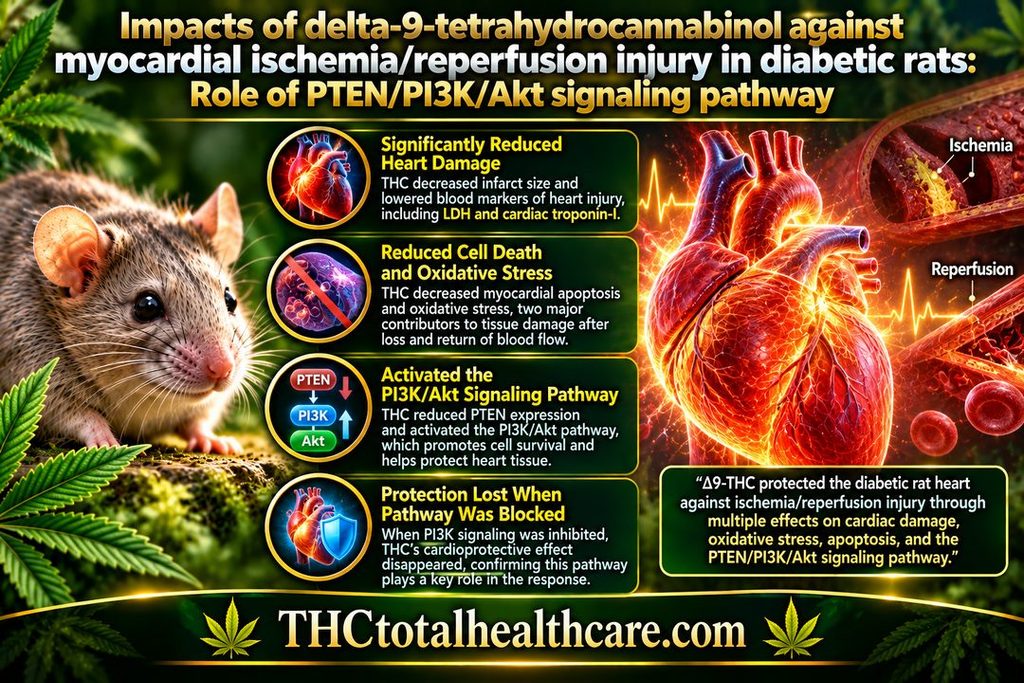
Impacts of delta 9-tetrahydrocannabinol against myocardial ischemia/reperfusion injury in diabetic rats: Role of PTEN/PI3K/Akt signaling pathway

In diabetic rats with myocardial ischemia/reperfusion injury, Δ9-THC significantly reduced heart damage and improved cardiac function. THC pretreatment decreased infarct size as well as blood markers of heart injury, including LDH and cardiac troponin-I.

THC also reduced myocardial apoptosis and oxidative stress, two major contributors to tissue damage when blood flow returns to the heart after a period of ischemia. These protective effects were accompanied by reduced PTEN expression and activation of the PI3K/Akt signaling pathway, which is involved in cell survival.

When researchers blocked PI3K signaling, THC’s cardioprotective effect disappeared, strengthening the evidence that this pathway played an important role in the response. The findings show that THC protected the diabetic rat heart against ischemia/reperfusion injury through multiple measurable effects on cardiac damage, oxidative stress, cell death, and survival signaling.

“Despite the current optimal therapy, patients with myocardial ischemia/reperfusion (IR) injury still experience a high mortality rate, especially when diabetes mellitus is present as a comorbidity. Investigating potential treatments aimed at improving the outcomes of myocardial IR injury in diabetic patients is necessary.

Our objective was to ascertain the cardioprotective effect of delta 9-tetrahydrocannabinol (THC) against myocardial IR injury in diabetic rats and examine the role of phosphatase and tensin homolog (PTEN)/phosphatidylinositol 3-kinase (PI3K)/protein kinase B (Akt) signaling pathway in mediating this effect.

Diabetes was induced in male Wistar rats (8-10 weeks old, 200-250 g; n = 60) by a single injection of streptozotocin. The duration of the diabetic period was 10 weeks. During the last 4 weeks of diabetic period, rats were treated with THC (1.5 mg/kg/day; intraperitoneally), either alone or in combination with LY294002, and then underwent IR intervention. After 24 h of reperfusion, infarct size, cardiac function, lactate dehydrogenase (LDH) and cardiac-specific isoform of troponin-I (cTn-I) levels, myocardial apoptosis, oxidative stress markers, and expression of PTEN, PI3K, and Akt proteins were evaluated.

THC pretreatment resulted in significant improvements in infarct size and cardiac function and decreases in LDH and cTn-I levels (P < 0.05). It also reduced myocardial apoptosis and oxidative stress, accompanied by the downregulation of PTEN expression and activation of the PI3K/Akt signaling pathway (P < 0.05). LY294002 pretreatment abolished the cardioprotective action of THC.

This study revealed the cardioprotective effects of THC against IR-induced myocardial injury in diabetic rats and also suggested that the mechanism may be associated with enhanced activity of the PI3K/Akt signaling pathway through the reduction of PTEN phosphorylation.”

https://pubmed.ncbi.nlm.nih.gov/38149557/

“Delta 9-tetrahydrocannabinol (THC) is the main psychoactive component of cannabis and has been shown to have potential therapeutic effects in various medical conditions. THC has been shown to have anti-inflammatory and antioxidant properties, which may reduce the inflammation and oxidative stress associated with myocardial IR injury. Recent studies have suggested that THC improves glucose metabolism and insulin sensitivity and reduces blood glucose concentrations, oxidative stress, and inflammation associated with diabetic cardiomyopathy.”

https://www.cjphysiology.org/article.asp?issn=0304-4920;year=2023;volume=66;issue=6;spage=446;epage=455;aulast=Zhao

Need this THC study explained? thcXplained.com
An Ultra-Low Dose of ∆9-Tetrahydrocannabinol Alleviates Alzheimer’s Disease-Related Cognitive Impairments and Modulates TrkB Receptor Expression in a 5XFAD Mouse Model

An ultra-low dose of Δ9-THC improved Alzheimer’s disease-related cognitive impairment in 5xFAD mice, including animals treated after memory problems were already established. The study found improvements in learning and memory without relying on repeated high-dose THC exposure.

The researchers also found changes in TrkB receptor expression, a signaling pathway closely tied to brain plasticity, learning, memory, and neuronal survival. These changes suggest that THC’s effects may involve more than temporary symptom relief and may influence mechanisms connected to cognitive function.

The findings add to a growing body of preclinical research showing that very low doses of THC can produce different biological effects than higher doses, particularly in the aging and Alzheimer’s-disease brain. In this model, a single ultra-low dose was enough to improve cognitive performance and alter a key neurotrophic signaling pathway.

“Alzheimer’s disease (AD) is the most common form of dementia, but there is still no available treatment.

Δ9-tetrahydrocannabinol (THC) is emerging as a promising therapeutic agent.

Using THC in conventional high doses may have deleterious effects. Therefore, we propose to use an ultra-low dose of THC (ULD-THC). We previously published that a single injection of ULD-THC ameliorated cognitive functioning in several models of brain injuries as well as in naturally aging mice.

Here, 5xFAD AD model mice received a single treatment of ULD-THC (0.002 mg/kg) after disease onset and were examined in two separate experiments for cognitive functions, neurotropic, and inflammatory factors in the hippocampus.

We show that a single injection of ULD-THC alleviated cognitive impairments in 6- and 12-month-old 5xFAD mice. On the biochemical level, our results indicate an imbalance between the truncated TrkB receptor isoform and the full receptor, with AD mice showing a greater tendency to express the truncated receptor, and ULD-THC improved this imbalance. We also investigated the expression of three AD-related inflammatory markers and found an ameliorating effect of ULD-THC.

The current research demonstrates for the first time the beneficial effects of a single ultra-low dose of THC in a mouse model of AD after disease onset.”

https://pubmed.ncbi.nlm.nih.gov/36012711/

“The current research demonstrates for the first time the beneficial effects of a single ultra-low dose of THC in a mouse model of AD after disease onset. As THC is a cheap, widely available substance already approved for use in other conditions, this research brings us closer to understanding its mechanisms and will possibly lead to new treatments.”

https://www.mdpi.com/1422-0067/23/16/9449/htm

Need this THC study explained? thcXplained.com

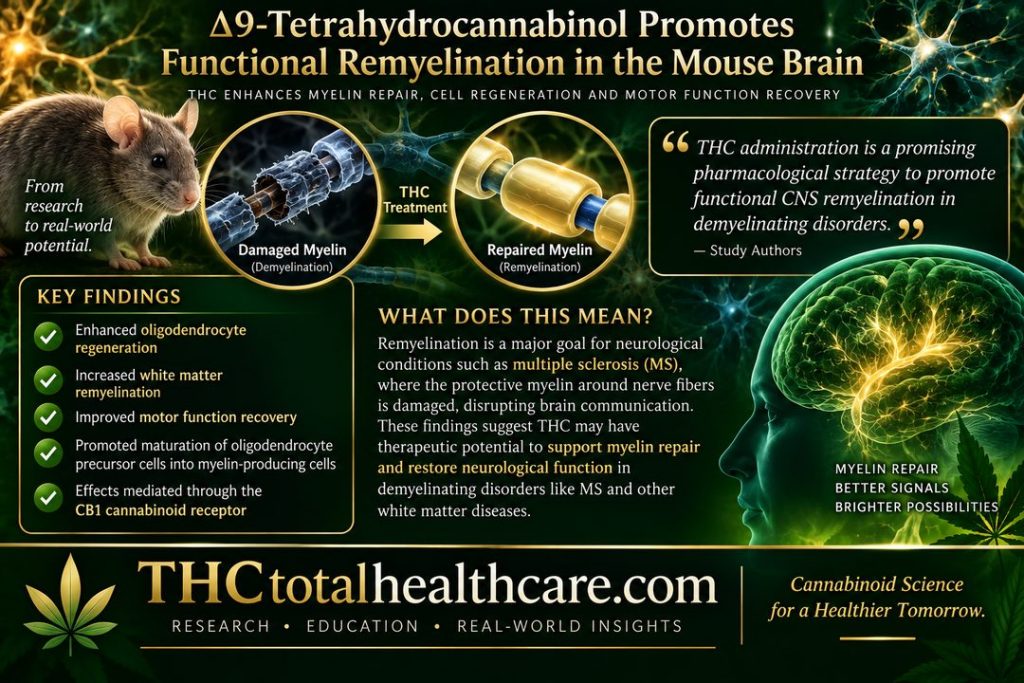
Δ 9 -Tetrahydrocannabinol promotes functional remyelination in the mouse brain

Myelin is the protective coating that surrounds nerve fibers and helps electrical signals move efficiently through the brain and spinal cord. Damage to myelin is a major feature of neurological disorders involving demyelination, making the repair of this protective layer an important therapeutic target.

In this mouse study, Δ9-THC promoted the regeneration of oligodendrocytes, the cells responsible for producing myelin, and enhanced remyelination in damaged white matter. THC treatment was also associated with improved recovery of motor function.

The researchers found that these effects involved activation of the CB1 cannabinoid receptor and the maturation of oligodendrocyte precursor cells into myelin-producing cells. The findings suggest that THC may have potential as a compound capable of supporting functional repair after myelin damage.

“Background and purpose: Research on demyelinating disorders aims to find novel molecules that are able to induce oligodendrocyte precursor cell differentiation to promote central nervous system remyelination and functional recovery. Δ9 -Tetrahydrocannabinol (THC), the most prominent active constituent of the hemp plant Cannabis sativa, confers neuroprotection in animal models of demyelination. However, the possible effect of THC on myelin repair has never been studied.

Experimental approach: By using oligodendroglia-specific reporter mouse lines in combination with two models of toxin-induced demyelination, we analysed the effect of THC on the processes of oligodendrocyte regeneration and functional remyelination.

Key results: We show that THC administration enhanced oligodendrocyte regeneration, white matter remyelination and motor function recovery. THC also promoted axonal remyelination in organotypic cerebellar cultures. THC remyelinating action relied on the induction of oligodendrocyte precursor differentiation upon cell cycle exit and via CB1 cannabinoid receptor activation.

Conclusions and implications: Overall, our study identifies THC administration as a promising pharmacological strategy aimed to promote functional CNS remyelination in demyelinating disorders.”

https://pubmed.ncbi.nlm.nih.gov/34216154/

“THC administration following cuprizone-induced demyelination enhanced oligodendrocyte regeneration, white matter remyelination and motor function recovery.”

“THC administration is a promising pharmacological strategy to promote functional CNS remyelination in demyelinating disorders.”

“Our study provides a novel therapeutic advantage of THC-based interventions in multiple sclerosis by promoting remyelination and functional recovery. New clinical trials with improved designs on cannabinoids in people with multiple sclerosis are needed now, considering these compounds as potential remyelinating/disease-modifying drugs to try to overcome previous failures. Our work also suggests that at least part of the neuroprotective action of phytocannabinoids in multiple sclerosis animal models and potentially in patients as well may be due to an enhanced CNS remyelination. Finally, this study also identifies THC as a potent inductor of oligodendrocyte progenitor cell differentiation under demyelination in mice, opening the possibility for this molecule to become a candidate drug to promote oligodendrocyte regeneration and remyelination in the treatment of demyelinating disorders.”

https://bpspubs.onlinelibrary.wiley.com/doi/10.1111/bph.15608

Need this THC study explained? thcXplained.com

Cannabinoids and Neurogenesis: The Promised Solution for Neurodegeneration?

molecules-logo“The concept of neurons as irreplaceable cells does not hold true today. Experiments and evidence of neurogenesis, also, in the adult brain give hope that some compounds or drugs can enhance this process, helping to reverse the outcomes of diseases or traumas that once were thought to be everlasting.

Cannabinoids, both from natural and artificial origins, already proved to have several beneficial effects (e.g., anti-inflammatory, anti-oxidants and analgesic action), but also capacity to increase neuronal population, by replacing the cells that were lost and/or regenerate a damaged nerve cell.

Neurogenesis is a process which is not highly represented in literature as neuroprotection, though it is as important as prevention of nervous system damage, because it can represent a possible solution when neuronal death is already present, such as in neurodegenerative diseases.

The aim of this review is to resume the experimental evidence of phyto- and synthetic cannabinoids effects on neurogenesis, both in vitro and in vivo, in order to elucidate if they possess also neurogenetic and neurorepairing properties.”

https://pubmed.ncbi.nlm.nih.gov/34684894/

“The current results of cannabinoids effects on neurogenesis are encouraging, and it is expectable that the amount of evidence continues to increase in the future with other experiments.”

https://www.mdpi.com/1420-3049/26/20/6313/htm

Activity of THC, CBD, and CBN on Human ACE2 and SARS-CoV1/2 Main Protease to Understand Antiviral Defense Mechanism

“THC, CBD, and CBN were reported as promising candidates against SARS-CoV2 infection, but the mechanism of action of these three cannabinoids is not understood.

This study aims to determine the mechanism of action of THC, CBD, and CBN by selecting two essential targets that directly affect the coronavirus infections as viral main proteases and human angiotensin-converting enzyme2.

Tested THC and CBD presented a dual-action action against both selected targets. Only CBD acted as a potent viral main protease inhibitor at the IC50 value of 1.86 ± 0.04 µM and exhibited only moderate activity against human angiotensin-converting enzyme2 at the IC50 value of 14.65 ± 0.47 µM.

THC acted as a moderate inhibitor against both viral main protease and human angiotensin-converting enzymes2 at the IC50 value of 16.23 ± 1.71 µM and 11.47 ± 3.60 µM, respectively.

Here, we discuss cannabinoid-associated antiviral activity mechanisms based on in silico docking studies and in vitro receptor binding studies.”

https://pubmed.ncbi.nlm.nih.gov/34638139/

https://www.thieme-connect.de/products/ejournals/abstract/10.1055/a-1581-3707

Efficacy of Δ 9 -Tetrahydrocannabinol (THC) Alone or in Combination With a 1:1 Ratio of Cannabidiol (CBD) in Reversing the Spatial Learning Deficits in Old Mice

Archive of &quot;Frontiers in Aging Neuroscience&quot;.“Decline in cognitive performance, an aspect of the normal aging process, is influenced by the endocannabinoid system (ECS). Cannabinoid receptor 1 (CB1) signaling diminishes with advancing age in specific brain regions that regulate learning and memory and abolishing CB1 receptor signaling accelerates cognitive aging in mice.
We recently demonstrated that prolonged exposure to low dose (3 mg/kg/day) Δ9-tetrahydrocannabinol (THC) improved the cognitive performances in old mice on par with young untreated mice. Here we investigated the potential influence of cannabidiol (CBD) on this THC effect, because preclinical and clinical studies indicate that the combination of THC and CBD often exhibits an enhanced therapeutic effect compared to THC alone.

We first tested the effectiveness of a lower dose (1 mg/kg/day) THC, and then the efficacy of the combination of THC and CBD in 1:1 ratio, same as in the clinically approved medicine Sativex®. Our findings reveal that a 1 mg/kg/day THC dose still effectively improved spatial learning in aged mice. However, a 1:1 combination of THC and CBD failed to do so.

The presence of CBD induced temporal changes in THC metabolism ensuing in a transient elevation of blood THC levels. However, as CBD metabolizes, the inhibitory effect on THC metabolism was alleviated, causing a rapid clearance of THC. Thus, the beneficial effects of THC seemed to wane off more swiftly in the presence of CBD, due to these metabolic effects.

The findings indicate that THC-treatment alone is more efficient to improve spatial learning in aged mice than the 1:1 combination of THC and CBD.”

https://pubmed.ncbi.nlm.nih.gov/34526890/

“In conclusion, our observations indicate that 1 mg/kg/day THC dose is still effective in improving the spatial learning in aged mice. With regard to the efficacy, THC-alone has proved to be more efficient in improving spatial learning in aged mice than its 1:1 combination with CBD. However, the possibility of THC/CBD being efficient in other ratios or at the earliest time-points, like immediately after the treatment cease, cannot be negated. Possibly, reducing the dose of CBD may improve the efficacy of the THC/CBD combination.”

https://www.frontiersin.org/articles/10.3389/fnagi.2021.718850/full

Analysis of Toxicity Effects of Delta-9-Tetrahydrocannabinol on Isolated Rat Heart Mitochondria

Publication Cover“Mitochondria have the main roles in myocardial tissue homeostasis, through providing ATP for the vital enzymes in intermediate metabolism, contractile apparatus and maintaining ion homeostasis. Mitochondria-related cardiotoxicity results from the exposure with illicit drugs have previously reported. These illicit drugs interference with processes of normal mitochondrial homeostasis and lead to mitochondrial dysfunction and mitochondrial-related oxidative stress.

Here, we investigated this hypothesis that delta-9-tetrahydrocannabinol (Delta-9-THC) as a main cannabinoid found in cannabis could directly cause mitochondrial dysfunction.

Our observation showed that THC did not cause a deleterious alteration in mitochondrial functions, ROS production, MMP collapse, mitochondrial swelling, oxidative stress and lipid peroxidation in used concentrations (5-100 µM), even in several tests, toxicity showed a decreasing trend.

Altogether, the results of the current study showed that THC is not directly toxic in isolated cardiac mitochondria, and even may be helpful in reducing mitochondrial toxicity.”

https://pubmed.ncbi.nlm.nih.gov/34431445/

https://www.tandfonline.com/doi/abs/10.1080/15376516.2021.1973168?journalCode=itxm20

Constituents of Cannabis Sativa

“The Cannabis sativa plant has been used medicinally and recreationally for thousands of years, but recently only relatively some of its constituents have been identified.

There are more than 550 chemical compounds in cannabis, with more than 100 phytocannabinoids being identified, including Δ9-tetrahydrocannabinol (THC) and cannabidiol (CBD).

These phytocannabinoids work by binding to the cannabinoid receptors, as well as other receptor systems. Also within cannabis are the aromatic terpenes, more than 100 of which have been identified.

Cannabis and its constituents have been indicated as therapeutic compounds in numerous medical conditions, such as pain, anxiety, epilepsy, nausea and vomiting, and post-traumatic stress disorder.

This chapter provides an overview of some of the biological effects of a number of the cannabinoids and terpenes, as well as discussing their known mechanisms of action and evidence of potential therapeutic effects.”

https://pubmed.ncbi.nlm.nih.gov/33332000/

https://link.springer.com/chapter/10.1007%2F978-3-030-57369-0_1

Antiseizure effects of the cannabinoids in the amygdala-kindling model

“Objective: Focal impaired awareness seizures (FIASs) are the most common seizure type in adults and are often refractory to medication. Management of FIASs is clinically challenging, and new interventions are needed for better seizure control. The amygdala-kindling model is a preclinical model of FIASs with secondary generalization.

The present study assessed the efficacy of cannabidiol (CBD), ∆9-tetrahydrocannabinol (THC), and a combination of CBD and THC in a 15:1 ratio at suppressing focal and secondarily generalized seizures in the amygdala-kindled rat.

Results: CBD alone produced a partial suppression of both generalized seizures (median effective dose [ED50 ] = 283 mg/kg) and focal seizures (ED40 = 320 mg/kg) at doses that did not produce ataxia. THC alone also produced partial suppression of generalized (ED50 = 10 mg/kg) and focal (ED50 = 30 mg/kg) seizures, but doses of 10 mg/kg and above produced hypolocomotion, although not ataxia. The addition of a low dose of THC to CBD (15:1) left-shifted the CBD dose-response curve, producing much lower ED50 s for both generalized (ED50 = 26 + 1.73 mg/kg) and focal (ED50 = 40 + 2.66 mg/kg) seizures. No ataxia or hypolocomotion was seen at these doses of the CBD + THC combination.

Significance: CBD and THC both have antiseizure properties in the amygdala-kindling model, although THC produces suppression of the amygdala focus only at doses that produce hypolocomotion. The addition of small amounts of THC greatly improves the effectiveness of CBD. A combination of CBD and THC might be useful for the management of FIASs.”

https://pubmed.ncbi.nlm.nih.gov/34251027/

https://onlinelibrary.wiley.com/doi/10.1111/epi.16973

Δ 9 -Tetrahydrocannabinol promotes functional remyelination in the mouse brain

British Journal of Pharmacology“Background and purpose: Research on demyelinating disorders aims to find novel molecules that are able to induce oligodendrocyte precursor cell differentiation to promote central nervous system remyelination and functional recovery.

Δ9 -Tetrahydrocannabinol (THC), the most prominent active constituent of the hemp plant Cannabis sativa, confers neuroprotection in animal models of demyelination. However, the possible effect of THC on myelin repair has never been studied.

Experimental approach: By using oligodendroglia-specific reporter mouse lines in combination with two models of toxin-induced demyelination, we analysed the effect of THC on the processes of oligodendrocyte regeneration and functional remyelination.

Key results: We show that THC administration enhanced oligodendrocyte regeneration, white matter remyelination and motor function recovery. THC also promoted axonal remyelination in organotypic cerebellar cultures. THC remyelinating action relied on the induction of oligodendrocyte precursor differentiation upon cell cycle exit and via CB1 cannabinoid receptor activation.

Conclusions and implications: Overall, our study identifies THC administration as a promising pharmacological strategy aimed to promote functional CNS remyelination in demyelinating disorders.”

https://pubmed.ncbi.nlm.nih.gov/34216154/

“Our study provides a novel therapeutic advantage of THC-based interventions in multiple sclerosis by promoting remyelination and functional recovery. New clinical trials with improved designs on cannabinoids in people with multiple sclerosis are needed now, considering these compounds as potential remyelinating/disease-modifying drugs to try to overcome previous failures. Our work also suggests that at least part of the neuroprotective action of phytocannabinoids in multiple sclerosis animal models and potentially in patients as well may be due to an enhanced CNS remyelination. Finally, this study also identifies THC as a potent inductor of oligodendrocyte progenitor cell differentiation under demyelination in mice, opening the possibility for this molecule to become a candidate drug to promote oligodendrocyte regeneration and remyelination in the treatment of demyelinating disorders.”

https://bpspubs.onlinelibrary.wiley.com/doi/10.1111/bph.15608
