
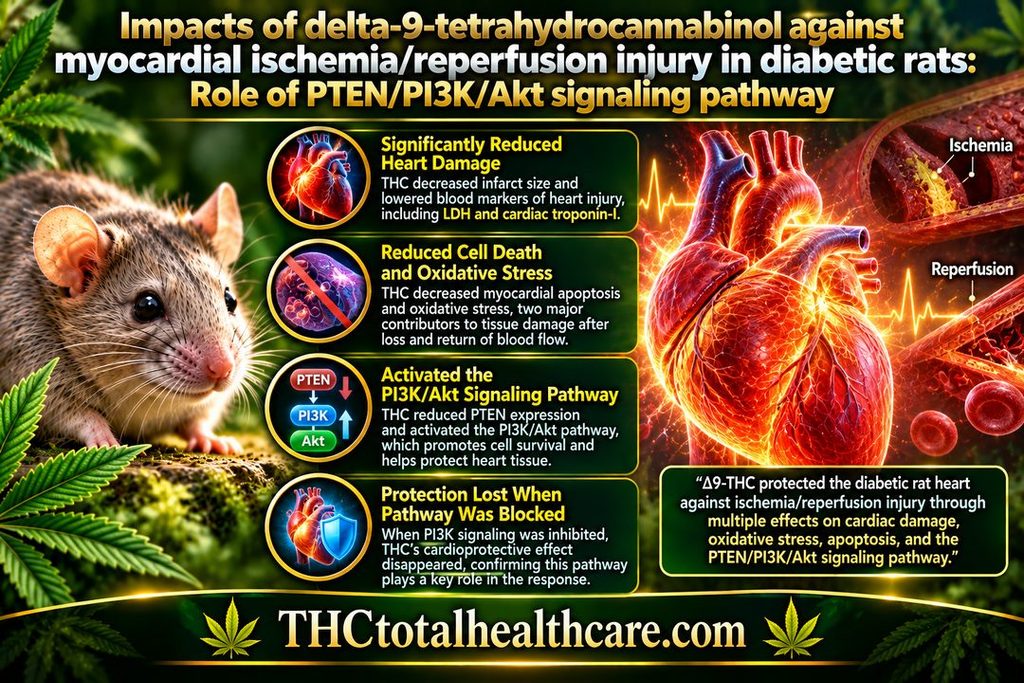
Impacts of delta 9-tetrahydrocannabinol against myocardial ischemia/reperfusion injury in diabetic rats: Role of PTEN/PI3K/Akt signaling pathway

In diabetic rats with myocardial ischemia/reperfusion injury, Δ9-THC significantly reduced heart damage and improved cardiac function. THC pretreatment decreased infarct size as well as blood markers of heart injury, including LDH and cardiac troponin-I.

THC also reduced myocardial apoptosis and oxidative stress, two major contributors to tissue damage when blood flow returns to the heart after a period of ischemia. These protective effects were accompanied by reduced PTEN expression and activation of the PI3K/Akt signaling pathway, which is involved in cell survival.

When researchers blocked PI3K signaling, THC’s cardioprotective effect disappeared, strengthening the evidence that this pathway played an important role in the response. The findings show that THC protected the diabetic rat heart against ischemia/reperfusion injury through multiple measurable effects on cardiac damage, oxidative stress, cell death, and survival signaling.

“Despite the current optimal therapy, patients with myocardial ischemia/reperfusion (IR) injury still experience a high mortality rate, especially when diabetes mellitus is present as a comorbidity. Investigating potential treatments aimed at improving the outcomes of myocardial IR injury in diabetic patients is necessary.

Our objective was to ascertain the cardioprotective effect of delta 9-tetrahydrocannabinol (THC) against myocardial IR injury in diabetic rats and examine the role of phosphatase and tensin homolog (PTEN)/phosphatidylinositol 3-kinase (PI3K)/protein kinase B (Akt) signaling pathway in mediating this effect.

Diabetes was induced in male Wistar rats (8-10 weeks old, 200-250 g; n = 60) by a single injection of streptozotocin. The duration of the diabetic period was 10 weeks. During the last 4 weeks of diabetic period, rats were treated with THC (1.5 mg/kg/day; intraperitoneally), either alone or in combination with LY294002, and then underwent IR intervention. After 24 h of reperfusion, infarct size, cardiac function, lactate dehydrogenase (LDH) and cardiac-specific isoform of troponin-I (cTn-I) levels, myocardial apoptosis, oxidative stress markers, and expression of PTEN, PI3K, and Akt proteins were evaluated.

THC pretreatment resulted in significant improvements in infarct size and cardiac function and decreases in LDH and cTn-I levels (P < 0.05). It also reduced myocardial apoptosis and oxidative stress, accompanied by the downregulation of PTEN expression and activation of the PI3K/Akt signaling pathway (P < 0.05). LY294002 pretreatment abolished the cardioprotective action of THC.

This study revealed the cardioprotective effects of THC against IR-induced myocardial injury in diabetic rats and also suggested that the mechanism may be associated with enhanced activity of the PI3K/Akt signaling pathway through the reduction of PTEN phosphorylation.”

https://pubmed.ncbi.nlm.nih.gov/38149557/

“Delta 9-tetrahydrocannabinol (THC) is the main psychoactive component of cannabis and has been shown to have potential therapeutic effects in various medical conditions. THC has been shown to have anti-inflammatory and antioxidant properties, which may reduce the inflammation and oxidative stress associated with myocardial IR injury. Recent studies have suggested that THC improves glucose metabolism and insulin sensitivity and reduces blood glucose concentrations, oxidative stress, and inflammation associated with diabetic cardiomyopathy.”

https://www.cjphysiology.org/article.asp?issn=0304-4920;year=2023;volume=66;issue=6;spage=446;epage=455;aulast=Zhao

Need this THC study explained? thcXplained.com
An Ultra-Low Dose of ∆9-Tetrahydrocannabinol Alleviates Alzheimer’s Disease-Related Cognitive Impairments and Modulates TrkB Receptor Expression in a 5XFAD Mouse Model

An ultra-low dose of Δ9-THC improved Alzheimer’s disease-related cognitive impairment in 5xFAD mice, including animals treated after memory problems were already established. The study found improvements in learning and memory without relying on repeated high-dose THC exposure.

The researchers also found changes in TrkB receptor expression, a signaling pathway closely tied to brain plasticity, learning, memory, and neuronal survival. These changes suggest that THC’s effects may involve more than temporary symptom relief and may influence mechanisms connected to cognitive function.

The findings add to a growing body of preclinical research showing that very low doses of THC can produce different biological effects than higher doses, particularly in the aging and Alzheimer’s-disease brain. In this model, a single ultra-low dose was enough to improve cognitive performance and alter a key neurotrophic signaling pathway.

“Alzheimer’s disease (AD) is the most common form of dementia, but there is still no available treatment.

Δ9-tetrahydrocannabinol (THC) is emerging as a promising therapeutic agent.

Using THC in conventional high doses may have deleterious effects. Therefore, we propose to use an ultra-low dose of THC (ULD-THC). We previously published that a single injection of ULD-THC ameliorated cognitive functioning in several models of brain injuries as well as in naturally aging mice.

Here, 5xFAD AD model mice received a single treatment of ULD-THC (0.002 mg/kg) after disease onset and were examined in two separate experiments for cognitive functions, neurotropic, and inflammatory factors in the hippocampus.

We show that a single injection of ULD-THC alleviated cognitive impairments in 6- and 12-month-old 5xFAD mice. On the biochemical level, our results indicate an imbalance between the truncated TrkB receptor isoform and the full receptor, with AD mice showing a greater tendency to express the truncated receptor, and ULD-THC improved this imbalance. We also investigated the expression of three AD-related inflammatory markers and found an ameliorating effect of ULD-THC.

The current research demonstrates for the first time the beneficial effects of a single ultra-low dose of THC in a mouse model of AD after disease onset.”

https://pubmed.ncbi.nlm.nih.gov/36012711/

“The current research demonstrates for the first time the beneficial effects of a single ultra-low dose of THC in a mouse model of AD after disease onset. As THC is a cheap, widely available substance already approved for use in other conditions, this research brings us closer to understanding its mechanisms and will possibly lead to new treatments.”

https://www.mdpi.com/1422-0067/23/16/9449/htm

Need this THC study explained? thcXplained.com
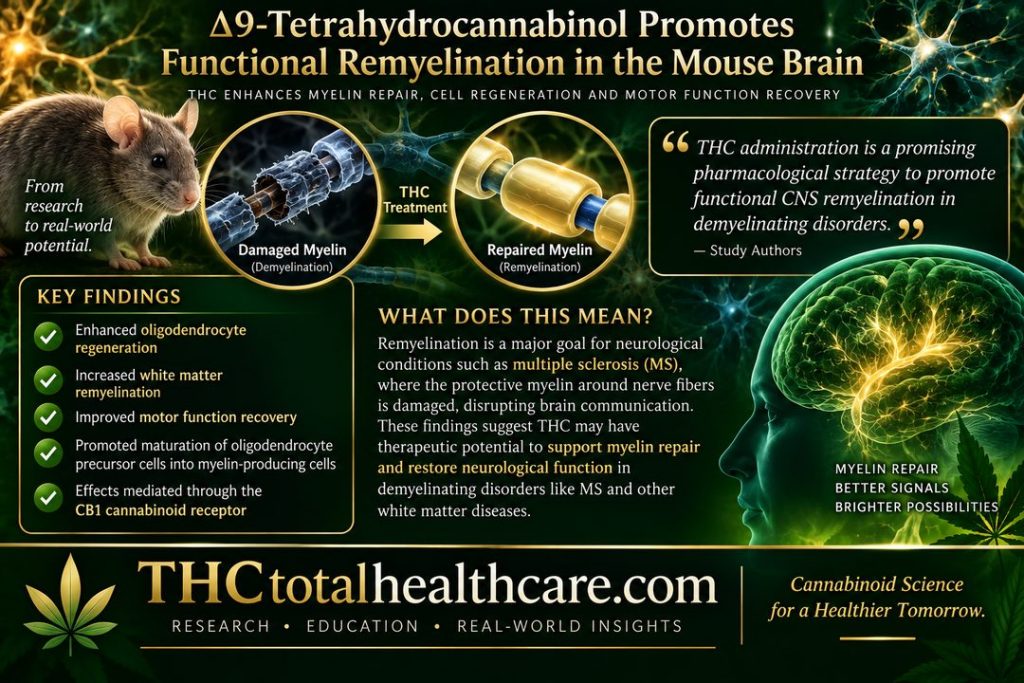
Δ 9 -Tetrahydrocannabinol promotes functional remyelination in the mouse brain

Myelin is the protective coating that surrounds nerve fibers and helps electrical signals move efficiently through the brain and spinal cord. Damage to myelin is a major feature of neurological disorders involving demyelination, making the repair of this protective layer an important therapeutic target.

In this mouse study, Δ9-THC promoted the regeneration of oligodendrocytes, the cells responsible for producing myelin, and enhanced remyelination in damaged white matter. THC treatment was also associated with improved recovery of motor function.

The researchers found that these effects involved activation of the CB1 cannabinoid receptor and the maturation of oligodendrocyte precursor cells into myelin-producing cells. The findings suggest that THC may have potential as a compound capable of supporting functional repair after myelin damage.

“Background and purpose: Research on demyelinating disorders aims to find novel molecules that are able to induce oligodendrocyte precursor cell differentiation to promote central nervous system remyelination and functional recovery. Δ9 -Tetrahydrocannabinol (THC), the most prominent active constituent of the hemp plant Cannabis sativa, confers neuroprotection in animal models of demyelination. However, the possible effect of THC on myelin repair has never been studied.

Experimental approach: By using oligodendroglia-specific reporter mouse lines in combination with two models of toxin-induced demyelination, we analysed the effect of THC on the processes of oligodendrocyte regeneration and functional remyelination.

Key results: We show that THC administration enhanced oligodendrocyte regeneration, white matter remyelination and motor function recovery. THC also promoted axonal remyelination in organotypic cerebellar cultures. THC remyelinating action relied on the induction of oligodendrocyte precursor differentiation upon cell cycle exit and via CB1 cannabinoid receptor activation.

Conclusions and implications: Overall, our study identifies THC administration as a promising pharmacological strategy aimed to promote functional CNS remyelination in demyelinating disorders.”

https://pubmed.ncbi.nlm.nih.gov/34216154/

“THC administration following cuprizone-induced demyelination enhanced oligodendrocyte regeneration, white matter remyelination and motor function recovery.”

“THC administration is a promising pharmacological strategy to promote functional CNS remyelination in demyelinating disorders.”

“Our study provides a novel therapeutic advantage of THC-based interventions in multiple sclerosis by promoting remyelination and functional recovery. New clinical trials with improved designs on cannabinoids in people with multiple sclerosis are needed now, considering these compounds as potential remyelinating/disease-modifying drugs to try to overcome previous failures. Our work also suggests that at least part of the neuroprotective action of phytocannabinoids in multiple sclerosis animal models and potentially in patients as well may be due to an enhanced CNS remyelination. Finally, this study also identifies THC as a potent inductor of oligodendrocyte progenitor cell differentiation under demyelination in mice, opening the possibility for this molecule to become a candidate drug to promote oligodendrocyte regeneration and remyelination in the treatment of demyelinating disorders.”

https://bpspubs.onlinelibrary.wiley.com/doi/10.1111/bph.15608

Need this THC study explained? thcXplained.com

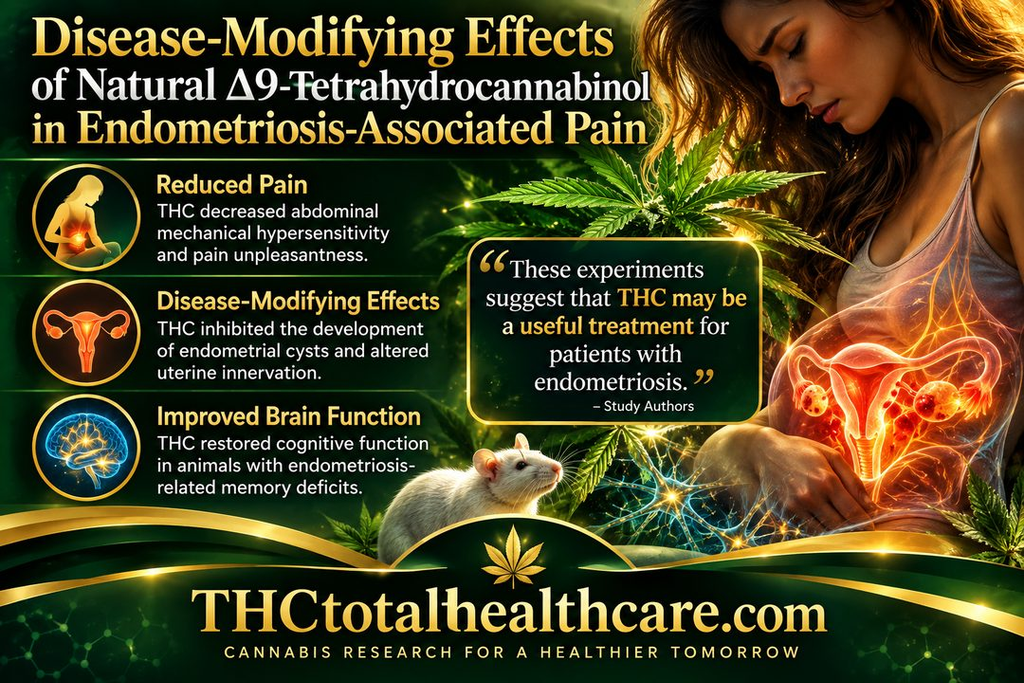
Disease-modifying effects of natural Δ9-tetrahydrocannabinol in endometriosis-associated pain.

In a mouse model of endometriosis, daily treatment with Δ9-THC reduced abdominal mechanical hypersensitivity and the unpleasantness associated with pain. THC also restored cognitive function in animals that had developed substantial memory deficits associated with endometriosis.

The effects went beyond pain relief. THC altered uterine innervation and, most notably, inhibited the development of endometrial cysts, suggesting a potential disease-modifying effect rather than simply masking symptoms.

These findings are important because endometriosis is a chronic condition in which pain, abnormal tissue growth, and neurological effects can all contribute to disease burden. The researchers concluded that the results support clinical investigation of THC as a potential treatment for women with endometriosis.

“Endometriosis is a chronic painful disease highly prevalent in women that is defined by growth of endometrial tissue outside the uterine cavity and lacks adequate treatment.

Medical use of cannabis derivatives is a current hot topic and it is unknown whether phytocannabinoids may modify endometriosis symptoms and development.

Here we evaluate the effects of repeated exposure to Δ9-tetrahydrocannabinol (THC) in a mouse model of surgically-induced endometriosis.

In this model, female mice develop mechanical hypersensitivity in the caudal abdomen, mild anxiety-like behavior and substantial memory deficits associated with the presence of extrauterine endometrial cysts.

Interestingly, daily treatments with THC (2 mg/kg) alleviate mechanical hypersensitivity and pain unpleasantness, modify uterine innervation and restore cognitive function without altering the anxiogenic phenotype. Strikingly, THC also inhibits the development of endometrial cysts.

These data highlight the interest of scheduled clinical trials designed to investigate possible benefits of THC for women with endometriosis.”

https://www.ncbi.nlm.nih.gov/pubmed/31931958

“These experiments suggest that THC may be a useful treatment for patients with endometriosis.”

https://elifesciences.org/articles/50356

Need this THC study explained? thcXplained.com

Using cannabis to help you sleep: Heightened frequency of medical cannabis use among those with PTSD.

“The use of cannabis for medical purposes is proliferating in the U.S., and PTSD is an explicitly approved condition for accessing medical cannabis in 5 states. Prior research suggests that people with PTSD often use cannabis to help cope with their condition…

Those with high PTSD scores were more likely to use cannabis to improve sleep, and for coping reasons more generally, compared with those with low PTSD scores. Cannabis use frequency was greater among those with high PTSD scores who used for sleep promoting purposes compared with those with low PTSD scores or those who did not use for sleep promoting purposes.

Consistent with prior research, this study found increased rates of coping-oriented use of cannabis and greater frequency of cannabis use among medical users with high PTSD scores compared with low PTSD scores. In addition, sleep improvement appears to be a primary motivator for coping-oriented use…”

http://www.ncbi.nlm.nih.gov/pubmed/24412475

IT’S TRUE: MEDICAL CANNABIS PROVIDES DRAMATIC RELIEF FOR SUFFERERS OF CHRONIC AILMENTS.

“Though controversial, medical cannabis has been gaining ground as a valid therapy, offering relief to suffers of diseases such as cancer, Post-Traumatic Stress Disorder, ALS and more. The substance is known to soothe severe pain, increase the appetite, and ease insomnia where other common medications fail.

In 2009, Zach Klein, a graduate of Tel Aviv University’s Department of Film and Television Studies, directed the documentary Prescribed Grass. Through the process, he developed an interest in the scientific research behind medical marijuana, and now, as a specialist in policy-making surrounding medical cannabis and an MA student at TAU’s Porter School of Environmental Studies, he is conducting his own research into the benefits of medical cannabis.”

Read more: .http://scienceblog.com/59316/its-true-medical-cannabis-provides-dramatic-relief-for-sufferers-of-chronic-ailments/

320px Cannabis macro Its True: Medical Cannabis Provides Dramatic Relief for Sufferers of Chronic Ailments ”

Smoked Medical Cannabis May Be Beneficial as Treatment for Chronic Neuropathic Pain, Study Suggests.

“Medicinal marijuana. A new study provides evidence that cannabis may offer relief to patients suffering from chronic neuropathic pain. (Credit: iStockphoto)”
 

“The medicinal use of cannabis has been debated by clinicians, researchers, legislators and the public at large for many years as an alternative to standard pharmaceutical treatments for pain, which may not always be effective and may have unwanted side effects. A new study by McGill University Health Centre (MUHC) and McGill University researchers provides evidence that cannabis may offer relief to patients suffering from chronic neuropathic pain.”

“This is the first trial to be conducted where patients have been allowed to smoke cannabis at home and to monitor their responses, daily,” says Dr. Mark Ware, lead author of the study, who is also Director of Clinical Research at the Alan Edwards Pain Management Unit at the MUHC and an assistant professor of anesthesia in McGill University’s Faculty of Medicine, and neuroscience researcher at the Research Institute of the MUHC.

In this study, low doses (25mg) of inhaled cannabis containing approximately 10% THC (the active ingredient in cannabis), smoked as a single inhalation using a pipe three times daily over a period of five days, offered modest pain reduction in patients suffering from chronic neuropathic pain (pain associated with nerve injury) within the first few days. The results also suggest that cannabis improved moods and helped patients sleep better. The effects were less pronounced in cannabis strains containing less than 10% THC.

“The patients we followed suffered from pain caused by injuries to the nervous system from post-traumatic (e.g. traffic accidents) or post-surgical (e.g. cut nerves) events, and which was not controlled using standard therapies” explains Dr. Ware. “This kind of pain occurs more frequently than many people recognize, and there are few effective treatments available. For these patients, medical cannabis is sometimes seen as their last hope.”

“This study marks an important step forward because it demonstrates the analgesic effects of cannabis at a low dose over a shot period of time for patients suffering from chronic neuropathic pain,” adds Dr. Ware. The study used herbal cannabis from Prairie Plant Systems (under contract to Health Canada to provide cannabis for research and medical purposes), and a 0% THC ‘placebo’ cannabis from the USA.”

Read more:http://www.sciencedaily.com/releases/2010/08/100830094926.htm

Cannabis as an adjunct to or substitute for opiates in the treatment of chronic pain.

Abstract

“There is a growing body of evidence to support the use of medical cannabis as an adjunct to or substitute for prescription opiates in the treatment of chronic pain. When used in conjunction with opiates, cannabinoids lead to a greater cumulative relief of pain, resulting in a reduction in the use of opiates (and associated side-effects) by patients in a clinical setting. Additionally, cannabinoids can prevent the development of tolerance to and withdrawal from opiates, and can even rekindle opiate analgesia after a prior dosage has become ineffective. Novel research suggests that cannabis may be useful in the treatment of problematic substance use. These findings suggest that increasing safe access to medical cannabis may reduce the personal and social harms associated with addiction, particularly in relation to the growing problematic use of pharmaceutical opiates. Despite a lack of regulatory oversight by federal governments in North America, community-based medical cannabis dispensaries have proven successful at supplying patients with a safe source of cannabis within an environment conducive to healing, and may be reducing the problematic use of pharmaceutical opiates and other potentially harmful substances in their communities.”

http://www.ncbi.nlm.nih.gov/pubmed/22880540