Hemp seed mitigates colonic inflammation through macrophage polarization and microbiota-barrier axis restoration

“Hemp seed, historically considered a byproduct of the hemp fiber industry, has gained increasing attention for its nutritional and functional properties. Recent advances in hemp seed research have elucidated its benefits for gut health; however, its impact on colitis remains unclear.

In this study, we demonstrate that hemp seed consumption reduced colonic inflammation and mitigated tissue injury in an experimental colitis mouse model.

Notably, hemp seed reduced macrophage infiltration and promoted a phenotypic shift from pro-inflammatory M1 to anti-inflammatory M2 macrophages. It also enhanced intestinal barrier function by restoring goblet cells, upregulating tight junction proteins, and reducing systemic lipopolysaccharide translocation. Furthermore, hemp seed optimized gut microbiota composition by enriching beneficial taxa, particularly Bifidobacterium, while suppressing colitis-associated genera.

Collectively, these findings indicate that hemp seed, as a whole-food dietary approach, confers protection against colitis by modulating immune responses, preserving barrier integrity, and reshaping gut microbiome.

These results underscore the potential of hemp seed as a sustainable nutritional strategy for promoting gut health.”

https://pubmed.ncbi.nlm.nih.gov/41328036

“The present study demonstrates that dietary hemp seed reduced colonic inflammation and alleviated tissue injury in the DSS-induced colitis mouse model.”

“Collectively, our study provides insights into the role of hemp seed in gut health and reinforces its potential as a promising and sustainable dietary intervention for IBD management.”

https://pubs.rsc.org/en/content/articlelanding/2026/fo/d5fo04119h

Combination of CBD with minor cannabinoid CBDV suppresses CXCR4 via CB2 receptor and alleviates colitis in mice

pubmed logo

“Cannabis extracts, particularly those rich in cannabinoids like cannabidiol (CBD), have shown potential anti-inflammatory properties and are being examined in managing conditions involving inflammation.

One proposed mechanism is their modulation of chemokine expression and function in immune cells. C-X-C chemokine receptor type 4 (CXCR4) plays a pivotal role in immune cell trafficking and is implicated in the pathogenesis of inflammatory bowel disease (IBD).

Given emerging evidence that cannabinoids can influence chemokine signaling, we explored whether they could downregulate CXCR4 in immune cells.

In this study, we show that the combination of CBD and cannabidivarin (CBDV) at a 20:1 ratio significantly reduces CXCR4 expression in MOLT-4 cells, murine splenocytes and human peripheral blood mononuclear cells. This reduction in CXCR4 expression correlated with impaired chemotactic responses and suppressed actin polymerization, effects that were abrogated by CB2 receptor inhibition. In vivo, the CBD:CBDV combination ameliorated disease severity in a murine model of DSS-induced colitis, improving disease activity index, colon length, and histological outcomes. These therapeutic benefits were absent in CB2 knockout mice, confirming CB2 dependence.

Our findings support a CB2-mediated mechanism by which the CBD:CBDV combination downregulates CXCR4, providing a mechanistic basis for the entourage effect and highlighting the significance of CBDV as a modulator of the CBD effect.

Overall, this study implicates cannabinoid combinations as a promising therapeutic strategy for treating IBD.”

https://pubmed.ncbi.nlm.nih.gov/41237459

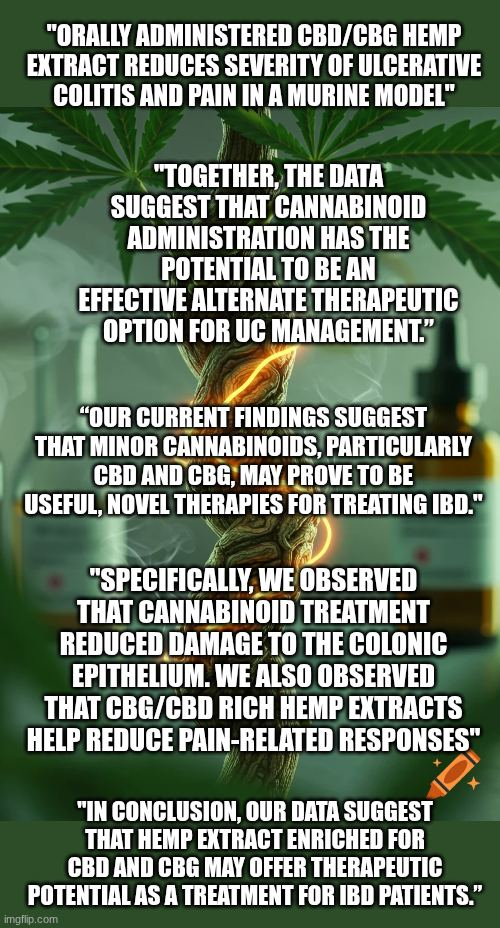
Orally Administered CBD/CBG Hemp Extract Reduces Severity of Ulcerative Colitis and Pain in a Murine Model

“Background: Ulcerative colitis (UC) is an autoimmune disorder characterized by inflammation of the mucosa that gives rise to a disrupted epithelial morphology. Persistent or recurrent inflammation and the debilitating nature of the associated symptoms make treatment of UC challenging. Cannabinoids derived from Cannabis sativa L. have been used for treatment of gastrointestinal disorders due to the wide-ranging therapeutic benefits of these compounds. 

Methods: We evaluated a commercial hemp extract, high in cannabigerol (CBG) and cannabidiol (CBD), as a novel treatment for UC symptoms using the dextran sodium sulfate (DSS) model in mice. Hemp extract was administered via two different routes of administration, intraperitoneal (i.p) and oral (p.o). 

Results: Specifically, we observed that cannabinoid treatment reduced damage to the colonic epithelium. We also observed that CBG/CBD rich hemp extracts help reduce pain-related responses in these animals. 

Conclusions: Together, the data suggest that cannabinoid administration has the potential to be an effective alternate therapeutic option for UC management.”

https://pubmed.ncbi.nlm.nih.gov/40943856/

“Our current findings suggest that minor cannabinoids, particularly CBD and CBG, may prove to be useful, novel therapies for treating IBD. These findings are important because patients already report using cannabis and cannabinoid-based products for managing their symptoms, despite little clinical data to support the use of high-THC products for treating IBD.

In conclusion, our data suggest that HE enriched for CBD and CBG may offer therapeutic potential as a treatment for IBD patients.”

https://www.mdpi.com/2077-0383/14/17/6095

Cannabidiol Enhances the Therapeutic Efficacy of Olsalazine and Cyclosporine in a Murine Model of Colitis

pubmed logo

“Current therapies for inflammatory bowel disease (IBD), such as olsalazine and cyclosporine, often exhibit limited long-term efficacy and are associated with adverse effects. Cannabidiol (CBD), a non-psychoactive phytocannabinoid, shows promise for its anti-inflammatory properties, though its effectiveness as a monotherapy remains inconclusive.

This study investigates the therapeutic potential of combining low-dose CBD (10 mg/kg) with olsalazine (50 mg/kg) or cyclosporine (2.5, 5 mg/kg) in dextran sulphate sodium (DSS)-induced acute and chronic colitis models in mice.

Disease severity was assessed via disease activity index (DAI), colon morphology, cytokine and chemokine expression, myeloperoxidase (MPO) activity, systemic inflammatory markers, and glucagon-like peptide-1 (GLP-1) regulation. Safety evaluations included haematology and plasma biochemistry. DSS-treated mice showed elevated DAI scores, colon shortening, heightened inflammation, and organ enlargement. Combination therapies significantly ameliorated colitis, reducing DAI, MPO activity, and inflammatory cytokines, while restoring colon length and GLP-1 levels-without inducing liver or kidney toxicity.

These findings demonstrate that combining a low dose of CBD with standard IBD drugs enhances therapeutic efficacy while minimizing side effects, supporting its integration into future combination strategies for more effective and safer IBD management.”

https://pubmed.ncbi.nlm.nih.gov/40869234/

“Cannabidiol (CBD), a non-psychoactive phytocannabinoid derived from Cannabis sativa, has emerged as a promising therapeutic candidate for the treatment of inflammatory conditions, including IBD. CBD’s anti-inflammatory, antioxidant, and immunomodulatory effects are mediated through multiple pathways, including the modulation of cytokine production, inhibition of oxidative stress, and interaction with the endocannabinoidome (eCBome).”

“Collectively, our data provide a strong preclinical rationale for leveraging low-dose CBD to enhance the efficacy of existing IBD therapies. The reproducible synergistic effects observed in acute and chronic colitis models—spanning clinical, morphological, molecular, metabolic, and safety domains—underscore CBD’s potential as a safer adjunct agent. CBD co-therapy with CSA or olsalazine offers a multifaceted approach to IBD treatment—achieving superior disease suppression, preserving intestinal and systemic homeostasis, and maintaining an acceptable safety profile. This strategy holds promise for improving patient outcomes while potentially reducing the doses and side effects of conventional IBD drugs. Clinical trials will be essential to confirm safety and efficacy in human IBD patients.”

https://www.mdpi.com/1422-0067/26/16/7913

Enhancing Tetrahydrocannabinol’s Therapeutic Efficacy in Inflammatory Bowel Disease: The Roles of Cannabidiol and the Cannabinoid 1 Receptor Allosteric Modulator ZCZ011

pubmed logo

“Background/Objectives: Current inflammatory bowel disease (IBD) treatments focus on symptomatic relief, highlighting the need for innovative approaches. Dysregulation of the cannabinoid 1 (CB1) receptor, part of the endocannabinoid system, is linked to colitis. While tetrahydrocannabinol (THC) alleviates colitis via CB1 activation, its psychotropic effects limit clinical use. ZCZ011, a CB1R allosteric modulator, and cannabidiol (CBD), a non-psychoactive cannabinoid, offer alternatives. This study investigated combining sub-therapeutic THC doses with ZCZ011 or CBD in a murine model of dextran sodium sulphate (DSS)-induced colitis. 

Methods: Acute colitis was induced with 4% DSS for 7 days, followed by 3 days of water. Chronic colitis was modelled over 24 days with alternating DSS concentrations. The combination of 2.5 mg/kg THC with 20 mg/kg ZCZ011 or 10 mg/kg CBD was evaluated. Key markers were assessed to determine efficacy and safety, including disease activity index (DAI), inflammation, cytokine levels, GLP-1, and organ health. 

Results: DSS-induced colitis resulted in increased DAI scores, cytokines, organ inflammation and dysregulation of GLP-1 and ammonia. THC at 10 mg/kg significantly improved colitis markers but was ineffective at 2.5 and 5 mg/kg. ZCZ011 alone showed transient effects. However, combining 2.5 mg/kg THC with either 20 mg/kg ZCZ011 or 10 mg/kg CBD significantly alleviated colitis markers, restored colon integrity and reestablished GLP-1 homeostasis. This combination also maintained favourable haematological and biochemical profiles, including a notable reduction in colitis-induced elevated ammonia levels. 

Conclusions: This study demonstrates the synergistic potential of low-dose THC combined with CBD or ZCZ011 as a novel, effective and safer therapeutic strategy for ulcerative colitis.”

https://pubmed.ncbi.nlm.nih.gov/40005963/

“This study provides compelling evidence that sub-therapeutic doses of THC combined with ZCZ011 or CBD offer a safe and effective strategy for managing both the inflammatory and metabolic components of IBD. Notably, the normalisation of GLP-1 and ammonia levels underscores the dual benefits of these treatments in alleviating colitis while addressing associated metabolic dysregulation and extraintestinal complications. This dual-action approach addresses key limitations of current therapies and emphasizes ECS modulation as a promising avenue for IBD treatment.”

https://www.mdpi.com/1424-8247/18/2/148

Entourage effects of nonpsychotropic cannabinoids on visceral sensitivity in experimental colitis

pubmed logo

“Abdominal pain is the most disabling symptom of inflammatory bowel diseases, but current treatments are limited, leading patients to seek alternatives such as cannabis.

Cannabis contains over 100 cannabinoids which, unlike tetrahydrocannabinol, are biologically active compounds often without psychotropic effects (ie, nonpsychotropic cannabinoids [npCBs]). These npCBs have analgesic and anti-inflammatory properties and may show potentiating effects when administered in combination, referred to as the entourage effect.

Here, we investigated the analgesic effects of cannabichromene, cannabidiol (CBD), cannabidivarin, and cannabigerol (CBG), individually and in combination, using the mouse model of dextran sulfate sodium colitis-induced visceral hypersensitivity (VHS).

We then explored antinociceptive targets through patch-clamp electrophysiology on dorsal root ganglia neurons and recombinant channels. We found that a single injection of 10 mg/kg of either CBD or CBG reduced both VHS and c-Fos activation in the spinal dorsal horn. Moreover, a combination of npCBs consisting of 5 mg/kg CBD with 1 mg/kg of cannabichromene, cannabidivarin, and CBG-all at subtherapeutic dosages-reduced VHS, without altering colitis. Electrophysiological recordings revealed that the antinociceptive mixture of npCBs acts through voltage-gated sodium and calcium channels, particularly Cav2.2, but not Cav3.2 and Kv channels.

These results suggest that CBD, CBG, and a mixture of npCBs given at subtherapeutic doses may be beneficial in managing VHS associated with inflammatory bowel disease.

SIGNIFICANCE STATEMENT: Cannabis is increasingly used as an alternative treatment for managing pain associated with chronic conditions. Nonpsychotropic cannabinoids, such as cannabidiol, interact with ionotropic and voltage-gated ion channels. In our study, we demonstrated that cannabidiol, cannabigerol, and a combination of nonpsychotropic cannabinoids, administered at subtherapeutic doses, effectively alleviated visceral hypersensitivity associated with inflammatory bowel disease.”

https://pubmed.ncbi.nlm.nih.gov/39921943/

https://jpet.aspetjournals.org/article/S0022-3565(25)09725-3/abstract

Cannabidiol Alleviates Intestinal Fibrosis in Mice with Ulcerative Colitis by Regulating Transforming Growth Factor Signaling Pathway

pubmed logo

“Objective: The aim of this study is to investigate the protective effect of Cannabidiol (CBD) on DSS-induced colitis in C57BL/6 mice and its related pathways.

Methods: A mouse model of ulcerative colitis (US) was induced by DSS. Enzyme-linked immunosorbent assay (ELISA), quantitative reverse transcription polymerase-chain reaction (qRT-PCR), Western blot (WB) and immunofluorescence (IF) were used to identify the key factors involved in inflammatory response, oxidative stress and intestinal fibrosis. In addition, we transfected si-RNA into CCD-18Co cells.

Results: The research suggests that CBD significantly improves intestinal inflammation by up-regulating the nuclear factor erythroid 2-related factor 2 (Nrf2) expression, inhibiting the classical Nuclear Factor kappa-light-chain-enhancer of activated B cells (NF-κb) pathway, and inhibiting the release of IL-6 (Interleukin), IL-1β, Tumor Necrosis Factor-α (TNF-α) and other factors. At the same time, CBD plays an antioxidant role by regulating Nrf2/ HO-1 (Heme Oxygenase-1) pathway and activating HO-1 activity. On the other hand, CBD may regulate Transforming growth factor beta (TGF-β)/SMADs signaling pathway by inhibiting the expression of TGF-β1, thereby inhibiting the expression of α-SMA, Collagen1, TIMP1 and other factors, thus playing an anti-fibrotic role. Notably, when Nrf2 is inhibited or lacking, CBD loses the above protective effect against DSS-induced colon injury.

Conclusion: CBD affects the classical NF-κb pathway, Nrf2/ Heme Oxygenase-1 (HO-1) pathway, and Transforming growth factor beta (TGF-β)/SMAD pathway by regulating Nrf2, thereby reducing colonic inflammation and oxidative stress and improving the progression of colonic fibrosis.”

https://pubmed.ncbi.nlm.nih.gov/39802511/

“Taken together, our study demonstrated that CBD affected the classical NF-κb pathway, Nrf2/HO-1 pathway, and TGF-β1/SMAD pathway by regulating Nrf2, thereby reducing intestinal inflammation, oxidative stress and intestinal fibrosis, improving intestinal function and pathological symptoms, and thereby protecting against DSS-induced colon injury. These findings provide new ideas and directions for the treatment of UC.”

https://www.dovepress.com/cannabidiol-alleviates-intestinal-fibrosis-in-mice-with-ulcerative-col-peer-reviewed-fulltext-article-JIR

Cannabis sativa alleviates experimentally acetic acid- induced ulcerative colitis in rats: targeting CB1/SIRT/MAPK signaling pathways

pubmed logo

“Background: Ulcerative colitis (UC) is a frequent inflammatory bowel disease (IBD) that causes long-lasting inflammation in the innermost lining of the rectum and colon.

Objective: The aim of this study was to evaluate the therapeutic effect of Cannabis sativa (C. sativa) on the amelioration of acetic acid-induced colitis in rats.

Materials and methods: Group 1: normal control group was intrarectally administered saline solution (0.9%); group 2: acetic acid (AA) group was given AA intra-rectally (2 mL of 4% (v/v) in 0.9% NaCl) once.; group 3&4: This group represented the ulcerative colitis-induced rats that were injected with acetic acid intra-rectally, then s.c. injection with C. sativa (20 and 40 mg/kg daily for 8 days).

Results: Colonic architectural abnormality significantly improved after pretreatment with C. sativa. Additionally, it significantly reduced the MDA level and prevented the depletion of GSH content. Moreover, C. sativa administration showed suppressive activities on pro-inflammatory cytokines, including NF-κB, MAPK, ERK, PI3K, AKT, HIF-1α, and TLR4. Moreover, it significantly upregulated the level of SIRT and CB1 in the colon tissue.

Conclusion: This study provided a novel impact for CB1 receptor activation produced by C. sativa against AA-induced UC in rats through inhibiting the TLR-4 MAPK/ERK, PI3K, and NFκB signaling pathways.”

https://pubmed.ncbi.nlm.nih.gov/39721800/

https://www.tandfonline.com/doi/full/10.1080/08923973.2024.2445733

High cannabigerol hemp extract moderates colitis and modulates the microbiome in an inflammatory bowel disease model

pubmed logo

“Cannabis sativa L. has a long history of medicinal use, particularly for gastrointestinal diseases. Patients with inflammatory bowel disease (IBD) report using cannabis to manage their symptoms, despite little data to support the use of cannabis or cannabis products to treat the disease.

In this study, we utilize the well-described dextran sodium sulfate (DSS) model of colitis in mice to assess the impact of commercially available, non-euphorigenic, high cannabigerol (CBG) hemp extract (20 mg/mL cannabigerol, 20.7 mg/mL cannabidiol, 1 mg/mL cannabichromene) on IBD activity and the colonic microbiome. Mice were given 2% DSS in drinking water for 5 days, followed by 2 days of regular drinking water. Over the 7 days, mice were dosed daily with either high CBG hemp extract or matched vehicle control.

Daily treatment with high CBG hemp extract dramatically reduces the severity of disease at the histological and organismal levels as measured by decreased disease activity index, increased colon length, and decreases in percent colon tissue damage. 16S rRNA gene sequencing of the fecal microbiota reveals high CBG hemp extract treatment results in alterations in the microbiota, that may be beneficial for colitis. Finally, using metabolomic analysis of fecal pellets, we find that mice treated with high CBG hemp extract have a normalization of several metabolic pathways, including those involved in inflammation.

Taken together these data suggest that high CBG hemp extracts may offer a novel treatment option for patients. 

Significance Statement Using the DSS model of colitis, we show that treatment with high CBG hemp extract reduces the severity of symptoms associated with colitis. Additionally, we show that treatment modulates both the fecal microbiota and metabolome with potential functional significance.”

https://pubmed.ncbi.nlm.nih.gov/39009468/

https://jpet.aspetjournals.org/content/early/2024/07/15/jpet.124.002204

Dietary Cannabidiol Activates PKA/AMPK Signaling and Attenuates Chronic Inflammation and Leaky Gut in DSS-Induced Colitis Mice

pubmed logo

“Scope: Inflammatory bowel disease (IBD) is characterized by chronic inflammation in the gut, accompanied by impaired epithelial integrity, increased macrophage infiltration, and enhanced colon cancer risk.

Methods and results: Cannabidiol (CBD), a phytocannabinoid isolated from cannabis plants, is supplemented into mice diet, and its beneficial effects against dextran sulfate sodium (DSS)-induced experimental colitis is evaluated. Eight-week-old mice were fed a standard diet supplemented with or without CBD (200 mg kg-1 ) for 5 weeks. In the 4th week of dietary treatment, mice were subjected to 2.5% DSS induction for 7 days, followed by 7 days of recovery, to induce colitis. CBD supplementation reduced body weight loss, gross bleeding, fecal consistency, and disease activity index. In addition, CBD supplementation protected the colonic structure, promoted tissue recovery, and ameliorated macrophage infiltration in the colonic tissue, which was associated with the activation of cyclic AMP-protein kinase A, extracellular signal-regulated kinase ½, and AMP-activated protein kinase signaling pathways. CBD supplementation also suppressed NLRP3 inflammasome activation and related pro-inflammatory marker secretion. Consistently, CBD feeding reduced tight junction protein claudin2 and myosin light chain kinase in DSS-treated mice.

Conclusion: Dietary CBD protects against inflammation and colitis symptoms induced by DSS, providing an alternative approach to IBD management.”

https://pubmed.ncbi.nlm.nih.gov/38175840/

https://onlinelibrary.wiley.com/doi/10.1002/mnfr.202300446