Endocannabinoid signaling in microglia

“Microglia, the innate immune cells of the central nervous system (CNS), execute their sentinel, housekeeping and defense functions through a panoply of genes, receptors and released cytokines, chemokines and neurotrophic factors. Moreover, microglia functions are closely linked to the constant communication with other cell types, among them neurons. Depending on the signaling pathway and type of stimuli involved, the outcome of microglia operation can be neuroprotective or neurodegenerative. Accordingly, microglia are increasingly becoming considered cellular targets for therapeutic intervention.

Among signals controlling microglia activity, the endocannabinoid (EC) system has been shown to exert a neuroprotective role in many neurological diseases.

Like neurons, microglia express functional EC receptors and can produce and degrade ECs. Interestingly, boosting EC signaling leads to an anti-inflammatory and neuroprotective microglia phenotype. Nonetheless, little evidence is available on the microglia-mediated therapeutic effects of EC compounds.

This review focuses on the EC signals acting on the CNS microglia in physiological and pathological conditions, namely on the CB1R, CB2R and TRPV1-mediated regulation of microglia properties. It also provides new evidence, which strengthens the understanding of mechanisms underlying the control of microglia functions by ECs.

Given the broad expression of the EC system in glial and neuronal cells, the resulting picture is the need for in vivo studies in transgenic mouse models to dissect the contribution of EC microglia signaling in the neuroprotective effects of EC-derived compounds.”

https://pubmed.ncbi.nlm.nih.gov/36222019/

https://onlinelibrary.wiley.com/doi/10.1002/glia.24281

Tonic Endocannabinoid Levels Modulate Retinal Signaling

ijerph-logo

“The endocannabinoid (eCB) system is critically involved in the modulation of synaptic transmission in the central nervous system, playing an important role in the control of emotional responses, neurodevelopment and synaptic plasticity among other functions. The eCB system is also present in the retina, with studies indicating changes in function after application of cannabinoid receptor agonists, antagonists and in knockout models. Whether eCBs are tonically released in the retina and their physiological functions is, however, still unknown. We investigated the role of the eCB system in the modulation of response strength of retinal ganglion cells (RGCs) to light stimulation, their receptive field organization, contrast sensitivity and excitability properties by performing whole-cell patch-clamp recordings in mouse RGCs before and after bath application of URB597, an inhibitor of the enzyme that degrades the eCB anandamide. Our results show that URB597 application leads to a reduction in the strength of synaptic inputs onto RGCs but paradoxically increases RGC excitability. In addition, URB597 was shown to modulate receptive field organization and contrast sensitivity of RGCs. We conclude that tonically released eCBs modulate retinal signaling by acting on traditional cannabinoid receptors (CB1R/CB2R) as well as on non-cannabinoid receptor targets. Thus, a thorough understanding of the effects of drugs that alter the endogenous cannabinoid levels and of exogenous cannabinoids is necessary to fully comprehend the impact of their medical as well as recreational use on vision.”

https://pubmed.ncbi.nlm.nih.gov/36231760/

https://www.mdpi.com/1660-4601/19/19/12460/htm

Cannabinoid receptor-2 attenuates neuroinflammation by promoting autophagy-mediated degradation of the NLRP3 inflammasome post spinal cord injury

Frontiers - Crunchbase Company Profile & Funding

“Background: Neuroinflammation following spinal cord injury (SCI) results in prolonged neurological damage and locomotor dysfunction. Polarization of microglia is vital to regulation of neuroinflammation, although the underlying mechanisms have not yet been elucidated. Endocannabinoid receptor subtype 2 (CB2R) is reported to ameliorate neurodegeneration via immunomodulation activities. However, the underlying machinery in the context of SCI remains unclear.

Methods: A lipopolysaccharide-induced microglia inflammation model and a mouse model of SCI were employed to investigate the regulatory role of CB2R in the polarization of microglia in response to excess neuroinflammation. Markers of inflammation and autophagy were measured by Western blot analysis, immunofluorescence, flow cytometry, and enzyme-linked immunosorbent assays. Histological staining with hematoxylin and eosin, Nissl, and Luxol® fast blue was conducted using commercial kits. The locomotor function of the hindlimbs of the experimental mice was evaluated with the Basso Mouse Scale, Louisville Swim Scale, and footprint assay.

Results: The results showed that CB2R promoted M2 differentiation, increased interleukin (IL)-10 expression, and inhibited M1 differentiation with decreased expression of IL-1β and IL-6. CB2R activation also increased ubiquitination of the NLRP3 inflammasome and interacted with the autophagy-related proteins p62 and microtubule-associated proteins 1B light chain 3. Treatment with the CB2R activator JWH-133 reduced loss of myelin, apoptosis of neurons, and glial scarring, leading to improved functional recovery of the hindlimbs, while the CB2R antagonist AM630 produced opposite results.

Conclusion: Taken together, these results suggested that CB2R activation attenuated neuroinflammation targeting microglial polarization by promoting NLRP3 clearance, thereby facilitating functional recovery post-SCI.”

https://pubmed.ncbi.nlm.nih.gov/36238284/

https://www.frontiersin.org/articles/10.3389/fimmu.2022.993168/full

The Enteric Glia and Its Modulation by the Endocannabinoid System, a New Target for Cannabinoid-Based Nutraceuticals?

molecules-logo

“The enteric nervous system (ENS) is a part of the autonomic nervous system that intrinsically innervates the gastrointestinal (GI) tract. Whereas enteric neurons have been deeply studied, the enteric glial cells (EGCs) have received less attention. However, these are immune-competent cells that contribute to the maintenance of the GI tract homeostasis through supporting epithelial integrity, providing neuroprotection, and influencing the GI motor function and sensation. The endogenous cannabinoid system (ECS) includes endogenous classical cannabinoids (anandamide, 2-arachidonoylglycerol), cannabinoid-like ligands (oleoylethanolamide (OEA) and palmitoylethanolamide (PEA)), enzymes involved in their metabolism (FAAH, MAGL, COX-2) and classical (CB1 and CB2) and non-classical (TRPV1, GPR55, PPAR) receptors. The ECS participates in many processes crucial for the proper functioning of the GI tract, in which the EGCs are involved. Thus, the modulation of the EGCs through the ECS might be beneficial to treat some dysfunctions of the GI tract. This review explores the role of EGCs and ECS on the GI tract functions and dysfunctions, and the current knowledge about how EGCs may be modulated by the ECS components, as possible new targets for cannabinoids and cannabinoid-like molecules, particularly those with potential nutraceutical use.”

https://pubmed.ncbi.nlm.nih.gov/36235308/

“Although further studies are needed to define the connections between the ECS and EGCs as a possible target to treat or reduce alterations associated with GI disorders, the use of cannabinoids may be beneficial in prevalent pathologies such as inflammatory bowel disease (IBD) and, maybe, other types of GI pathologies displaying ENS inflammation.”

https://www.mdpi.com/1420-3049/27/19/6773/htm

Therapeutic Effects of Medicinal Cannabinoids on the Gastrointestinal System in Pediatric Patients: A Systematic Review

View details for Cannabis and Cannabinoid Research cover image

“Changes in cannabis legalization have generated interest in medicinal cannabinoids for therapeutic uses, including those that target the gastrointestinal (GI) tract. These effects are mediated through interactions with the endocannabinoid system. Given the increasing societal awareness of the therapeutic potential of cannabinoids, it is important to ensure pediatric representation in clinical studies investigating cannabinoid use.

This systematic review aims to assess the efficacy of medicinal cannabinoids in treating GI symptoms in pediatric patients. A literature search of Medline, Embase, CINAHL, Web of Science, and the Cochrane Library was performed from inception until June 23, 2020. Study design, patient characteristics, type, dose and duration of medicinal cannabinoid therapy, and GI outcomes were extracted. From 7303 records identified, 5 studies met all inclusion criteria. Included studies focused on chemotherapy-induced nausea, inflammatory bowel disease, and GI symptoms associated with severe complex motor disorders.

Results varied based on the symptom being treated, the type of cannabinoid, and the patient population. Medicinal cannabinoids may have a potential role in treating specific GI symptoms in specific patient populations. The limited number and heterogenicity of included studies highlight the demand for future research to distinguish effects among different cannabinoid types and patient populations and to examine drug interactions. As interest increases, higher quality studies are needed to understand the efficacy of cannabinoids as a pediatric GI treatment and whether these benefits outweigh the associated risks (Registration Number: PROSPERO CRD42020202486).”

https://pubmed.ncbi.nlm.nih.gov/36219741/

https://www.liebertpub.com/doi/10.1089/can.2022.0192

Cannabinoid signaling modulation through JZL184 restores key phenotypes of a mouse model for Williams-Beuren syndrome

eLife logo

“Williams-Beuren syndrome (WBS) is a rare genetic multisystemic disorder characterized by mild-to-moderate intellectual disability and hypersocial phenotype, while the most life-threatening features are cardiovascular abnormalities. Nowadays, there are no pharmacological treatments to directly ameliorate the main traits of WBS.

The endocannabinoid system (ECS), given its relevance for both cognitive and cardiovascular function, could be a potential druggable target in this syndrome.

We analyzed the components of the ECS in the complete deletion (CD) mouse model of WBS and assessed the impact of its pharmacological modulation in key phenotypes relevant for WBS. CD mice showed the characteristic hypersociable phenotype with no preference for social novelty and poor short-term object-recognition performance.

Brain cannabinoid type-1 receptor (CB1R) in CD male mice showed alterations in density and coupling with no detectable change in main endocannabinoids. Endocannabinoid signaling modulation with subchronic (10 days) JZL184, a selective inhibitor of monoacylglycerol lipase, specifically normalized the social and cognitive phenotype of CD mice. Notably, JZL184 treatment improved cardiovascular function and restored gene expression patterns in cardiac tissue.

These results reveal the modulation of the ECS as a promising novel therapeutic approach to improve key phenotypic alterations in WBS.”

https://pubmed.ncbi.nlm.nih.gov/36217821/

“Taken together, the results of this study are of great importance given the few preclinical studies addressing potential treatments for WBS. In this regard, the modulation of the ECS may be an appropriate novel therapeutic strategy to tackle not only the social phenotype but also memory shortfalls and cardiovascular deficits in WBS.”

https://elifesciences.org/articles/72560

[Activation of cannabinoid receptor 2 alleviates acute lung injury in rats with lipopolysaccharide-induced sepsis]

南方医科大学学报

“Objective: To investigate the protective effect of cannabinoid receptor 2 (CB2) activation against acute lung injury in rats with lipopolysaccharide (LPS)-induced sepsis and explore the underlying mechanism.

Results: The rat models of sepsis showed severe damage of alveolar structures with significantly decreased fluid clearance rate, lowered pulmonary expressions of CB2, occludin and ZO-1 mRNA and proteins, increased water content in the lung tissue, and increased phosphorylation level of P38 MAPK and TNF-α and IL-1β levels in lung lavage fluid (all P < 0.05). Treatment with JWH133 improved alveolar pathology in the septic rats, but there was still inflammatory infiltration; lung tissue water content, phosphorylation of P38 MAPK, and TNF-α and IL-1β levels in lung lavage fluid were all significantly decreased, and the fluid clearance rate, pulmonary expressions of CB2, occludin and ZO-1 were significantly increased (all P < 0.05). Additional treatment with SB203580 resulted in further improvements of alveolar pathologies, lowered phosphorylation levels of P38 MAPK in the lung tissue and TNF-α and IL-1β levels in lung lavage fluid, and increased the protein expressions of occludin and ZO-1 (P < 0.05) without causing significant changes in mRNA and protein expression of CB2 (P > 0.05).

Conclusion: In rats with LPS-induced sepsis, activation of CB2 can inhibit the p38 MAPK signaling pathway, reduce the release of inflammatory factors in the lung tissues, promote tight junction protein expressions, and thus offer protection against acute lung injury.”

https://pubmed.ncbi.nlm.nih.gov/36210711/

https://www.j-smu.com/CN/10.12122/j.issn.1673-4254.2022.09.14

Role of the endocannabinoid system in the pathophysiology of endometriosis and therapeutic implications

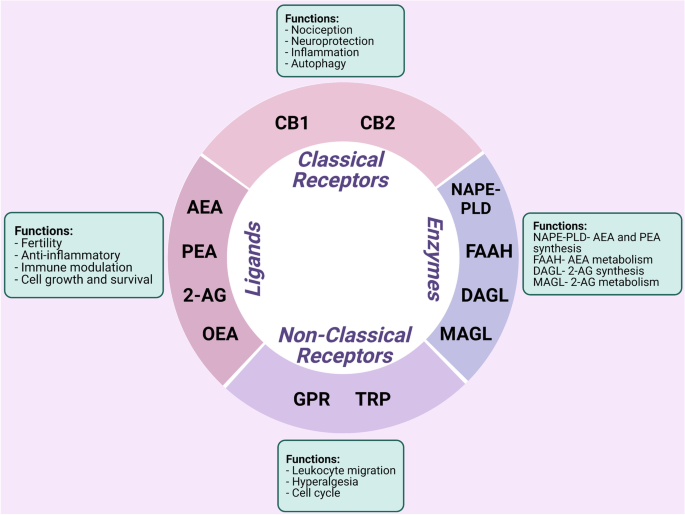
figure 1

“Endometriosis patients experience debilitating chronic pain, and the first-line treatment is ineffective at managing symptoms. Although surgical removal of the lesions provides temporary relief, more than 50% of the patients experience disease recurrence. Despite being a leading cause of hysterectomy, endometriosis lacks satisfactory treatments and a cure. Another challenge is the poor understanding of disease pathophysiology which adds to the delays in diagnosis and overall compromised quality of life. Endometriosis patients are in dire need of an effective therapeutic strategy that is both economical and effective in managing symptoms, while fertility is unaffected.

Endocannabinoids and phytocannabinoids possess anti-inflammatory, anti-nociceptive, and anti-proliferative properties that may prove beneficial for endometriosis management, given that inflammation, vascularization, and pain are hallmark features of endometriosis.

Endocannabinoids are a complex network of molecules that play a central role in physiological processes including homeostasis and tissue repair, but endocannabinoids have also been associated in the pathophysiology of several chronic inflammatory diseases including endometriosis and cancers. The lack of satisfactory treatment options combined with the recent legalization of recreational cannabinoids in some parts of the world has led to a rise in self-management strategies including the use of cannabinoids for endometriosis-related pain and other symptoms.

In this review, we provide a comprehensive overview of endocannabinoids with a focus on their potential roles in the pathophysiology of endometriosis. We further provide evidence-driven perspectives on the current state of knowledge on endometriosis-associated pain, inflammation, and therapeutic avenues exploiting the endocannabinoid system for its management.”

https://pubmed.ncbi.nlm.nih.gov/36207747/

https://jcannabisresearch.biomedcentral.com/articles/10.1186/s42238-022-00163-8

Identification of CB1 Ligands among Drugs, Phytochemicals and Natural-Like Compounds: Virtual Screening and In Vitro Verification

Go to ACS Chemical Neuroscience

“Cannabinoid receptor type 1 (CB1) is an important modulator of many key physiological functions and thus a compelling molecular target. However, safe CB1 targeting is a non-trivial task. In recent years, there has been a surge of data indicating that drugs successfully used in the clinic for years (e.g. paracetamol) show CB1 activity. Moreover, there is a lot of promise in finding CB1 ligands in plants other than Cannabis sativa. In this study, we searched for possible CB1 activity among already existing drugs, their metabolites, phytochemicals, and natural-like molecules. We conducted two iterations of virtual screening, verifying the results with in vitro binding and functional assays. The in silico procedure consisted of a wide range of structure- and ligand-based methods, including docking, molecular dynamics, and quantitative structure-activity relationship (QSAR). As a result, we identified travoprost and ginkgetin as CB1 ligands, which provides a starting point for future research on the impact of their metabolites or preparations on the endocannabinoid system. Moreover, we found five natural-like compounds with submicromolar or low micromolar affinity to CB1, including one mixed partial agonist/antagonist viable for hit-to-lead phase. Finally, the computational procedure established in this work will be of use for future screening campaigns for novel CB1 ligands.”

https://pubmed.ncbi.nlm.nih.gov/36197801/

https://pubs.acs.org/doi/10.1021/acschemneuro.2c00502

A Cannabinoid Hairy-Tale: Hair Loss or Hair Gain?

Journal of Cosmetic Dermatology

“Background: Few studies have reported on the use of cannabinoid products to treat hair loss.

Aim: This article aims to reconcile cannabinoids’ impact on hair growth.

Method: A comprehensive and structured search was conducted in PubMed and Google Scholar on 23 June 2022.

Result: While cannabidiol (CBD), a phytocannabinoid, may cause hair growth, several other phytocannabinoids may lead to hair loss. Additionally, the effect of CBD on hair growth may be concentration-dependent. CBD may cause hair loss at high concentrations (≥10 μM). Therefore, the concentration of CBD needs to be adjusted so that it is optimal for hair growth. One trial found that once-daily application of CBD-rich topical cannabis extract for six months increased nonvellus hair count by approximately 93.5% in 35 Caucasian AGA patients: 28 males aged 28-72 years [average 43 years] and 7 females aged 46-76 years [average 61 years]. Each application contained 3-4 mg of CBD. The CBD-rich topical cannabis extract was prepared by ultra-pulverizing Cannabis sativa [hemp] flower into a green chalk-like powder [10.78% CBD and 0.21% tetrahydrocannabinol] and then infusing the powder into a lanolin paste and Emu oil carrier.

Conclusion: Topical CBD preparations require further studies to establish their safety and efficacy profile. An ideal topical cannabinoid preparation should contain CBD at the right concentration and lack phytocannabinoid adulterants.”

https://pubmed.ncbi.nlm.nih.gov/36181341/

https://onlinelibrary.wiley.com/doi/10.1111/jocd.15427