Comparative Anti-Obesity Potential of Cannabigerol-Dominant Cannabis sativa L. Inflorescence Extracts via Differential Regulation of Lipid Metabolism in 3T3-L1 Cells

“Obesity is a chronic metabolic disorder characterized by excessive accumulation of body fat and is a major risk factor for various diseases, including type 2 diabetes, hypertension, and cardiovascular diseases.

This study investigated the anti-obesity effects of cannabigerol-dominant C. sativa inflorescence extracts (CEs) obtained using various ethanol concentrations.

The extracts were analyzed by UPLC to determine their major components. Additionally, anti-obesity mechanisms of the extracts were further determined through RT-qPCR and Western blot analysis to evaluate gene and protein expression levels. A total of seven cannabinoids, including cannabigerol as a major constituent, were identified within CE.

Differentiation of 3T3-L1 cells was dose-dependently inhibited by CE at all ethanol concentrations. Furthermore, the gene and protein expression levels of key adipogenic and lipogenic markers, such as PPARγ, C/EBPα, SREBP-1c, and FAS, were significantly downregulated by CE treatment. In contrast, the expression of factors involved in lipolysis and white adipose tissue browning, such as HSL, ATGL, UCP1, and PGC-1α, was markedly increased by CE treatment. These effects were enhanced in an ethanol concentration-dependent manner.

In conclusion, these results demonstrate that cannabigerol-dominant C. sativa effectively mitigates obesity by suppressing adipogenesis and lipogenesis while concurrently stimulating lipolysis and white adipose tissue browning.”

https://pubmed.ncbi.nlm.nih.gov/41751885

 “In conclusion, these results suggest that CE acts as a safe and effective therapeutic agent by simultaneously regulating adipogenesis, lipogenesis, lipolysis, and WAT browning.”

https://www.mdpi.com/1422-0067/27/4/1747

Aerobic training and cannabidiol activate the PI3K/AKT/PDX1 axis to ameliorate beta-cell dysfunction in a rat model of diet-induced obesity

Background: This study investigated the therapeutic potential of cannabidiol (CBD) and aerobic training (AT), both alone and in combination, to ameliorate beta-cell dysfunction in a rat model of diet-induced obesity, with a specific focus on the phosphatidylinositol 3-kinase (PI3K)/ protein Kinase B (AKT)/pancreatic and duodenal homeobox 1 (PDX1) pathway.

Methods: Thirty-two male Wistar rats were fed a high-fat diet (HFD) for 8 weeks to induce obesity. They were then randomly assigned to four groups (n = 8/group): HFD (sedentary), HFD + CBD (10 mg/kg, 5x/week), HFD + AT (30-minute treadmill running,50-80% maximal speed, 5x/week, 8 week), and HFD + CBD+AT (combined treatment) for a further 8 weeks. Following the intervention, beta-cell function was assessed via the HOMA-Beta index, and pancreatic gene expression of PI3K, AKT, and PDX1 was analyzed using RT-PCR.

Results: Both the HFD + CBD and HFD + CBD+AT groups showed a significant improvement in beta-cell function, as indicated by a higher HOMA-Beta index compared to the HFD group (p = 0.002 and p = 0.001, respectively). AT alone (HFD + AT) did not significantly alter HOMA-Beta. In contrast, all intervention groups (HFD + CBD, HFD + AT, and HFD + CBD+AT) demonstrated a significant upregulation in the gene expression of PI3K, AKT, and PDX1 compared to the HFD group (p < 0.001 for all). Notably, the combined treatment of CBD and AT (HFD + CBD+AT) produced a synergistic effect, resulting in a greater increase in the expression of all three genes compared to either intervention alone. No significant correlation was found between HOMA-Beta and the gene expression levels within any group (p > 0.05).

Conclusions: CBD and AT independently activate the pancreatic PI3K/AKT/PDX1 pathway, with their combination showing synergy. CBD, but not AT alone, improved functional beta-cell mass. This pathway activation represents a key mechanism for protecting beta-cells in obesity.”

https://pubmed.ncbi.nlm.nih.gov/41721911

https://link.springer.com/article/10.1007/s11033-026-11573-9

Cannabidiol mitigates high-fat-diet-induced early-stage inflammation in two adipose tissue fat depots of Wistar rats

“Cannabidiol (CBD) has potential for treating obesity-induced inflammation; thus, we studied the influence of CBD on the accumulation of lipid precursors of inflammation, the, enzymes, and cytokine levels in the subcutaneous (SAT) and visceral adipose tissue (VAT) of animals with obesity-induced early-stage inflammation.

Our experiment was performed on rats fed a high-fat (HFD) or control diet, which received CBD or its vehicle. The accumulation and composition of lipid fractions were assessed via gas‒liquid chromatography, whereas the expression of inflammatory pathway enzymes and the cytokine content were evaluated via Western blot or multiplexing, respectively.

In addition to selective changes in the content of cytokines, the administration of CBD to HFD-fed rats also decreased the deposition of all the lipid fractions in VAT, whereas in SAT, only the free fatty acid and diacylglycerol fractions were affected. Moreover, CBD reduced the deposition of arachidonic acid and the expression of enzymes associated with the synthesis of lipid precursors of inflammation in both the SAT and VAT of HFD-fed rats.

Although the data revealed the beneficial influence of CBD on lipid precursors of inflammation metabolism in both fat depots, more pronounced changes were observed in VAT, which is a tissue that is more predisposed to metabolic disease development.”

https://pubmed.ncbi.nlm.nih.gov/41571764

https://www.nature.com/articles/s41598-026-36666-0

Adipogenicity-induced human mesenchymal stem cells treated with hemp seed oil stimulate brown-like adipocytes and decrease adipokine levels through the activation of cannabinoid receptor 2 (CB2)

pubmed logo

“The endocannabinoid system (ECS) is essential for energy hemostasis, obesity, and other metabolic disorders.

Cannabidiol and polyunsaturated fatty acids (PUFAs), which are found in hemp seed oil (HSO), have been found to regulate adipose tissue through the ECS. Thus, human mesenchymal stem cells (hMSCs) were differentiated into pre-adipocytes and then treated with cannabidiol (CBD), tetrahydrocannabinol (THC), 0.05% HSO, or 0.1% HSO for 3 days (72 h).

The mixture was subsequently maintained in maintenance media for 14 days, after which the condition media (CM) was collected. In addition, THP-1 cells were used to assess the inflammatory response upon exposure to CM collected from different groups of experimental cells. Quantification for lipid accumulation (Oil red O), gene expression (RT‒qPCR), and protein levels (Western blot) were performed.

We found that HSO-treated cells matured toward brown-like adipose tissue with a spindle shape and decreased intracellular lipid accumulation. HSO treatment decreased the expression of genes associated with fat accumulation and browning (BAT), with the exception of UCP-1, which leans toward brown-like adipocytes. HSO treatment upregulated the cannabinoid receptors 2 (CB2), TRPV1, and GPCR55 mRNAs and leptin mRNA found with lower expression; no alterations were observed in cannabinoid receptors 1 (CB1), FAAH, and MGL mRNAs. In THP-1 macrophage, HSO treated CM decreased the expression of IL-6, IL-8, TNF-α, and leptin mRNAs significantly when compared to CBD and THC.

The potential of HSO in promoting brown fat characteristics through the CB2 and its effect on inflammation status offers an intriguing area for future research and therapeutic interventions.”

https://pubmed.ncbi.nlm.nih.gov/41258240

“Overall, the availability of balanced ratios of omega 3/omega 6 PUFAs and CBD in HSO favors in maintaining optimal ECS ligands in adipocytes. Our current study revealed that HSO treatment might promote the maturation of hMSC preadipocytes toward brown-like adipose tissue, which evident morphologically. ECS might mediate this effect, as HSO treatment downregulates the CB1 receptor and increases the CB2 receptor at the mRNA and protein levels. In addition, HSO treatment decreased inflammatory marker of IL-6, IL-8, TNF-α, and leptin compared to untreated cells; however, HSO treatment resulted in a minimalized the provoking of inflammatory cytokines compared with CBD and THC treatments in THP-1 cells. In conclusion, the potential of HSO in promoting the development of brown fat characteristics through the ECS and its effect on inflammation status offers an intriguing area for future research and therapeutic interventions.”

https://jcannabisresearch.biomedcentral.com/articles/10.1186/s42238-025-00343-2

Obesogenic diet impairs memory consolidation via the hippocampal endocannabinoid system

pubmed logo

“Although obesogenic high-fat/high-sugar diets impair memory function in humans and rodents, the underlying mechanisms remain elusive. Given that the brain endocannabinoid system and type-1 cannabinoid receptors (CB1Rs) control memory processes and are overactive under obesogenic conditions, we studied whether the effects of obesogenic diet consumption on memory function are dependent on this system.

Using an object recognition memory (ORM) task in male mice, we showed that CB1R activity is required for obesogenic-diet-induced impairment of long-term memory performance. This impairment was prevented by post-training systemic blockade of CB1R, which also normalized training-induced hippocampal cellular and synaptic overactivation.

Consistently, the obesogenic diet potentiated the increase in hippocampal endocannabinoid levels and enhanced CB1R expression induced by ORM, and genetic CB1R deletion from hippocampal glutamatergic neurons abolished diet-induced memory deficits. Strikingly, the obesogenic diet enhanced the hippocampal mechanistic target of rapamycin (mTOR) pathway in a CB1R-dependent manner, and pharmacological mTOR inhibition after training rescued diet-induced ORM consolidation deficits.

Together, these results establish how an obesogenic environment can lead to hippocampal overactivation of the endocannabinoid system and the mTOR pathway to eventually impair memory consolidation. Thus, these results shed light on the mechanisms of diet-induced cognitive alterations and may pave the way for novel therapeutic strategies.”

https://pubmed.ncbi.nlm.nih.gov/41237773

“Foodomics Reveals Anti-Obesity Properties of Cannabinoids from Hemp Oil”

https://pubmed.ncbi.nlm.nih.gov/36382382

“Anti-obesity effect of unsaponifiable matter from hemp seed in 3T3-L1 adipocytes and high-fat diet-induced obese mice”

https://pubmed.ncbi.nlm.nih.gov/41047880

Anti-Obesity diet drug from cannabis works!

https://www.news-medical.net/news/2006/01/17/15421.aspx

The Endocannabinoid System in the Development and Treatment of Obesity: Searching for New Ideas

pubmed logo

“Obesity is a complex, multifactorial disease and a growing global health challenge associated with type 2 diabetes, cardiovascular disorders, cancer, and reduced quality of life. The existing pharmacological therapies are characterized by their limited number and efficacy, and safety concerns further restrict their utilization.

This review synthesizes extensive knowledge regarding the role of the endocannabinoid system (ECS) in the pathogenesis of obesity, as well as its potential as a therapeutic target. A thorough evaluation of preclinical and clinical data concerning endocannabinoid ligands, cannabinoid receptors (CB1, CB2), their genetic variants, and pharmacological interventions targeting the ECS was conducted.

Literature data suggests that the overactivation of the ECS may play a role in the pathophysiology of excessive food intake, dysregulated energy balance, adiposity, and metabolic disturbances.

The pharmacological modulation of ECS components, by means of CB1 receptor antagonists/inverse agonists, CB2 receptor agonists, enzyme inhibitors, and hybrid or allosteric ligands, has demonstrated promising anti-obesity effects in animal models. However, the translation of these findings into clinical practice remains challenging due to safety concerns, particularly neuropsychiatric adverse events.

The development of novel strategies, including peripherally restricted compounds, hybrid dual-target agents, dietary modulation of endocannabinoid tone, and non-pharmacological interventions, promises to advance the field of obesity management.”

https://pubmed.ncbi.nlm.nih.gov/41096816/

“Taken together, the growing body of evidence suggests that targeting the ECS, either pharmacologically or through lifestyle interventions, may open a new chapter in the prevention and treatment of obesity.”

https://www.mdpi.com/1422-0067/26/19/9549

Anti-obesity effect of unsaponifiable matter from hemp seed in 3T3-L1 adipocytes and high-fat diet-induced obese mice

“The favorable lipid profile of hemp seed could be a potential source of unsaponifiable matter rich in fat-soluble phytochemicals such as phytosterols, vitamin E, and cannabidiol (CBD). Despite its nutritional value, studies investigating the functional properties of hemp seed, particularly its anti-obesity potential, remain limited.

The aim of this study was to obtain unsaponifiable matter from hemp seed (HUSM), analyze its fat-soluble phytochemicals and evaluate its anti-obesity activity using both in vitro and in vivo experimental models.

The results showed that HUSM contained abundant carotenoids, vitamin E, phytosterols, policosanols, and CBD, with trace amounts of THC (0.06%), Furthermore, HUSM inhibited adipocyte differentiation and lipid accumulation in a dose-dependent manner, significantly reducing lipid accumulation by up to 79% without cytotoxicity in 3T3-L1 adipocytes.

HUSM treatment led to reduced abdominal size and body weight gain, decreased adipose tissue and liver size, and lower plasma triglycerides, total cholesterol, and LDL cholesterol levels. These effects were mediated through the AMPK signalling pathway, which plays a pivotal role in regulating adipogenesis and lipogenesis. Additionally, HUSM improved adipokine balance, reducing leptin and increasing adiponectin levels, indicating recovery of dysfunctional adipose tissues.

These findings highlight the potential of HUSM as a natural anti-obesity therapeutic, offering new avenues for the treatment and prevention of obesity and related metabolic disorders through the AMPK signalling pathway.”

https://pubmed.ncbi.nlm.nih.gov/41047880/

https://pubs.rsc.org/en/content/articlelanding/2025/fo/d5fo02231b

Cannabidiol attenuates diet-induced metabolic endotoxemia, neuroinflammation, and anxiety-like behaviors in male aged rats

pubmed logo

“Obesity and aging synergistically reinforce neuroinflammation and disruption of homeostatic mechanisms, triggering pathological behaviors such as increased anxiety.

Cannabidiol (CBD) has been reported to exert anxiolytic, anti-inflammatory, and neuroprotective effects, supporting the hypothesis that it may attenuate the detrimental consequences of obesity, even in aged animals.

To test this hypothesis, 18-month-old male Wistar rats were divided into four experimental groups: control + vehicle (CT + vehicle), CT + CBD, cafeteria diet + vehicle (CAF + vehicle) and CAF + CBD. The animals were fed their diets for 8 weeks. Oral treatment with CBD (15 mg/kg/day) or vehicle began in the 9th week and continued until the end of the experiment, concurrently with the ongoing diet.

We found that the CAF increased anxiety-like behaviors in the open field and elevated plus maze tests, while CBD mitigated these behaviors in the open field. Obesogenic diet also increased circulating levels of lipopolysaccharide, which were reduced by CBD. In the prefrontal cortex, CAF increased levels of interleukin-6 (IL-6), which were decreased by CBD. Additionally, CBD reduced the expression of tumor necrosis factor-α (TNF-α) and toll-like receptor 4 (TLR4). CAF feeding also caused a reduction in the main endocannabinoids, 2-Arachidonoylglycerol (2-AG) and anandamide (AEA). In the prefrontal cortex, CAF increased transcripts of cannabinoid receptor 1 (CB1) and reduced those of cannabinoid receptor 2 (CB2) and serotonin receptor 5-Hydroxytryptamine receptor 1A (5-HT1A). Moreover, levels of triggering receptor expressed on myeloid cells 2 (TREM2) were reduced by the diet.

These findings support the notion that obesity, through its metabolic and inflammatory consequences, exacerbates neuroinflammation and contributes to the dysregulation of the endocannabinoid system in aged animals. Notably, CBD demonstrated the ability to attenuate inflammatory markers and improve anxiety-like behavior, suggesting its potential as a therapeutic strategy to counteract obesity-induced neurobiological alterations in aging.”

https://pubmed.ncbi.nlm.nih.gov/41022293/

“CBD reversed systemic and central inflammatory effects of obesity.”

https://linkinghub.elsevier.com/retrieve/pii/S0889159125003630

Cannabis Improves Metabolic Dysfunction and Macrophage Signatures in Obese Mice

“Obesity rates continue to rise, highlighting the need for new treatments that are effective, safe, and widely accessible. Aligned with the easing of restrictions on cannabis use, interest in its therapeutic potential is evolving. As such, we examined the effects of the cannabis plant with high cannabidiol (CBD) content or high Δ9-tetrahydrocannabinol (THC) content on metabolic and immune dysregulation in obese mice.

Briefly, female C57BL/6 mice were randomized into four groups (n=15/group): 1) Lean, 2) Obese Placebo, 3) Obese CBD, and 4) Obese THC. Lean mice consumed a low-fat diet for the study duration. Obese mice consumed a high-fat diet for 16 weeks prior to a 4-week cannabis (3x/week; high CBD = ~4.2 mg/kg and high THC = ~7.3 mg/kg) intervention.

Consistent with our hypothesis, obesity increased Homeostasis Model Assessment of Insulin Resistance (HOMA-IR) and metabolic dysfunction-associated steatohepatitis (MASH) both of which were significantly mitigated by either high (10.5%) CBD or high (18.16%) THC cannabis (p<0.05). Interestingly, these changes appeared to occur independent of significant weight loss or measurable changes in food intake.

Diet-induced obesity also increased infiltrating macrophages, pan macrophages, and M1-like pro-inflammatory macrophages in adipose tissue and liver. These effects were rescued by high CBD and high THC (p<0.05), providing evidence consistent with causation for the improvements in HOMA-IR and MASH.

Despite the legal complexities surrounding cannabis use, these data suggest both CBD and THC can be a viable therapy to target macrophages and improve metabolic health and immune dysregulation with obesity.”

https://pubmed.ncbi.nlm.nih.gov/40960937/

https://journals.physiology.org/doi/abs/10.1152/ajpcell.00503.2025

Cannabidiol regulates apoptosis and glial cells homeostasis in the prefrontal cortex of offspring from obese rat mothers

pubmed logo

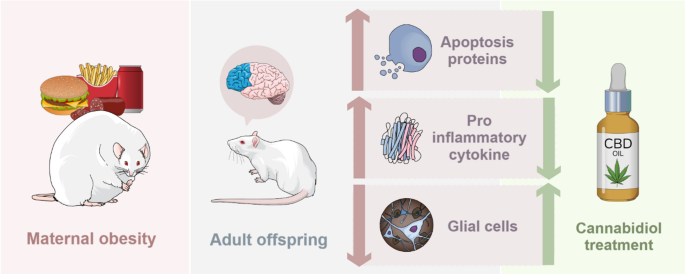
“Maternal obesity during pregnancy poses significant health risks for both mother and progeny, including long-term impacts on brain function. In previous studies, we demonstrated that cafeteria diet (CAF) consumption during gestation induces neuroinflammation and behavioral deficits in the offspring, which are reversed by cannabidiol (CBD) treatment. However, the effects of CBD on apoptosis-related pathways in this context remain unclear.

Here, we investigated whether CBD treatment can modulate pro-apoptotic signaling and glial cells morphology in adult offspring of obese mothers.

Wistar rats were fed a CAF for 12 weeks before mating, during pregnancy, and lactation. Offspring received oral CBD (50 mg/kg) for 3 weeks starting at postnatal day 70. In the prefrontal cortex, we assessed apoptosis-related proteins, TNFα gene expression, and astrocytes and microglia morphology.

Male and female offspring of CAF-fed dams showed increased levels of BAD, which were mitigated by CBD treatment. JNK was also elevated in female offspring of obese mothers, and CBD reduced this increase. In females, CBD treatment led to a decrease in AKT concentrations. TNFα expression was elevated in the prefrontal cortex of male offspring of obese mothers. Additionally, a reduction in GFAP- and IBA-1-positive cells in the prefrontal cortex was observed in male offspring of obese dams, which was reversed by CBD.

These findings suggest that maternal obesity promotes a pro-apoptotic and inflammatory brain environment, and CBD may counteract these effects via modulation of glial activity and apoptotic pathways.”

https://pubmed.ncbi.nlm.nih.gov/40892197/

https://link.springer.com/article/10.1007/s11011-025-01687-7