“An age-related decline in endocannabinoid system (ECS) activity may contribute to conditions such as chronic pain and Alzheimer’s disease. Although cannabis is increasingly used by older adults to alleviate age-related conditions, it remains unclear how cannabinoids affect ECS activity across the lifespan.
The present study assayed levels of seven endocannabinoids (AEA, 2-AG, DEA, LEA, PEA, SEA, and OEA) in a sample of adults (N = 142; younger 21-24 years, n = 38; midlife 25-54, n = 73; older 55-71, n = 31) assayed before cannabis use (baseline [pre-use]) and ~ 1 h after flower or ~ 2 h after edible cannabis use.
At baseline, older adults exhibited lower AEA and DEA than younger adults, and lower LEA than midlife adults.
Acute cannabis use increased AEA, DEA, LEA, PEA, SEA, and OEA across all age groups (all p < .001). 2-AG showed no increase. For AEA and DEA, increases were larger in older adults (Time×Age).
These findings indicate broad endocannabinoid elevations after cannabis use regardless of age, alongside age-related differences at baseline and in acute responses.”
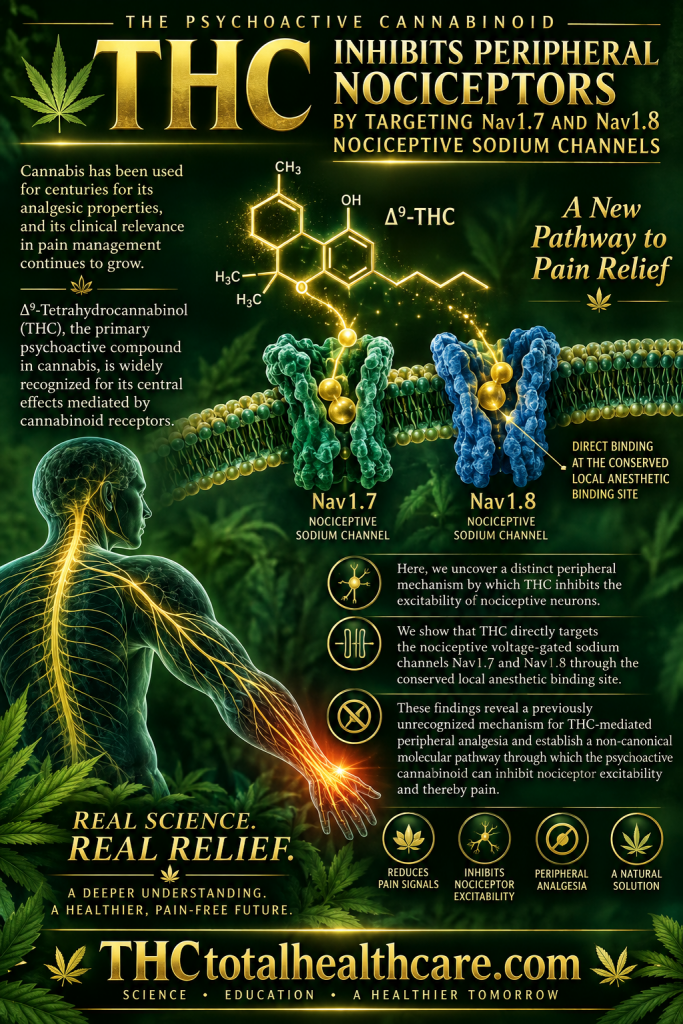
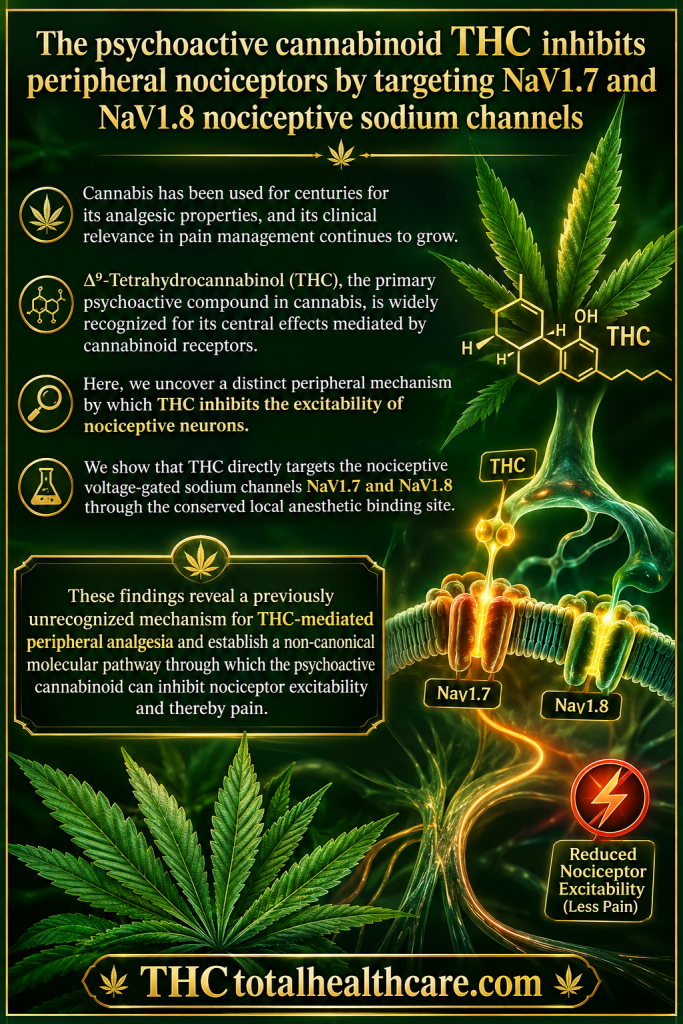
“Δ⁹-Tetrahydrocannabinol (THC), the primary psychoactive compound in cannabis, is widely recognized for its central effects mediated by cannabinoid receptors. Here, we uncover a distinct peripheral mechanism by which THC inhibits the excitability of nociceptive neurons.
We show that THC directly targets the nociceptive voltage-gated sodium channels NaV1.7 and NaV1.8 through the conserved local anesthetic binding site. This interaction reduces sodium currents and suppresses action potential generation in peripheral sensory neurons.
Our findings demonstrate that, beyond its central psychoactivity, THC exerts direct peripheral nociceptor inhibition via modulation of NaV1.7 and NaV1.8, offering new insight into cannabinoid-based analgesia independent of cannabinoid receptor signaling.”
“Cannabis has been used for centuries for its analgesic properties, and its clinical relevance in pain management continues to grow.”
“These findings reveal a previously unrecognized mechanism for THC-mediated peripheral analgesia and establish a non-canonical molecular pathway through which the psychoactive cannabinoid can inhibit nociceptor excitability and thereby pain.”
“Chronic musculoskeletal pain (CMP) is a pervasive condition that can impair daily functioning and quality of life. Traditional pharmaceutical therapies, including non-steroidal anti-inflammatory drugs, gabapentinoids, and opioids, often yield suboptimal results and carry notable risks, such as adverse side effects and dependence.
Increasing interest has turned toward medical cannabis, particularly combined formulations of cannabidiol (CBD) and tetrahydrocannabinol (THC), as a potential alternative or complement to current pain management strategies.
Evidence suggests that cannabinoids interact with the endocannabinoid system to modulate nociception and inflammation, offering meaningful pain relief and possibly reducing opioid requirements.
However, heterogeneity in study designs, product formulations, and regulatory frameworks presents challenges in drawing definitive conclusions. Additionally, while most adverse effects, such as fatigue, dizziness, and mild cognitive changes, are generally reported as tolerable, concerns remain about long-term safety and standardization of dosing.
Taken together, the existing literature points to a promising role for medical cannabis in CMP management, underscoring the need for further high-quality research to establish best practices, clarify patient selection, and guide clinicians in safe and effective cannabinoid therapy.”
“This scoping review highlights the potential role of medical cannabis in managing musculoskeletal pain. Evidence suggests it may reduce pain, enhance well-being, and improve quality of life, particularly as an alternative or adjunct to opioids. Adverse effects are typically mild, supporting its use as a safer long-term option. However, data on long-term efficacy, especially for CBD, remain limited.
Given the risks of opioid dependence, cannabis offers a promising therapeutic alternative.”
“Prescription opioid misuse is a significant public health concern among individuals with chronic pain. Treating severe pain often requires high doses of opioids, increasing the risk of developing an opioid use disorder.
Cannabidiol (CBD) is a non-intoxicating component of cannabis that has shown therapeutic potential without abuse liability.
This study investigated the effects of CBD on oxycodone self-administration and hyperalgesia in an animal model of chronic neuropathic pain.
Adult male rats were trained to self-administer intravenous oxycodone (0.06 mg/kg/infusion). Subsequently, they underwent chronic constriction injury (CCI) of the sciatic nerve or received sham surgery. Paw withdrawal latency was measured using the Hargreaves test as an indicator of thermal pain sensitivity. CBD (0, 1, 3, and 10 mg/kg, IP) was administered before the self-administration sessions, and pain testing was conducted afterward. The rats acquired oxycodone self-administration, as indicated by more active than inactive lever presses. CCI surgery decreased the paw withdrawal latency, confirming the induction of neuropathic pain. CCI alone did not affect oxycodone self-administration, suggesting that neuropathic pain does not substantially influence opioid intake at the dose tested.
Treatment with CBD reduced oxycodone self-administration in both the sham and CCI rats. Oxycodone self-administration in the CCI rats reversed the CCI-induced decrease in paw withdrawal latency. However, CBD did not affect the antinociceptive effect of oxycodone in CCI rats.
Taken together, these findings demonstrate that CBD reduces oxycodone self-administration without affecting the antinociceptive effects of oxycodone in neuropathic pain.
This study supports the potential of CBD to reduce opioid use and misuse, regardless of pain status.”
“Introduction: Cannabis has been decriminalized by many states and shows promise in treating both neuropathic and non-neuropathic pain through its interaction with the endocannabinoid system and anti-inflammatory effects. This study examines differences in cannabis use for adults whose most bothersome chronic pain condition is neuropathic vs. non-neuropathic.
Materials and methods: Survey data were collected from adults receiving care at a pain clinic. Participants completed demographic questions and standardized self-report measures (PROMIS Pain Intensity/Interference and the ID-Pain tool). Participants’ most bothersome pain condition(s) were categorized as neuropathic or non-neuropathic pain based on ID-Pain scores. Linear regression models assessed differences in frequency and duration of cannabis product use between groups, adjusting for age and sex.
Results: A total of 113 individuals were recruited; following exclusions and missing data, 104 participants (61.5% female) were included in the final analysis. Of these, 36.5% reported neuropathic pain as their most bothersome, and 63.5% reported non-neuropathic pain. Those with neuropathic pain reported significantly more days per month of Tetrahydrocannabinol/Cannabidiol (THC/CBD) combination (b = 5.96, p = 0.02), Cannabidiol-only (CBD-only) (b = 8.82, p = 0.03), and Tetrahydrocannabinol-only (THC-only) products (b = 7.04, p = 0.02). They also used THC-only (b = 0.97, p < 0.05) and THC/CBD (b = 1.09, p < 0.01) products more frequently per day. Neuropathic pain was positively associated with pain intensity (b = 4.10, p < 0.001) and interference (b = 4.95, p < 0.001).
Discussion: Adults whose most bothersome pain condition(s) were neuropathic used cannabis, especially THC and THC/CBD combination products, more frequently than those whose most bothersome pain was non-neuropathic. Participants with neuropathic pain also reported higher levels of pain intensity and interference. Further longitudinal research is needed to confirm whether increased use of THC-rich cannabis provides symptom relief for adults with neuropathic pain.”
“Cannabis interacts with the endocannabinoid system, making it a potential treatment for neuropathic pain.”
“Because previous studies found THC products to be more effective in managing neuropathic pain by interacting with the endocannabinoid system, it is possible that our participants also experienced benefit; this could explain their higher use of THC containing products.
“The effect of chronic marijuana use on patients is unknown, including in the surgical setting. Marijuana produces many effects on the body, which should be considered when providing medical care.
Chronic marijuana use may affect surgical opioid requirements. To explore this possibility, an observational study was completed by conducting a retrospective chart review of patients who underwent surgery with general anesthesia.
Patients were identified in the electronic medical record via self-reporting as marijuana users (users) or nonmarijuana users (nonusers). Users and nonusers were case-matched based on age, gender, weight, and procedure. After case matching, 570 patients’ charts were analyzed, and intraoperative opioid, intraoperative propofol, and post-anesthesia care unit opioid requirements were compared.
Marijuana users required less intraoperative opioids (mean [standard deviation (SD)] 27.2 [20.5] morphine milligram equivalents [MMEs]) compared to those who were marijuana nonusers (31.3 [22.1] MME).
These results show a statistically significant difference in the intraoperative opioid requirement between case-matched users and nonusers (p = 0.02), with p = 0.013 after statistical adjustment for racial differences between the marijuana user and nonuser cohorts. Users and nonusers required similar amounts of intraoperative propofol (242.2 [220.2] and 257.8 [250.9], respectively) and post-operative opioids (7.3 [6.0] and 8.0 [9.0], respectively). The differences in intraoperative propofol and post-operative opioid requirements were not different statistically with p-values of 0.43 and 0.31, respectively.
Based on this study population, marijuana users required less intraoperative opioids when compared to case-matched marijuana nonusers, with no difference in intraoperative propofol or post-operative opioid requirements.
Perspective: Typical preoperative screening includes queries about patient substance use including marijuana, but details such as frequency and length of use are infrequently asked. The addition of these details to the assessment may provide improved understanding of a patient’s surgical opioid requirements.”
“Question Is participation in the New York State (NYS) medical cannabis program associated with reduced prescription opioid receipt among adults with chronic pain?
Findings In this cohort study of 204 adults with chronic pain, participation in the NYS medical cannabis program, defined as monthly dispensation of medical cannabis reported by the dispensary pharmacist, was associated with significantly reduced prescription opioid receipt.
Meaning These findings suggest that participation in a pharmacist-directed medical cannabis program may help reduce prescription opioid receipt among adults with chronic pain.
Abstract
Importance Medical cannabis is increasingly considered a substitute for prescription opioid medications for chronic pain, driven by the urgent need for opioid alternatives to combat the ongoing epidemic.
Objective To determine the association between participation in the New York State (NYS) medical cannabis program and prescription opioid receipt among adults with chronic pain.
Design, Setting, and Participants This cohort study used data from the NYS Prescription Monitoring Program (PMP) from September 2018 through July 2023. Adults prescribed opioids for chronic pain who were newly certified for medical cannabis use in NYS were recruited from a large academic medical center and nearby medical cannabis dispensaries in the Bronx, New York. Monthly dispensation of medical cannabis to study participants was monitored for 18 months. Data analyses were performed from February 3, 2025, to July 15, 2025.
Exposure Portion of days covered each month by pharmacist report of dispensed medical cannabis.
Main Outcomes and Measures Prescription opioid receipt, defined as NYS PMP-reported prescription monthly opioid dispensation (mean daily dose in morphine milliequivalents [MME]), was assessed with marginal structural models adjusted for time-invariant and time-varying confounders, including self-reported unregulated cannabis use. Nonprescribed opioid use was also assessed during the study period.
Results Among 204 participants, the mean (SD) age at baseline was 56.8 (12.8) years, and 113 (55.4%) were female. At baseline, participants’ mean (SD) pain severity score was 6.6 (1.8) out of 10, and mean (SD) pain interference score was 6.8 (1.9) out of 10. Baseline mean (SD) daily MME was 73.3 (133.0). During the 18-month follow-up period, participants’ mean (SD) daily MME decreased to 57.4 (127.8). This reduction in mean daily MME was associated with the monthly portion of days covered with medical cannabis; compared with no medical cannabis dispensed, participants dispensed a 30-day supply of medical cannabis were exposed to 3.53 fewer MME per day (β = −3.53; 95% CI, −6.68 to −0.04; P = .03).
Conclusions and Relevance In this cohort study, participation in NYS’s medical cannabis program was associated with reduced prescription opioid receipt during 18 months of prospective follow-up, accounting for unregulated cannabis use.”
“Access to medical cannabis through a state-regulated program was associated with significantly lower rates of opioid prescriptions among adults with chronic pain, according to findings recently published in JAMA Internal Medicine.
The study included 204 adults enrolled in the New York State medical cannabis program, which provided monthly access to medical cannabis through a dispensary pharmacist, and 142 ultimately obtained the treatment. The data spanned from September 2018 through July 2023. Researchers measured prescription opioid receipt via mean daily dose in morphine milliequivalents (MME) and compared it with how many days’ worth of cannabis individuals were dispensed each month based on pharmacists’ reports.
After 18 months, the mean daily MME decreased by 22%, from 73 to 57.
The authors noted that instead of measuring medical cannabis exposure via its legalization status, they directly analyzed pharmacy dispensation amounts, a more accurate indicator of uptake. Randomized clinical trials are needed to see whether medical cannabis reduces opioid use, they added.”
“Importance: Medical cannabis is increasingly considered a substitute for prescription opioid medications for chronic pain, driven by the urgent need for opioid alternatives to combat the ongoing epidemic.
Objective: To determine the association between participation in the New York State (NYS) medical cannabis program and prescription opioid receipt among adults with chronic pain.
Design, setting, and participants: This cohort study used data from the NYS Prescription Monitoring Program (PMP) from September 2018 through July 2023. Adults prescribed opioids for chronic pain who were newly certified for medical cannabis use in NYS were recruited from a large academic medical center and nearby medical cannabis dispensaries in the Bronx, New York. Monthly dispensation of medical cannabis to study participants was monitored for 18 months. Data analyses were performed from February 3, 2025, to July 15, 2025.
Exposure: Portion of days covered each month by pharmacist report of dispensed medical cannabis.
Main outcomes and measures: Prescription opioid receipt, defined as NYS PMP-reported prescription monthly opioid dispensation (mean daily dose in morphine milliequivalents [MME]), was assessed with marginal structural models adjusted for time-invariant and time-varying confounders, including self-reported unregulated cannabis use. Nonprescribed opioid use was also assessed during the study period.
Results: Among 204 participants, the mean (SD) age at baseline was 56.8 (12.8) years, and 113 (55.4%) were female. At baseline, participants’ mean (SD) pain severity score was 6.6 (1.8) out of 10, and mean (SD) pain interference score was 6.8 (1.9) out of 10. Baseline mean (SD) daily MME was 73.3 (133.0). During the 18-month follow-up period, participants’ mean (SD) daily MME decreased to 57.4 (127.8). This reduction in mean daily MME was associated with the monthly portion of days covered with medical cannabis; compared with no medical cannabis dispensed, participants dispensed a 30-day supply of medical cannabis were exposed to 3.53 fewer MME per day (β = -3.53; 95% CI, -6.68 to -0.04; P = .03).
Conclusions and relevance: In this cohort study, participation in NYS’s medical cannabis program was associated with reduced prescription opioid receipt during 18 months of prospective follow-up, accounting for unregulated cannabis use.”
“These findings suggest that participation in a pharmacist-directed medical cannabis program may help reduce prescription opioid receipt among adults with chronic pain.”
“Chronic pain syndromes (CPS) are debilitating conditions for which cannabis extracts and cannabinoids have shown promise as effective treatments. However, accessibility to these treatments is limited due to the absence of suitable formulations and standardized dosage guidelines. This is particularly critical for women, who present sex-specific differences in pain burden, pain perception, and pain-related cannabinoid pharmacology.
We conducted a retrospective open-label cross-sectional study on 29 female CPS patients who received full-spectrum cannabis extracts (FCEs) with standardized compositions produced by two patient-led civil societies. An individually tailored dosage protocol was used, with dosage schemes adjusted based on individualized clinical assessments of initial conditions and treatment responses. Patients received either CBD-dominant extracts, THC-dominant extracts, or a combination of both. To evaluate the results, we conducted a comprehensive online patient-reported outcome survey covering core CPS symptoms, comorbidities, personal burden, and quality of life-including open-ended questions to capture the practical and subjective impacts of CPS and FCEs treatment on patients’ lives.
Despite most patients already using medications for pain and mood disorders, all reported some level of pain relief, and most reported improvements in cognitive function, motor abilities, professional activities, irritability, anxiety, melancholy, fatigue, and sleep quality. Qualitative content analysis of open-ended responses revealed that FCEs had relevant positive effects on practical and subjective domains, as well as personal relationships. No patients had to discontinue extract use due to adverse effects, and most reduced or ceased their use of analgesic and psychiatric medications. The optimal dosage regime, including CBD-to-THC proportions, was established through a response-based protocol, varied considerably, and showed no clear link to specific pain types.
These real-life results strongly suggest that a broad scope of benefits can be achieved by using flexible dosing schemes of cannabis extracts in managing diverse CPS conditions in female patients. Therefore, this study highlights the significance of tailoring treatment plans to individual CPS cases. Moreover, it demonstrates the feasibility of utilizing quality-controlled cannabis extracts produced by civil societies as either adjuncts or primary pharmacotherapeutic options in CPS management.”
“Studies with isolated cannabinoids revealed relief of chronic pain, inflammation, depression, and other CPS-associated comorbidities in animal models.
Isolated cannabidiol (CBD) has shown analgesic and anti-inflammatory effects in humans, while tetrahydrocannabinol (THC) seems to produce pain relief by modulating neuronal activity in pain-associated areas of the central nervous system, such as the periaqueductal area, and the descending supraspinal inhibitory pathways, often involved in cases of CPS. Accordingly, THC isolated oil promoted significant relief of chronic neuropathic pain in comparison to placebo.”
“Our study provides compelling real-world evidence of the broad, integrative benefits of full-spectrum cannabis extracts (FCEs) for women with chronic pain syndromes (CPS).”