
“Anti-virulence strategies are being explored as a novel approach to combat pathogens. Such strategies include inhibition of surface adhesion, tissue invasion, toxin production, and/or interference with the gene regulation of other virulence traits.
Listeria monocytogenes, the causative agent of listeriosis, is a facultative intracellular food pathogen characterized by a wide distribution in the environment. Its ability to persist within biofilms and to develop resistance to sanitizers is the cause of significant problems in food processing plants and of steep costs for the food industry.
In humans, the treatment of listeriosis is hampered by the intracellular location of listeriae and the poor intracellular penetration of some antibiotics. Eleven
L. monocytogenes isolates from patients who were diagnosed with invasive listeriosis in Italy in 2014-2016 were studied.
This
in vitro and
in vivo study explored the antibacterial and anti-virulence properties of a steam-distilled essential oil of
Cannabis sativa L., which is being intensively investigated for its high content in powerful bioactive phytochemicals.
Susceptibility experiments demonstrated a moderate bactericidal activity of the essential oil (Minimum Bactericidal Concentration > 2048 μg/mL).
Food contamination with
L. monocytogenes is a major concern for the food industry, particularly for plants making ready-to-eat and processed food.
The present work provides a baseline in the study of the anti-virulence properties of the
C. sativa essential oil against
L. monocytogenes. Further studies are needed to understand if it could be used as an alternative agent for the control of
L. monocytogenes in food processing plants.”

 “Cannabinoid receptor 1 (CB1) is a promising therapeutic target for a variety of disorders. Distinct efficacy profiles showed different therapeutic effects on CB1 dependent on three classes of ligands: agonists, antagonists, and inverse agonists. To discriminate the distinct efficacy profiles of the ligands, we carried out molecular dynamics (MD) simulations to identify the dynamic behaviors of inactive and active conformations of CB1 structures with the ligands. In addition, the molecular mechanics Poisson-Boltzmann surface area (MM-PBSA) method was applied to analyze the binding free energy decompositions of the CB1-ligand complexes. With these two methods, we found the possibility that the three classes of ligands can be discriminated. Our findings shed light on the understanding of different efficacy profiles of ligands by analyzing the structural behaviors of intact CB1 structures and the binding energies of ligands, thereby yielding insights that are useful for the design of new potent CB1 drugs.”
https://www.ncbi.nlm.nih.gov/pubmed/30213978
https://www.nature.com/articles/s41598-018-31749-z
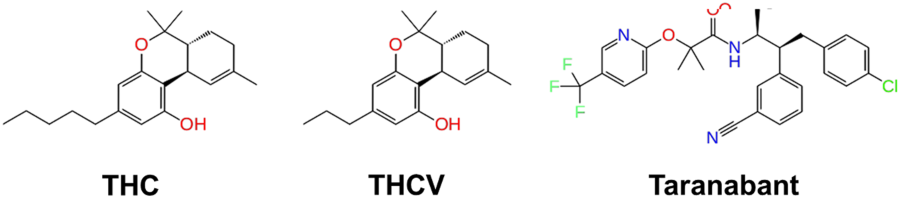
“Chemical structure of the partial agonist THC, antagonist THCV, and inverse agonist Taranabant.”
“Cannabinoid receptor 1 (CB1) is a promising therapeutic target for a variety of disorders. Distinct efficacy profiles showed different therapeutic effects on CB1 dependent on three classes of ligands: agonists, antagonists, and inverse agonists. To discriminate the distinct efficacy profiles of the ligands, we carried out molecular dynamics (MD) simulations to identify the dynamic behaviors of inactive and active conformations of CB1 structures with the ligands. In addition, the molecular mechanics Poisson-Boltzmann surface area (MM-PBSA) method was applied to analyze the binding free energy decompositions of the CB1-ligand complexes. With these two methods, we found the possibility that the three classes of ligands can be discriminated. Our findings shed light on the understanding of different efficacy profiles of ligands by analyzing the structural behaviors of intact CB1 structures and the binding energies of ligands, thereby yielding insights that are useful for the design of new potent CB1 drugs.”
https://www.ncbi.nlm.nih.gov/pubmed/30213978
https://www.nature.com/articles/s41598-018-31749-z
“Chemical structure of the partial agonist THC, antagonist THCV, and inverse agonist Taranabant.”
 “The evolving policies regarding the use of therapeutic Cannabis have steadily increased the public interest in its use as a complementary and alternative medicine in several disorders, including inflammatory bowel disease.
Endocannabinoids represent both an appealing therapeutic strategy and a captivating scientific dilemma.
Results from clinical trials have to be carefully interpreted owing to possible reporting-biases related to cannabinoids psychotropic effects. Moreover, discriminating between symptomatic improvement and the real gain on the underlying inflammatory process is often challenging.
This review summarizes the advances and latest discovery in this ever-changing field of investigation, highlighting the main limitations in the current use of these drugs in clinical practice and the possible future perspectives to overcome these flaws.”
“The evolving policies regarding the use of therapeutic Cannabis have steadily increased the public interest in its use as a complementary and alternative medicine in several disorders, including inflammatory bowel disease.
Endocannabinoids represent both an appealing therapeutic strategy and a captivating scientific dilemma.
Results from clinical trials have to be carefully interpreted owing to possible reporting-biases related to cannabinoids psychotropic effects. Moreover, discriminating between symptomatic improvement and the real gain on the underlying inflammatory process is often challenging.
This review summarizes the advances and latest discovery in this ever-changing field of investigation, highlighting the main limitations in the current use of these drugs in clinical practice and the possible future perspectives to overcome these flaws.”
 “Targeting peripheral CB1R is desirable for the treatment of metabolic syndromes without adverse neuropsychiatric effects.
We previously reported a human hCB1b isoform that is selectively enriched in pancreatic beta-cells and hepatocytes, providing a potential peripheral therapeutic hCB1R target. It is unknown whether there are peripherally enriched mouse and rat CB1R (mCB1 and rCB1, respectively) isoforms.
In this study, we found no evidence of peripherally enriched rodent CB1 isoforms; however, some mCB1R isoforms are absent in peripheral tissues. We show that the mouse Cnr1 gene contains six exons that are transcribed from a single promoter. We found that mCB1A is a spliced variant of extended exon 1 and protein-coding exon 6; mCB1B is a novel spliced variant containing unspliced exon 1, intron 1, and exon 2, which is then spliced to exon 6; and mCB1C is a spliced variant including all 6 exons.
Using RNAscope in situ hybridization, we show that the isoforms mCB1A and mCB1B are expressed at a cellular level and colocalized in GABAergic neurons in the hippocampus and cortex. RT-qPCR reveals that mCB1A and mCB1B are enriched in the brain, while mCB1B is not expressed in the pancreas or the liver. Rat rCB1R isoforms are differentially expressed in primary cultured neurons, astrocytes, and microglia.
We also investigated modulation of Cnr1 expression by insulin in vivo and carried out in silico modeling of CB1R with JD5037, a peripherally restricted CB1R inverse agonist, using the published crystal structure of hCB1R.
The results provide models for future CB1R peripheral targeting.”
“Targeting peripheral CB1R is desirable for the treatment of metabolic syndromes without adverse neuropsychiatric effects.
We previously reported a human hCB1b isoform that is selectively enriched in pancreatic beta-cells and hepatocytes, providing a potential peripheral therapeutic hCB1R target. It is unknown whether there are peripherally enriched mouse and rat CB1R (mCB1 and rCB1, respectively) isoforms.
In this study, we found no evidence of peripherally enriched rodent CB1 isoforms; however, some mCB1R isoforms are absent in peripheral tissues. We show that the mouse Cnr1 gene contains six exons that are transcribed from a single promoter. We found that mCB1A is a spliced variant of extended exon 1 and protein-coding exon 6; mCB1B is a novel spliced variant containing unspliced exon 1, intron 1, and exon 2, which is then spliced to exon 6; and mCB1C is a spliced variant including all 6 exons.
Using RNAscope in situ hybridization, we show that the isoforms mCB1A and mCB1B are expressed at a cellular level and colocalized in GABAergic neurons in the hippocampus and cortex. RT-qPCR reveals that mCB1A and mCB1B are enriched in the brain, while mCB1B is not expressed in the pancreas or the liver. Rat rCB1R isoforms are differentially expressed in primary cultured neurons, astrocytes, and microglia.
We also investigated modulation of Cnr1 expression by insulin in vivo and carried out in silico modeling of CB1R with JD5037, a peripherally restricted CB1R inverse agonist, using the published crystal structure of hCB1R.
The results provide models for future CB1R peripheral targeting.”
 “Pain is characterized as a complex experience, dependent not only on the regulation of nociceptive sensory systems but also on the activation of mechanisms that control emotional processes in limbic brain areas.
Non-opioid, non-steroidal anti-inflammatory drugs (NSAIDs) are the most widely used analgesics in the treatment of not-severe pain. We have recently shown that repeated doses result in tolerance to these drugs like opioids.
Here we investigated the central brain mechanisms of non-opioid induced antinociception in the non-acute pain models of rats, such as the ‘formalin test’ and a relation between administration of NSAIDs in the limbic brain area, – the anterior cingulated cortex (ACC), – and the endocannabinoid system.
The present data support the notion that endocannabinoids’ CB1 receptor contributes in part to antinociceptive effects of NSAIDs and probably involved in activation of the descending opioid modulatory system of pain.”
“Pain is characterized as a complex experience, dependent not only on the regulation of nociceptive sensory systems but also on the activation of mechanisms that control emotional processes in limbic brain areas.
Non-opioid, non-steroidal anti-inflammatory drugs (NSAIDs) are the most widely used analgesics in the treatment of not-severe pain. We have recently shown that repeated doses result in tolerance to these drugs like opioids.
Here we investigated the central brain mechanisms of non-opioid induced antinociception in the non-acute pain models of rats, such as the ‘formalin test’ and a relation between administration of NSAIDs in the limbic brain area, – the anterior cingulated cortex (ACC), – and the endocannabinoid system.
The present data support the notion that endocannabinoids’ CB1 receptor contributes in part to antinociceptive effects of NSAIDs and probably involved in activation of the descending opioid modulatory system of pain.”
 “Recently, we demonstrated that the antipsychotic dopaminergic and serotoninergic agonist aripiprazole induced peripheral antinociception. However, the mechanism underlying this effect has not been fully established.
Here, our aim was to identify possible relationships between this action of aripiprazole and the endocannabinoid system.
“Recently, we demonstrated that the antipsychotic dopaminergic and serotoninergic agonist aripiprazole induced peripheral antinociception. However, the mechanism underlying this effect has not been fully established.
Here, our aim was to identify possible relationships between this action of aripiprazole and the endocannabinoid system.
 “Glioblastoma multiforme (GBM) is the most frequent and aggressive type of brain tumor due, at least in part, to its poor response to current anticancer treatments. These features could be explained, at least partially, by the presence within the tumor mass of a small population of cells termed Glioma Initiating Cells (GICs) that has been proposed to be responsible for the relapses occurring in this disease. Thus, the development of novel therapeutic approaches (and specifically those targeting the population of GICs) is urgently needed to improve the survival of the patients suffering this devastating disease.
Previous observations by our group and others have shown that Δ9-Tetrahydrocannabinol (THC, the main active ingredient of marijuana) and other cannabinoids including
“Glioblastoma multiforme (GBM) is the most frequent and aggressive type of brain tumor due, at least in part, to its poor response to current anticancer treatments. These features could be explained, at least partially, by the presence within the tumor mass of a small population of cells termed Glioma Initiating Cells (GICs) that has been proposed to be responsible for the relapses occurring in this disease. Thus, the development of novel therapeutic approaches (and specifically those targeting the population of GICs) is urgently needed to improve the survival of the patients suffering this devastating disease.
Previous observations by our group and others have shown that Δ9-Tetrahydrocannabinol (THC, the main active ingredient of marijuana) and other cannabinoids including  “Schizophrenia is considered a debilitating neurodevelopmental psychiatric disorder and its pharmacotherapy remains problematic without recent major advances. The development of interventions able to prevent the emergence of schizophrenia would therefore represent an enormous progress.
Here, we investigated whether treatment with
“Schizophrenia is considered a debilitating neurodevelopmental psychiatric disorder and its pharmacotherapy remains problematic without recent major advances. The development of interventions able to prevent the emergence of schizophrenia would therefore represent an enormous progress.
Here, we investigated whether treatment with