
 “This article retraces the story of cannabis from the earliest contacts of humans with the plant to its subsequent global expansion, its medicinal uses, and the discovery of the endocannabinoid system in the 20th century. Cannabis was attested to around 12 000 years ago near the Altai Mountains in Central Asia, and since then, cannabis seeds have accompanied the migration of nomadic peoples. Records of the medicinal use of cannabis appear before the Common Era in China, Egypt, and Greece (Herodotus), and later in the Roman empire (Pliny the Elder, Dioscorides, Galen). In the 19th century, orientalists like Silvestre de Sacy, and Western physicians coming into contact with Muslim and Indian cultures, like O’Shaughnessy and Moreau de Tours, introduced the medicinal use of cannabis into Europe. The structure of the main psychoactive phytocannabinoid, tetrahydrocannabinol (THC), was determined in Israel by Mechoulam and Gaoni in 1964. This discovery opened the gate for many of the subsequent developments in the field of endocannabinoid system (ECS) research. The advances in the scientific knowledge of the ECS place the debate on cannabis liberalization in a new context.”
Category Archives: Endocannabinoid System
Plant-derived natural therapeutics targeting cannabinoid receptors in metabolic syndrome and its complications: A review
 “The endocannabinoid system (ECS) is natural physiological system in the humans. The presence of the ECS system involves different roles in body. The endocannabinoid system involves regulation of most of the centers, which regulates the hunger and leads to changes in the weight.
In the present article, we reviewed the role of natural cannabinoid compounds in metabolic disorders and related complications. We studied variety of a plant-derived cannabinoids in treating the metabolic syndrome including stoutness, fatty acid liver diseases, insulin obstruction, dementia, hypertension, lipid abnormalities, non-alcoholic steatohepatitis, endothelial damage, and polycystic ovarian syndrome and so on.
The activation of cannabinoid receptors demonstrates a significant number of beneficial approaches concerning metabolic syndrome and reduces the pro-inflammatory cytokines on account of aggravation, decreased oxidative stress and uneasiness, diminishes liver fibrosis, with reduces adiponectin.
Pre-clinical investigations of plant-derived cannabinoids resulted in promising outcomes.
The different distinctive plant-derived cannabinoids were discovered like cannabidiol (CBD), cannabinol (CBN), cannabichromene (CBC), and cannabidiol (CBG). It has been observed that endogenous cannabinoids and plant-derived cannabinoids have an advantageous impact on limiting the metabolic disorder arising due to lifestyle changes.”
https://pubmed.ncbi.nlm.nih.gov/33113429/
https://www.sciencedirect.com/science/article/pii/S0753332220310817?via%3Dihub
Cannabinoid Receptor Subtype 2 (CB2R) in a Multitarget Approach: Perspective of an Innovative Strategy in Cancer and Neurodegeneration
 “The cannabinoid receptor subtype 2 (CB2R) represents an interesting and new therapeutic target for its involvement in the first steps of neurodegeneration as well as in cancer onset and progression.
Several studies, focused on different types of tumors, report a promising anticancer activity induced by CB2R agonists due to their ability to reduce inflammation and cell proliferation. Moreover, in neuroinflammation, the stimulation of CB2R, overexpressed in microglial cells, exerts beneficial effects in neurodegenerative disorders.
With the aim to overcome current treatment limitations, new drugs can be developed by specifically modulating, together with CB2R, other targets involved in such multifactorial disorders.
Building on successful case studies of already developed multitarget strategies involving CB2R, in this Perspective we aim at prompting the scientific community to consider new promising target associations involving HDACs (histone deacetylases) and σ receptors by employing modern approaches based on molecular hybridization, computational polypharmacology, and machine learning algorithms.”
https://pubmed.ncbi.nlm.nih.gov/33094613/
https://pubs.acs.org/doi/10.1021/acs.jmedchem.0c01357

The Activation of Cannabinoid Type-2 Receptor with JWH-133 Protects Uterine Ischemia/Reperfusion-Induced Damage
 “Uterus transplantation is a complex surgical procedure. Uterine ischemia/reperfusion (IR) damage occurring in this process may cause loss of function in the uterus. Cell damage must be prevented for a healthy uterine function and successful transplantation.
Cannabinoids, with their increasing clinical use, are substances with strong anti-inflammatory and antioxidative effects and have a role in immune system regulation. However, their efficacy in uterine IR damage is still unknown.
This study provides information on the potential applications cannabinoids agonist JWH-133 in uterine IR damage and, hence, in the transplant process.
Results: In the uterine IR group, NF-κB expression and MDA levels were detected at high levels. Histopathological examinations and TUNEL staining revealed extensive cell damage. On the other hand, in groups treated with JWH-133, dose-dependent NF-κB expression and MDA levels decreased (p < 0.05). Depending on the dose, the rate of surviving cells increased in TUNEL staining results.
Conclusion: The results showed that JWH-133 was effective in reducing uterine IR damage. Cannabinoids may be a new alternative that may be used in the transplantation process in the future.”
Cannabinoids in Metabolic Syndrome and Cardiac Fibrosis
 “This article provides a concise overview of how cannabinoids and the endocannabinoid system (ECS) have significant implications for the prevention and treatment of metabolic syndrome (MetS) and for the treatment of cardiovascular disorders, including cardiac fibrosis.
Recent findings: Over the past few years, the ECS has emerged as a pivotal component of the homeostatic mechanisms for the regulation of many bodily functions, including inflammation, digestion, and energy metabolism. Therefore, the pharmacological modulation of the ECS by cannabinoids represents a novel strategy for the management of many diseases. Specifically, increasing evidence from preclinical research studies has opened new avenues for the development of cannabinoid-based therapies for the management and potential treatment of MetS and cardiovascular diseases. Current information indicates that modulation of the ECS can help maintain overall health and well-being due to its homeostatic function. From a therapeutic perspective, cannabinoids and the ECS have also been shown to play a key role in modulating pathophysiological states such as inflammatory, neurodegenerative, gastrointestinal, metabolic, and cardiovascular diseases, as well as cancer and pain. Thus, targeting and modulating the ECS with cannabinoids or cannabinoid derivatives may represent a major disease-modifying medical advancement to achieve successful treatment for MetS and certain cardiovascular diseases.”
https://pubmed.ncbi.nlm.nih.gov/33089434/
https://link.springer.com/article/10.1007%2Fs11906-020-01112-7
Cannabinoid Receptors and Their Relationship With Chronic Pain: A Narrative Review
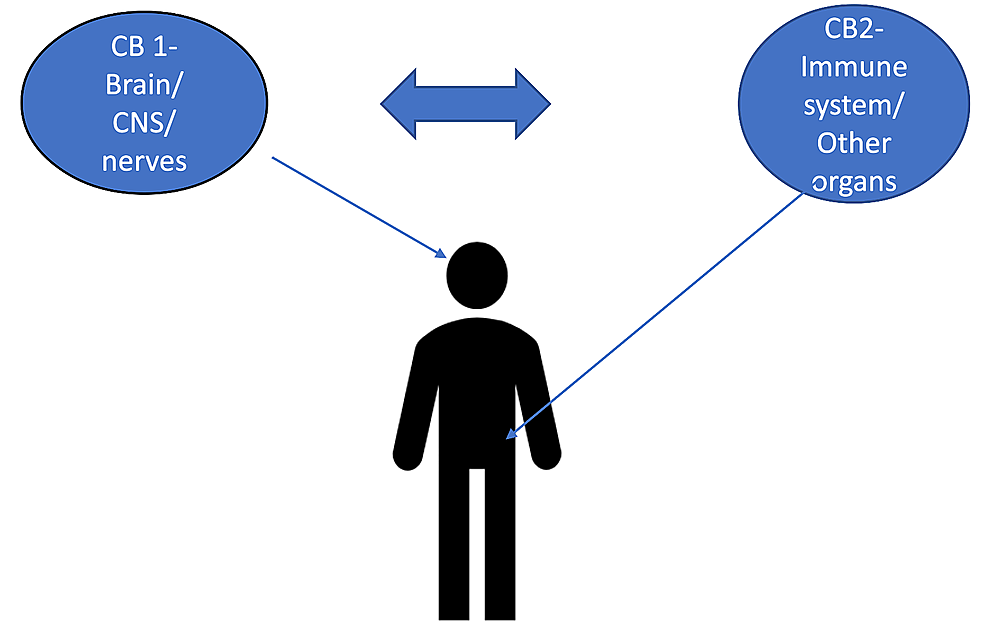 “The burden of chronic pain has affected many individuals leading to distress and discomfort, alongside numerous side effects with conventional therapeutic approaches.
Cannabinoid receptors are naturally found in the human body and have long been an interest in antinociception. These include CB1 and CB2 receptors, which are promising candidates for the treatment of chronic inflammatory pain.
The mechanism of action of the receptors and how they approach pain control in inflammatory conditions show that it can be an adjunctive approach towards controlling these symptoms. Numerous studies have shown how the targeted approach towards these receptors has activated them promoting a release in cytokines, all leading to anti-inflammatory effects and immune system regulation.
Cannabinoid activation of glycine and gamma-aminobutyric acid (GABA) models also showed efficacy in pain management. Chronic conditions such as osteoarthritis were shown to also benefit from this considerable treatment. However, it is unclear how the cannabinoid system works in relation with the pain pathway. Therefore, in this review we aim to analyse the role of the cannabinoid system in chronic inflammatory pain.”
Cannabinoid Receptors: An Update on Cell Signaling, Pathophysiological Roles and Therapeutic Opportunities in Neurological, Cardiovascular, and Inflammatory Diseases
 “The identification of the human cannabinoid receptors and their roles in health and disease, has been one of the most significant biochemical and pharmacological advancements to have occurred in the past few decades. In spite of the major strides made in furthering endocannabinoid research, therapeutic exploitation of the endocannabinoid system has often been a challenging task.
An impaired endocannabinoid tone often manifests as changes in expression and/or functions of type 1 and/or type 2 cannabinoid receptors. It becomes important to understand how alterations in cannabinoid receptor cellular signaling can lead to disruptions in major physiological and biological functions, as they are often associated with the pathogenesis of several neurological, cardiovascular, metabolic, and inflammatory diseases.
This review focuses mostly on the pathophysiological roles of type 1 and type 2 cannabinoid receptors, and it attempts to integrate both cellular and physiological functions of the cannabinoid receptors. Apart from an updated review of pre-clinical and clinical studies, the adequacy/inadequacy of cannabinoid-based therapeutics in various pathological conditions is also highlighted. Finally, alternative strategies to modulate endocannabinoid tone, and future directions are also emphasized.”
The immunosuppressive effect of the endocannabinoid system on the inflammatory phenotypes of macrophages and mesenchymal stromal cells: a comparative study
“The inflammatory sequence is the first phase of wound healing. Macrophages (MPhs) and mesenchymal stromal cells (MSCs) respond to an inflammatory microenvironment by adapting their functional activity, which polarizes them into the pro-inflammatory phenotypes M1 and MSC1. Prolongation of the inflammatory phase results in the formation of chronic wounds. The endocannabinoid system (ECS) possesses immunomodulatory properties that may impede this cellular phenotypic switch.
Methods: We investigated the immunosuppressive influence of the endocannabinoids anandamide (AEA) and 2-arachidonoylglycerol (2-AG) on the M1 and MSC1 cytokine secretion. Lipopolysaccharides (LPS) were used as inflammagen to stimulate MPhs and MSCs. Both inflammatory phenotypes were co-exposed to AEA or 2-AG, the specific cannabinoid receptor CB2 agonist JWH-133 served as reference. The inflammatory responses were detected by CD80/163 immuno-labelling and by ELISA measures of secreted IL-6, IL-8, MIF, TNF-α, TGF-β, and VEGF.
Results: M1 cells were found positive for CD80 expression and secreted less IL-6 and IL-8 than MSC1 cells, while both cell types produced similar amounts of MIF. TNF-α release was increased by M1, and growth factors were secreted by MSC1, only. Cannabinoid receptor ligands efficiently decreased the inflammatory response of M1, while their impact was less pronounced in MSC1.
Conclusions: The ECS down-regulated the inflammatory responses of MPhs and MSCs by decreasing the cytokine release upon LPS treatment, while CB2 appeared to be of particular importance. Hence, stimulating the ECS by manipulation of endo- or use of exogenous cannabinoids in vivo may constitute a potent therapeutic option against inflammatory disorders.”
https://pubmed.ncbi.nlm.nih.gov/33026642/
https://link.springer.com/article/10.1007%2Fs43440-020-00166-3
Signaling Through the Type 2 Cannabinoid Receptor Regulates the Severity of Acute and Chronic Graft versus Host Disease
 “Graft versus host disease (GVHD) pathophysiology is a complex interplay between cells that comprise the adaptive and innate arms of the immune system. Effective prophylactic strategies are therefore contingent upon approaches that address contributions from both immune cell compartments.
In the current study, we examined the role of the type 2 cannabinoid receptor (CB2R) which is expressed on nearly all immune cells and demonstrated that absence of the CB2R on donor CD4+ or CD8+ T cells, or administration of a selective CB2R pharmacological antagonist, exacerbated acute GVHD lethality. This was accompanied primarily by the expansion of proinflammatory CD8+ T cells indicating that constitutive CB2R expression on T cells preferentially regulated CD8+ T cell alloreactivity. Using a novel CB2R-EGFP reporter mouse, we observed significant loss of CB2R expression on T cells, but not macrophages, during acute GVHD, indicative of differential alterations in receptor expression under inflammatory conditions.
Therapeutic targeting of the CB2R with the agonists, tetrahydrocannabinol (THC) and JWH-133, revealed that only THC mitigated lethal T cell-mediated acute GVHD. Conversely, only JWH-133 was effective in a sclerodermatous chronic GVHD model where macrophages contribute to disease biology. In vitro, both THC and JWH-133 induced arrestin recruitment and ERK phosphorylation via CB2R, but THC had no effect on CB2R-mediated inhibition of adenylyl cyclase.
These studies demonstrate that the CB2R plays a critical role in the regulation of GVHD and suggest that effective therapeutic targeting is dependent upon agonist signaling characteristics and receptor selectivity in conjunction with the composition of pathogenic immune effector cells.”
The impact of cannabinoid type 2 receptors (CB2Rs) in neuroprotection against neurological disorders
 “Cannabinoids have long been used for their psychotropic and possible medical properties of symptom relief. In the past few years, a vast literature shows that cannabinoids are neuroprotective under different pathological situations.
Most of the effects of cannabinoids are mediated by the well-characterized cannabinoid receptors, the cannabinoid type 1 receptor (CB1R) and cannabinoid type 2 receptor (CB2R). Even though CB1Rs are highly expressed in the central nervous system (CNS), the adverse central side effects and the development of tolerance resulting from CB1R activation may ultimately limit the clinical utility of CB1R agonists. In contrast to the ubiquitous presence of CB1Rs, CB2Rs are less commonly expressed in the healthy CNS but highly upregulated in glial cells under neuropathological conditions.
Experimental studies have provided robust evidence that CB2Rs seem to be involved in the modulation of different neurological disorders. In this paper, we summarize the current knowledge regarding the protective effects of CB2R activation against the development of neurological diseases and provide a perspective on the future of this field. A better understanding of the fundamental pharmacology of CB2R activation is essential for the development of clinical applications and the design of novel therapeutic strategies.”