“Recent clinical and preclinical research has suggested that cannabidiol (CBD) and Δ9-tetrahydrocannabinol (Δ9-THC) have interactive effects on measures of cognition; however, the nature of these interactions is not yet fully characterized.
To address this, we investigated the effects of Δ9-THC and CBD independently and in combination with proposed therapeutic dose ratios of 1:1 and 1:3 Δ9-THC:CBD in adult rhesus monkeys performing a stop signal task (SST).
These results indicate that CBD, when combined with Δ9-THC in clinically available dose ratios, does not exacerbate and, under restricted conditions may even attenuate, Δ9-THC’s behavioral effects.”
“The endocannabinoid system (ECS) has emerged as an important regulator of both physiological and pathological processes. Notably, this endogenous system plays a key role in the modulation of pain and inflammation in a number of tissues.
The components of the ECS, including endocannabinoids, their cognate enzymes and cannabinoid receptors, are localized in the eye, and evidence indicates that ECS modulation plays a role in ocular disease states.
Of these diseases, ocular inflammation presents a significant medical problem, given that current clinical treatments can be ineffective or are associated with intolerable side-effects. Furthermore, a prominent comorbidity of ocular inflammation is pain, including neuropathic pain, for which therapeutic options remain limited.
Recent evidence supports the use of drugs targeting the ECS for the treatment of ocular inflammation and pain in animal models; however, the potential for therapeutic use of cannabinoid drugs in the eye has not been thoroughly investigated at this time.
This review will highlight evidence from experimental studies identifying components of the ocular ECS and discuss the functional role of the ECS during different ocular inflammatory disease states, including uveitis and corneal keratitis.
Candidate ECS targeted therapies will be discussed, drawing on experimental results obtained from both ocular and non-ocular tissue(s), together with their potential application for the treatment of ocular inflammation and pain.”
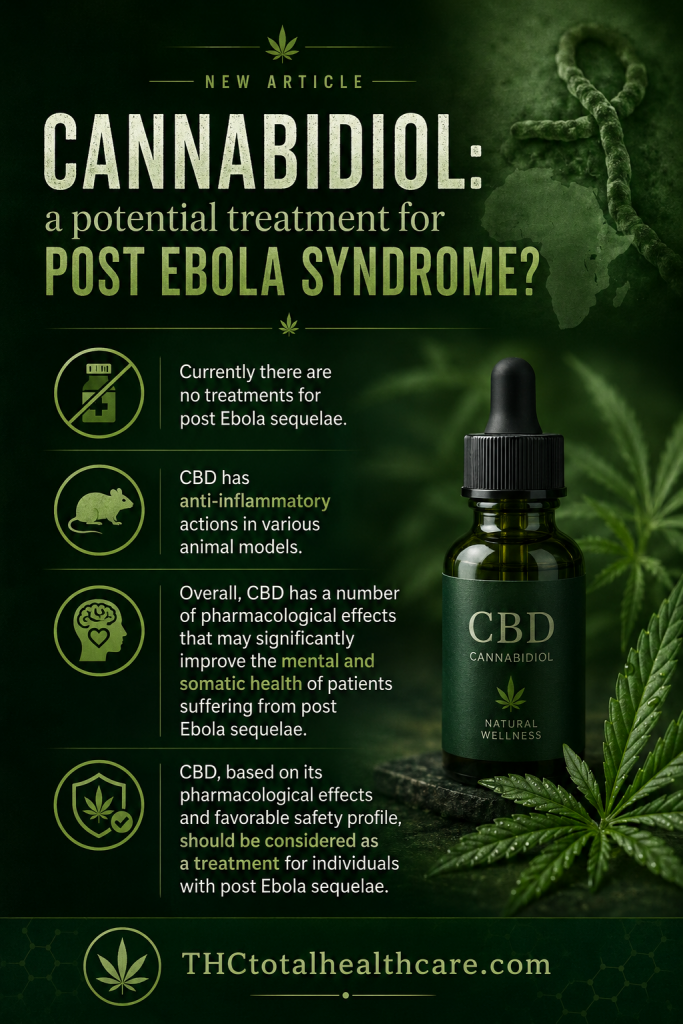
“Patients recovered from Ebola virus infection may experience short- and long-term physical, neuropsychological and social sequelae, including arthralgia, musculoskeletal pain, ophthalmic inflammation, auditory problems, fatigue, confusion, insomnia, short-term memory impairment, anxiety, depression and anorexia, all lasting from 2 weeks to more than 2 years.
Currently there are no treatments for post Ebola sequelae.
We hypothesize that cannabidiol (CBD) may attenuate some of these post Ebola sequelae, several of which have been postulated to result from inflammation and/or an autoimmune response.
CBD has anti-inflammatory actions in various animal models.
Clinical studies have shown that oral administration of CBD, compared to placebo, significantly reduces anxiety, has antinociceptive and anticonvulsant actions, and may be therapeutic for insomnia.
Overall, CBD has a number of pharmacological effects that may significantly improve the mental and somatic health of patients suffering from post Ebola sequelae.
In humans, CBD, at therapeutic doses, does not: 1) elicit dependence or tolerance; 2) significantly alter heart rate or blood pressure; 3) affect gastrointestinal transit; 4) produce significant cognitive or psychomotor impairments. Mild sedation and nausea are the most commonly reported adverse effects associated with CBD.
CBD, based on its pharmacological effects and favorable safety profile, should be considered as a treatment for individuals with post Ebola sequelae.”
“The use of cannabidiol (CBD) to treat post Ebola clinical sequelae is proposed. CBD could decrease pain, inflammation, and neuropsychological problems. CBD does not elicit significant adverse or toxic effects in humans.”
“In conclusion, it is hypothesized that CBD, based on its pharmacological effects and favorable safety profile, should be considered as a treatment for individuals with post Ebola syndrome.”
“To test the neuroprotective effects of the nonpsychoactive cannabinoid cannabidiol (CBD), piglets received i.v. CBD or vehicle after hypoxia-ischemia (HI: temporary occlusion of both carotid arteries plus hypoxia).
CBD administration was free from side effects; moreover, CBD administration was associated with cardiac, hemodynamic, and ventilatory beneficial effects.
In conclusion, administration of CBD after HI reduced short-term brain damage and was associated with extracerebral benefits.”
“Newborn piglets exposed to acute hypoxia-ischemia (HI) received i.v. cannabidiol (HI + CBD) or vehicle (HI + VEH). In HI + VEH, 72 h post-HI brain activity as assessed by amplitude-integrated EEG (aEEG) had only recovered to 42 ± 9% of baseline, near-infrared spectroscopy (NIRS) parameters remained lower than normal, and neurobehavioral performance was abnormal (27.8 ± 2.3 points, normal 36). In the brain, there were fewer normal and more pyknotic neurons, while astrocytes were less numerous and swollen. Cerebrospinal fluid concentration of neuronal-specific enolase (NSE) and S100β protein and brain tissue percentage of TNFα(+) cells were all higher. In contrast, in HI + CBD, aEEG had recovered to 86 ± 5%, NIRS parameters increased, and the neurobehavioral score normalized (34.3 ± 1.4 points). HI induced histological changes, and NSE and S100β concentration and TNFα(+) cell increases were suppressed by CBD. In conclusion, post-HI administration of CBD protects neurons and astrocytes, leading to histological, functional, biochemical, and neurobehavioral improvements.”
“Aging-related neurodegenerative diseases, such as Parkinson’s disease (PD) or related disorders, are an increasing societal and economic burden worldwide.
Δ9-Tetrahydrocannabinol (THC) is discussed as a neuroprotective agent in several in vitro and in vivo models of brain injury. However, the mechanisms by which THC exhibits neuroprotective properties are not completely understood.
In the present study, we investigated neuroprotective mechanisms of THC in glutamate-induced neurotoxicity in primary murine mesencephalic cultures, as a culture model for PD.
THC protected dopaminergic neurons and other cell types of primary dissociated cultures from glutamate-induced neurotoxicity.
Moreover, THC significantly counteracted the glutamate-induced mitochondrial membrane depolarization and apoptosis.
In conclusion, THC exerts anti-apoptotic and restores mitochondrial membrane potential via a mechanism dependent on CB1 receptor.
It strengthens the fact that THC has a benefit on degenerative cellular processes occurring, among others, in PD and other neurodegenerative diseases by slowing down the progression of neuronal cell death.”
“Peripherally restricted CB1 receptor inverse agonists hold potential as useful therapeutics to treat obesity and related metabolic diseases without causing undesired CNS-mediated adverse effects. We identified a series of tetrahydropyrazolo[4,3-c]pyridine derivatives as potent and highly peripherally selective CB1 receptor inverse agonists. This discovery was achieved by introducing polar functional groups into the molecule, which increase the topological polar surface area and reduce its brain-penetrating ability.”
“Tetrahydroindazole derivatives as potent and peripherally selective cannabinoid-1 (CB1) receptor inverse agonists. A series of potent and receptor-selective cannabinoid-1 (CB1) receptor inverse agonists has been discovered. Peripheral selectivity of the compounds was assessed by a mouse tissue distribution study, in which the concentrations of a test compound in both plasma and brain were measured. A number of peripherally selective compounds have been identified through this process. Compound 2p was further evaluated in a 3-week efficacy study in the diet-induced obesity (DIO) mouse model. Beneficial effects on plasma glucose were observed from the compound-treated mice.” https://www.ncbi.nlm.nih.gov/pubmed/27671496
“The gonadal hormones testosterone (T) in adult males and estradiol (E2) in adult females have been reported to modulate behavioral effects of ∆9-tetrahydrocannabinol (THC). This study determined whether activational effects of T and E2 are sex-specific, and whether hormones modulate production of the active metabolite 11-hydroxy-THC (11-OH-THC) and the inactive metabolite 11-nor-9-carboxy-THC (THC-COOH). Adult male and female rats were gonadectomized (GDX) and treated with nothing (0), T (10-mm Silastic capsule/100g body weight), or E2 (1-mm Silastic capsule/rat). Three weeks later, saline or the cytochrome P450 inhibitor proadifen (25mg/kg; to block THC metabolism and boost THC’s effects) was injected i.p.; 1h later, vehicle or THC (3mg/kg females, 5mg/kg males) was injected i.p., and rats were tested for antinociceptive and motoric effects 15-240min post-injection. T did not consistently alter THC-induced antinociception in males, but decreased it in females (tail withdrawal test). Conversely, T decreased THC-induced catalepsy in males, but had no effect in females. E2 did not alter THC-induced antinociception in females, but enhanced it in males. The discrepant effects of T and E2 on males’ and females’ behavioral responses to THC suggests that sexual differentiation of THC sensitivity is not simply due to activational effects of hormones, but also occurs via organizational hormone or sex chromosome effects. Analysis of serum showed that proadifen increased THC levels, E2 increased 11-OH-THC in GDX males, and T decreased 11-OH-THC (and to a lesser extent, THC) in GDX females. Thus, hormone modulation of THC’s behavioral effects is caused in part by hormone modulation of THC oxidation to its active metabolite. However, the fact that hormone modulation of metabolism did not alter THC sensitivity similarly on all behavioral measures within each sex suggests that other mechanisms also play a role in gonadal hormone modulation of THC sensitivity in adult rats.”
“Core deficits in social functioning are associated with various neuropsychiatric and neurodevelopmental disorders, yet biomarker identification and the development of effective pharmacological interventions has been limited.
Recent data suggest the intriguing possibility that endogenous cannabinoids, a class of lipid neuromodulators generally implicated in the regulation of neurotransmitter release, may contribute to species-typical social functioning.
Systematic study of the endogenous cannabinoid signaling could, therefore, yield novel approaches to understand the neurobiological underpinnings of atypical social functioning.
This article provides a critical review of the major components of the endogenous cannabinoid system (for example, primary receptors and effectors-Δ9-tetrahydrocannabinol, cannabidiol, anandamide and 2-arachidonoylglycerol) and the contributions of cannabinoid signaling to social functioning.
Data are evaluated in the context of Research Domain Criteria constructs (for example, anxiety, chronic stress, reward learning, motivation, declarative and working memory, affiliation and attachment, and social communication) to enable interrogation of endogenous cannabinoid signaling in social functioning across diagnostic categories.
The empirical evidence reviewed strongly supports the role for dysregulated cannabinoid signaling in the pathophysiology of social functioning deficits observed in brain disorders, such as autism spectrum disorder, schizophrenia, major depressive disorder, posttraumatic stress disorder and bipolar disorder.
Moreover, these findings indicate that the endogenous cannabinoid system holds exceptional promise as a biological marker of, and potential treatment target for, neuropsychiatric and neurodevelopmental disorders characterized by impairments in social functioning.”
“Cannabis is the most popular illicit drug on the European market. Over 16 million young Europeans have used it at least once in the last few years. The recent trends in the consumption of marihuana differ between countries. Some countries face an increase in the prevalence of cannabis use, including Poland, where the level cannabis use has been systematically increasing since the 1990’s. According to a recent ESPAD study, 19% of Polish adolescents aged 15-16 have used cannabis in the last year. Marihuana is also a leading substance when analyzing the data of seizures and crimes. The recent EMCDDA Annual report on the drug situation in Europe notes the increasing potency in cannabis available on the market. Some countries face an increasing number of emergencies caused by marihuana, which was unlikely to have happened previously. In almost all European countries there is an ongoing discussion about loosening marijuana laws or its complete legalization. There is also ongoing discussion on the use of marihuana in therapy as a medicine. Many scientific studies are being conducted in this field. Some of the results are promising; however, there is no well-designed human trial which would unequivocally confirm that medical cannabis is effective as a medicine, or more effective than other medicines on the market. The problem is that the debate on the medical use of marihuana becomes more ideological and less professional. The medical use of marihuana is strongly supported by organizations lobbying for the legalization of cannabis use. Research on the medical use of cannabis should be continued, as there are some promising results supporting therapy in different medical conditions. However, the use of cannabis as a medicine should be discussed only among professionals. If marihuana is to be used for medical purposes, the fact that it is the most popular illicit drug in Europe is irrelevant.”