
“Cannabinoids have demonstrated anticarcinogenic properties in a variety of malignancies, including in prostate cancer. In the present study, we explored the anti-cancer effects of the synthetic cannabinoid WIN 55,212-2 (WIN) in prostate cancer.
Tag Archives: agonists
Combined CB2 Receptor Agonist and Photodynamic Therapy Synergistically Inhibit Tumor Growth in Triple Negative Breast Cancer.
 “Triple negative breast cancer (TNBC) is the deadliest form of breast cancer because compared with other types of breast cancer, it is more aggressive, diagnosed at later stage and more likely to develop recurrence.
Many patients do not experience adequate tumor control after current clinical treatments involving surgical removal, chemotherapy and/or radiotherapy, leading to disease progression and significantly decreased quality of life.
Here we report a new combinatory therapy strategy involving cannabinoid-based medicine and photodynamic therapy (PDT) for the treatment of TNBC.
This combinatory therapy targets two proteins upregulated in TNBC: the cannabinoid CB2 receptor (CB2R, a G-protein coupled receptor) and translocator protein (TSPO, a mitochondria membrane receptor). We found that the combined CB2R agonist and TSPO-PDT treatment resulted in synergistic inhibition in TNBC cell and tumor growth.
This combinatory therapy approach provides new opportunities to treat TNBC with high efficacy. In addition, this study provides new evidence on the therapeutic potential of CB2R agonists for cancer.”
https://www.ncbi.nlm.nih.gov/pubmed/30240926
https://www.sciencedirect.com/science/article/pii/S1572100018301571?via%3Dihub
“Triple negative breast cancer (TNBC) is the deadliest form of breast cancer because compared with other types of breast cancer, it is more aggressive, diagnosed at later stage and more likely to develop recurrence.
Many patients do not experience adequate tumor control after current clinical treatments involving surgical removal, chemotherapy and/or radiotherapy, leading to disease progression and significantly decreased quality of life.
Here we report a new combinatory therapy strategy involving cannabinoid-based medicine and photodynamic therapy (PDT) for the treatment of TNBC.
This combinatory therapy targets two proteins upregulated in TNBC: the cannabinoid CB2 receptor (CB2R, a G-protein coupled receptor) and translocator protein (TSPO, a mitochondria membrane receptor). We found that the combined CB2R agonist and TSPO-PDT treatment resulted in synergistic inhibition in TNBC cell and tumor growth.
This combinatory therapy approach provides new opportunities to treat TNBC with high efficacy. In addition, this study provides new evidence on the therapeutic potential of CB2R agonists for cancer.”
https://www.ncbi.nlm.nih.gov/pubmed/30240926
https://www.sciencedirect.com/science/article/pii/S1572100018301571?via%3Dihub
Cannabinoids and spinal cord stimulation for the treatment of failed back surgery syndrome refractory pain
“This study aimed to evaluate pain and its symptoms in patients with failed back surgery syndrome (FBSS) refractory to other therapies, treated with a combination of delta-9-tetrahydrocannabinol (THC) and cannabidiol (CBD), in association with spinal cord stimulation (SCS). Results: Effective pain management as compared to baseline result was achieved in all the cases studied. The positive effect of cannabinoid agonists on refractory pain was maintained during the entire duration of treatment with minimal dosage titration. Pain perception, evaluated through numeric rating scale, decreased from a baseline mean value of 8.18±1.07–4.72±0.9 by the end of the study duration (12 months) (P<0.001). Conclusion: The results indicate that cannabinoid agonists (THC/CBD) can have remarkable analgesic capabilities, as adjuvant of SCS, for the treatment of chronic refractory pain of FBSS patients.” https://www.ncbi.nlm.nih.gov/pubmed/30233233 https://www.dovepress.com/cannabinoids-and-spinal-cord-stimulation-for-the-treatment-of-failed-b-peer-reviewed-article-JPR
“Outcomes indicate remarkable analgesic capabilities of cannabinoid agonists (THC/CBD) as an adjuvant to SCS for treating chronic refractory pain in FBSS patients, since all the cases studied achieved effective pain management compared to baseline.”
https://www.mdlinx.com/journal-summaries/cannabinoids-delta-9-tetrahydrocannabinol-thc-cannabidiol/2018/09/13/7544234/
]]>
Exploring the Ligand Efficacy of Cannabinoid Receptor 1 (CB1) using Molecular Dynamics Simulations.
 “Cannabinoid receptor 1 (CB1) is a promising therapeutic target for a variety of disorders. Distinct efficacy profiles showed different therapeutic effects on CB1 dependent on three classes of ligands: agonists, antagonists, and inverse agonists. To discriminate the distinct efficacy profiles of the ligands, we carried out molecular dynamics (MD) simulations to identify the dynamic behaviors of inactive and active conformations of CB1 structures with the ligands. In addition, the molecular mechanics Poisson-Boltzmann surface area (MM-PBSA) method was applied to analyze the binding free energy decompositions of the CB1-ligand complexes. With these two methods, we found the possibility that the three classes of ligands can be discriminated. Our findings shed light on the understanding of different efficacy profiles of ligands by analyzing the structural behaviors of intact CB1 structures and the binding energies of ligands, thereby yielding insights that are useful for the design of new potent CB1 drugs.”
https://www.ncbi.nlm.nih.gov/pubmed/30213978
https://www.nature.com/articles/s41598-018-31749-z
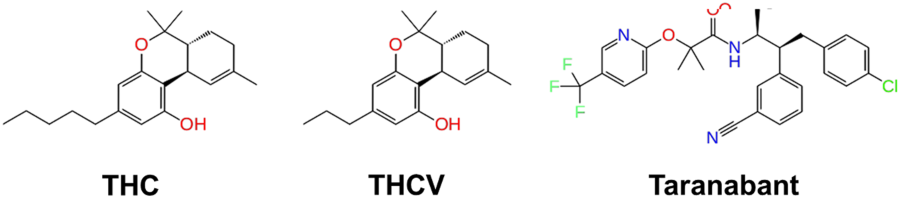
“Chemical structure of the partial agonist THC, antagonist THCV, and inverse agonist Taranabant.”
“Cannabinoid receptor 1 (CB1) is a promising therapeutic target for a variety of disorders. Distinct efficacy profiles showed different therapeutic effects on CB1 dependent on three classes of ligands: agonists, antagonists, and inverse agonists. To discriminate the distinct efficacy profiles of the ligands, we carried out molecular dynamics (MD) simulations to identify the dynamic behaviors of inactive and active conformations of CB1 structures with the ligands. In addition, the molecular mechanics Poisson-Boltzmann surface area (MM-PBSA) method was applied to analyze the binding free energy decompositions of the CB1-ligand complexes. With these two methods, we found the possibility that the three classes of ligands can be discriminated. Our findings shed light on the understanding of different efficacy profiles of ligands by analyzing the structural behaviors of intact CB1 structures and the binding energies of ligands, thereby yielding insights that are useful for the design of new potent CB1 drugs.”
https://www.ncbi.nlm.nih.gov/pubmed/30213978
https://www.nature.com/articles/s41598-018-31749-z
“Chemical structure of the partial agonist THC, antagonist THCV, and inverse agonist Taranabant.”
 “Drug addiction is a chronic relapsing disorder that produces a dramaticglobal health burden worldwide. Not effective treatment of drug addiction is currently available probably due to the difficulties to find an appropriate target to manage this complex disease raising the needs for further identification of novel therapeutic approaches.
The endocannabinoid system has been found to play a crucial role in the neurobiological substrate underlying drug addiction.
Endocannabinoids and cannabinoid receptors are widely expressed in the main areas of the mesocorticolimbic system that participate in the initiation and maintenance of drug consumption and in the development of compulsion and loss of behavioral control occurring during drug addiction.
The identification of the important role played by CB1 cannabinoid receptors in drug addiction encouraged the possible used of an early commercialized CB1 receptor antagonist for treating drug addiction.
However, the incidence of serious psychiatric adverse events leaded to the sudden withdrawal from the market of this CB1 antagonist and all the research programs developed by pharmaceutical companies to obtain new CB1 antagonists were stopped.
Currently, new research strategies are under development to target the endocannabinoid system for drug addiction avoiding these side effects, which include allosteric negative modulators of CB1 receptors and compounds targeting CB2 receptors.
Recent studies showing the potential role of CB2 receptors in the addictive properties of different drugs of abuse have open a promising research opportunity to develop novel possible therapeutic approaches.”
“Drug addiction is a chronic relapsing disorder that produces a dramaticglobal health burden worldwide. Not effective treatment of drug addiction is currently available probably due to the difficulties to find an appropriate target to manage this complex disease raising the needs for further identification of novel therapeutic approaches.
The endocannabinoid system has been found to play a crucial role in the neurobiological substrate underlying drug addiction.
Endocannabinoids and cannabinoid receptors are widely expressed in the main areas of the mesocorticolimbic system that participate in the initiation and maintenance of drug consumption and in the development of compulsion and loss of behavioral control occurring during drug addiction.
The identification of the important role played by CB1 cannabinoid receptors in drug addiction encouraged the possible used of an early commercialized CB1 receptor antagonist for treating drug addiction.
However, the incidence of serious psychiatric adverse events leaded to the sudden withdrawal from the market of this CB1 antagonist and all the research programs developed by pharmaceutical companies to obtain new CB1 antagonists were stopped.
Currently, new research strategies are under development to target the endocannabinoid system for drug addiction avoiding these side effects, which include allosteric negative modulators of CB1 receptors and compounds targeting CB2 receptors.
Recent studies showing the potential role of CB2 receptors in the addictive properties of different drugs of abuse have open a promising research opportunity to develop novel possible therapeutic approaches.”
 “Microglia, the resident immune cells of the brain, play important roles in defending the brain against pathogens and supporting neuronal circuit plasticity. Chronic or excessive pro-inflammatory responses of microglia damage neurons, therefore their activity is tightly regulated.
Pharmacological and genetic studies revealed that
“Microglia, the resident immune cells of the brain, play important roles in defending the brain against pathogens and supporting neuronal circuit plasticity. Chronic or excessive pro-inflammatory responses of microglia damage neurons, therefore their activity is tightly regulated.
Pharmacological and genetic studies revealed that  “We recently reported that a CB2R agonist, GW405833 (GW), reduced both the ACh-induced Ca2+ oscillations and the L-arginine-induced Ca2+ signal enhancement in mouse pancreatic acinar cells, suggesting that GW-induced inhibition may prevent the pathogenesis of acute pancreatitis.
In this study, we aim to evaluate the effects of other cannabinoid ligands on Ca2+ signaling in acinar cells.
In conclusion, CB2R agonists play critical roles in modulating Ca2+ signals in mouse pancreatic acinar cells, while other cannabinoid ligands modulate Ca2+ oscillations in a heterogeneous manner through a CB receptor or non-CB-receptor mechanism.”
“We recently reported that a CB2R agonist, GW405833 (GW), reduced both the ACh-induced Ca2+ oscillations and the L-arginine-induced Ca2+ signal enhancement in mouse pancreatic acinar cells, suggesting that GW-induced inhibition may prevent the pathogenesis of acute pancreatitis.
In this study, we aim to evaluate the effects of other cannabinoid ligands on Ca2+ signaling in acinar cells.
In conclusion, CB2R agonists play critical roles in modulating Ca2+ signals in mouse pancreatic acinar cells, while other cannabinoid ligands modulate Ca2+ oscillations in a heterogeneous manner through a CB receptor or non-CB-receptor mechanism.”
 “Obesity is an increasing health problem worldwide. Its related comorbidities imply a high cost for the National Health System and diminish a patient’s life quality.
Adipose tissue is composed of three types of cells. White adipocytes are involved in fat storage and secretion of hormones. Brown adipocytes are involved in thermogenesis and caloric expenditure. Beige adipocytes are transitional adipocytes that in response to various stimuli can turn from white to brown and could be protective against the obesity, enhancing energy expenditure.
The conversion of white in beige adipose tissue is a potential new therapeutic target for obesity.
Cannabinoid receptors (CB) regulate thermogenesis, food intake and inflammation. CB1 ablation or inhibition helps reducing body weight and food intake. Stimulation of CB2 limits inflammation and promotes anti-obesity effects by reducing food intake and weight gain. Its genetic ablation results in adiposity development.
CB receptors are also responsible for transforming white adipose tissue towards beige or brown adipocytes, therefore their modulation can be considered potential anti-obesity target. CB1 principal localization in central nervous system represents an important limit. Stimulation of CB2, principally localized on peripheral cells instead, should facilitate the anti-obesity effects without exerting remarkable psychotropic activity.”
“Obesity is an increasing health problem worldwide. Its related comorbidities imply a high cost for the National Health System and diminish a patient’s life quality.
Adipose tissue is composed of three types of cells. White adipocytes are involved in fat storage and secretion of hormones. Brown adipocytes are involved in thermogenesis and caloric expenditure. Beige adipocytes are transitional adipocytes that in response to various stimuli can turn from white to brown and could be protective against the obesity, enhancing energy expenditure.
The conversion of white in beige adipose tissue is a potential new therapeutic target for obesity.
Cannabinoid receptors (CB) regulate thermogenesis, food intake and inflammation. CB1 ablation or inhibition helps reducing body weight and food intake. Stimulation of CB2 limits inflammation and promotes anti-obesity effects by reducing food intake and weight gain. Its genetic ablation results in adiposity development.
CB receptors are also responsible for transforming white adipose tissue towards beige or brown adipocytes, therefore their modulation can be considered potential anti-obesity target. CB1 principal localization in central nervous system represents an important limit. Stimulation of CB2, principally localized on peripheral cells instead, should facilitate the anti-obesity effects without exerting remarkable psychotropic activity.”
 “Pain is characterized as a complex experience, dependent not only on the regulation of nociceptive sensory systems but also on the activation of mechanisms that control emotional processes in limbic brain areas.
Non-opioid, non-steroidal anti-inflammatory drugs (NSAIDs) are the most widely used analgesics in the treatment of not-severe pain. We have recently shown that repeated doses result in tolerance to these drugs like opioids.
Here we investigated the central brain mechanisms of non-opioid induced antinociception in the non-acute pain models of rats, such as the ‘formalin test’ and a relation between administration of NSAIDs in the limbic brain area, – the anterior cingulated cortex (ACC), – and the endocannabinoid system.
The present data support the notion that endocannabinoids’ CB1 receptor contributes in part to antinociceptive effects of NSAIDs and probably involved in activation of the descending opioid modulatory system of pain.”
“Pain is characterized as a complex experience, dependent not only on the regulation of nociceptive sensory systems but also on the activation of mechanisms that control emotional processes in limbic brain areas.
Non-opioid, non-steroidal anti-inflammatory drugs (NSAIDs) are the most widely used analgesics in the treatment of not-severe pain. We have recently shown that repeated doses result in tolerance to these drugs like opioids.
Here we investigated the central brain mechanisms of non-opioid induced antinociception in the non-acute pain models of rats, such as the ‘formalin test’ and a relation between administration of NSAIDs in the limbic brain area, – the anterior cingulated cortex (ACC), – and the endocannabinoid system.
The present data support the notion that endocannabinoids’ CB1 receptor contributes in part to antinociceptive effects of NSAIDs and probably involved in activation of the descending opioid modulatory system of pain.”