Cannabinoids, Endocannabinoids and Cancer

Logo of nihpa

“The endocannabinoid system consists of an array of endogenously produced bioactive lipids that activate cannabinoid receptors. Although the primary focus of endocannabinoid biology has been on neurological and psychiatric effects, recent work has revealed several important interactions between the endocannabinoid system and cancer. Several different types of cancer have abnormal regulation of the endocannabinoid system that contributes to cancer progression and correlates to clinical outcomes.

Modulation of the endocannabinoid system by pharmacological agents in various cancer types reveals that it can mediate antiproliferative and apoptotic effects by both cannabinoid receptor-dependent and -independent pathways. Selective agonists and antagonists of the cannabinoid receptors, inhibitors of endocannabinoid hydrolysis, and cannabinoid analogs have been utilized to probe the pathways involved in the effects of the endocannabinoid system on cancer cell apoptosis, proliferation, migration, adhesion, and invasion. The antiproliferative and apoptotic effects produced by some of these pharmacological probes reveal that the endocannabinoid system is a promising new target for the development of novel chemotherapeutics to treat cancer.”

Although there is a strong set of data in vitro, in cellular model systems, and in mouse model systems, there is a dearth of clinical data on the effects of cannabinoids in the treatment of cancer in humans. This fact is quite surprising considering the large library of compounds that have been developed and used to study the effects of cannabinoids on cancer in model systems.

Despite the lack of preclinical and clinical data, there is a strong agreement that pharmacological targeting of the endocannabinoid system is emerging as one of the most promising new methods for reducing the progression of cancer. In particular, combination therapy utilizing both traditional chemotherapeutics and molecules targeting the endocannabinoid system may be an excellent next generation treatment for cancer.”

http://www.ncbi.nlm.nih.gov/pmc/articles/PMC3366283/

The endocannabinoid system in cancer-potential therapeutic target?

Cover image

“Endogenous arachidonic acid metabolites with properties similar to compounds of Cannabis sativa Linnaeus, the so-called endocannabinoids, have effects on various types of cancer. Although endocannabinoids and synthetic cannabinoids may have pro-proliferative effects, predominantly inhibitory effects on tumor growth, angiogenesis, migration and metastasis have been described. Remarkably, these effects may be selective for the cancer cells, while normal cells and tissues are spared. Such apparent tumor cell selectivity makes the endocannabinoid system an attractive potential target for cancer therapy. In this review we discuss various means by which the endocannabinoid system may be targeted in cancer and the current knowledge considering the regulation of the endocannabinoid system in malignancy.”  http://www.ncbi.nlm.nih.gov/pubmed/18249558

http://www.sciencedirect.com/science/article/pii/S1044579X07001058

Endocannabinoids as emerging suppressors of angiogenesis and tumor invasion (review).

Journal Cover

“The medicinal properties of extracts from the hemp plant Cannabis sativa have been known for centuries but only in the 90s membrane receptors for the Cannabis major principle were discovered in mammalian cells. Later on the endogenous ligands for the cannabinoid receptors were identified and the term ‘endocannabinoid system’ was coined to indicate the complex signaling system of cannabinoid receptors, endogenous ligands and the enzymes responsible for their biosynthesis and inactivation.

The ‘endocannabinoid system’ is involved in a broad range of functions and in a growing number of pathological conditions.

There is increasing evidence that endocannabinoids are able to inhibit cancer cell growth in culture as well as in animal models.

Most work has focused on the role of endocannabinoids in regulating tumor cell growth and apoptosis and ongoing research is addressed to further dissect the precise mechanisms of cannabinoid antitumor action. However, endocannabinoids are now emerging as suppressors of angiogenesis and tumor spreading since they have been reported to inhibit angiogenesis, cell migration and metastasis in different types of cancer, pointing to a potential role of the endocannabinoid system as a target for a therapeutic approach of such malignant diseases.

The potential use of cannabinoids to retard tumor growth and spreading is even more appealing considering that they show a good safety profile, regarding toxicity, and are already used in cancer patients as palliatives to stimulate appetite and to prevent devastating effects such as nausea, vomiting and pain.”  http://www.ncbi.nlm.nih.gov/pubmed/17342320

https://www.spandidos-publications.com/or/17/4/813

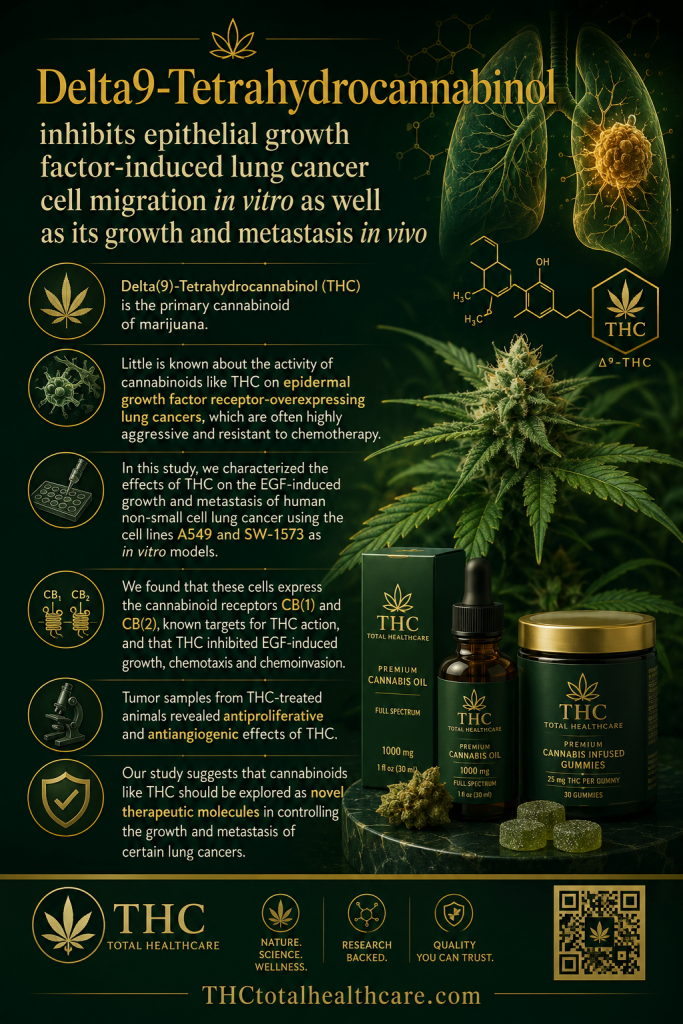
Delta9-Tetrahydrocannabinol inhibits epithelial growth factor-induced lung cancer cell migration in vitro as well as its growth and metastasis in vivo – Harvard Medical School

“Delta(9)-Tetrahydrocannabinol (THC) is the primary cannabinoid of marijuana and has been shown to either potentiate or inhibit tumor growth, depending on the type of cancer and its pathogenesis. Little is known about the activity of cannabinoids like THC on epidermal growth factor receptor-overexpressing lung cancers, which are often highly aggressive and resistant to chemotherapy. In this study, we characterized the effects of THC on the EGF-induced growth and metastasis of human non-small cell lung cancer using the cell lines A549 and SW-1573 as in vitro models. We found that these cells express the cannabinoid receptors CB(1) and CB(2), known targets for THC action, and that THC inhibited EGF-induced growth, chemotaxis and chemoinvasion. Moreover, signaling studies indicated that THC may act by inhibiting the EGF-induced phosphorylation of ERK1/2, JNK1/2 and AKT. THC also induced the phosphorylation of focal adhesion kinase at tyrosine 397. Additionally, in in vivo studies in severe combined immunodeficient mice, there was significant inhibition of the subcutaneous tumor growth and lung metastasis of A549 cells in THC-treated animals as compared to vehicle-treated controls. Tumor samples from THC-treated animals revealed antiproliferative and antiangiogenic effects of THC. Our study suggests that cannabinoids like THC should be explored as novel therapeutic molecules in controlling the growth and metastasis of certain lung cancers.”

http://www.ncbi.nlm.nih.gov/pubmed/17621270

Cannabinoid-associated cell death mechanisms in tumor models

“In recent years, cannabinoids (the active components of Cannabis sativa) and their derivatives have received considerable interest due to findings that they can affect the viability and invasiveness of a variety of different cancer cells. Moreover, in addition to their inhibitory effects on tumor growth and migration, angiogenesis and metastasis, the ability of these compounds to induce different pathways of cell death has been highlighted. Here, we review the most recent results generating interest in the field of death mechanisms induced by cannabinoids in cancer cells. In particular, we analyze the pathways triggered by cannabinoids to induce apoptosis or autophagy and investigate the interplay between the two processes. Overall, the results reported here suggest that the exploration of molecular mechanisms induced by cannabinoids in cancer cells can contribute to the development of safe and effective treatments in cancer therapy.”

http://www.ncbi.nlm.nih.gov/pubmed/22614735

Dixie X Hemp CBD Wellness Products Online Store Now Open!

“At long last, Dixie X the revolutionary hemp CBD powered wellness products from Dixie Elixirs & Edibles are now available for sale over the Internet at dixiex.com.

Medical Marijuana Inc. (OTC: MJNA), a leading hemp industry innovator, is pleased to announce a new on-line sales website for its Hemp-based Dixie X line of products:  www.dixiex.comThis announcement supports the company’s large scale national launch of on-line sales of its Hemp-based Cannabidiol (CBD) enriched health and wellness Dixie X products.

According to the company, since Dixie X is manufactured from non-THC high CBD concentrate industrial Hemp it can be legally shipped to consumers in all 50 states in the U.S. as well as internationally.”

http://dixieelixirs.com/dixie-x-store-open/

Cancer-fighting Potential of Cannabidiol Bodes Well for Dixie X Hemp Products

“Research by California Pacific Medical Center indicating that cannabidiol (CBD), a non-psychotropic compound found in hemp, may arrest the spread of aggressive, metastatic cancer cells, is drawing the attention of the medical community. John Malanca of medical cannabis resource UnitedPatientsGroup.com believes this encouraging news will also bring CBD to the attention of health-minded consumers.

“Many people want the health benefits of CBD, but they don’t want to get ‘high,’” said Malanca. “Dixie X products deliver a new option, and as our understanding and awareness of the health benefits of CBD grow, so does the attractiveness of Dixie X CBD wellness products.”

http://www.prweb.com/releases/cbd-pills/medical-cannabis-resource/prweb9985704.htm

Pot compound seen as tool against cancer

“Marijuana, already shown to reduce pain and nausea in cancer patients, may be promising as a cancer-fighting agent against some of the most aggressive forms of the disease.

A growing body of early research shows a compound found in marijuana – one that does not produce the plant’s psychotropic high – seems to have the ability to “turn off” the activity of a gene responsible for metastasis in breast and other types of cancers.

Two scientists at San Francisco’s California Pacific Medical Center Research Institute first released data five years ago that showed how this compound – called cannabidiol – reduced the aggressiveness of human breast cancer cells in the lab.”

Marijuana’s better known cannabinoid – delta-9 tetrahydrocannabinol, or THC – had already shown some anticancer properties in tumors, but the non-psychotropic cannabidiol had largely gone unstudied. McAllister initial research showed CBD had anticancer potential as well.”

http://www.sfgate.com/health/article/Pot-compound-seen-as-tool-against-cancer-3875562.php

Marijuana compound could stop aggressive cancer metastasis

“A compound found in cannabis could halt the spread of many forms of aggressive cancer, scientists have claimed.

Researchers found that the compound, called cannabidiol, had the ability to “switch off” the gene responsible for metastasis in an aggressive form of breast cancer, the Daily Mail reported.

Importantly, this substance does not produce the psychoactive properties of the cannabis plant.

The team from the California Pacific Medical Center, in San Francisco, first spotted its potential five years ago, after it stopped the proliferation of human breast cancer cells in the lab, the report said.

They discovered that the compound had turned off the overexpression of ID-1, stopping them from travelling to distant tissues.

Other potentially treatable cancers are forms of leukaemia, lung, ovarian and brain cancers, which also have high levels of ID-1.”

http://in.news.yahoo.com/marijuana-compound-could-stop-aggressive-cancer-metastasis-064950912.html

The endocannabinoid system in the cancer therapy: an overview.

“The endocannabinoid system comprises the cannabinoid receptors type 1 (CB1) and type 2 (CB2), their endogenous ligands (endocannabinoids), and the proteins responsible for their biosynthesis and degradation. This ubiquitous signalling system, that has attracted a great deal of scientist interest in the past 15 years, regulates several physiological and pathological functions. In mammals, among other functions, the endocannabinoid is involved in nervous, cardiovascular, metabolic, reproductive and immune functions. Finally, yet importantly, endocannabinoids are known to exert important antiproliferative actions in a great number of tumor cells including breast, brain, skin, thyroid, prostate and colorectal. The following review describes our current knowledge on the effects of two of the most studied endocannabinoids (AEA and 2-AG) on various types of tumor and summarizes the possible mechanism of observed antitumor effects.”  http://www.ncbi.nlm.nih.gov/pubmed/21428888

http://www.eurekaselect.com/73874/article