
 “Cannabis sativa, also known as marijuana or hemp, produces a non-psychoactive compound cannabidiol (CBD). To investigate the defensive role of CBD, a feeding preference assay was performed with tobacco hornworm Manduca sexta. The larvae clearly show feeding preference towards the Cannabis tissue containing low CBD over high CBD. While the larva avoided the high CBD diet, we investigated detrimental effects of CBD in the insects’ diet. Contrasted to the performance on low CBD-infused artificial diet (AD), larvae reared on the high CBD diet suffer significantly reduced growth and increased mortality. Through testing different carriers, we found that the increase of EtOH in the diet is negatively correlated with insect development and behaviors. Notably, CBD treatment significantly improved ethanol-intoxicated larval survival rate by 40% and also improved diet searching activity, resulting in increased diet consumption. Electrophysiology results revealed that the CBD-treated ganglia had delayed but much larger response with electric stimuli in comparison to the larvae reared on AD only and EtOH-added diet. Our results show CBDs’ defensive role against pest insects, which suggests its possible use as an insecticide. We also provide evidence that CBD alleviates alcohol-induced stress; consequently, improving the performance and viability of M. sexta larvae.”
Tag Archives: cannabis
Acute and short-term administrations of delta-9-tetrahydrocannabinol modulate major gut metabolomic regulatory pathways in C57BL/6 mice.
“Delta-9-tetrahydrocannabinol (THC) is the primary psychoactive compound in Cannabis, which is studied extensively for its medicinal value. A central gap in the science is the underlying mechanisms surrounding THC’s therapeutic effects and the role of gut metabolite profiles. Using a mass-spectrometry based metabolomics, we show here that intraperitoneal injection of THC in C57BL/6 mice modulates metabolic profiles that have previously been identified as integral to health. Specifically, we investigated the effects of acute (single THC injection denoted here as ‘1X’) and short -term (five THC injections on alternate days denoted as ‘5X’) THC administration on fecal and intestinal tissue metabolite profiles. Results are consistent with the hypothesis that THC administration alters host metabolism by targeting two prominent lipid metabolism pathways: glycerophospholipid metabolism and fatty acid biosynthesis.”
Cannabis Expectancies for Sleep.

“Up to 35% of adults in the United States suffer from sleep disturbances, which covary with a host of negative mental and physical health outcomes.
Previous research suggests that cannabis‘ sedative effects may be associated with improved sleep. The present study examined the self-reported effect of cannabis use on individual’s sleep-related problems.
Participants included 311 individuals recruited online, who reported both sleep-related problems and cannabis use. Analyses revealed that participants expected cannabis to decrease the incidence of sleep-related problems, including allowing participants to have an earlier bedtime, to fall asleep more quickly, and to have a longer night’s sleep. Moreover, expectancies about the influence of cannabis on sleep negatively covaried with cannabis-related problems.
These findings suggest that individuals believe using cannabis might positively influence their sleep quality and believing so may be protective against cannabis problems. Randomized control trials of cannabis for insomnia appear justified.”
https://www.ncbi.nlm.nih.gov/pubmed/31319769
https://www.tandfonline.com/doi/abs/10.1080/02791072.2019.1643053?journalCode=ujpd20
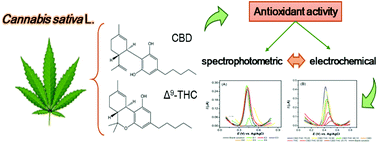
Probing the antioxidant activity of Δ9-tetrahydrocannabinol and cannabidiol in Cannabis sativa extracts.
The isolated cannabinoids, the different stoichiometric ratios of CBD and THC, and the natural extracts proved to have remarkable antioxidant properties in all the methods employed in this work.
The antioxidant activity of CBD and THC was compared against that of the well-defined antioxidants such as ascorbic acid (AA), resveratrol (Resv) and (-)-epigallocatechin-3-gallate (EGCG). Clear evidence of the synergistic and antagonistic effects between CBD and THC regarding to their antioxidant activities was observed.
Moreover, a good correlation was obtained between the optical and electrochemical methods, which proved that the reported experimental procedures can easily be adapted to determine the antioxidant activity of extracts from various Cannabis sativa species and related compounds.”
https://www.ncbi.nlm.nih.gov/pubmed/31318364
https://pubs.rsc.org/en/content/articlelanding/2019/AN/C9AN00890J#!divAbstract
Cannabidiol Treatment Might Promote Resilience to Cocaine and Methamphetamine Use Disorders: A Review of Possible Mechanisms.
 “Currently, there are no approved pharmacotherapies for addiction to cocaine and other psychostimulant drugs. Several studies have proposed that cannabidiol (CBD) could be a promising treatment for substance use disorders.
In the present work, the authors describe the scarce preclinical and human research about the actions of CBD on the effects of stimulant drugs, mainly cocaine and methamphetamine (METH). Additionally, the possible mechanisms underlying the therapeutic potential of CBD on stimulant use disorders are reviewed.
CBD has reversed toxicity and seizures induced by cocaine, behavioural sensitization induced by amphetamines, motivation to self-administer cocaine and METH, context- and stress-induced reinstatement of cocaine and priming-induced reinstatement of METH seeking behaviours. CBD also potentiated the extinction of cocaine- and amphetamine-induced conditioned place preference (CPP), impaired the reconsolidation of cocaine CPP and prevented priming-induced reinstatement of METH CPP.
Observational studies suggest that CBD may reduce problems related with crack-cocaine addiction, such as withdrawal symptoms, craving, impulsivity and paranoia (Fischer et al., 2015). The potential mechanisms involved in the protective effects of CBD on addiction to psychostimulant drugs include the prevention of drug-induced neuroadaptations (neurotransmitter and intracellular signalling pathways changes), the erasure of aberrant drug-memories, the reversion of cognitive deficits induced by psychostimulant drugs and the alleviation of mental disorders comorbid with psychostimulant abuse. Further, preclinical studies and future clinical trials are necessary to fully evaluate the potential of CBD as an intervention for cocaine and methamphetamine addictive disorders.”
Potential Mechanisms Influencing the Inverse Relationship Between Cannabis and Nonalcoholic Fatty Liver Disease: A Commentary.
“Nonalcoholic fatty liver disease (NAFLD) develops when the liver is unable to oxidize or export excess free fatty acids generated by adipose tissue lipolysis, de novo lipogenesis, or dietary intake. Although treatment has generally been centered on reversing metabolic risk factors that increase the likelihood of NAFLD by influencing lifestyle modifications, therapeutic modalities are being studied at the cellular and molecular level.
The endocannabinoid system has been of recent focus. The agonism and antagonism of cannabinoid receptors play roles in biochemical mechanisms involved in the development or regression of NAFLD. Exocannabinoids and endocannabinoids, the ligands which bind cannabinoid receptors, have been studied in this regard.
Exocannabinoids found in cannabis (marijuana) may have a therapeutic benefit. Our recent study demonstrated an inverse association between marijuana use and NAFLD among adults in the United States.
This commentary combines knowledge on the role of the endocannabinoid system in the setting of NAFLD with the findings in our article to hypothesize different potential mechanisms that may influence the inverse relationship between cannabis and NAFLD.” https://www.ncbi.nlm.nih.gov/pubmed/31308686
S-Adenosyl-L-Methionine (SAMe), Cannabidiol (CBD), and Kratom in Psychiatric Disorders: Clinical and Mechanistic Considerations.
 “Given the limitations of prescription antidepressants, many individuals have turned to natural remedies for the management of their mood disorders.
We review three selected natural remedies that may be of potential use as treatments for depressive disorders and other psychiatric or neurological conditions.
The best studied and best supported of these three remedies is S-adenosyl-L-methionine (SAMe), a methyl donor with a wide range of physiological functions in the human organism.
With the increasing legalization of cannabis-related products, cannabidiol (CBD) has gained popularity for various potential indications and has even obtained approval in the United States and Canada for certain neurological conditions.
Kratom, while potentially useful for certain individuals with psychiatric disorders, is perhaps the most controversial of the three remedies, in view of its greater potential for abuse and dependence.
For each remedy, we will review indications, doses and delivery systems, potential anti-inflammatory and immunomodulatory action, adverse effects, and will provide recommendations for clinicians who may be considering prescribing these remedies in their practice.” https://www.ncbi.nlm.nih.gov/pubmed/31301401
https://www.sciencedirect.com/science/article/pii/S0889159119302788?via%3Dihub
Nabiximols for the Treatment of Cannabis Dependence: A Randomized Clinical Trial.
“This study demonstrates that cannabinoid agonist treatment, in this case using nabiximols, in combination with psychosocial interventions is a safe approach for reducing cannabis use among individuals with cannabis dependence who are seeking treatment.” https://www.ncbi.nlm.nih.gov/pubmed/31305874
https://jamanetwork.com/journals/jamainternalmedicine/fullarticle/2737918
“nabiximols: An herbal preparation containing a defined quantity of specific cannabinoids formulated for oromucosal spray administration with potential analgesic activity. Nabiximols contains a standardized extract of tetrahydrocannabinol (THC), the non-psychoactive cannabinoid cannabidiol (CBD), other minor cannabinoids, flavonoids, and terpenes from two cannabis plant varieties.” https://www.cancer.gov/publications/dictionaries/cancer-drug/def/nabiximols
“Cannabis treatment counters addiction: First study of its kind. Trial shows cannabis replacement therapy can be effective” https://www.sciencedaily.com/releases/2019/07/190715114247.htm
Biological bases for a possible effect of cannabidiol in Parkinson’s disease.
 “Current pharmacotherapy of Parkinson’s disease (PD) is palliative and unable to modify the progression of neurodegeneration. Treatments that can improve patients’ quality of life with fewer side effects are needed, but not yet available.
Cannabidiol (CBD), the major non-psychotomimetic constituent of cannabis, has received considerable research attention in the last decade. In this context, we aimed to critically review the literature on potential therapeutic effects of CBD in PD and discuss clinical and preclinical evidence supporting the putative neuroprotective mechanisms of CBD.
RESULTS:
Few studies addressed the biological bases for the purported effects of CBD on PD. Six preclinical studies showed neuroprotective effects, while three targeted the antidyskinetic effects of CBD. Three human studies have tested CBD in patients with PD: an open-label study, a case series, and a randomized controlled trial. These studies reported therapeutic effects of CBD on non-motor symptoms.
CONCLUSIONS:
Additional research is needed to elucidate the potential effectiveness of CBD in PD and the underlying mechanisms involved.”
https://www.ncbi.nlm.nih.gov/pubmed/31314869
http://www.scielo.br/scielo.php?script=sci_arttext&pid=S1516-44462019005012104&tlng=en
The protective mechanism of cannabidiol in cardiac injury: A systematic review of non-clinical studies.
 “Cardiac disease is accounted as the leading cause of worldwide morbidity and mortality, mainly in association with induction of inflammation and oxidative stress. The disease is characterized by the overproduction of reactive oxygen and/or nitrogen species (ROS/RNS), and reduced antioxidant capacity.
Cannabidiol (CBD) is a non-psychoactive ingredient of marijuana that reported to be safe and well tolerated in patients. Due to its pleiotropic effect, CBD has been shown to exert cytoprotective effects. This study intended to clarify the mechanisms and the potential role of CBD regarding cardiac injuries treatment.
RESULTS:
Our findings obviously demonstrate that CBD has multi-functional protective assets to improve cardiac injuries; preliminary through scavenging of free radicals, and reduction of oxidative stress, apoptosis, and inflammation.
CONCLUSION:
CBD can protect against cardiac injuries, mainly through its anti-oxidant, anti-inflammatory, and anti-apoptotic effects on the basis of non-clinical studies.”
https://www.ncbi.nlm.nih.gov/pubmed/31291873
http://www.eurekaselect.com/173374/article
“Cytoprotection is a process by which chemical compounds provide protection to cells against harmful agents.” https://en.wikipedia.org/wiki/Cytoprotection