

“A growing number of studies suggest therapeutic applications of cannabidiol (CBD), a recently U.S. Food and Drug Administration (FDA)-approved medication for epilepsy, in treatment of many other neuropsychological disorders. However, pharmacological action and the mechanisms by which CBD exerts its effects are not fully understood.
Here, we examined the effects of CBD on oral sucrose self-administration in rodents and explored the receptor mechanisms underlying CBD-induced behavioral effects using pharmacological and transgenic approaches.
Systemic administration of CBD produced a dose-dependent reduction in sucrose self-administration in rats and in wild-type (WT) and CB1-/- mice but not in CB2-/- mice. CBD appeared to be more efficacious in CB1-/- mice than in WT mice.
Similarly, pretreatment with AM251, a CB1R antagonist, potentiated, while AM630, a selective CB2R antagonist, blocked CBD-induced reduction in sucrose self-administration, suggesting the involvement of CB1 and CB2 receptors.
Taken together, the present findings suggest that CBD may have therapeutic potential in reducing binge eating and the development of obesity.”
 “Neuropsychiatric symptoms (NPS) in dementia impact profoundly on the quality of life of people living with dementia and their care givers. Evidence for the effectiveness and safety of current therapeutic options is varied.

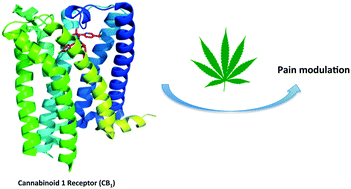
 “Mammalian ω3- and ω6-PUFAs are synthesized from essential fatty acids (EFAs) or supplied by the diet. PUFAs are constitutive elements of membrane-architecture and precursors of lipid signaling molecules. EFAs and long chain PUFAs are precursors in the synthesis of endocannabinoid-ligands of the Gi/o-protein coupled cannabinoid receptors 1 and 2 in the endocannabinoid-system, which critically regulates energy homeostasis, as metabolic signaling system in hypothalamic neuronal circuits, and behavioral parameters. We utilized the auxotrophic fatty acid desaturase 2 deficient (fads2-/-) mouse, deficient in long chain PUFA-synthesis, to follow the age dependent dynamics of the PUFA pattern in the CNS-phospholipidome in unbiased dietary studies of three cohorts on sustained long chain PUFA-free, ω6-arachidonic and ω3-docosahexaenoic acid supplemented diets and their impact on the precursor pool of CB1 ligands. We discovered the transformation of eicosa-all cis-5,11,14-trienoic acid, uncommon in mammalian lipidomes, into two novel endocannabinoids, 20:35,11,14-ethanolamide and 2-20:35,11,14-glycerol, acting as ligands of CB1 in HEK293-cells. Labeling experiments excluded a Δ8-desaturase activity and proved the position-specificity of FADS2. The fads2 -/- mutant might serve as an unbiased model in vivo in the development of novel CB1-agonists and antagonists.”
 “Obesity is characterized by chronic low-grade inflammation that contributes to development of cardiometabolic disorders.
  “The acute toxicity of organophosphorus-based compounds is primarily a result of acetylcholinesterase inhibition in the central and peripheral nervous systems. The resulting cholinergic crisis manifests as seizure, paralysis, respiratory failure and neurotoxicity. Though overstimulation of muscarinic receptors is the mechanistic basis of central organophosphorus (OP) toxicities, short-term changes in synapse physiology that precede OP-induced seizures have not been investigated in detail. To study acute effects of OP exposure on synaptic function, field excitatory postsynaptic potentials (fEPSPs) were recorded from Schaffer collateral synapses in the mouse hippocampus CA1 stratum radiatum during perfusion with various OP compounds. Administration of the OPs paraoxon, soman or VX rapidly and stably depressed fEPSPs via a presynaptic mechanism, while the non-OP proconvulsant tetramethylenedisulfotetramine had no effect on fEPSP amplitudes. OP-induced presynaptic long-term depression manifested prior to interictal spiking, occurred independent of recurrent firing, and did not require NMDA receptor currents, suggesting that it was not mediated by activity-dependent calcium uptake. Pharmacological dissection revealed that the presynaptic endocannabinoid type 1 receptor (CB1R) as well as postsynaptic M1 and M3 muscarinic acetylcholine receptors were necessary for OP-LTD. Administration of CB1R antagonists significantly reduced survival in mice after a soman challenge, revealing an acute protective role for endogenous CB1R signaling during OP exposure. Collectively these data demonstrate that the endocannabinoid system alters glutamatergic synaptic function during the acute response to OP acetylcholinesterase inhibitors.”