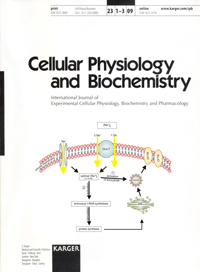
Crystal Structure of the Human Cannabinoid Receptor CB2

Figure thumbnail fx1

“The cannabinoid receptor CB2 is predominately expressed in the immune system, and selective modulation of CB2 without the psychoactivity of CB1 has therapeutic potential in inflammatory, fibrotic, and neurodegenerative diseases. Here, we report the crystal structure of human CB2 in complex with a rationally designed antagonist, AM10257, at 2.8 Å resolution. The CB2-AM10257 structure reveals a distinctly different binding pose compared with CB1. However, the extracellular portion of the antagonist-bound CB2 shares a high degree of conformational similarity with the agonist-bound CB1, which led to the discovery of AM10257’s unexpected opposing functional profile of CB2 antagonism versus CB1 agonism. Further structural analysis using mutagenesis studies and molecular docking revealed the molecular basis of their function and selectivity for CB2 and CB1. Additional analyses of our designed antagonist and agonist pairs provide important insight into the activation mechanism of CB2. The present findings should facilitate rational drug design toward precise modulation of the endocannabinoid system.”
“Study reveals the structure of the 2nd human cannabinoid receptor”   HTTPS://MIPT.RU/ENGLISH/NEWS/STUDY_REVEALS_THE_STRUCTURE_OF_THE_2ND_HUMAN_CANNABINOID_RECEPTOR

CB2R agonist prevents nicotine induced lung fibrosis.

 Publication Cover“Nicotine stimulates fibroblast proliferation while increasing inflammation and fibrosis of tissues.

The cannabinoid receptor 1 (CB1R) is mainly located in the CNS, while cannabinoid receptor 2 (CB2R) is located in the immune cells within the body. CB2R regulates inflammatory processes and fibroblast function.

Nicotine induces interstitial lung fibrosis that is enhanced by the CB2R antagonist and diminished by the CB2R agonist. Therefore, the CB2R agonist may offer a protection against fibrosis.”

https://www.ncbi.nlm.nih.gov/pubmed/30675824

https://www.tandfonline.com/doi/abs/10.1080/01902148.2018.1543368?journalCode=ielu20

Crystal Structure of the Human Cannabinoid Receptor CB2.

Image result for cell journal

“The cannabinoid receptor CB2 is predominately expressed in the immune system, and selective modulation of CB2 without the psychoactivity of CB1 has therapeutic potential in inflammatory, fibrotic, and neurodegenerative diseases.

Here, we report the crystal structure of human CB2 in complex with a rationally designed antagonist, AM10257, at 2.8 Å resolution. The CB2-AM10257 structure reveals a distinctly different binding pose compared with CB1. However, the extracellular portion of the antagonist-bound CB2 shares a high degree of conformational similarity with the agonist-bound CB1, which led to the discovery of AM10257’s unexpected opposing functional profile of CB2 antagonism versus CB1 agonism.

Further structural analysis using mutagenesis studies and molecular docking revealed the molecular basis of their function and selectivity for CB2 and CB1. Additional analyses of our designed antagonist and agonist pairs provide important insight into the activation mechanism of CB2. The present findings should facilitate rational drug design toward precise modulation of the endocannabinoid system.”

https://www.ncbi.nlm.nih.gov/pubmed/30639103

https://linkinghub.elsevier.com/retrieve/pii/S0092867418316258

Cannabidiol reduces airway inflammation and fibrosis in experimental allergic asthma.

European Journal of Pharmacology “Asthma is characterized by chronic lung inflammation and airway hyperresponsiveness. Asthma remains a major public health problem and, at present, there are no effective interventions capable of reversing airway remodelling. Cannabidiol (CBD) is known to exert immunomodulatory effects through the activation of cannabinoid-1 and -2 (CB1 and CB2) receptors located in the central nervous system and immune cells, respectively. However, as the role of CBD on airway remodelling and the mechanisms of CB1 and CB2 aren’t fully elucidated, this study was designed to evaluate the effects of cannabidiol in this scenario. Allergic asthma was induced in Balb/c mice exposed to ovalbumin, and respiratory mechanics, collagen fibre content in airway and alveolar septa, cytokine levels, and CB1 and CB2 expression were determined. Moreover, expressions of CB1 and CB2 in induced sputum of asthmatic individuals and their correlation with airway inflammation and lung function were also evaluated. CBD treatment, regardless of dosage, decreased airway hyperresponsiveness, whereas static lung elastance only reduced with high dose. These outcomes were accompanied by decreases in collagen fibre content in both airway and alveolar septa and the expression of markers associated with inflammation in the bronchoalveolar lavage fluid and lung homogenate. There was a significant and inverse correlation between CB1levels and lung function in asthmatic patients. CBD treatment decreased the inflammatory and remodelling processes in the model of allergic asthma. The mechanisms of action appear to be mediated by CB1/CB2 signalling, but these receptors may act differently on lung inflammation and remodelling.” https://www.ncbi.nlm.nih.gov/pubmed/30481497 https://www.sciencedirect.com/science/article/pii/S0014299918306836?via%3Dihub
]]>