Cannabidiol-treated rats exhibited higher motor score after cryogenic spinal cord injury

SpringerLink

“Cannabidiol (CBD), a non-psychoactive constituent of cannabis, has been reported to induce neuroprotective effects in several experimental models of brain injury. We aimed at investigating whether this drug could also improve locomotor recovery of rats submitted to spinal cord cryoinjury.

Rats were distributed into five experimental groups. Animals were submitted to laminectomy in vertebral segment T10 followed or not by application of liquid nitrogen for 5 s into the spinal cord at the same level to cause cryoinjury. The animals received injections of vehicle or CBD (20 mg/kg) immediately before, 3 h after and daily for 6 days after surgery. The Basso, Beattie, and Bresnahan motor evaluation test was used to assess motor function post-lesion one day before surgery and on the first, third, and seventh postoperative days. The extent of injury was evaluated by hematoxylin-eosin histology and FosB expression.

Cryogenic lesion of the spinal cord resulted in a significant motor deficit. Cannabidiol-treated rats exhibited a higher Basso, Beattie, and Bresnahan locomotor score at the end of the first week after spinal cord injury: lesion + vehicle, day 1: zero, day 7: four, and lesion + Cannabidiol 20 mg/kg, day 1: zero, day 7: seven. Moreover, at this moment there was a significant reduction in the extent of tissue injury and FosB expression in the ventral horn of the spinal cord.

The present study confirmed that application of liquid nitrogen to the spinal cord induces reproducible and quantifiable spinal cord injury associated with locomotor function impairments.

Cannabidiol improved locomotor functional recovery and reduced injury extent, suggesting that it could be useful in the treatment of spinal cord lesions.”


https://pubmed.ncbi.nlm.nih.gov/21915768/

https://link.springer.com/article/10.1007/s12640-011-9273-8

Medical Cannabis Used as an Alternative Treatment for Chronic Pain Demonstrates Reduction in Chronic Opioid Use – A Prospective Study

Pain Physician:::::

“Background: Chronic opioid therapy (COT) has been used to treat many chronic pain conditions even with poor evidence for its long-term effectiveness. Medical cannabis has emerged with certain pain-relieving properties, which has led to questions as to its’ potential application, especially in relation to its effect on opioid use.

Objectives: This study investigates a proposed clinical context in offering medical cannabis as a treatment for chronic pain for those already using chronic opioid therapy. It then details patients’ daily morphine milligram equivalent (MME) usage.

Study design: This single-center prospective study follows a group of patients trialing medical cannabis treatment for chronic pain that is already using COT in order to determine individual efficacy. Continued medical cannabis treatment was a decision made by the patient, after trialing medical cannabis, to either continue medical cannabis along with COT at a reduced daily MME, or to revert back to their previous COT regimen.

Setting: This study was performed at the Allegheny Health Network Institute for Pain Medicine in Pittsburgh, Pennsylvania. The state of Pennsylvania legalized medical cannabis in April of 2016, and it became available to patients in February of 2018 through medical dispensaries.

Methods: One hundred and fifteen patients met the inclusion criteria, with the majority of those excluded due to not being treated with COT. Of the 115 who chose to undergo a medical cannabis trial in addition to their COT, 75 chose to remain certified for medical cannabis as they had significant pain relief and subsequently weaned down on opioids. Additionally, of the 115 choosing to undergo a medical cannabis trial, 30 chose to be decertified due to ineffectiveness or side effects, and those were placed back on their COT regimen. The other 10 were not included for other denoted reasons. Compliance was monitored through urine drug screens (UDS).

Results: There was a 67.1% average decrease in daily MME/patient from 49.9 to 16.4 MME at the first follow-up. There was a 73.3% decrease in MME at second follow-up from 49.9 to 13.3 MME with an ANOVA analysis denoting a significant difference of P < 0.0001.

Limitations: The period of follow-up presented at this point includes their first 6 months of treatment with medical cannabis and COT concomitantly.

Conclusions: Presenting medical cannabis to chronic pain patients on COT should be done in the context of a patient choice between medical cannabis WITH decrement of COT or continued current dose of COT in order to maximize effectiveness in opioid reduction as well as to limit polypharmacy concerns regarding medical cannabis. Allowing for a temporary short-term period where patients may trial medical cannabis, while concomitantly gradually weaning their COT, is also essential in determining medical cannabis’ individual effectiveness for that patient’s specific type of chronic pain, which should serve to maximize long-term opioid reduction results and hence decrease opioid-related overdose deaths.”

https://pubmed.ncbi.nlm.nih.gov/35051158/

https://www.painphysicianjournal.com/linkout?issn=&vol=25&page=E113

Cannabidiol increases gramicidin current in human embryonic kidney cells: An observational study

Plos One | Publons

“Gramicidin is a monomeric protein that is thought to non-selectively conduct cationic currents and water. Linear gramicidin is considered an antibiotic. This function is considered to be mediated by the formation of pores within the lipid membrane, thereby killing bacterial cells.

The main non-psychoactive active constituent of the cannabis plant, cannabidiol (CBD), has recently gained interest, and is proposed to possess various potential therapeutic properties, including being an antibiotic. We previously determined that CBD’s activity on ion channels could be, in part, mediated by altering membrane biophysical properties, including elasticity.

In this study, our goal was to determine the empirical effects of CBD on gramicidin currents in human embryonic kidney (HEK) cells, seeking to infer potential direct compound-protein interactions. Our results indicate that gramicidin, when applied to the extracellular HEK cell membrane, followed by CBD perfusion, increases the gramicidin current.”

https://pubmed.ncbi.nlm.nih.gov/35913948/

“One compound with amphiphilic properties is cannabidiol (CBD), the primary non-psychotropic constituent of Cannabis sativa. CBD is a clinically and experimentally substantiated therapeutic compound with efficacy against a variety of conditions, including seizure disorders (for which CBD is FDA-approved), pain, and muscle spasms. Furthermore, CBD has been suggested to have antibiotic properties.”

https://journals.plos.org/plosone/article?id=10.1371/journal.pone.0271801

A polarized supercell produces specialized metabolites in cannabis trichomes

Press – The Jensen Laboratory

“For centuries, humans have cultivated cannabis for the pharmacological properties that result from consuming its specialized metabolites, primarily cannabinoids and terpenoids. Today, cannabis is a multi-billion-dollar industry whose existence rests on the biological activity of tiny cell clusters, called glandular trichomes, found mainly on flowers. Cannabinoids are toxic to cannabis cells,1 and how the trichome cells can produce and secrete massive quantities of lipophilic metabolites is not known.1 To address this gap in knowledge, we investigated cannabis glandular trichomes using ultra-rapid cryofixation, quantitative electron microscopy, and immuno-gold labeling of cannabinoid pathway enzymes. We demonstrate that the metabolically active cells in cannabis form a “supercell,” with extensive cytoplasmic bridges across the cell walls and a polar distribution of organelles adjacent to the apical surface where metabolites are secreted. The predicted metabolic role of the non-photosynthetic plastids is supported by unusual membrane arrays in the plastids and the localization of the start of the cannabinoid/terpene pathway in the stroma of the plastids. Abundant membrane contact sites connected plastid paracrystalline cores with the plastid envelope, plastid with endoplasmic reticulum (ER), and ER with plasma membrane. The final step of cannabinoid biosynthesis, catalyzed by tetrahydrocannabinolic acid synthase (THCAS), was localized in the cell-surface wall facing the extracellular storage cavity. We propose a new model of how the cannabis cells can support abundant metabolite production, with emphasis on the key role of membrane contact sites and extracellular THCA biosynthesis. This new model can inform synthetic biology approaches for cannabinoid production in yeast or cell cultures.”

https://pubmed.ncbi.nlm.nih.gov/35917819/

https://www.cell.com/current-biology/fulltext/S0960-9822(22)01115-0?

“Study defines how cannabis cells make cannabinoids”

https://www.news-medical.net/news/20220803/Study-defines-how-cannabis-cells-make-cannabinoids.aspx

Mortality risk for individuals with cannabis use disorders in relation to alcohol use disorders: Results of a follow-up study

Psychiatry Research

“Background: There are few studies on mortality on individuals entering treatment for cannabis use disorders.

Objectives: To estimate mortality risk for individuals treated for cannabis use disorders comparing patients with concomitant alcohol use disorders to those with only cannabis use disorders.

Methods: Follow-up study on 1136 residents in Northern Italy who turned to health services following problems caused by cannabis use disorders between 2009 and 2019. Individuals with concomitant use of opioids, amphetamines, cocaine, or injecting drugs were excluded. Crude mortality rates per 1000 Person Years (CMR), and standardized mortality ratios adjusted for age, sex and calendar year (SMR) were calculated.

Results: Elevated CMRs (CMR 4.4, 3-6.4), higher among patients with concomitant alcohol use disorders (CMR 10.2, 6.6-15.6) compared to those with only cannabis use disorders (CMR 1.8, 0.9-3.6) were found. Regarding excess mortality with respect to the general population, SMRs were higher and statistically significant (SMR 5.4, 3.7-7.8), both among patients with concomitant alcohol use disorders (SMR 10.2, 6.6-15.6) and among those with only cannabis use disorders (SMR 2.3, 1.1-4.5).

Conclusions: The results of this study show that individuals with only cannabis use disorders have a lower mortality risk compared to those with both cannabis and alcohol use disorders.”

https://pubmed.ncbi.nlm.nih.gov/35908347/

“The results of our study show that individuals with only cannabis use disorders have a lower mortality risk compared to those with cannabis and alcohol use disorders.”

https://www.sciencedirect.com/science/article/abs/pii/S0165178122003365?via%3Dihub

“Daily drinking is associated with increased mortality”

https://www.ncbi.nlm.nih.gov/pmc/articles/PMC6214719/

[Medical cannabis]

“Health is a human right. In order to guarantee that right, it is fundamental that all activities concerning health in different contexts (clinical, research, teaching) contribute to the construction of an efficient system that promotes excellence, equity, justice, and solidarity. In this issue, we take on alternatives regarding the use of medical cannabis from this perspective. Health research and its contribution to knowledge – in particular with respect to the development of new pharmaceuticals – represents not only a challenge related to technology and production, but also an opportunity for ensuring the autonomy of the health system.”

https://pubmed.ncbi.nlm.nih.gov/35900986/

http://revistas.unla.edu.ar/saludcolectiva/article/view/3991

Anti-inflammatory effects of cannabidiol against lipopolysaccharides in cardiac sodium channels

“Background: Sepsis, caused by a dysregulated host response to infections, can lead to cardiac arrhythmias. However, the mechanisms underlying sepsis-induced inflammation, and how inflammation provokes cardiac arrhythmias, are not well understood. We hypothesized that CBD may ameliorate lipopolysaccharides (LPS)-induced cardiotoxicity via Toll-like receptor 4 (TLR-4) and cardiac sodium channels (Nav1.5).

Methods and results: We incubated human immune cells (THP-1 macrophages) with LPS for 24 hours, then extracted the THP-1 incubation media. ELISA assay showed that LPS (1 or 5 μg/ml), in a concentration-dependent manner, or MPLA (TLR-4 agonist, 5 μg/ml) stimulated the THP-1 cells to release inflammatory cytokines (TNF-α and IL-6). Prior incubation (4 hours) with cannabidiol (CBD: 5 μM) or C34 (TLR-4 antagonist: 5 μg/ml) inhibited LPS and MPLA-induced release of both IL-6 and TNF-α. Human induced pluripotent stem cell-derived cardiomyocytes (hiPSC-CM) were subsequently incubated for 24 hours in the media extracted from THP-1 cells incubated with LPS, MPLA alone, or in combination with CBD or C34. Voltage-clamp experiments showed a right shift in the voltage dependence of Nav1.5 activation, steady state fast inactivation (SSFI), increased persistent current and prolonged in silico action potential duration in hiSPC-CM incubated in the LPS or MPLA-THP-1 media. Co-incubation with CBD or C34 rescued the biophysical dysfunction caused by LPS and MPLA.

Conclusion: Our results suggest that CBD may protect against sepsis-induced inflammation and subsequent arrhythmias through (i) inhibition of the release of inflammatory cytokines, antioxidant and anti-apoptotic effects and/or (ii) direct effect on Nav1.5.”

https://pubmed.ncbi.nlm.nih.gov/35906756/

https://bpspubs.onlinelibrary.wiley.com/doi/10.1111/bph.15936

Industrial hemp seed: from the field to value-added food ingredients

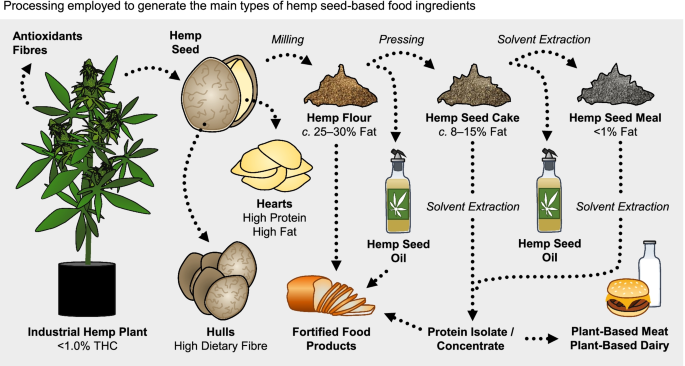
figure 1

“Industrial hemp, with low levels of the intoxicating cannabinoid tetrahydrocannabinol (THC), is grown for fibre and seeds. The industrial hemp industry is poised for expansion. The legalisation of industrial hemp as an agricultural commodity and the inclusion of hemp seed in foods is helping to drive the expansion of the hemp food ingredients industry.

This paper discusses the opportunity to build an industrial hemp industry, with a focus on the prospects of hemp seed and its components in food applications. The market opportunities for industrial hemp products are examined. Various aspects of the science that underpins the development of an industrial hemp industry through the food supply chain are presented. This includes a discussion on the agronomy, on-farm and post-harvest considerations and the various types of food ingredients that can be made from hemp seed. The characteristics of hemp seed meal, hemp seed protein and hemp seed oil are reviewed. Different processes for production of value-added ingredients from hemp seed, hemp seed oil and hemp seed protein, are examined. The applicability of hemp seed ingredients in food applications is reviewed. The design of hemp seed ingredients that are fit-for-purpose for target food applications, through the selection of varieties and processing methods for production of various hemp seed ingredients, needs to consider market-led opportunities. This will require an integrated through chain approach, combined with the development of on-farm and post-farm strategies, to ensure that the hemp seed ingredients and foods containing hemp seed are acceptable to the consumer.”

https://pubmed.ncbi.nlm.nih.gov/35906681/

“Overall, the opportunity to build a whole supply chain is particularly attractive for the farm sector wishing to diversify and plant sustainable crops with potential for economic returns.”

https://jcannabisresearch.biomedcentral.com/articles/10.1186/s42238-022-00156-7

Cannabis use does not increase actual creativity but biases evaluations of creativity

Cover image for Journal of Applied Psychology

“In this research, we examine the effects of cannabis use on creativity and evaluations of creativity. Drawing on both the broaden-and-build theory and the affect-as-information model, we propose that cannabis use would facilitate more creativity as well as more favorable evaluations of creativity via cannabis-induced joviality. We tested this prediction in two experiments, wherein participants were randomly assigned to either a cannabis use or cannabis abstinence condition.

We find support for our prediction that cannabis use facilitates joviality, which translates to more favorable evaluations of creativity of one’s own ideas and others’ ideas. However, our prediction that cannabis use facilitates creativity via joviality was not supported. Our findings suggest that cannabis use may positively bias evaluations of creativity but have no impact on creativity. Implications for theory and practice are discussed.”

https://pubmed.ncbi.nlm.nih.gov/35901408/

https://psycnet.apa.org/doiLanding?doi=10.1037%2Fapl0000599

Cannabidiol for the treatment of autism spectrum disorder: hope or hype?

SpringerLink

“Rationale: Autism spectrum disorder (ASD) is defined as a group of neurodevelopmental disorders whose symptoms include impaired communication and social interaction, restricted and repetitive patterns of behavior, and varying levels of intellectual disability. ASD is observed in early childhood and is one of the most severe chronic childhood disorders in prevalence, morbidity, and impact on society. It is usually accompanied by attention deficit hyperactivity disorder, anxiety, depression, sleep disorders, and epilepsy. The treatment of ASD has low efficacy, possibly because it has a heterogeneous nature, and its neurobiological basis is not clearly understood.

Drugs such as risperidone and aripiprazole are the only two drugs available that are recognized by the Food and Drug Administration, primarily for treating the behavioral symptoms of this disorder. These drugs have limited efficacy and a high potential for inducing undesirable effects, compromising treatment adherence. Therefore, there is great interest in exploring the endocannabinoid system, which modulates the activity of other neurotransmitters, has actions in social behavior and seems to be altered in patients with ASD. Thus, cannabidiol (CBD) emerges as a possible strategy for treating ASD symptoms since it has relevant pharmacological actions on the endocannabinoid system and shows promising results in studies related to disorders in the central nervous system.

Objectives: Review the preclinical and clinical data supporting CBD’s potential as a treatment for the symptoms and comorbidities associated with ASD, as well as discuss and provide information with the purpose of not trivializing the use of this drug.”

https://pubmed.ncbi.nlm.nih.gov/35904579/

https://link.springer.com/article/10.1007/s00213-022-06196-4