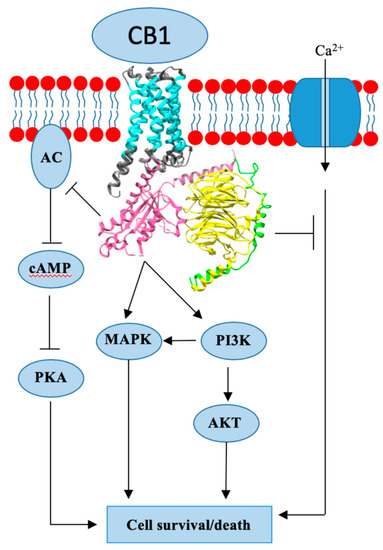
Cannabinoid Signaling in Glioma Cells.

 “Cannabinoids are a group of structurally heterogeneous but pharmacologically related compounds, including plant-derived cannabinoids, synthetic substances and endogenous cannabinoids, such as anandamide and 2-arachidonoylglycerol.

Cannabinoids elicit a wide range of central and peripheral effects mostly mediated through cannabinoid receptors. There are two types of specific Gi/o-protein-coupled receptors cloned so far, called CB1 and CB2, although an existence of additional cannabinoid-binding receptors has been suggested. CB1 and CB2 differ in their predicted amino acid sequence, tissue distribution, physiological role and signaling mechanisms.

Significant alterations of a balance in the cannabinoid system between the levels of endogenous ligands and their receptors occur during malignant transformation in various types of cancer, including gliomas.

Cannabinoids exert anti-proliferative action in tumor cells.

Induction of cell death by cannabinoid treatment relies on the generation of a pro-apoptotic sphingolipid ceramide and disruption of signaling pathways crucial for regulation of cellular proliferation, differentiation or apoptosis. Increased ceramide levels lead also to ER-stress and autophagy in drug-treated glioblastoma cells.

Beyond blocking of tumor cells proliferation cannabinoids inhibit invasiveness, angiogenesis and the stem cell-like properties of glioma cells, showing profound activity in the complex tumor microenvironment. Advances in translational research on cannabinoid signaling led to clinical investigations on the use of cannabinoids in treatments of glioblastomas.”

https://www.ncbi.nlm.nih.gov/pubmed/32034716

https://link.springer.com/chapter/10.1007%2F978-3-030-30651-9_11

“Cannabinoids exert anti-proliferative action in tumor cells.” https://www.ncbi.nlm.nih.gov/pubmed/22879071

“A glioma is a primary brain tumor that originates from the supportive cells of the brain, called glial cells.” http://neurosurgery.ucla.edu/body.cfm?id=159

“Remarkably, cannabinoids kill glioma cells selectively and can protect non-transformed glial cells from death.” http://www.ncbi.nlm.nih.gov/pubmed/15275820

Endocannabinoids as Therapeutic Targets.

Archives of Medical Research“Most of the drugs of abuse affect the brain by interacting with naturally expressed molecular receptors. Marihuana affects a series of receptors including cannabinoid receptor 1 (CB1R) and CB2R, among others. Endogenous molecules with cannabinoid activity interact with these receptors naturally. Receptors, ligands, synthesizing and degrading enzymes, as well as transporters, have been described.

This endocannabinoid system modulates behaviors and physiological processes, i.e. food intake, the sleep-waking cycle, learning and memory, motivation, and pain perception, among others. The rather broad distribution of endocannabinoids in the brain explains the different effects marihuana induces in its users. However, this very same anatomical and physiological distribution makes this system a useful target for therapeutic endeavors.

In this review, we briefly discuss the potential of small molecules that target the endocannabinoids as therapeutic tools to improve behaviors and treat illnesses. We believe that under medical supervision, endocannabinoid targets offer new advantages for patients for controlling multiple medical disorders.”

https://www.ncbi.nlm.nih.gov/pubmed/32028095

https://www.sciencedirect.com/science/article/abs/pii/S0188440919304746?via%3Dihub

Cannabis Sativa Revisited-Crosstalk between microRNA Expression, Inflammation, Oxidative Stress, and Endocannabinoid Response System in Critically Ill Patients with Sepsis.

cells-logo“Critically ill patients with sepsis require a multidisciplinary approach, as this situation implies multiorgan distress, with most of the bodily biochemical and cellular systems being affected by the condition. Moreover, sepsis is characterized by a multitude of biochemical interactions and by dynamic changes of the immune system. At the moment, there is a gap in our understanding of the cellular, genetic, and molecular mechanisms involved in sepsis.

One of the systems intensely studied in recent years is the endocannabinoid signaling pathway, as light was shed over a series of important interactions of cannabinoid receptors with biochemical pathways, specifically for sepsis. Furthermore, a series of important implications on inflammation and the immune system that are induced by the activity of cannabinoid receptors stimulated by the delta-9-tetrahydrocannabinol (Δ9-THC) and cannabidiol (CBD) have been noticed.

One of the most important is their ability to reduce the biosynthesis of pro-inflammatory mediators and the modulation of immune mechanisms. Different studies have reported that cannabinoids can reduce oxidative stress at mitochondrial and cellular levels.

The aim of this review paper was to present, in detail, the important mechanisms modulated by the endocannabinoid signaling pathway, as well as of the molecular and cellular links it has with sepsis. At the same time, we wish to present the possible implications of cannabinoids in the most important biological pathways involved in sepsis, such as inflammation, redox activity, immune system, and epigenetic expression.”

https://www.ncbi.nlm.nih.gov/pubmed/32012914

https://www.mdpi.com/2073-4409/9/2/307

The endocannabinoid receptors CB1 and CB2 affect the regenerative potential of adipose tissue MSCs.

Experimental Cell Research“Human adipose tissue includes large quantities of mesenchymal stromal cells (atMSCs), which represent an abundant cell source for therapeutic applications in the field of regenerative medicine.

Adipose tissue secrets various soluble factors including endocannabinoids, and atMSCs express the cannabinoid receptors CB1 and CB2. This indicates that adipose tissue possesses an endocannabinoid system (ECS). The ECS is also ascribed great significance for wound repair, e.g. by modulating inflammation. However, the exact effects of CB1/CB2 activation in human atMSCs have not been investigated, yet.

In the present study, we stimulated human atMSCs with increasing concentrations (1-30 μM) of the unspecific cannabinoid receptor ligand WIN55,212-2 and the specific CB2 agonist JWH-133, either alone or co-applied with the receptor antagonist Rimonabant (CB1) or AM 630 (CB2). We investigated the effects on metabolic activity, cell number, differentiation and cytokine release, which are important processes during tissue regeneration.

WIN decreased metabolic activity and cell number, which was reversed by Rimonabant. This suggests a CB1 dependent mechanism, whereas the number of atMSCs was increased after CB2 ligation. WIN and JWH increased the release of VEGF, TGF-β1 and HGF. Adipogenesis was enhanced by WIN, which could be reversed by blocking CB1. There was no effect on osteogenesis, and only WIN increased chondrogenic differentiation.

Our results indicate that definite activation of the cannabinoid receptors exerted different effects in atMSCs, which could be of specific value in cell-based therapy for wound regeneration.”

https://www.ncbi.nlm.nih.gov/pubmed/32006556

https://www.sciencedirect.com/science/article/abs/pii/S001448272030080X?via%3Dihub

Image 1

Organophosphate agent induces ADHD-like behaviors via inhibition of brain endocannabinoid-hydrolyzing enzyme(s) in adolescent male rats.

 Go to Volume 0, Issue ja“Anticholinergic organophosphate (OP) agents act on the diverse serine hydrolases, thereby revealing unexpected biological effects. Epidemiological studies indicate a relationship between OP exposure and development of attention-deficit/hyperactivity disorder (ADHD)-like symptoms, whereas no plausible mechanism for the OP-induced ADHD has been established.

The present investigation employs ethyl octylphosphonofluoridate (EOPF) as an OP-probe which is an extremely potent inhibitor of endocannabinoid (EC, anandamide and 2-arachidonoylglycerol)-hydrolyzing enzymes: i.e., fatty acid amide hydrolase (FAAH) and monoacylglycerol lipase (MAGL).

Ex vivo experiment shows that EOPF treatment decreases FAAH and MAGL activities and conversely increases EC levels in rat brain. Subsequently, EOPF (treated intraperitoneally once at 0, 1, 2, or 3 mg/kg) clearly induces ADHD-like behaviors (in elevated plus-maze test) in both Wistar and spontaneously hypertensive rats. The EOPF-induced behaviors are reduced by a concomitant administration of cannabinoid receptor inverse agonist SLV-319.

Accordingly, EC system is a feasible target for OP-caused ADHD-like behaviors in adolescent rats.”

https://www.ncbi.nlm.nih.gov/pubmed/31995978

https://pubs.acs.org/doi/abs/10.1021/acs.jafc.9b08195

The Critical Role of Cannabinoid Receptor 2 in URB602-induced Protective Effects Against Renal Ischemia-Reperfusion Injury in the Rat.

 Image result for shock journal“Renal ischemia-reperfusion injury (IRI) is a major cause of acute kidney injury (AKI) and even induces remote organ damage.

Accumulating proofs demonstrates that the endocannabinoid system (ECS) may provide a promising access for treatment strategy of renal IRI associated AKI.

In the current study, using the established renal IRI model of rat, we tested the hypothesis that pretreatment of URB602, 30 min before renal IRI, alleviates kidney injury and relevant distant organ damage via limiting oxidative stress and inflammation.

Taken together, our data indicate that URB602 acts as a reactive oxygen species scavenger and anti-inflammatory media in renal IRI mainly depending on the activation of CB2.”

https://www.ncbi.nlm.nih.gov/pubmed/32004183


Cryo-EM Structure of the Human Cannabinoid Receptor CB2-Gi Signaling Complex.

Image result for cell journal“Drugs selectively targeting CB2 hold promise for treating neurodegenerative disorders, inflammation, and pain while avoiding psychotropic side effects mediated by CB1. The mechanisms underlying CB2 activation and signaling are poorly understood but critical for drug design. Here we report the cryo-EM structure of the human CB2-Gi signaling complex bound to the agonist WIN 55,212-2. The 3D structure reveals the binding mode of WIN 55,212-2 and structural determinants for distinguishing CB2 agonists from antagonists, which are supported by a pair of rationally designed agonist and antagonist. Further structural analyses with computational docking results uncover the differences between CB2 and CB1 in receptor activation, ligand recognition, and Gi coupling. These findings are expected to facilitate rational structure-based discovery of drugs targeting the cannabinoid system.”

https://www.ncbi.nlm.nih.gov/pubmed/32004460

https://www.cell.com/cell/fulltext/S0092-8674(20)30054-4?_returnURL=https%3A%2F%2Flinkinghub.elsevier.com%2Fretrieve%2Fpii%2FS0092867420300544%3Fshowall%3Dtrue

Activation and Signaling Mechanism Revealed by Cannabinoid Receptor-Gi Complex Structures.

Image result for cell journal“Human endocannabinoid systems modulate multiple physiological processes mainly through the activation of cannabinoid receptors CB1 and CB2. Their high sequence similarity, low agonist selectivity, and lack of activation and G protein-coupling knowledge have hindered the development of therapeutic applications. Importantly, missing structural information has significantly held back the development of promising CB2-selective agonist drugs for treating inflammatory and neuropathic pain without the psychoactivity of CB1. Here, we report the cryoelectron microscopy structures of synthetic cannabinoid-bound CB2 and CB1 in complex with Gi, as well as agonist-bound CB2 crystal structure. Of important scientific and therapeutic benefit, our results reveal a diverse activation and signaling mechanism, the structural basis of CB2-selective agonists design, and the unexpected interaction of cholesterol with CB1, suggestive of its endogenous allosteric modulating role.”

https://www.ncbi.nlm.nih.gov/pubmed/32004463

https://www.cell.com/cell/fulltext/S0092-8674(20)30055-6?_returnURL=https%3A%2F%2Flinkinghub.elsevier.com%2Fretrieve%2Fpii%2FS0092867420300556%3Fshowall%3Dtrue

Cannabinoids for the Treatment of Chronic Pruritus: A Review.

Journal of the American Academy of Dermatology Home“Medical marijuana is becoming widely available to patients in the U.S. and with recreational marijuana now legalized in many states, patient interest is on the rise.

The endocannabinoid system plays an important role in skin homeostasis in addition to broader effects on neurogenic responses such as pruritus and nociception, inflammation, and immune reactions. There are numerous studies of in vitro and animal models that provide insight into the possible mechanisms of cannabinoid modulation on pruritus, with the most evidence behind neuronal modulation of both peripheral itch fibers and centrally-acting cannabinoid receptors.

In addition, human studies, while limited due to differences in cannabinoids used, disease models, and delivery method, have consistently shown significant reductions in both scratching and symptomatology in chronic pruritus. Clinical studies that have shown reduction in pruritus in several dermatologic (atopic dermatitis, psoriasis, asteatotic eczema, prurigo nodularis, allergic contact dermatitis) and systemic (uremic pruritus, cholestatic pruritus) diseases.

These preliminary human studies warrant controlled trials to confirm the benefit of cannabinoids for treatment of pruritus and to standardize treatment regimens and indications. In patients who have refractory chronic pruritus after standard therapies, cannabinoid formulations may be considered as an adjuvant therapy where it is legal.”

https://www.ncbi.nlm.nih.gov/pubmed/31987788

https://www.jaad.org/article/S0190-9622(20)30120-1/pdf

Endocannabinoid system in irritable bowel syndrome and cannabis as a therapy.

Complementary Therapies in Medicine“Irritable bowel syndrome (IBS) global burden is underestimated despite its high prevalence. It’s a gastrointestinal disease having obscure pathophysiology with multiple therapies yet unsatisfactory remedies.

The Endocannabinoid system (ECS) of our body plays a key role in maintaining normal physiology of the gastrointestinal tract as well as involves abnormalities including functional diseases like IBS. This review highlights the importance of the Endocannabinoid system, its connections with the normal gastrointestinal functions and abnormalities like IBS.

It also discusses the role of cannabis as medical therapy in IBS patients.

A literature search for articles related to endocannabinoids in IBS and medical cannabis in PubMed and Google Scholar was conducted. The studies highlighted the significant participation of ECS in IBS. However, the breach in obtaining the promising therapeutic model for IBS needed further investigation in ECS and uncover other treatments for IBS.

This review summarizes ECS, highlights the relationship of ECS with IBS and explores cannabis as a potential therapy to treat IBS.”

https://www.ncbi.nlm.nih.gov/pubmed/31987224

https://www.sciencedirect.com/science/article/pii/S0965229919310179?via%3Dihub