“Cannabinoids are naturally occurring compounds, derivatives of Indian hemp, in which tetrahydrocannabinol (THC) is the most important. Marijuana, hashish and hash oil are among those most commonly used in the group.
Cannabinoids (marjhuana and hashish) have been used throughout recorded history as effective drugs in treating various diseases and conditions such as: malaria, hypertension, constipation, bronchial asthma, rheumatic pains, and as natural pain relief in labour and joint pains.
Marijuana acts through cannabinoid receptors CB 1 and CB2. Both receptors inhibit cAMP accummulation (through Gi/o proteins) and stimulate mitrogen- activated protein kinase. CB1 rceptors are located in CNS and in adipose tissue, digestive tract, muscles, heart, lungs, liver, kidneys, gonads, prostate gland and other peripheral tissues. CB2 cannabinoid receptors are located in the peripheral nervous system (at the ends of peripheral nerves), and on the surfaces of the cells of the immunological system.
The discovery of endogenous cannabinoids has contributed to a better understanding of their role in the regulation of the intake of food, energetic homeostasis and their significant influence on the endocrine system.”
“Complaints about Δ9-tetrahydrocannabinol (THC):cannabidiol (CBD) oromucosal spray (Sativex®; GW Pharma Ltd, Sailsbury, UK) in the management of multiple sclerosis spasticity include unpleasant taste and oral mucosal anomalies.
This pilot study assessed the use of sugar-free chewing gum and/or a refrigerated bottle of THC:CBD oromucosal spray to mitigate these effects.
RESULTS:
Taste perception in patients receiving chewing gum ± cold bottle intervention (Groups A and C combined) was significantly (p = 0.0001) improved from baseline to week 4 while maintaining spasticity control.
“Objective: This retrospective study assessed safety, tolerability and efficacy of cannabidiol (CBD) based medical cannabis, as an adjuvant therapy, for refractory behavioral problems in children with ASD.
Background: Anecdotal evidence of successful cannabis treatment in children with autism spectrum disorder (ASD) are accumulating but formal studies are lacking.
Design/Methods: Sixty children with ASD (age = 11.8± 3.5, range 5.0–17.5; 77% low functioning; 83% boys) were treated with oral CBD and tetrahydrocannabinol (THC) at a ratio of 20:1. The dose was up-titrated to effect (maximal CBD dose − 10mg/kg/d). Tolerability and efficacy were assessed using a modified Liverpool Adverse Events Profile, the Caregiver Global Impression of Change (CGIC) scale, the Home Situations Questionnaire–Autism Spectrum Disorder (HSQ-ASD) and the Autism Parenting Stress Index (APSI).
Results: Following the cannabis treatment, behavioral outbreaks were much improved or very much improved (on the CGIC scale) in 61% of patients. The anxiety and communication problems were much or very much improved in 39% and 47% respectively. Disruptive behaviors, were improved by 29% from 4.74±1.82 as recorded at baseline on the HSQ-ASD to 3.36±1.56 following the treatment. Parents reported less stress as reflected in the APSI scores, changing by 33% from 2.04±0.77 to 1.37±0.59. The effect on all outcome measures was more apparent in boys with non-syndromic ASD. Adverse events included sleep disturbances (14%) irritability (9%) and loss of appetite (9%).
Conclusions: This preliminary study support the feasibility of CBD based medical cannabis as a promising treatment option for refractory behavioral problems in children with ASD. Based on these promising results, we have launched a large, double blind, placebo controlled cross-over trial with 120 participants (NCT02956226).”
“The true incidence of anorexia secondary to human immunodeficiency virus (HIV)/acquired immunodeficiency syndrome (AIDS) and cancer is not well classified owing to the fact that there is a lack of standardized definitions and recent clinical data in these settings.
Dronabinol, or Δ-9-tetrahydrocannabinol, is a synthetic molecule that closely mimics the action of Cannabis sativa L., a naturally occurring compound activated in the central nervous system by cannabinoid receptors.
Dronabinol exerts its effects by directly acting on the vomiting and appetite control centers in the brain, which in turn increases appetite and prevents vomiting.
In the USA, dronabinol is currently available in two dosage formulations – oral capsule and oral solution. While the oral capsule was initially approved by the US Food and Drug Administration in 1985, the recent approval of the oral solution in 2016 presents an “easy-to-swallow” alternative for patients using or intending to use dronabinol.
Dronabinol is indicated in adult patients with HIV/AIDS for the treatment of anorexia and weight loss. However, there is no approved indication in the setting of cancer-related anorexia and weight loss. This review aims at presenting available data on the use of oral dronabinol in the management of anorexia and weight loss in HIV/AIDS and cancer, as well as characterizing and highlighting the pharmacotherapeutic considerations of the newest formulation of dronabinol.”
“Question Is frequent or heavy cannabis use associated with cognitive dysfunction in adolescents and young adults?
Findings This systematic review and meta-analysis of 69 cross-sectional studies of 2152 cannabis users and 6575 comparison participants showed a small but significant overall effect size for reduced cognitive functioning in adolescents and young adults who reported frequent cannabis use. However, studies requiring abstinence from cannabis for longer than 72 hours had a very small, nonsignificant effect size.
Meaning Although continued cannabis use may be associated with small reductions in cognitive functioning, results suggest that cognitive deficits are substantially diminished with abstinence.
Conclusions and Relevance Associations between cannabis use and cognitive functioning in cross-sectional studies of adolescents and young adults are small and may be of questionable clinical importance for most individuals. Furthermore, abstinence of longer than 72 hours diminishes cognitive deficits associated with cannabis use. Although other outcomes (eg, psychosis) were not examined in the included studies, results indicate that previous studies of cannabis in youth may have overstated the magnitude and persistence of cognitive deficits associated with use.”
https://www.ncbi.nlm.nih.gov/pubmed/29710074https://jamanetwork.com/journals/jamapsychiatry/article-abstract/2678214?redirect=true
“Symptom management in older adults, including pain and distressing non-pain symptoms, can be challenging. Medications can cause side effects that worsen quality of life or create other symptoms, and polypharmacy itself can be detrimental in older adults.
Cannabinoids may offer a way of managing selected symptoms with fewer side effects. Medical marijuana is an important area of study for older adults because of the side effects of other medications. It is also important for Baby Boomers, who are likely to have more experience with marijuana than older adults of previous generations. Therefore, geriatricians should understand medical marijuana’s clinical indications, adverse effects, and legal context. This article reviews the evidence regarding indications for and risks of medical marijuana use in older adults.”https://www.ncbi.nlm.nih.gov/pubmed/29668039https://onlinelibrary.wiley.com/doi/abs/10.1111/jgs.15346
“Our study finds that the therapeutic use of cannabis is safe and efficacious in the elderly population.” https://www.ncbi.nlm.nih.gov/pubmed/29398248
“Cannabis is commonly used to alleviate symptoms of negative affect. However, a paucity of research has examined the acute effects of cannabis on negative affect in everyday life.
The current study provides a naturalistic account of perceived changes in symptoms of depression, anxiety, and stress as a function of dose and concentration of Δ9tetrahydrocannabinol (THC) and cannabidiol (CBD).
Cannabis is commonly used to alleviate depression, anxiety, and stress. Indeed, one of the most commonly reported motives for cannabis use is to cope with stress, with 72% of daily cannabis users reporting use of cannabis to relax or relieve tension.
Results from the present study indicate that medical cannabis users report a substantial and significant reduction in symptoms of negative affect shortly after using cannabis.”
https://www.ncbi.nlm.nih.gov/pubmed/29656267https://www.sciencedirect.com/science/article/pii/S0165032718303100]]>
“Anticancer Effects of Cannabinoids may be able to Prolong Life.
Cannabinoids are multitarget substances. Currently available are dronabinol (synthetic delta-9-tetrahydrocannabinol, THC), synthetic cannabidiol (CBD) the respective substances isolated and purified from cannabis, a refined extract, nabiximols (THC:CBD = 1.08:1.00); and nabilone, which is also synthetic and has properties that are very similar to those of THC.
Cannabinoids have a role in the treatment of cancer as palliative interventions against nausea, vomiting, pain, anxiety, and sleep disturbances. THC and nabilone are also used for anorexia and weight loss, whereas CBD has no orexigenic effect. The psychotropic effects of THC and nabilone, although often undesirable, can improve mood when administered in low doses. CBD has no psychotropic effects; it is anxiolytic and antidepressive.
Of particular interest are glioma studies in animals where relatively high doses of CBD and THC demonstrated significant regression of tumor volumes (approximately 50% to 95% and even complete eradication in rare cases). Concomitant treatment with X-rays or temozolomide enhanced activity further. Similarly, a combination of THC with CBD showed synergistic effects. Although many questions, such as on optimized treatment schedules, are still unresolved, today’s scientific results suggest that cannabinoids could play an important role in palliative care of brain tumor patients.
THC, a partial CB1, CB2 agonist, has the stigma of psychotropic effects that are mediated by CB1 stimulation. However, CB1 stimulation is necessary for improving mood and appetite and many other effects. At present, it is hard to imagine a better approach than adjusting THC doses individually to balance wanted versus unwanted effects. Generally, higher doses are needed to achieve analgesic and antiemetic effects. Even much higher, supraphysiologic oral doses would be needed to combat tumors.
Combinations were synergistic under many circumstances such as in pain and antitumor studies. Cannabinoids differ in their antitumor activities and probably in their mechanisms and targets, which is a rationale for combinations. However, for many pharmacological effects (except against tumors) roughly 10-times higher daily doses are needed for CBD compared to THC.
In summary, the endocannabinoid system is likely playing a crucial role in palliative care. The future will show whether an optimized treatment strategy with cannabinoids can also prolong life of brain tumor patients by their virtue to combat cancer cells.”
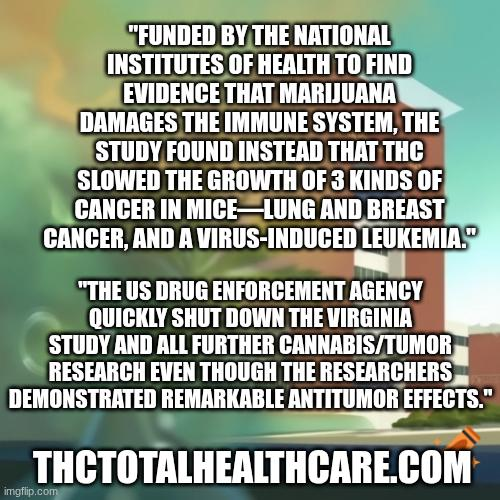
“Funded by the National Institutes of Health to find evidence that marijuana damages the immune system, the study found instead that THC slowed the growth of 3 kinds of cancer in mice—lung and breast cancer, and a virus-induced leukemia. The US Drug Enforcement Agency quickly shut down the Virginia study and all further cannabis/tumor research even though the researchers demonstrated remarkable antitumor effects.”
“Ajulemic acid (AJA, CT-3, IP-751, JBT-101, anabasum) is a first-in-class, synthetic, orally active, cannabinoid-derived drug that preferentially binds to the CB2 receptor and is nonpsychoactive.
In preclinical studies, and in Phase 1 and 2 clinical trials, AJA showed a favorable safety, tolerability, and pharmacokinetic profile. It also demonstrated significant efficacy in preclinical models of inflammation and fibrosis. It suppresses tissue scarring and stimulates endogenous eicosanoids that resolve chronic inflammation and fibrosis without causing immunosuppression.
AJA is currently being developed for use in 4 separate but related indications including systemic sclerosis (SSc), cystic fibrosis, dermatomyositis (DM), and systemic lupus erythematosus. Phase 2 clinical trials in the first 3 targets demonstrated that it is safe, is a potential treatment for these orphan diseases and appears to be a potent inflammation-resolving drug with a unique mechanism of action, distinct from the nonsteroidal anti-inflammatory drug (NSAID), and will be useful for treating a wide range of chronic inflammatory diseases.
It may be considered to be a disease-modifying drug unlike most NSAIDs that only provide symptomatic relief. AJA is currently being evaluated in 24-month open-label extension studies in SSc and in skin-predominant DM. A Phase 3 multicenter trial to demonstrate safety and efficacy in SSc has recently been initiated.”

 “Cannabinoids are naturally occurring compounds, derivatives of Indian hemp, in which tetrahydrocannabinol (THC) is the most important. Marijuana, hashish and hash oil are among those most commonly used in the group.
Cannabinoids (marjhuana and hashish) have been used throughout recorded history as effective drugs in treating various diseases and conditions such as: malaria, hypertension, constipation, bronchial asthma, rheumatic pains, and as natural pain relief in labour and joint pains.
Marijuana acts through cannabinoid receptors CB 1 and CB2. Both receptors inhibit cAMP accummulation (through Gi/o proteins) and stimulate mitrogen- activated protein kinase. CB1 rceptors are located in CNS and in adipose tissue, digestive tract, muscles, heart, lungs, liver, kidneys, gonads, prostate gland and other peripheral tissues. CB2 cannabinoid receptors are located in the peripheral nervous system (at the ends of peripheral nerves), and on the surfaces of the cells of the immunological system.
The discovery of endogenous cannabinoids has contributed to a better understanding of their role in the regulation of the intake of food, energetic homeostasis and their significant influence on the endocrine system.”
“Cannabinoids are naturally occurring compounds, derivatives of Indian hemp, in which tetrahydrocannabinol (THC) is the most important. Marijuana, hashish and hash oil are among those most commonly used in the group.
Cannabinoids (marjhuana and hashish) have been used throughout recorded history as effective drugs in treating various diseases and conditions such as: malaria, hypertension, constipation, bronchial asthma, rheumatic pains, and as natural pain relief in labour and joint pains.
Marijuana acts through cannabinoid receptors CB 1 and CB2. Both receptors inhibit cAMP accummulation (through Gi/o proteins) and stimulate mitrogen- activated protein kinase. CB1 rceptors are located in CNS and in adipose tissue, digestive tract, muscles, heart, lungs, liver, kidneys, gonads, prostate gland and other peripheral tissues. CB2 cannabinoid receptors are located in the peripheral nervous system (at the ends of peripheral nerves), and on the surfaces of the cells of the immunological system.
The discovery of endogenous cannabinoids has contributed to a better understanding of their role in the regulation of the intake of food, energetic homeostasis and their significant influence on the endocrine system.”
 “Complaints about Δ9-tetrahydrocannabinol (THC):
 “The true incidence of anorexia secondary to human immunodeficiency virus (HIV)/acquired immunodeficiency syndrome (AIDS) and cancer is not well classified owing to the fact that there is a lack of standardized definitions and recent clinical data in these settings.
Dronabinol, or Δ-9-tetrahydrocannabinol, is a synthetic molecule that closely mimics the action of Cannabis sativa L., a naturally occurring compound activated in the central nervous system by
“The true incidence of anorexia secondary to human immunodeficiency virus (HIV)/acquired immunodeficiency syndrome (AIDS) and cancer is not well classified owing to the fact that there is a lack of standardized definitions and recent clinical data in these settings.
Dronabinol, or Δ-9-tetrahydrocannabinol, is a synthetic molecule that closely mimics the action of Cannabis sativa L., a naturally occurring compound activated in the central nervous system by  “Symptom management in older adults, including pain and distressing non-pain symptoms, can be challenging. Medications can cause side effects that worsen quality of life or create other symptoms, and polypharmacy itself can be detrimental in older adults.
 “Ajulemic acid (AJA, CT-3, IP-751, JBT-101, anabasum) is a first-in-class, synthetic, orally active,