
 “Omega-3 fatty acid derived endocannabinoids are metabolized by cytochrome P450s to form bioactive endocannabinoid epoxides that are anti-inflammatory.
RESULTS:
Cannabinoids are found in marijuana and also are produced naturally in the body from ω-3 and ω-6 fatty acids. Exocannabinoids in marijuana, are known to be responsible for some of its euphoric effects, but they also exhibit anti-inflammatory benefits. Our study revealed a cascade of enzymatic reactions that convert ω-3 fatty acids into anti-inflammatory endocannabinoid epoxides that act through the same receptors in the body as marijuana (PNAS 2017).
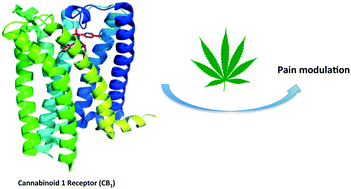
Endocannabinoids are ligands for cannabinoidreceptor 1 and 2 (CB1 and CB2). CB1 receptor agonists exhibit psychotropic properties while CB2 receptor agonists have anti-inflammatory effects. Consequently, there is a strong interest in the discovery of CB2 selective agonists to mitigate inflammatory pathologies. The work details the discovery and characterization of naturally occurring ω-3-derived endocannabinoid epoxides that are formed via enzymatic oxidation of ω-3 endocannabinoids by cytochrome P450 epoxygenases. These dual functional ω-3 endocannabinoid epoxides exhibit preference towards binding to CB2 receptor and are anti-inflammatory and vasodilatory and reciprocally modulate platelet aggregation. Some of the other regioisomers of ω-3 endocannabinoid epoxides are partial agonists of CB1 and stop tumor cell metastasis (J. Med. Chem 2018). By virtue of their physiological properties, they are expected to play important roles in neuroinflammation and pain.
CONCLUSIONS:
This finding demonstrates how omega-3 fatty acids can produce some of the same medicinal qualities as marijuana, but without a psychotropic effect. In summary, the ω-3 endocannabinoid epoxides are found at concentrations comparable to those of other endocannabinoids and are expected to play critical roles during inflammation in vivo.”
https://www.ncbi.nlm.nih.gov/pubmed/31223777
https://academic.oup.com/cdn/article/3/Supplement_1/nzz031.FS15-01-19/5518049





 “Age-related cognitive decline has been associated with proinflammatory cytokines, yet the precise relationship between cognitive decline and cytokine load remains to be elucidated. β-caryophyllene (BCP) is a cannabinoid receptor 2 (CB2) agonist with established anti-inflammatory effects that is known to improve memory and increase lifespan. It is of interest to explore the potential of BCP to reduce age-related cognitive decline and proinflammatory cytokine load. In this study, we assessed changes in circulating cytokines across the lifespan, memory performance in young and aged mice, and the effects of BCP on memory function and cytokine load. The plasma levels of 12 cytokines were assessed in male Swiss-Webster mice at 3, 12, and 18 months of age using multiplexed flow cytometry. Working memory was compared in 3 and 12 month-old mice using spontaneous alternations. A dose-response function (100-300 mg/kg, subchronic administration) for BCP-induced memory restoration was determined in 3 and 12 month-old mice. Finally, the effects on cytokine levels of the peak memory enhancing dose of BCP was assessed in 18 month-old mice. Circulating levels of several cytokines significantly increased with age. Multilinear regression analysis showed that IL-23 levels were most strongly associated with age. Aged mice showed deficits in working memory and higher levels of IL-23, both of which were reversed by BCP treatment. BCP appears to reverse age-associated impairments in memory and modulates cytokine production. IL-23 may play a significant role in the aging process, and future research should determine whether it has utility as a biomarker for novel anti-aging therapeutics.”
 “Mammalian ω3- and ω6-PUFAs are synthesized from essential fatty acids (EFAs) or supplied by the diet. PUFAs are constitutive elements of membrane-architecture and precursors of lipid signaling molecules. EFAs and long chain PUFAs are precursors in the synthesis of endocannabinoid-ligands of the Gi/o-protein coupled cannabinoid receptors 1 and 2 in the endocannabinoid-system, which critically regulates energy homeostasis, as metabolic signaling system in hypothalamic neuronal circuits, and behavioral parameters. We utilized the auxotrophic fatty acid desaturase 2 deficient (fads2-/-) mouse, deficient in long chain PUFA-synthesis, to follow the age dependent dynamics of the PUFA pattern in the CNS-phospholipidome in unbiased dietary studies of three cohorts on sustained long chain PUFA-free, ω6-arachidonic and ω3-docosahexaenoic acid supplemented diets and their impact on the precursor pool of CB1 ligands. We discovered the transformation of eicosa-all cis-5,11,14-trienoic acid, uncommon in mammalian lipidomes, into two novel endocannabinoids, 20:35,11,14-ethanolamide and 2-20:35,11,14-glycerol, acting as ligands of CB1 in HEK293-cells. Labeling experiments excluded a Δ8-desaturase activity and proved the position-specificity of FADS2. The fads2 -/- mutant might serve as an unbiased model in vivo in the development of novel CB1-agonists and antagonists.”