
“Question Is frequent or heavy cannabis use associated with cognitive dysfunction in adolescents and young adults? Findings This systematic review and meta-analysis of 69 cross-sectional studies of 2152 cannabis users and 6575 comparison participants showed a small but significant overall effect size for reduced cognitive functioning in adolescents and young adults who reported frequent cannabis use. However, studies requiring abstinence from cannabis for longer than 72 hours had a very small, nonsignificant effect size. Meaning Although continued cannabis use may be associated with small reductions in cognitive functioning, results suggest that cognitive deficits are substantially diminished with abstinence. Conclusions and Relevance Associations between cannabis use and cognitive functioning in cross-sectional studies of adolescents and young adults are small and may be of questionable clinical importance for most individuals. Furthermore, abstinence of longer than 72 hours diminishes cognitive deficits associated with cannabis use. Although other outcomes (eg, psychosis) were not examined in the included studies, results indicate that previous studies of cannabis in youth may have overstated the magnitude and persistence of cognitive deficits associated with use.” https://www.ncbi.nlm.nih.gov/pubmed/29710074 https://jamanetwork.com/journals/jamapsychiatry/article-abstract/2678214?redirect=true
Tag Archives: cannabis
Medical Marijuana Use in Older Adults.
 “Symptom management in older adults, including pain and distressing non-pain symptoms, can be challenging. Medications can cause side effects that worsen quality of life or create other symptoms, and polypharmacy itself can be detrimental in older adults.
Cannabinoids may offer a way of managing selected symptoms with fewer side effects.
Medical marijuana is an important area of study for older adults because of the side effects of other medications. It is also important for Baby Boomers, who are likely to have more experience with marijuana than older adults of previous generations. Therefore, geriatricians should understand medical marijuana’s clinical indications, adverse effects, and legal context.
This article reviews the evidence regarding indications for and risks of medical marijuana use in older adults.”
https://www.ncbi.nlm.nih.gov/pubmed/29668039
https://onlinelibrary.wiley.com/doi/abs/10.1111/jgs.15346
“Our study finds that the therapeutic use of cannabis is safe and efficacious in the elderly population.” https://www.ncbi.nlm.nih.gov/pubmed/29398248
“Symptom management in older adults, including pain and distressing non-pain symptoms, can be challenging. Medications can cause side effects that worsen quality of life or create other symptoms, and polypharmacy itself can be detrimental in older adults.
Cannabinoids may offer a way of managing selected symptoms with fewer side effects.
Medical marijuana is an important area of study for older adults because of the side effects of other medications. It is also important for Baby Boomers, who are likely to have more experience with marijuana than older adults of previous generations. Therefore, geriatricians should understand medical marijuana’s clinical indications, adverse effects, and legal context.
This article reviews the evidence regarding indications for and risks of medical marijuana use in older adults.”
https://www.ncbi.nlm.nih.gov/pubmed/29668039
https://onlinelibrary.wiley.com/doi/abs/10.1111/jgs.15346
“Our study finds that the therapeutic use of cannabis is safe and efficacious in the elderly population.” https://www.ncbi.nlm.nih.gov/pubmed/29398248
“Medical cannabis significantly safer for elderly with chronic pain than Opioids” https://www.sciencedaily.com/releases/2018/02/180213111508.htm
]]>Cannabis and Anti-Cancer Drugs: Societal Usage and Expected Pharmacological Interactions – A Review.
“Cannabis is a plant that has been used for centuries to relieve a wide range of symptoms. Since the 1960s, interest in medical research into this plant has grown steadily. Already very popular for recreational use, a growing number of consumers not accustomed to using cannabis for psychoactive purposes, have begun to use it as an alternative or complement to mainstream pharmaceutical medicines. The principal unsubstantiated or “social” uses of cannabis are based mainly on data that is at best controversial, but usually not scientifically proven. The aim of this review is to identify the scientific basis and reasons that lead patients with cancer to consume cannabis, and also to identify whether there is a risk of interaction between cannabis and anti-cancer medicines through drug transporters (P-glycoprotein and other ABC-superfamily members) Cytochromes P450 (3A, 1A, 2B, 2C 2D families…) and glucuronyl-transferases.” https://www.ncbi.nlm.nih.gov/pubmed/29660159 https://onlinelibrary.wiley.com/doi/abs/10.1111/fcp.12373
“Cannabinoids as Anticancer Drugs.” https://www.ncbi.nlm.nih.gov/pubmed/28826542
“Targeting the endocannabinoid system as a potential anticancer approach.” https://www.ncbi.nlm.nih.gov/pubmed/29390896 “Anticancer mechanisms of cannabinoids” https://www.ncbi.nlm.nih.gov/pmc/articles/PMC4791144/ http://www.thctotalhealthcare.com/tag/anticancer/]]>Endocannabinoid system in systemic lupus erythematosus: first evidence for a deranged 2-arachidonoylglycerol metabolism.
 “The endocannabinoid (eCB) system plays a key role in many physiological and pathological conditions and its dysregulation has been described in several rheumatological and autoimmune diseases. Yet, its possible alteration in systemic lupus erythematosus (SLE) has never been investigated.
Here, we aimed filling this gap in plasma and peripheral blood mononuclear cells (PBMCs) of patients with SLE and age- and sex- matched healthy subjects (HS).
In conclusion, our results demonstrate, for the first time, an alteration of eCB system in SLE patients. They represents the first step toward the understanding of the role of eCB system in SLE that likely suggest DAGL and 2-AG as potential biomarkers of SLE in easily accessible blood samples.
Our data provides proof-of-concept to the development of cannabis-based medicine as immune-modulating agents.”
https://www.ncbi.nlm.nih.gov/pubmed/29655919
“The endocannabinoid (eCB) system plays a key role in many physiological and pathological conditions and its dysregulation has been described in several rheumatological and autoimmune diseases. Yet, its possible alteration in systemic lupus erythematosus (SLE) has never been investigated.
Here, we aimed filling this gap in plasma and peripheral blood mononuclear cells (PBMCs) of patients with SLE and age- and sex- matched healthy subjects (HS).
In conclusion, our results demonstrate, for the first time, an alteration of eCB system in SLE patients. They represents the first step toward the understanding of the role of eCB system in SLE that likely suggest DAGL and 2-AG as potential biomarkers of SLE in easily accessible blood samples.
Our data provides proof-of-concept to the development of cannabis-based medicine as immune-modulating agents.”
https://www.ncbi.nlm.nih.gov/pubmed/29655919
A Naturalistic Examination of the Perceived Effects of Cannabis on Negative Affect
“Cannabis is commonly used to alleviate symptoms of negative affect. However, a paucity of research has examined the acute effects of cannabis on negative affect in everyday life. The current study provides a naturalistic account of perceived changes in symptoms of depression, anxiety, and stress as a function of dose and concentration of Δ9tetrahydrocannabinol (THC) and cannabidiol (CBD). Cannabis is commonly used to alleviate depression, anxiety, and stress. Indeed, one of the most commonly reported motives for cannabis use is to cope with stress, with 72% of daily cannabis users reporting use of cannabis to relax or relieve tension. Results from the present study indicate that medical cannabis users report a substantial and significant reduction in symptoms of negative affect shortly after using cannabis.” https://www.ncbi.nlm.nih.gov/pubmed/29656267 https://www.sciencedirect.com/science/article/pii/S0165032718303100]]>
The use of cannabis in supportive care and treatment of brain tumor
“Anticancer Effects of Cannabinoids may be able to Prolong Life.
Cannabinoids are multitarget substances. Currently available are dronabinol (synthetic delta-9-tetrahydrocannabinol, THC), synthetic cannabidiol (CBD) the respective substances isolated and purified from cannabis, a refined extract, nabiximols (THC:CBD = 1.08:1.00); and nabilone, which is also synthetic and has properties that are very similar to those of THC. Cannabinoids have a role in the treatment of cancer as palliative interventions against nausea, vomiting, pain, anxiety, and sleep disturbances. THC and nabilone are also used for anorexia and weight loss, whereas CBD has no orexigenic effect. The psychotropic effects of THC and nabilone, although often undesirable, can improve mood when administered in low doses. CBD has no psychotropic effects; it is anxiolytic and antidepressive. Of particular interest are glioma studies in animals where relatively high doses of CBD and THC demonstrated significant regression of tumor volumes (approximately 50% to 95% and even complete eradication in rare cases). Concomitant treatment with X-rays or temozolomide enhanced activity further. Similarly, a combination of THC with CBD showed synergistic effects. Although many questions, such as on optimized treatment schedules, are still unresolved, today’s scientific results suggest that cannabinoids could play an important role in palliative care of brain tumor patients. THC, a partial CB1, CB2 agonist, has the stigma of psychotropic effects that are mediated by CB1 stimulation. However, CB1 stimulation is necessary for improving mood and appetite and many other effects. At present, it is hard to imagine a better approach than adjusting THC doses individually to balance wanted versus unwanted effects. Generally, higher doses are needed to achieve analgesic and antiemetic effects. Even much higher, supraphysiologic oral doses would be needed to combat tumors. Combinations were synergistic under many circumstances such as in pain and antitumor studies. Cannabinoids differ in their antitumor activities and probably in their mechanisms and targets, which is a rationale for combinations. However, for many pharmacological effects (except against tumors) roughly 10-times higher daily doses are needed for CBD compared to THC. In summary, the endocannabinoid system is likely playing a crucial role in palliative care. The future will show whether an optimized treatment strategy with cannabinoids can also prolong life of brain tumor patients by their virtue to combat cancer cells.”https://academic.oup.com/nop/article/4/3/151/2918616
“Cannabinoid Drug Prolongs the Life of Brain Tumor Patients in Phase II Trials” https://labiotech.eu/gw-pharmaceuticals-brain-tumor/
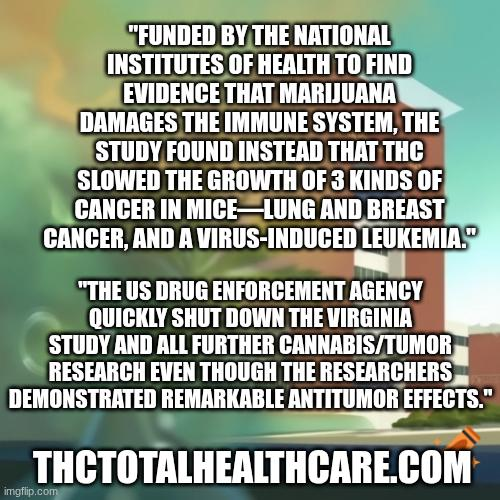
]]>“Funded by the National Institutes of Health to find evidence that marijuana damages the immune system, the study found instead that THC slowed the growth of 3 kinds of cancer in mice—lung and breast cancer, and a virus-induced leukemia. The US Drug Enforcement Agency quickly shut down the Virginia study and all further cannabis/tumor research even though the researchers demonstrated remarkable antitumor effects.”
Reefer to the Rescue: The Dope on Cannabidiol as a Multi-Symptom Panacea for Dravet Syndrome
“Dravet syndrome (DS) is a debilitating developmental disorder typified by severe seizures and delayed onset of psychomotor deficits. In addition to increasing the risk for sudden unexpected death in epilepsy (SUDEP), the medically refractory status epilepticus in DS can be life-threatening, which makes it crucial to identify drugs to reduce seizures. The quest for a viable drug to limit seizures in DS has intersected with the recent excitement over the potential use of cannabinoids as antiepileptic agents, leading to extensive anecdotal reports of the potential for cannabinoids to limit seizures in DS Cannabinoids are active derivatives of the marijuana plant, Cannabis sativa. The study reveals a strong preclinical basis for the use of CBD in DS. They find that CBD pre-treatment reduces both duration and severity of thermally-induced behavioral seizures.
In conclusion, Kaplan and colleagues provide the first preclinical demonstration that CBD may help alleviate seizures in a mouse model of DS validating the translational potential of CBD in patients with DS.
The demonstration that CBD improves deficits in social interactions in DS launches an exciting therapeutic possibility of alleviating behavioral impairments that persist beyond the seizures and pave the way for mechanistic studies that could positively impact treatment of autism spectrum disorders.”
http://epilepsycurrents.org/doi/10.5698/1535-7597.18.2.118?code=amep-siteThe Endocannabinoid System, Aggression, and the Violence of Synthetic Cannabinoid Use, Borderline Personality Disorder, Antisocial Personality Disorder, and Other Psychiatric Disorders
“While most human research has concluded that the active ingredient of marijuana, Δ9-tetrahydrocannabinol, tends to dampen rather than provoke aggression in acute doses, recent evidence supports a relationship between the ingestion of synthetic cannabinoids and emergence of violent or aggressive behavior.
To summarize, this paper will draw upon basic and clinical research to explain how the endocannabinoid system may contribute to the genesis of aggressive behavior.”
Non-Dependent and Dependent Daily Cannabis Users Differ in Mental Health but Not Prospective Memory Ability.
 “Research suggests that daily cannabis users have impaired memory for past events, but it is not clear whether they are also impaired in prospective memory (PM) for future events.
The present study examined PM in daily cannabis users who were either dependent or non-dependent, and compared them with non-using controls.
Findings suggest that when carefully matched on baseline variables, and not differing in premorbid IQ or alcohol use, young, near-daily cannabis users do not differ from non-using controls in PM performance.”
https://www.ncbi.nlm.nih.gov/pubmed/29636705
https://www.frontiersin.org/articles/10.3389/fpsyt.2018.00097/full
“Research suggests that daily cannabis users have impaired memory for past events, but it is not clear whether they are also impaired in prospective memory (PM) for future events.
The present study examined PM in daily cannabis users who were either dependent or non-dependent, and compared them with non-using controls.
Findings suggest that when carefully matched on baseline variables, and not differing in premorbid IQ or alcohol use, young, near-daily cannabis users do not differ from non-using controls in PM performance.”
https://www.ncbi.nlm.nih.gov/pubmed/29636705
https://www.frontiersin.org/articles/10.3389/fpsyt.2018.00097/full