Molecular mechanism of TRPV2 channel modulation by cannabidiol.

eLife logo

“Transient receptor potential vanilloid 2 (TRPV2) plays a critical role in neuronal development, cardiac function, immunity, and cancer.

Cannabidiol (CBD), the non-psychotropic therapeutically active ingredient of Cannabis sativa, is an activator of TRPV2 and also modulates other transient receptor potential (TRP) channels.

We show that CBD interacts with TRPV2 through a hydrophobic pocket located between S5 and S6 helices of adjacent subunits, which differs from known ligand and lipid binding sites in other TRP channels. CBD-bound TRPV2 structures revealed that the S4-S5 linker plays a critical role in channel gating upon CBD binding. Additionally, nanodiscs permitted us to visualize two distinct TRPV2 apo states in a lipid environment.

Together these results provide a foundation to further understand TRPV channel gating, their divergent physiological functions, and to accelerate structure-based drug design.”

https://www.ncbi.nlm.nih.gov/pubmed/31566564

https://elifesciences.org/articles/48792

Enhancing Breast Cancer Treatment Using a Combination of Cannabidiol and Gold Nanoparticles for Photodynamic Therapy.

ijms-logo“Indisputably, cancer is a global crisis that requires immediate intervention. Despite the use of conventional treatments over the past decades, it is acceptable to admit that these are expensive, invasive, associated with many side effects and, therefore, a reduced quality of life.
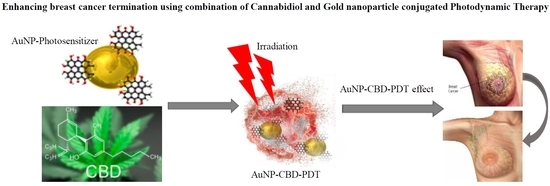
One of the most possible solutions to this could be the use of gold nanoparticle (AuNP) conjugated photodynamic therapy (PDT) in combination with cannabidiol (CBD), a Cannabis derivative from the Cannabis sativa.

Since the use of Cannabis has always been associated with recreation and psychoactive qualities, the positive effects of Cannabis or its derivatives on cancer treatment have been misunderstood and hence misinterpreted.

On the other hand, AuNP-PDT is the most favoured form of treatment for cancer, due to its augmented specificity and minimal risk of side effects compared to conventional treatments. However, its use requires the consideration of several physical, biologic, pharmacologic and immunological factors, which may hinder its effectiveness if not taken into consideration.

In this review, the role of gold nanoparticle mediated PDT combined with CBD treatment on breast cancer cells will be deliberated.”

https://www.ncbi.nlm.nih.gov/pubmed/31561450

https://www.mdpi.com/1422-0067/20/19/4771

Preclinical and Clinical Evidence Supporting Use of Cannabidiol in Psychiatry.

Image result for hindawi “Cannabidiol (CBD) is a major chemical compound present in Cannabis sativa.

CBD is a nonpsychotomimetic substance, and it is considered one of the most promising candidates for the treatment of psychiatric disorders.

The aim of this review is to illustrate the state of art about scientific research and the evidence of effectiveness of CBD in psychiatric patients.

RESULTS:

Preclinical and clinical studies on potential role of CBD in psychiatry were collected and further discussed. We found four clinical studies describing the effects of CBD in psychiatric patients: two studies about schizophrenic patients and the other two studies carried out on CBD effects in patients affected by generalized social anxiety disorder (SAD).

CONCLUSION:

Results from these studies are promising and suggest that CBD may have a role in the development of new therapeutic strategies in mental diseases, and they justify an in-depth commitment in this field. However, clinical evidence we show for CBD in psychiatric patients is instead still poor and limited to schizophrenia and anxiety, and it needs to be implemented with further studies carried out on psychiatric patients.”

https://www.ncbi.nlm.nih.gov/pubmed/31558911

“Results of our research, enriched in assessment of methodological quality of the studies, confirm the view of this cannabinoid as a promising molecule especially in particular sectors of psychiatry such as schizophrenia, anxiety, depression, and autism. CBD is considered a safe substance and is one of the most promising candidates for the treatment of psychiatric disorders”.

https://www.hindawi.com/journals/ecam/2019/2509129/

The non-euphoric phytocannabinoid cannabidivarin counteracts intestinal inflammation in mice and cytokine expression in biopsies from UC pediatric patients.

Pharmacological Research“Patients with ulcerative colitis (UC) using marijuana have been reported to experience symptomatic benefit.

Cannabidivarin (CBDV) is a safe non-psychoactive phytocannabinoid able to activate TRPA1, a member of TRP channels superfamily, which plays a pivotal role in intestinal inflammation.

Here, we have investigated the potential intestinal anti-inflammatory effect of CBDV in mice and in biopsies from pediatric patients with active UC.

Our preclinical study shows that CBDV exerts intestinal anti-inflammatory effects in mice via TRPA1, and in children with active UC.

Since CBDV has a favorable safety profile in humans, it may be considered for possible clinical trials in patients with UC.”

https://www.ncbi.nlm.nih.gov/pubmed/31553934

https://linkinghub.elsevier.com/retrieve/pii/S1043661819311077

Cannabidiol Is a Novel Modulator of Bacterial Membrane Vesicles.

 Image result for frontiers in cellular and infection microbiology“Membrane vesicles (MVs) released from bacteria participate in cell communication and host-pathogen interactions.

Roles for MVs in antibiotic resistance are gaining increased attention and in this study we investigated if known anti-bacterial effects of cannabidiol (CBD), a phytocannabinoid from Cannabis sativa, could be in part attributed to effects on bacterial MV profile and MV release.

We found that CBD is a strong inhibitor of MV release from Gram-negative bacteria (E. coli VCS257), while inhibitory effect on MV release from Gram-positive bacteria (S. aureus subsp. aureus Rosenbach) was negligible. When used in combination with selected antibiotics, CBD significantly increased the bactericidal action of several antibiotics in the Gram-negative bacteria.

In addition, CBD increased antibiotic effects of kanamycin in the Gram-positive bacteria, without affecting MV release. CBD furthermore changed protein profiles of MVs released from E. coli after 1 h CBD treatment.

Our findings indicate that CBD may pose as a putative adjuvant agent for tailored co-application with selected antibiotics, depending on bacterial species, to increase antibiotic activity, including via MV inhibition, and help reduce antibiotic resistance.”

https://www.ncbi.nlm.nih.gov/pubmed/31552202

https://www.frontiersin.org/articles/10.3389/fcimb.2019.00324/full 

Δ9-Tetrahydrocannabinol During Adolescence Attenuates Disruption of Dopamine Function Induced in Rats by Maternal Immune Activation.

Image result for frontiers in behavioral neuroscience“Here, we hypothesized that adolescent Δ9-tetrahydrocannabinol (THC) worsens the impact of prenatal maternal immune activation (MIA) on ventral tegmental area (VTA) dopamine cells in rat offspring.

Adolescent THC attenuated several MIA-induced effects.

Contrary to our expectations, adolescent THC did not worsen MIA-induced deficits.”

https://www.ncbi.nlm.nih.gov/pubmed/31551729

https://www.frontiersin.org/articles/10.3389/fnbeh.2019.00202/full

Cannabis use in cancer: a survey of the current state at BC Cancer before recreational legalization in Canada.

Image result for Curr Oncol.“Cancer patients experience multiple symptoms throughout their illness, and some report benefit from the use of cannabis. There are concerns that many patients are accessing products inappropriate for their situation and potentially putting themselves at risk.
In the present study, we aimed to capture the prevalence of cannabis use among cancer patients at BC Cancer before recreational legalization in Canada and to identify the reasons that patients take cannabis, the various routes of administration they use, and the reasons that prior users stopped.

RESULTS:

Of surveys sent to 2998 patients, 821 (27.4%) were returned and included in analysis. Of those respondents, 23% were currently using cannabis-based products, almost exclusively for medical purposes, and an additional 28% had been users in the past (most often recreationally). Of the patients currently using cannabis, 31% had medical authorization. The most common symptoms that the current users were targeting were pain, insomnia, nausea, and anxiety; many were also hoping for anticancer effects.

CONCLUSIONS:

More than half the respondents had tried cannabis at some time, and almost one quarter of respondents were currently taking cannabis to help manage their symptoms or treat their cancer, or both. Many more patients would consider use with appropriate guidance from a health care professional. More research is needed to inform physicians and patients about safe uses and doses and about the potential adverse effects of cannabis use.”

https://www.ncbi.nlm.nih.gov/pubmed/31548810

Potential of Cannabinoid Receptor Ligands as Treatment for Substance Use Disorders.

 “Substance use disorder (SUD) is a major public health crisis worldwide, and effective treatment options are limited.

During the past 2 decades, researchers have investigated the impact of a variety of pharmacological approaches to treat SUD, one of which is the use of medical cannabis or cannabinoids.

Significant progress was made with the discovery of rimonabant, a selective CB1 receptor (CB1R) antagonist (also an inverse agonist), as a promising therapeutic for SUDs and obesity. However, serious adverse effects such as depression and suicidality led to the withdrawal of rimonabant (and almost all other CB1R antagonists/inverse agonists) from clinical trials worldwide in 2008.

Since then, much research interest has shifted to other cannabinoid-based strategies, such as peripheral CB1R antagonists/inverse agonists, neutral CB1R antagonists, allosteric CB1R modulators, CB2R agonists, fatty acid amide hydrolase (FAAH) inhibitors, monoacylglycerol lipase (MAGL) inhibitors, fatty acid binding protein (FABP) inhibitors, or nonaddictive phytocannabinoids with CB1R or CB2R-binding profiles, as new therapeutics for SUDs.

In this article, we first review recent progress in research regarding the endocannabinoid systems, cannabis reward versus aversion, and the underlying receptor mechanisms. We then review recent progress in cannabinoid-based medication development for the treatment of SUDs.

As evidence continues to accumulate, neutral CB1R antagonists (such as AM4113), CB2R agonists (JWH133, Xie2-64), and nonselective phytocannabinoids (cannabidiol, β-caryophyllene, ∆9-tetrahydrocannabivarin) have shown great therapeutic potential for SUDs, as shown in experimental animals.

Several cannabinoid-based medications (e.g., dronabinol, nabilone, PF-04457845) that entered clinical trials have shown promising results in reducing withdrawal symptoms in cannabis and opioid users.”

https://www.ncbi.nlm.nih.gov/pubmed/31549358

https://link.springer.com/article/10.1007%2Fs40263-019-00664-w

Antiproliferative and antioxidant effect of polar hemp extracts (Cannabis sativa L., Fedora cv.) in human colorectal cell lines.

Publication Cover “Total phenolic content and antioxidant activity of polar extracts of edible resources from Fedora hemp cultivar (Cannabis sativa L.), namely seed, flour and oil, were evaluated. The main components in the polar extracts were identified using HPLC-DAD and HPLC-ESI-MS/MS. As expected, the molecular profile of components from seeds and flour was strictly similar, dominated by N-trans-caffeoyltyramine. The profile of oil polar extracts contained hydroxycinnamic acid derivatives and cannabinoids at lower extent. While the extracts from hemp seed and flour did not interfere with growth of Caco-2 and HT-29 cell, the one from oil (150 µg/mL) significantly reduced cell viability after 24 h of treatment. This effect was associated with the activation of apoptotic cell death and was independent from the antioxidant capacity of the oil polar extract. Notably, HT-29 cells differentiated with sodium butyrate were not sensitive to the cytotoxic effect of the oil extract.”

https://www.ncbi.nlm.nih.gov/pubmed/31544542

https://www.tandfonline.com/doi/abs/10.1080/09637486.2019.1666804?journalCode=iijf20